Where to Sell a Ram in Uzbekistan in 2026: Mol Bozori, Middleman, or Online Listing
Mol bozori, a middleman at the gate, slaughter, mahalla, or an online listing. We run the numbers on a 75 kg ram to see how much money each sales channel eats up in Uzbekistan in 2026.
Where to sell a ram in Uzbekistan in 2026 depends less on which channel is "best" and more on how many head you have and what your working day is worth. There are five practical options: take it to the mol bozori — the livestock market — sell it to a middleman at the gate, slaughter it and sell the meat, arrange a deal within the mahalla, or post an online listing. Below is a breakdown of each, calculated on a ram with a live weight of 75 kg at August 2026 prices; the exchange rate used for conversion is about 12,000 soum per dollar.
Mol bozori is a livestock market where animals change hands directly, buyers haggling per head while mentally pricing by live weight per kilogram. It doesn't run every day: each district has its own market day, usually a weekend, and trading starts before dawn — by five in the morning the market is already packed.
How much do different channels pay per kilogram of live weight?
What matters isn't "how much will they pay for the ram" but how much they'll pay per kilogram of live weight. In the summer of 2026, meat rams in Uzbekistan go for roughly 55,000–65,000 soum per kilogram (≈$4.6–5.4). The lower end is for selling an unfattened animal right at your gate; the upper end is the market price on a good day.
Middlemen pay on average 55,000–60,000 soum per kilogram, depending on the animal's condition and breed. In the calculations below we take the upper figure — 60,000 soum — to keep the comparison fair to the middleman.
| Channel | Price per kg live weight | Revenue for a 75 kg ram |
|---|---|---|
| Middleman at the gate | ~60,000 soum (≈$5.0) | 4,500,000 soum (≈$375) |
| Mol bozori | ~65,000 soum (≈$5.4) | 4,875,000 soum (≈$406) |
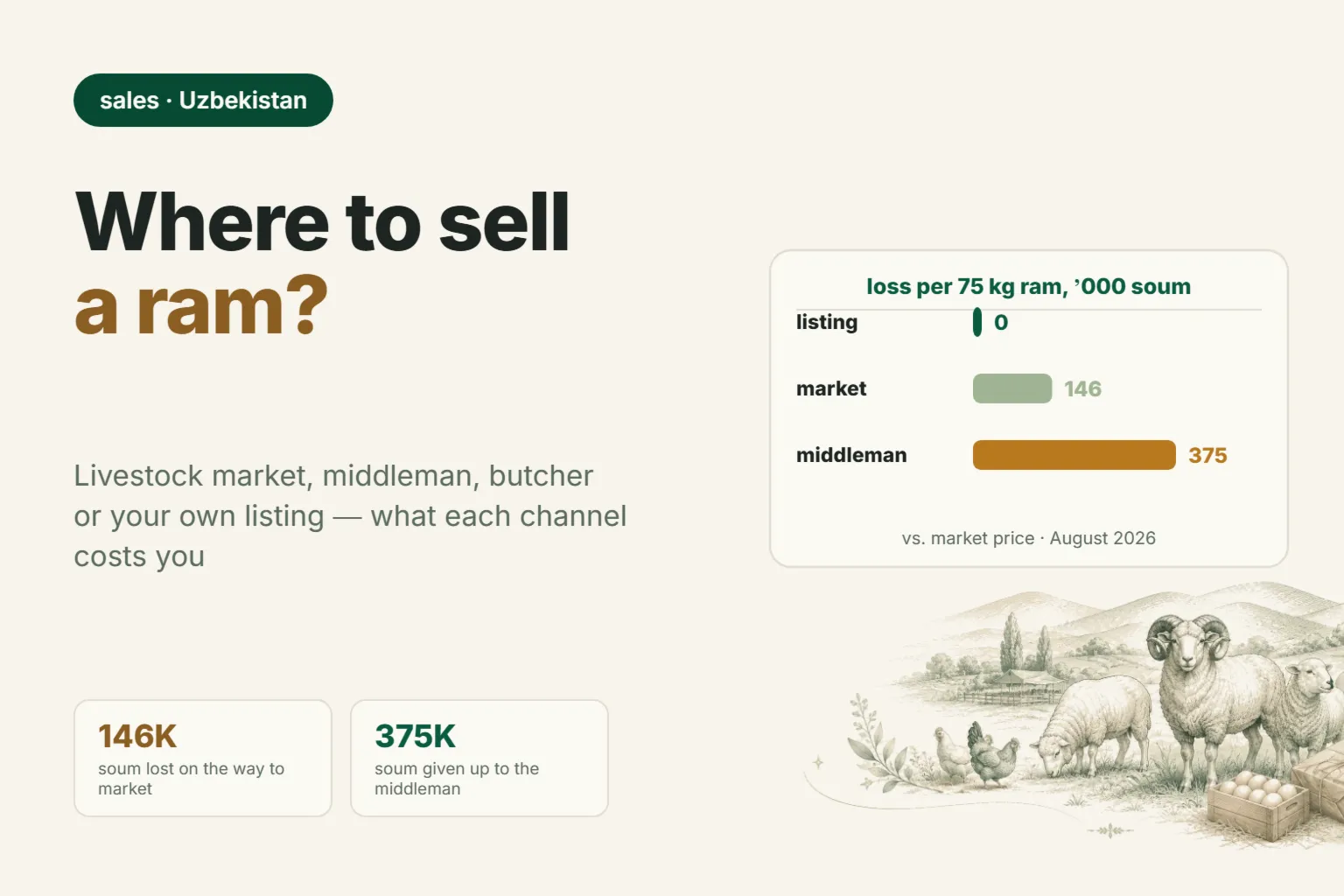
The gap is 375,000 soum (≈$31) per head, about 7.7% of the market price. That's exactly what's at stake when you decide whether to make the trip. But the market price never lands in your pocket whole: part of it gets eaten by the road, and almost nobody counts that part.
How much weight does a ram lose on the way to market?
An animal in transit doesn't eat or drink, and the contents of its stomach and gut empty out along the way — so the ram steps onto the scale lighter than it left the yard. According to the University of Wyoming's agricultural extension service, most of a sheep's weight loss happens in the first 12 hours of transport: on trips under six hours it runs 1–4%, and on longer hauls it can reach 6–12%.
Let's take the midpoint for a short trip — 3%. For a 75 kg ram that's 2.25 kg. At the market price of 65,000 soum per kilogram, that's 146,250 soum (≈$12) lost per head — just from the trip itself. For ten head, that's 1,462,500 soum (≈$122).
Let's run the numbers for a trip to the mol bozori with ten 75 kg rams:
| What we're calculating | Amount |
|---|---|
| Sell to a middleman at home (10 × 75 kg × 60,000) | 45,000,000 soum (≈$3,750) |
| Sell at the market with 3% shrink (10 × 72.75 kg × 65,000) | 47,287,500 soum (≈$3,941) |
| Difference in favor of the market | 2,287,500 soum (≈$191) |
Here's the main takeaway you can't see without doing the math: the market's advantage is nearly half of what the price gap suggests. Out of the 3,750,000 soum in "extra" revenue implied by the price list, shrink eats 1,462,500 soum, and from the remaining 2,287,500 soum you still need to subtract fuel or hired transport and your own working day. If you don't sell, there's a trip back and a second round of shrink. Hence the rule: with one or two head, the market almost never pays off; the advantage only shows up on a batch of ten or more, and only if the road is cheap.
One cheap trick recovers some of the loss: if the market allows it, letting the animals rest at the sale site for 24–48 hours with water and hay brings some of the weight back.
Middleman at the gate: what you pay 5,000 soum per kilogram for
A middleman sells you speed and zero hassle: he shows up, takes the animal, pays cash the same day. No road, no shrink, no risk of hauling it back. For that he takes about 5,000 soum (≈$0.42) per kilogram — roughly 8% of the price — out of which he still has to cover transport and carry the risk of unsold stock. For a household that needs money now, for one or two head, for a yard with no transport of its own, this is a perfectly normal working channel, and there's nothing to be ashamed of.
The main loss here isn't the percentage — it's the eyeballed weight. An experienced buyer estimates weight more accurately than the owner does, and the error is rarely in your favor. The gap between "eyeballed at 70" and "on the scale at 75" is 300,000 soum (≈$25) per head — more than his entire margin. The market works the same way, by the way: there too, people haggle per head, not by what the scale says. That's why it pays to weigh the ram before the deal, or at least measure it with a tape: see how to estimate a ram's weight without scales — the calculation from chest girth and body length.
Slaughter and sell the meat: the channel with the most mistakes
Mutton at the market goes for 90,000–120,000 soum per kilogram (≈$7.5–10.0) — almost double the price of a kilogram of live weight, which is where the eternal "I'm getting ripped off" comes from. In reality, a ram yields only about half its live weight in meat.
The fair-price formula is simple:
price per kilogram of meat × dressing percentage = ceiling price per kilogram of live weight
At 120,000 soum for meat and a 52% dressing percentage, that's 62,400 soum (≈$5.2) per kilogram of live weight — less than the 65,000 soum a live ram fetches at the market on a good day. For a detailed breakdown by breed, see dressing percentage in rams.
Slaughter makes sense in exactly one case: if you sell the meat retail yourself — your own stall, regular customers, a shashlik joint. Then you pocket the gap between wholesale and retail. Handing the carcass over wholesale to a meat buyer is almost always worse than selling the ram live, but slaughterhouse rates vary one-and-a-half to two times across regions — run the numbers for your own area.
Neighbors and the mahalla: the best price, but a channel that doesn't scale
Selling to people you know and neighbors gets you the best terms: no road, no shrink, no haggling down to the last soum. The price is often even higher than the market's — the buyer watched the animal grow up.
There's exactly one downside, and it's decisive: this channel doesn't scale. You can sell two or three rams a year this way, not thirty. And it only works for someone the mahalla has known for a long time.
Is it worth selling a ram through Telegram groups and classifieds sites?
Free and fast, but with two well-known problems. First, the listing sinks: in an active group it scrolls off the top within hours, so you have to re-post it again and again. Second, the traffic has no real intent behind it: you'll get plenty of messages asking "what's your final price," and no purchase. Nobody checks weight or a vet certificate there, so buyers show up wary, ready to haggle hard.
How to sell a ram with a listing on an online marketplace
It's still the internet, but with structured fields instead of free text: the buyer immediately sees breed, sex, live weight, age, price, and photos — and comes to you with a specific question instead of "tell me about the ram."
That's how our marketplace works. QoyHunter is a record-keeping CRM for sheep, plus a marketplace at bazar.qoyhunter.com. Listing is free, the owner sets the price, and the buyer messages you directly on the platform — no middleman involved. If your farm already keeps records, you can list the animal for sale straight from its record card — breed, weight, age, and sex are pulled straight from that same entry.
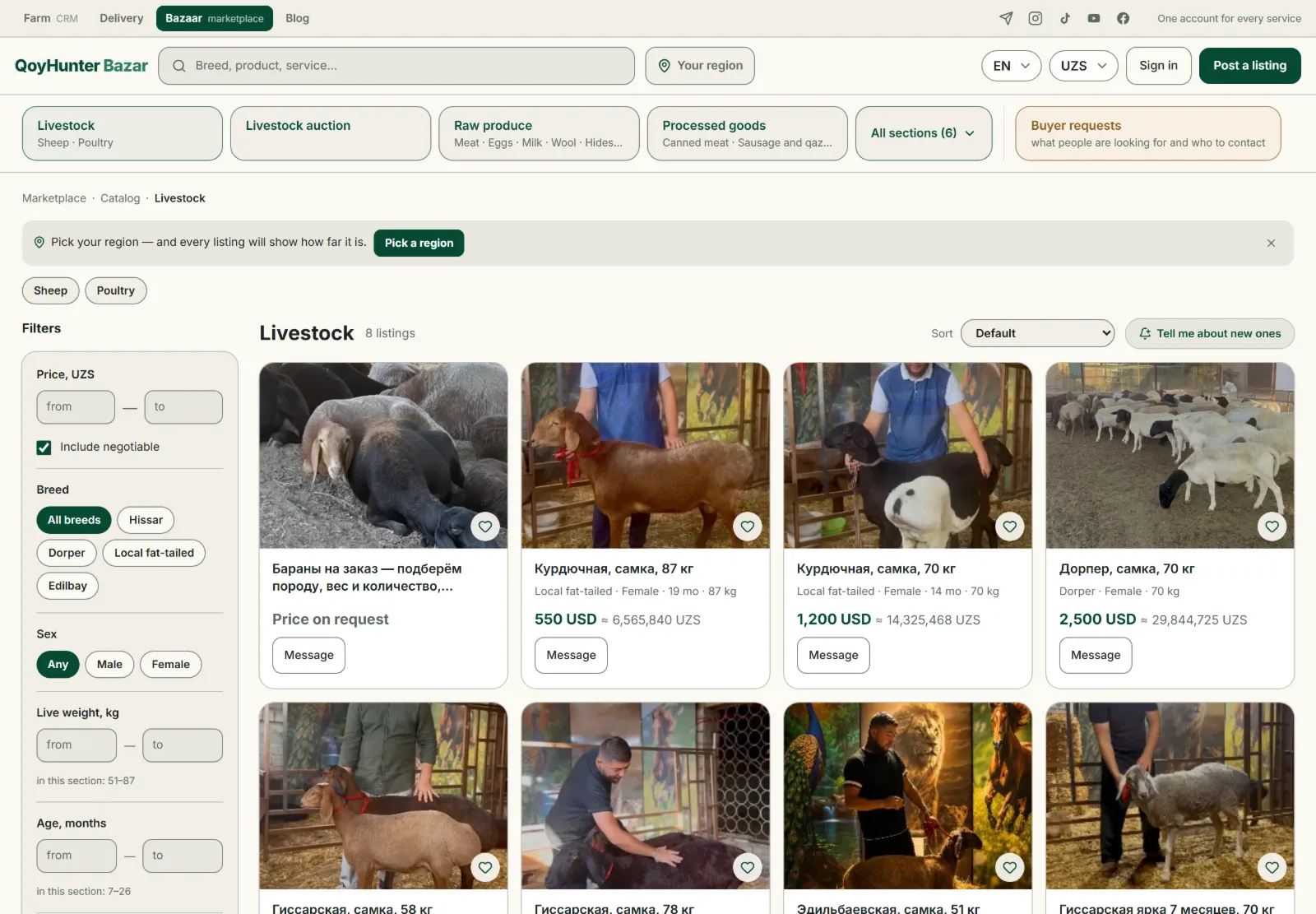
Let's be honest about the marketplace's size. As of August 15, 2026, there are 18 listings on the site, 8 of them in the "Animals" section, and almost all of them are still ours: the platform is just launching, and there's no weekend-market buyer flow here yet. Its strength lies elsewhere — a listing costs nothing and stays up without any effort from you while you're busy with the flock, and buyers filter animals by breed, sex, live weight, and age, and see the distance to you in kilometers.
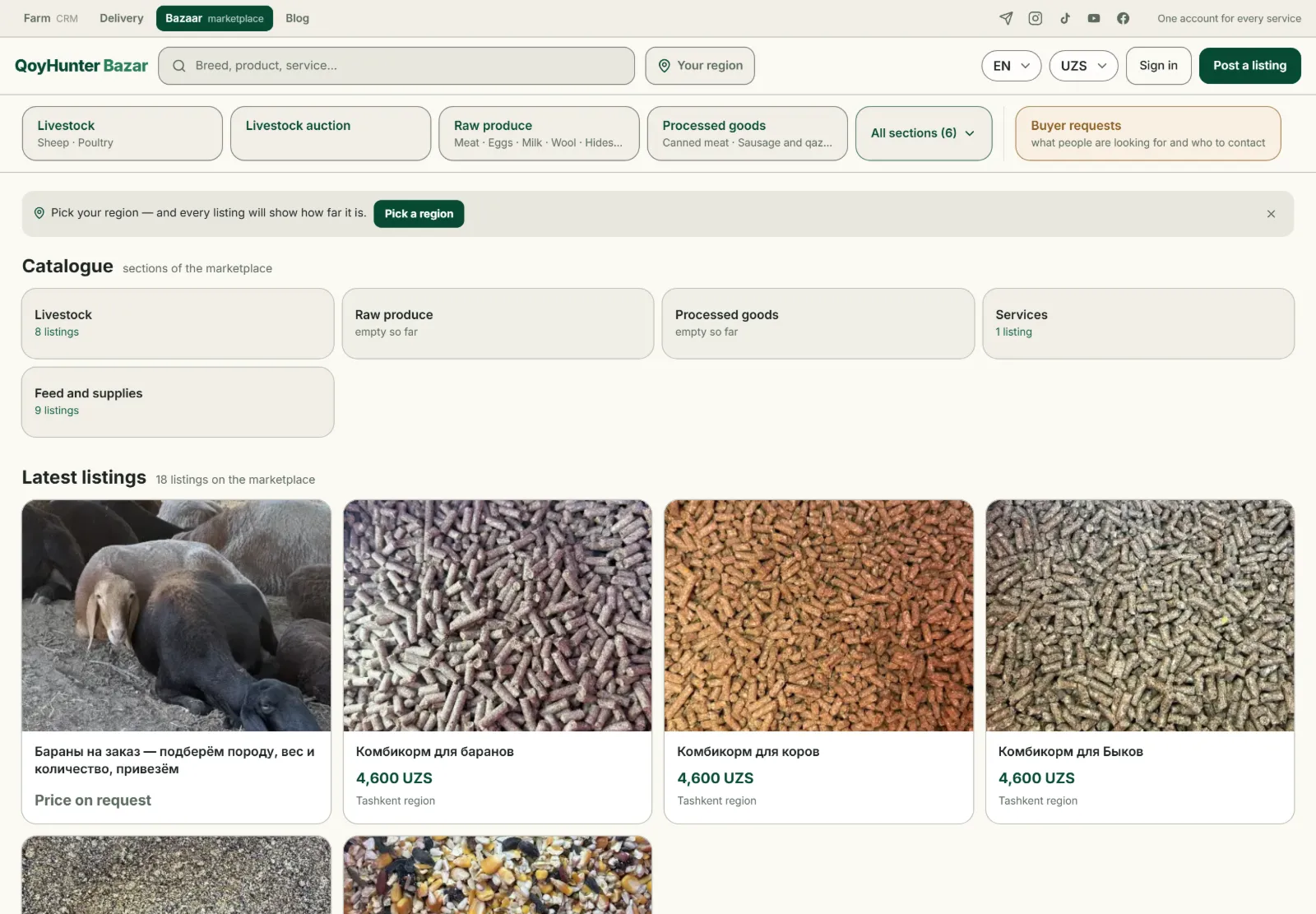
One thing worth knowing before you post: the marketplace has separate filters for "vet certificate verified by the platform" and "vaccinated only." Just attaching a certificate isn't enough — it has to be submitted for verification, or the listing won't show up in that filtered view, and a certificate from the animal's record card doesn't carry over automatically. To see what's currently listed and at what price, check out sheep and rams for sale. If the buyer is from another region and has no truck of their own, livestock transport across Tashkent and the region can move the animal — it's a separate service, discussed only after the deal is done.
How much weight a ram loses on the road and who ends up paying for it is broken down in the guide to livestock truck transport across the Tashkent region.
Comparing sales channels: a quick table
| Channel | Price | Speed | What eats the money | Best for |
|---|---|---|---|---|
| Mol bozori | High | 1 day | 1–4% shrink, the road, your day | Batches of 10+ head |
| Middleman at the gate | ~5,000 soum/kg below market | Hours | Eyeballed estimate, haggling | Urgent cash, 1–2 head |
| Slaughter and sell the meat | High only at retail | Days | 50–60% dressing percentage, processing | You have your own retail outlet |
| Neighbors, mahalla | Best | However it goes | Nothing | 2–3 head a year |
| Telegram groups, classifieds | Whatever you agree on | Days-weeks | Listing sinks, empty calls | Anyone willing to keep re-posting |
| Marketplace listing | You set it yourself | However long it takes to find a buyer | Waiting | Anyone selling regularly |
There's a sixth channel that didn't make this list, because it doesn't work for every ram: the online auction. At auction, buyers bid the price up themselves, and it only pays off where the animal isn't interchangeable — a breeding ram, a rare breed, an exceptional weight. When bidding earns a price premium, and when a meat ram sells for the same price per kilogram anyway, is covered in online ram auctions.
What raises the price in any channel
The channel matters less than the animal's condition and how well you prepare the deal. Four things work the same way everywhere:
- Weigh before selling. Knowing the exact weight is your bargaining leverage and your protection against a guessed estimate.
- Get the animal into good condition. A thin ram sells for less not just because of lower weight but also at a lower price per kilogram: dressing percentage drops to 40–45% in thin animals and crossbreeds with wool breeds, versus 50–60% in well-fed fat-tailed sheep, and an experienced buyer can spot the difference at a glance.
- Have a vet certificate ready. It removes the buyer's biggest fear — buying a sick animal.
- Time it to the season. Before Qurban Hayit, demand and prices climb; in the off-season the same ram is worth noticeably less. In 2026 the holiday fell on May 27, and animals need to be prepared for it a month and a half to two months in advance. For the overall price picture across the country, see how much a ram costs in Uzbekistan in 2026.
If you are buying rather than selling, the logic is mirrored: the same channels, but it is the animal you have to check, not the buyer. Point by point, that is covered in what to check on a ram before you hand over the money.
If you are selling a batch of twenty head rather than a single ram, the choice of channel works differently: what matters is the bulk discount and the deadline, not the road and the shrink. The wholesale buyers are covered in who buys rams in bulk.
FAQ
Is it more profitable to sell a ram at the mol bozori or to a middleman?
At the mol bozori, revenue is about 5,000 soum higher per kilogram of live weight — that's 375,000 soum (≈$31) on a 75 kg ram. But from that gap you have to subtract shrink on the road (1–4% of weight, around 146,000 soum per head), fuel or hired transport, and your own working day. With one or two head, the trip usually doesn't pay off; with a batch of ten or more, about 2.3 million soum (≈$191) of gain remains before subtracting transport costs.
How much weight does a ram lose on the way to market?
On trips under six hours, a sheep loses 1–4% of its live weight; on longer hauls, up to 6–12% (according to the University of Wyoming's agricultural extension service). For a 75 kg ram, three percent is 2.25 kg, or about 146,000 soum (≈$12) at the August 2026 market price. Some of the weight comes back if you let the animal rest with water and hay for 24–48 hours before the sale.
How much does it cost to list a ram for sale on QoyHunter?
Listing is free. The owner sets the price in the listing, and the buyer messages them directly on the platform — no middleman involved.
What should you put in a listing to sell a ram faster?
Breed, sex, age in months, live weight in kilograms, price, and the region where the animal is located. Always include a photo of the actual ram, not a distant shot of the flock. If you have a vet certificate and vaccination records, attach them and submit the certificate for verification: buyers filter listings by exactly these details.
Is it profitable to slaughter a ram and sell the meat?
Only if you sell the meat retail yourself. A ram yields about half its live weight in meat, so at a mutton price of 120,000 soum per kilogram, the fair live-weight price is about 62,400 soum (≈$5.2) per kilogram. Handing the carcass over wholesale is usually worse than selling the ram live, but slaughterhouse rates vary a lot by region — run the numbers for your own area.
What should the listing itself say, so buyers actually find it?
Ram listings get found by filters: breed, sex, age in months, and live weight in kilograms. A blank field means the card won't show up at all, no matter how good the text is. A field-by-field breakdown, a headline formula, and a checklist before you publish — in how to sell a ram online.
Manage your flock in QoyHunterCRM for sheep farmers: livestock, health, weighing, finance and analytics — in the app and a Telegram bot.All features →