Ram delivery in Tashkent and the region: what to transport them in and how much weight is lost on the road
Ram delivery in Tashkent and the region: what to transport them in, how much live weight is lost, and who pays. Loading density, heat, paperwork, cost in soum.
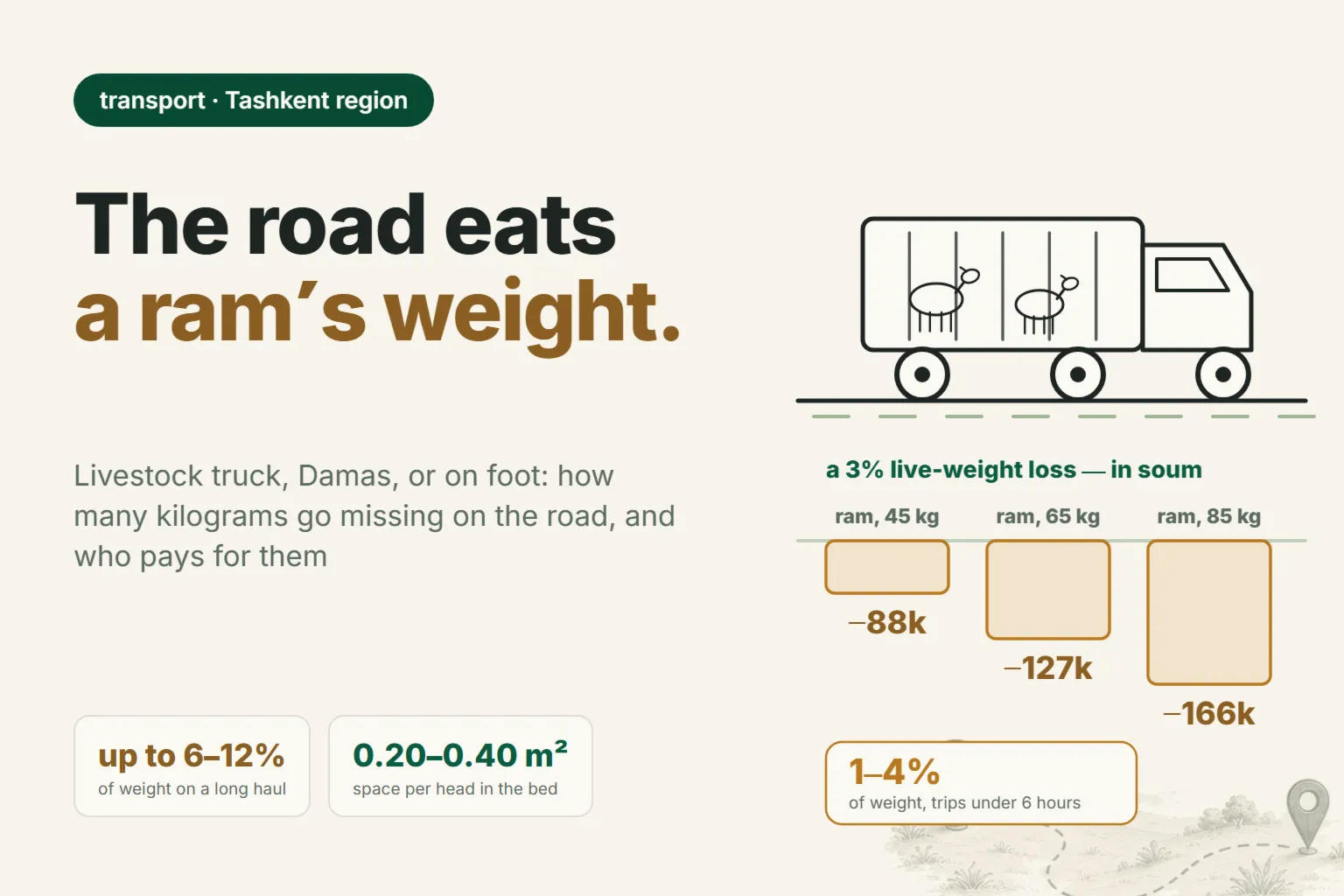
Delivering rams within Tashkent and the Tashkent region is priced by negotiation: carriers work it out from distance, headcount, and whether loading is needed. But the real money on this trip isn't spent on fuel — it's lost on the scale. According to the University of Wyoming Extension, a sheep loses 1–4% of its live weight on a trip under six hours, and up to 6–12% on a long haul. According to the University of Kentucky Cooperative Extension, lambs lose 4–7% on a farm-to-market trip. On an 85 kg ram, three percent is 2.55 kg — around 166,000 soum (≈$14) at 65,000 soum per kilogram of live weight, the top of the market range as of August 2026.
What follows: what livestock gets transported in across Uzbekistan, what each method costs, how much space a ram needs in the back of a vehicle, and who pays for the lost kilograms. All figures are as of August 2026; the conversion rate is 11,800 soum per dollar (the Central Bank of Uzbekistan's rate on 28 August 2026).
What livestock gets transported in across Uzbekistan: six methods
There's no single correct method — the choice depends on how many head you're moving, how far, and which matters more to you: the price of the trip or the weight you'll lose.
Driving the flock on foot
The oldest and cheapest method: the flock is walked to a neighbouring village, pasture, or market. It costs no money, but you still pay — in weight. On the road, the animal doesn't eat or rest, and hooves wear down faster on asphalt than on dirt. A sensible limit is a few kilometres over familiar ground that a vehicle can't reach.
There's a separate risk on a public road: a flock crossing traffic means accidents and animals going missing.
Car or trailer
In Uzbekistan, one or two head are often carried in a car boot or a trailer. It's a last-resort option: only viable over a very short distance and only in cool weather, and we don't recommend transporting animals this way ourselves. In a closed boot in summer, a ram can suffer heatstroke within a few hours: there's no airflow and no room to stand.
A trailer without high sides and a non-slip floor is dangerous in a different way: on a turn, the animal's legs slide apart, it falls, and gets injured. An injury isn't just unfortunate — it's an immediate cut to the sale price.
Minivan (Damas)
The workhorse for 3–6 head over a distance of up to 100–150 km. Cheap, available, and you'll find one in any district. The downsides: low ceiling, weak ventilation, and no ramp — loading is done by hand, by two people, which is stressful for both the animal and the handler.
Flatbed pickup (Labo)
Same carrying capacity, but the platform is open: plenty of air, but the animals ride exposed to sun and wind. You need high sides or sturdy mesh, or a ram will jump out at the very first stop, and on a turn it gets thrown around.
Flatbed truck with mesh sides
The classic choice for a batch of 15–30 head: the sides are built up with mesh or wooden panels, and the floor is covered with straw. It works, but has two problems. First, loading: without a ramp, rams are hoisted over the side by hand. Second, the open top: in summer the animals ride in direct sun, in winter in the wind.
Livestock truck with a loading ramp
A purpose-built vehicle: a tall body with slatted sides, a fold-down ramp, a non-slip floor, and sometimes partitions between sections. The flock walks in on its own — nobody has to lift anything. A single trip takes anywhere from 30 to 80 head, depending on the vehicle.
It's the most expensive option per trip and the cheapest per head once you're moving a large batch. For a single animal, a livestock truck almost never pays off — unless that one animal is breeding stock worth as much as the vehicle.
Seller's vehicle or a lift from the market
Mol bozor — the livestock market held at weekends in most districts — always has vehicles willing to deliver your purchase. It's convenient and usually cheap, but this kind of ride comes with no agreement on the animal's condition on arrival and no one accountable for it.
Which method to choose: comparison
| Method | Headcount | When it fits | What it costs you |
|---|---|---|---|
| Driving on foot | any | 2–5 km over familiar ground | Weight, hooves, road risk |
| Car, trailer | 1–2 | Short distance, cool weather | Risk of heatstroke and injury |
| Damas minivan | 3–6 | Up to 100–150 km | Hand loading, weak ventilation |
| Labo flatbed pickup | 3–6 | Short distance, cool weather | Sun, wind, needs high sides |
| Flatbed truck | 15–30 | A batch within the region | Sun and wind, hand loading |
| Livestock truck with ramp | 30–80 | A batch, long distance, breeding stock | Pricier per trip, cheaper per head |
| Lift from the market | 1–5 | A one-off purchase at the mol bozor | Nobody's accountable for the animal |
How much live weight a ram loses on the road
Weight loss in transit is, first and foremost, not muscle but the contents of the gut and water: the animal doesn't eat, doesn't drink, and burns reserves on stress. According to the Mississippi State University Extension, around two-thirds of the lost weight is manure, roughly another quarter is urine, and only the remainder is tissue.
How much a sheep specifically loses:
- 1–4% of live weight on a trip under six hours, and up to 6–12% on a long haul — University of Wyoming Extension;
- 4–7% on a farm-to-market trip — University of Kentucky Cooperative Extension; for lambs aged 5–8 months, the loss is 5% or more.
What that means in money at 65,000 soum per kilogram of live weight (the top of the market range; the usual range is 55,000–65,000 soum/kg):
| Live weight before loading | 3% loss | 6% loss |
|---|---|---|
| 45 kg | 1.35 kg ≈ 88,000 soum ($7) | 2.7 kg ≈ 176,000 soum ($15) |
| 65 kg | 1.95 kg ≈ 127,000 soum ($11) | 3.9 kg ≈ 254,000 soum ($21) |
| 85 kg | 2.55 kg ≈ 166,000 soum ($14) | 5.1 kg ≈ 332,000 soum ($28) |
On a batch of 20 rams at 85 kg each, three percent works out to 51 kg of live weight — roughly 3.3 million soum (≈$280). That's exactly why "how much does the trip cost" is the second question. The first one is "how much will we lose on the road, and who pays for it."
Some of that weight comes back. Once the animal is in a pen with water and hay, whatever it lost from the gut fills back up quickly; the tissue portion of the loss recovers more slowly. But if a ram is taken straight to the scale or the slaughterhouse on arrival day, there's nothing left to recover — you're selling or buying a "dry" ram.
Where the scale stands: settle it before loading
This is the main money question in a delivery, and it has to be asked before the animal is loaded.
- Weighed at the seller's — the buyer pays for the loss on the road.
- Weighed at the buyer's after unloading — the seller pays for the loss.
- Agreed a price per head, not per kilogram — nobody pays for the loss, but then the price gets discussed on different terms altogether.
The argument over this always breaks out after unloading, when it's too late to negotiate. How to work out the price per kilogram, and what to check on the animal before the money changes hands, is covered separately — in the article on buying a ram in Tashkent from a listing.
How much space a ram needs in the back of a vehicle
Too tight, and the animals crush each other — one that falls can't get back up. Too loose, and braking or turning throws them around the vehicle. Council Regulation (EC) No 1/2005 on the protection of animals during transport provides a benchmark; there's no published table for road transport in Uzbekistan, so the EU standard is a convenient starting point.
| Animal | Live weight | Space per head |
|---|---|---|
| Shorn sheep and lambs of 26 kg and over | up to 55 kg | 0.20–0.30 m² |
| Shorn sheep and lambs of 26 kg and over | over 55 kg | from 0.30 m² |
| Unshorn sheep | up to 55 kg | 0.30–0.40 m² |
| Unshorn sheep | over 55 kg | from 0.40 m² |
| Heavily pregnant ewes | up to 55 kg | 0.40–0.50 m² |
| Heavily pregnant ewes | over 55 kg | from 0.50 m² |
| Small lambs | — | under 0.20 m² is permitted |
What that means in practice: a 6 m² vehicle bed fits around 20 medium shorn sheep, or 13–15 large unshorn rams. The regulation itself notes that the area should be adjusted for breed, size, the animals' condition, fleece length, weather, and trip length. Separate chapters require that animals stay accessible for inspection and be watered at least every 12 hours en route.
In hot weather, load more loosely. In a trial by New Zealand researchers (New Zealand Veterinary Journal, Fisher et al., 2002), 35 kg lambs were transported at 0.20 and 0.26 m² per head: during a three-hour stop in the heat, the peak temperature-humidity index reached 91.0 in the tighter group versus 84.9 in the looser one. The extra 0.06 m² per animal works like ventilation.
Feed and water before and after the trip
Don't feed animals right before loading: a full rumen combined with jolting causes bloat, and a cramped animal may not be able to get back up. According to Meat & Livestock Australia guidance, sheep are taken off lush green feed (fresh alfalfa, grass) before the trip and switched to dry hay; industry guidelines put the off-feed period at 4–24 hours, depending on the distance.
Advice on water differs: Australian guidelines allow 24–36 hours without water on long hauls, while on a short trip it's simpler not to withhold it at all and just water the animals before departure.
Don't stretch the fast out too long, either. In a study on sheep (the journal Animals, Xiao et al., 2024), a 12-hour fast lowered cortisol levels — meaning the animals coped with the trip more calmly — but it also worsened blood nutritional-status markers. The point is simple: remove the lush feed, and don't starve the animal for a full day "to make the ride easier."
After unloading, give water and hay first; grain goes back into the diet the next day. A sudden switch to concentrates after a hungry trip triggers rumen acidosis.
How to transport animals in the heat
In summer, a daytime trip in the Tashkent region is about the worst idea there is. Sheep cool themselves mainly by breathing: they do have sweat glands, but the fleece stops moisture from evaporating, and in a crowded vehicle bed with no airflow, breathing doesn't work well either. In a trial on sheep (Journal of Animal Science, 2023), under prolonged heat and high humidity, respiration rate rose from 66 to 183 breaths per minute — almost triple.
Practical takeaways from Ohio State University Extension guidance on heat stress in small ruminants:
- don't transport during the hottest part of the day; the best times are early morning or late evening;
- park in the shade at stops, angled across the wind so air flows through the bed, and don't keep it closed up;
- give water before and after the trip, and at stops on a longer route.
The visible sign of overheating is fast, shallow breathing with an open mouth. If you see that at a stop, ventilate the bed and water the animals — don't keep driving.
Flooring, partitions, and an escort
Cover the floor with straw or a rubber mat: on bare metal, animals' legs slide apart and get hurt. Larger rams are better kept apart with partitions so they don't fight on the road. And someone should ride with the animals, or at least check on them at stops: an animal that falls in a crowded bed gets trampled and doesn't make it to its destination.
Deaths in transit, though, are rare. A study of livestock transport in southern Italy found mortality in transit for sheep and goats at 0.038%, rising to 0.084% for lambs; Czech statistics on sheep put it at 0.015%. The real losses on this road are elsewhere: weight, injuries, and meat quality.
If the ram is going to slaughter: rest before it
Transport stress burns through glycogen reserves in the muscle. If an animal is slaughtered right after a long trip, the meat's pH doesn't have time to drop to normal (it stays around 6.4–6.8 instead of roughly 5.7), and you get so-called DFD meat — dark, firm, and dry, with poor keeping quality. This shows up both in reviews on how transport affects mutton quality and in material on pre-slaughter rest.
The industry rule of thumb: let the animal rest in a pen for 4 to 24 hours before slaughter, with water available; holding it longer than a day isn't worth it — carcass weight drops away, and pH drifts from normal. How much meat you actually get from live weight is worked out in the article on dressing percentage in rams.
What paperwork you need to transport livestock
The general framework is the Law of the Republic of Uzbekistan «On Veterinary Medicine»: it requires owners to sell animals in compliance with veterinary and sanitary rules, and gives veterinary inspectors the right to bar the use of any vehicle whose condition doesn't meet those rules. As of May 2026, the agencies have split: veterinary oversight is handled by the Committee for Food Safety, while livestock development sits with the Agency for Livestock and Pasture Development under the Ministry of Agriculture.
The procedure for veterinary paperwork on transport within the country is thinly documented in public sources: the current regulation on permit documents covers export, import, and transit, and the earlier 2004 rules were repealed in 2018. So the only reliable route is to ask your district veterinary station what exactly your route requires, and do it before the trip — not at a checkpoint.
Worth remembering regardless:
- in practice, veterinary accompanying documents are issued by the service where the animal is kept — meaning the seller's side;
- documents are issued for the animals, not the vehicle: every animal gets its own veterinary passport, though for sheep and goats a group passport is allowed;
- on a sale, the seller certifies the sale in the passport, and the buyer then has seven days to register the animal where it's kept;
- a veterinary certificate doesn't guarantee the animal's health going forward — it records an inspection on a specific day and replaces neither your own inspection nor quarantine;
- a law on animal identification, registration, and tracking has been in force since 7 August 2026: an ear tag or chip, a shared database, a note logged on every change of owner. Owner obligations under it phase in from 1 January 2028, but the requirement not to keep untagged livestock already exists — under the 2017 identification rules.
For breaching veterinary rules, the Code of Administrative Liability sets a fine for individuals of one to three base calculation units. From 1 September 2026, the base unit is 440,000 soum — meaning a fine of 440,000–1,320,000 soum (≈$37–112).
Who does the transporting: your own vehicle, a hired carrier, or a delivery service
Your own vehicle works for anyone who transports regularly and keeps equipment for it. Converting a car trailer for livestock as a one-off is more expensive and more dangerous than hiring a vehicle.
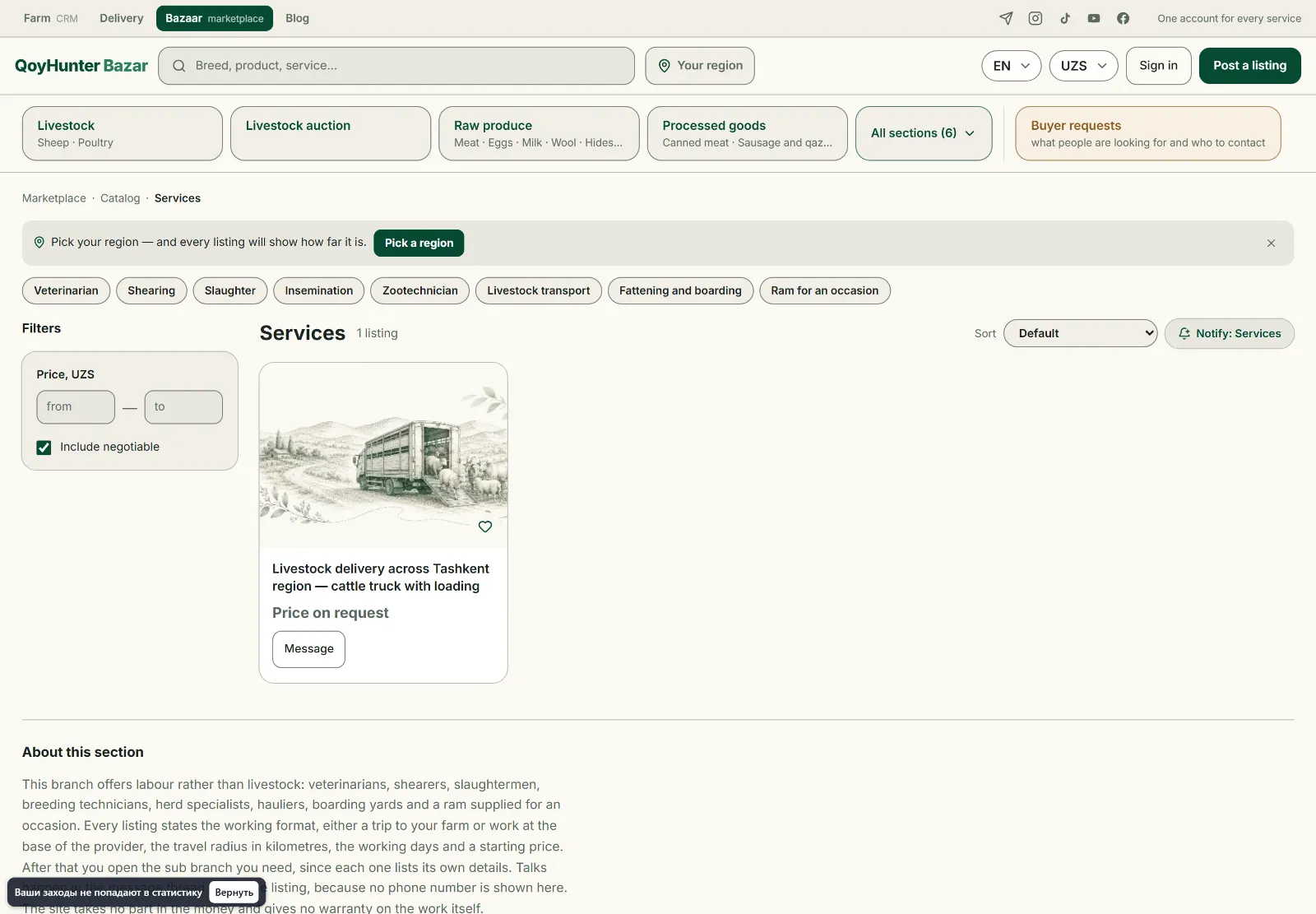
A hired carrier is the most common option. People find one through contacts, at the market, or through a listing: on the QoyHunter marketplace, offers like this sit in the livestock transport services section — though as of 31 August 2026 there's only one listing there, and it's ours: a livestock truck with a loading ramp, based in Yangiyul. When you negotiate, ask three things: is there a ramp for loading, what's the floor covered with, and who rides with the animals.
A delivery service is for when you don't have time to hunt for a vehicle. Ours is ram delivery across Tashkent and the Tashkent region: you leave a request — where from, where to, and how many head — and get a callback, a vehicle assigned, and a price worked out. We deliver on our own vehicles within Tashkent and the region; longer routes are by arrangement. It's part of QoyHunter, the CRM for sheep record-keeping and the bazar.qoyhunter.com marketplace, where an animal goes from its record card to a listing in a couple of clicks.
If you're still deciding what to buy for transport, take a look at ram and ewe listings for sale: each listing states the breed, weight, and region, which covers half of what you'd otherwise have to ask a carrier.
What to remember
- The road is paid for in weight: 1–4% on a trip under six hours, up to 6–12% on a long haul.
- Settle where the scale stands before loading, not after unloading.
- Space per head: 0.20–0.30 m² for a shorn sheep, from 0.40 m² for a large unshorn ram; give more room in the heat.
- Take animals off lush feed 12 hours before departure, but leave water available.
- In summer, transport at night or early morning; a closed boot in the heat can kill an animal within hours.
- Let the animal rest for 4–24 hours before slaughter, or the meat comes out dark and tough.
FAQ
How much does ram delivery cost in Tashkent and the region?
The price is negotiable: carriers work it out from distance, headcount, and whether loading is needed. There's no single market rate — state your route (from — to) and headcount and ask for a quote. When comparing two offers, divide the trip price by the headcount: a livestock truck costs more per trip than a minivan, but on a full batch it usually works out cheaper per head.
How much weight does a ram lose during transport?
On a trip under six hours, 1–4% of live weight; on a long haul, up to 6–12% (University of Wyoming Extension); for lambs, a farm-to-market trip works out to 4–7% (University of Kentucky Cooperative Extension). For an 85 kg ram, three percent is 2.55 kg, around 166,000 soum (≈$14). Most of the loss is gut contents and water, which comes back within a day or two of watering and feeding.
Can you transport a ram in a car boot?
In cool weather and over a very short distance, people do this, but in summer it's dangerous for the animal's life: a closed boot has no ventilation, and a ram can suffer heatstroke within a few hours. If there's no other transport available, travel early in the morning, with airflow, and for no more than an hour.
What paperwork is needed to transport sheep within Uzbekistan?
Veterinary accompanying documents, issued by the veterinary service where the animal is located — meaning the seller's side. The exact list for domestic routes isn't spelled out in public sources, so check with your district veterinary station before the trip. The general framework is the Law of the Republic of Uzbekistan «On Veterinary Medicine»; veterinary oversight has been handled by the Committee for Food Safety since May 2026.
How many sheep fit in a vehicle bed?
Under Council Regulation (EC) No 1/2005, a shorn sheep up to 55 kg needs 0.20–0.30 m², an unshorn ram over 55 kg needs at least 0.40 m², and a heavily pregnant ewe needs 0.40–0.50 m² or more. That means a 6 m² vehicle bed fits around 20 medium sheep, or 13–15 large rams. In hot weather, load more loosely: with more space per head, the temperature and humidity in the vehicle bed are lower.
Manage your flock in QoyHunterCRM for sheep farmers: livestock, health, weighing, finance and analytics — in the app and a Telegram bot.All features →