How to Estimate a Ram's Weight Without Scales: Tape, Formula, and Table
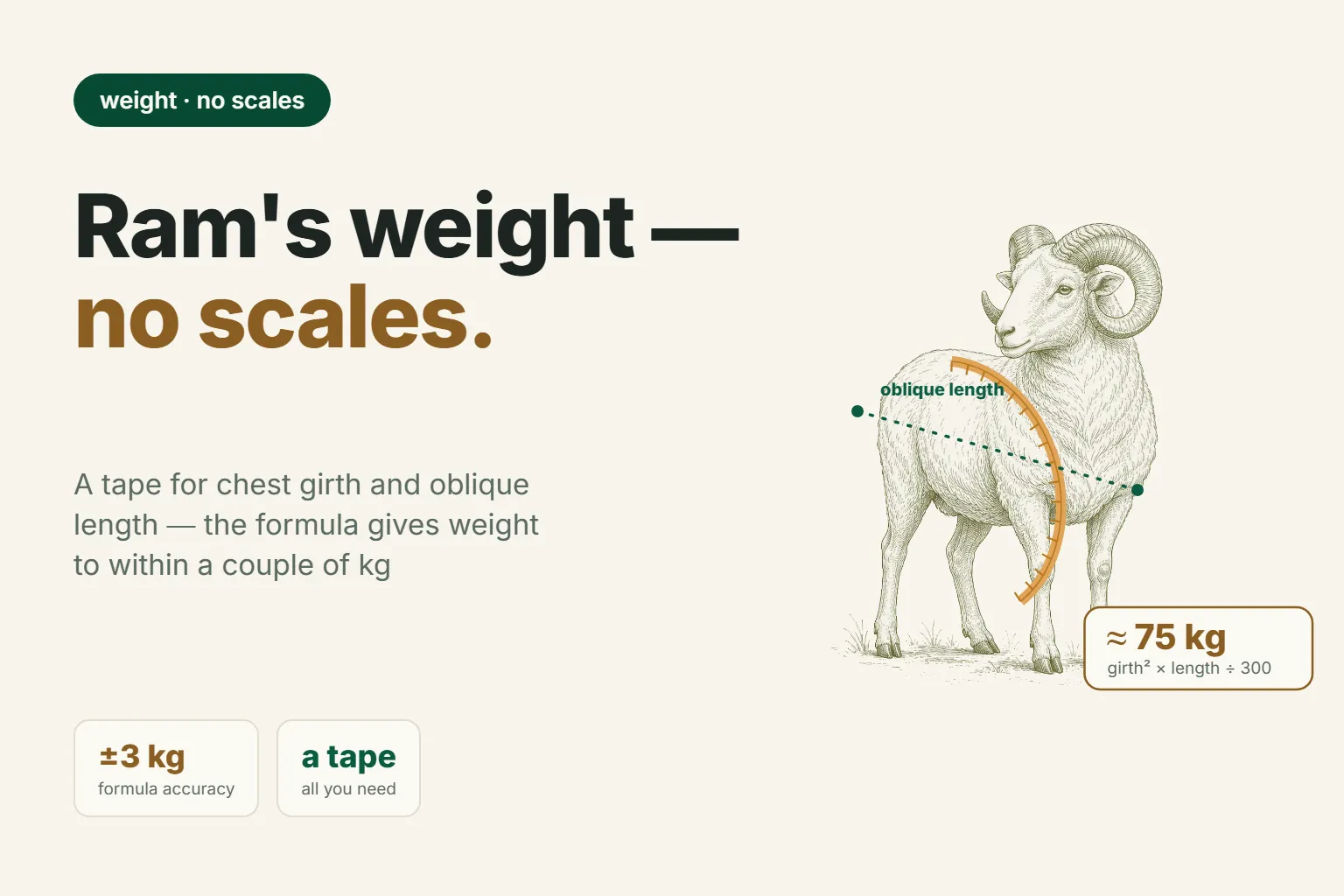
Heart girth and oblique body length are all you need to estimate a ram's weight to within ±5–10 %. The tape-measure formula, a ready-made heart-girth table, and measuring rules for fat-tailed breeds.
Not every farm has platform scales, yet you need to know a ram's weight constantly — when selling, when calculating a medicine dose, when tracking fattening progress. The good news: an ordinary measuring tape — the tailor's "centimeter" — gives you weight accurate to about ±5–10 %. For most farm tasks, that's enough. Let's go through the formula, a ready-made table, and the measuring rules people get wrong most often.
Why Knowing the Exact Weight Matters
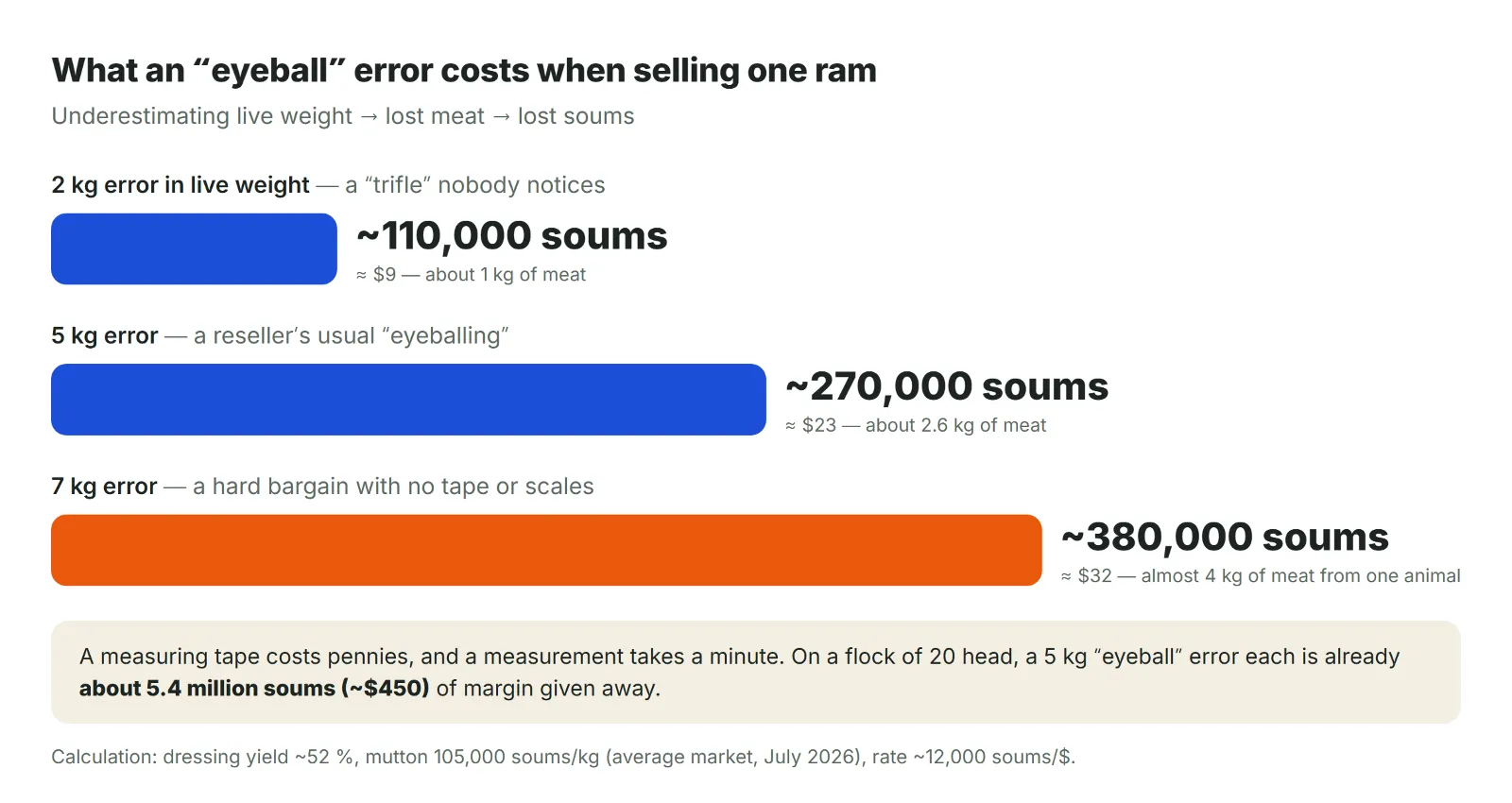
- Money at the point of sale. A ram's price comes down to kilograms: weight × condition × breed. Buyers and resellers eyeball an animal in their own favor, and a 5–7 kg error in live weight on a single ram means roughly 250–450 thousand soums ($20–38). For more on pricing itself, see our breakdown of ram prices.
- Medication dosing. Dewormers, vaccines, and nearly all veterinary drugs are dosed per kilogram of live weight. An under-dose fails to kill parasites and trains them to resist the drug; an over-dose is toxic, especially for pregnant ewes. The drug's instructions and your vet always set the dose — but both calculations start from the animal's real weight, and "about 60 kg" isn't good enough here.
- Tracking fattening progress. Weight gain is the main indicator of whether the feed is paying off: on pasture and during fattening, that's roughly 120–250 g per day (see our feeding guide for details). Without regular numbers, you'll find out that gains have stalled far too late.
Two Measurements That Decide Everything
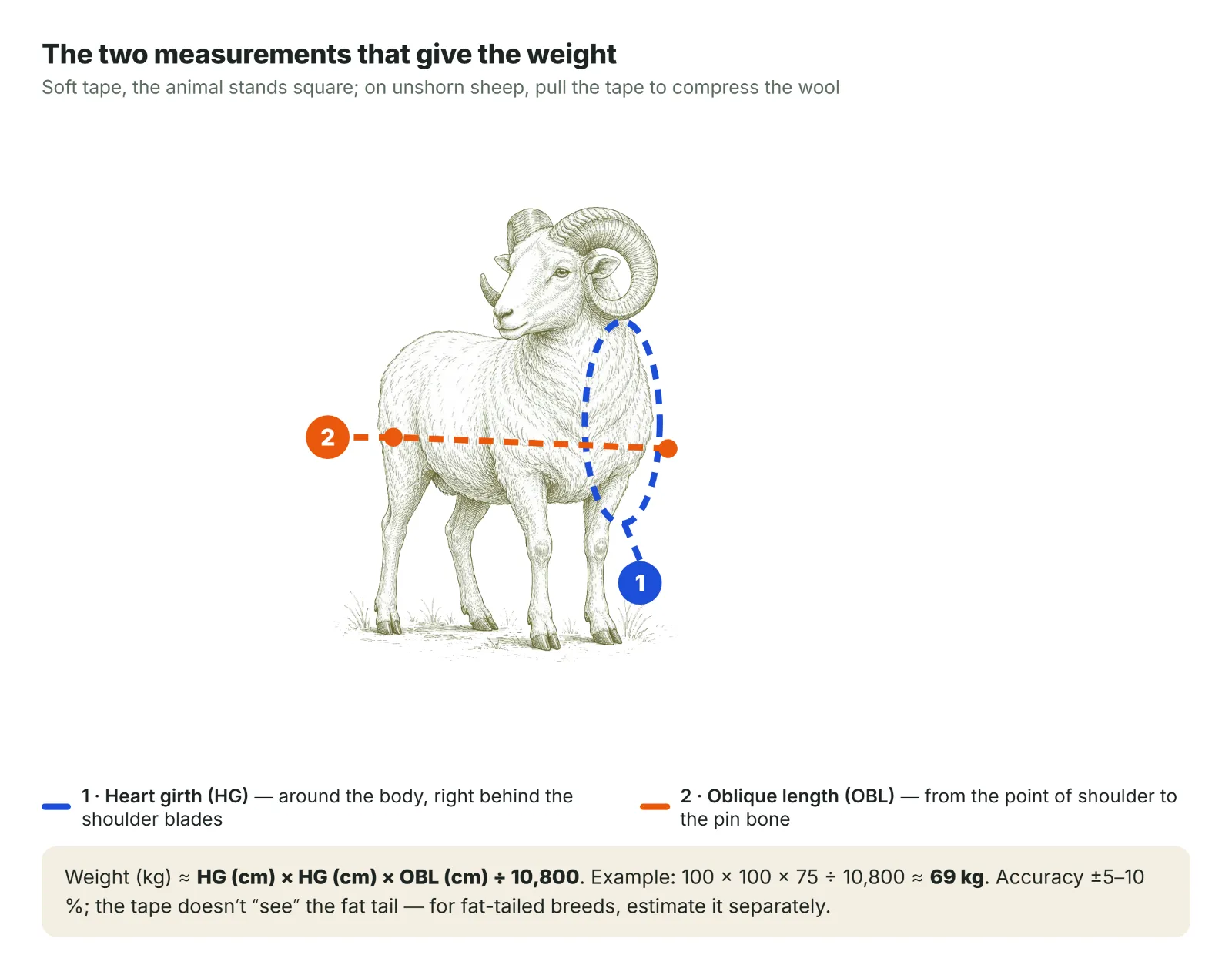
You only need two measurements taken with a soft tape:
- Heart girth (HG) — the tape runs vertically around the body, right behind the shoulder blades and front legs, at the deepest point of the chest.
- Oblique body length (OBL) — measured in a straight line from the point of the shoulder joint (front edge of the shoulder) to the pin bone (rear point of the pelvis). Not from the nose, and not to the tip of the tail — the body only.
The Tape-Measure Weight Formula
The classic tape-measure formula (known in English-language references as the Schaeffer formula: girth² × length / 300, in inches and pounds), used by sheep farmers worldwide, looks like this in metric units:
Weight (kg) ≈ HG (cm) × HG (cm) × OBL (cm) / 10,800
Example: a young ram has a heart girth of 100 cm and an oblique length of 75 cm. Calculate: 100 × 100 × 75 / 10,800 ≈ 69 kg.
The formula's accuracy is that same ±5–10 %: it won't replace scales on a breeding farm, but for sales, medication dosing, and tracking fattening, it's accurate enough.
Adjusting for the fat tail. The formula was derived for meat breeds without a fat tail, and a tape wrapped around the chest simply doesn't "see" the tail. In adult Hissar, Edilbay, and Jaidara rams, the fat tail weighs 10–20 kg (see our breed comparison). So for fat-tailed animals, the tape calculation understates the full live weight — estimate the tail separately by its size, or agree honestly with the buyer that the quoted weight is "by tape only."
Table: Heart Girth to Approximate Weight
If you only measure the heart girth, you can estimate weight from the table below. It's calculated using the same formula for animals of typical proportions, where the oblique length is roughly 70–80 % of the heart girth:
| Heart Girth | Approximate Live Weight |
|---|---|
| 70 cm | 22–25 kg |
| 80 cm | 33–38 kg |
| 90 cm | 47–54 kg |
| 100 cm | 65–74 kg |
| 110 cm | 86–99 kg |
| 120 cm | 112–128 kg |
The range in each row reflects differences in body length and body condition. If a ram is noticeably longer or shorter than average, don't trust the table — take both measurements and use the formula instead.
How to Measure Without Fooling Yourself
- Measure in the morning, before feeding and watering. Feed eaten and water drunk add a few "phantom" kilograms to any measurement taken later in the day. You can only compare measurements taken at the same time of day.
- The animal should stand square on all four legs, on level ground, with its head in a natural position — not raised or lowered.
- Press the wool down. The tape must sit snug against the body, compressing the fleece: on unshorn, coarse-wool sheep, thick wool adds several centimeters to the girth — that's an extra 5–10 kg of "paper" weight.
- Take 2–3 measurements and average them: the ram shifts its stance, takes a breath — and the number already changes.
- Record the result with a date. A single measurement tells you almost nothing — the trend over time tells you everything.
Four More Ways Without Platform Scales
- Spring scale (kantar) — for lambs. A lamb under 25–30 kg is easy to weigh in a sturdy bag or sack hung from a spring scale hook. It's the most accurate "at-home" way to track weight gain in young stock.
- Bathroom scale. Step on the scale yourself, then again holding the lamb: the difference is its weight. This works as long as you can still lift the animal.
- Scales at the livestock market. Large markets have platform scales — you can weigh the animal before the sale. Weighing in front of the buyer is a strong bargaining argument: an "eyeball" dispute never gets settled in the seller's favor.
- Your own platform scale. For a farm with 20–30 head or more, buying electronic scales pays for itself quickly: accurate weight gain means accurate fattening economics, and selling "by the scale" shuts down any reseller's attempt to haggle away extra kilograms.
If you have decided on your own scales, it makes more sense to buy them before fattening rather than after: to buy livestock scales pays for itself on the very first batch of 20 head.
A single weight figure says little on its own: the meaning appears once you have two measurements and a known number of days between them. How to turn two weighings into average daily gain, and what the norm is for fat-tailed breeds, is set out in how to calculate daily weight gain in sheep.
From Weight to Meat and Money
Live weight isn't meat yet. The dressing percentage for fat-tailed breeds is about 50–60 % of live weight: 58–60 % for Hissars, roughly 50–55 % for Edilbay and Jaidara. So a ram with a live weight of 70 kg yields around 36–40 kg of carcass including the tail.
At a market price of UZS 90,000–120,000 (~$7.5–10) per kg for mutton, that ram is worth 3.2–4.8 million soums ($270–400) "in meat." Now you can see what a careless measurement costs: a 5 kg error in live weight from the tape means ±2.5–3 kg of meat — roughly 230–360 thousand soums ($19–30) on a single animal.
In Short: The Working Method
- In the morning, before feeding, use a soft tape to measure the heart girth and oblique length.
- Calculate: HG × HG × OBL / 10,800 — that's the weight in kilograms; for fat-tailed breeds, add your estimate of the tail.
- Repeat every 2–4 weeks and keep records: the weight gain will show whether the feed is working and when it's time to sell.
It's easy to keep records like these in a weighing and measurement log — free flock accounting from your phone: weighings, weight gains, and vet treatments for every animal — and you can sell a ram on the sheep listings with stated weight.
A measured weight isn't just for haggling: in a sale listing it's a separate field buyers filter by, and without it the card simply won't show up. What else you need to include in the listing — how to sell a ram online.
Manage your flock in QoyHunterCRM for sheep farmers: livestock, health, weighing, finance and analytics — in the app and a Telegram bot.All features →