Dressing Percentage in Sheep: How Much Meat You Get From Live Weight, and Whether It Pays to Sell Live or as Carcass
Mutton at the bazaar costs 120,000 soum a kilogram, while you're offered 60,000 for live weight. We run the numbers on where the other half goes: dressing percentage by breed, a formula for a fair price, and when slaughter pays off — and when it eats into your profit.
At the bazaar, a kilogram of mutton costs 120,000 soum. A livestock buyer pulls into your yard and offers 60,000 for a kilogram of live weight. Exactly half — and the first thought is usually the same: you're being robbed.
Let's do the honest math. The gap comes down almost entirely to one number — dressing percentage. Below: how much meat different sheep breeds actually give, how to check in a minute whether the price you're offered is fair, and what a full calculation of "sell live vs. slaughter and sell as meat" shows. Prices are for Uzbekistan, summer 2026, at an exchange rate of roughly 12,000 soum to the dollar.
What Dressing Percentage Is, and Why the Numbers Never Match
Dressing percentage is the ratio of carcass weight to pre-slaughter live weight, expressed as a percentage.
- Pre-slaughter live weight — the animal's weight after a 24-hour fast without food. Over those 24 hours a sheep loses 2.5–3.5% of its weight: the stomach and gut contents empty out. On a 75 kg sheep that's about 2 kg — the "where did those go" kilos, if you weighed the animal in the evening and slaughtered it the next morning.
- Carcass weight (dressed weight) — the carcass plus internal fat. The carcass is the body without the head, legs, hide, and internal organs (the kidneys, with the fat around them, stay in). For fat-tailed breeds, the fat tail is removed and weighed separately, but it still counts toward the carcass weight.
That's where the mismatched numbers come from. One source counts the fat tail in, another doesn't; one is measuring a well-fed adult wether, another a lamb straight off the pasture. So don't ask "what's the dressing percentage for an Edilbay" — ask "what's the dressing percentage for my sheep, in its current condition."
Three things move dressing percentage the most: body condition, breed, and age. Condition matters more than breed: well-finished sheep dress out at 50–55%, poorly finished ones drop to 35–40% — with the exact same bloodline. Fat gets laid down in the carcass and fat tail, while the bones, hide, and offal stay roughly the same weight regardless.
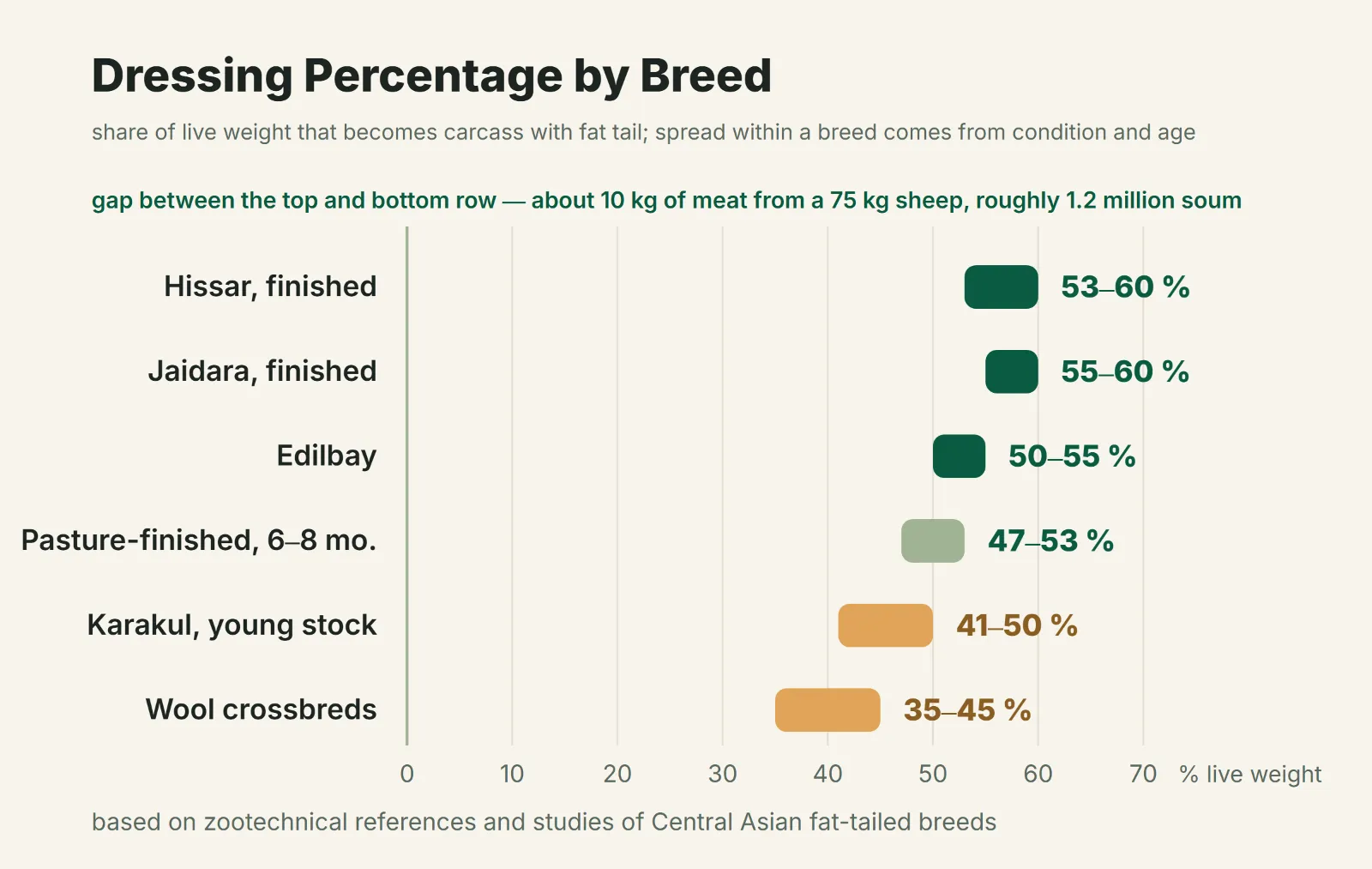
Dressing Percentage by Breed: The Table
| Breed / Type | Dressing Percentage | Carcass from a 75 kg Live Sheep |
|---|---|---|
| Hissar, finished adult | 53–60% | 40–45 kg |
| Jaidara, finished adult | 55–60% | 41–45 kg |
| Edilbay | 50–55% | 37–41 kg |
| Fat-tailed young stock on pasture finishing (6–8 mo.) | 47–53% | — |
| Karakul (young stock, feedlot) | 41–50% | 31–37 kg |
| Crossbreds with wool breeds | 35–45% | 26–34 kg |
The young-stock figures come from zootechnical studies of Central Asian fat-tailed breeds: Hissar ram lambs dress out at 49.8% at 4 months, and after 60 days of pasture finishing, at 53.0%. For 7-month-old ram lambs raised in mountain conditions: Hissar — 51.5%, Jaidara — 47.6%, Tajik meat-fat-wool breed — 43.8%.
Keep the top and bottom rows of the table in mind. The difference between a fat-tailed sheep in good condition and a wool crossbred of the same live weight is about 10 kilograms of meat. At bazaar prices, that's roughly 1.2 million soum (≈ $100) per head.
The Formula That Checks the Buyer's Price
It's short:
Price per kilogram of meat × dressing percentage = ceiling price per kilogram of live weight.
That's the upper limit: what your sheep would be worth if slaughter, transport, market stall, and time cost nothing. Whatever the buyer keeps below that number is payment for their work and risk.
Let's plug in the bazaar price of 120,000 soum/kg:
| Dressing Percentage | Ceiling Price per kg Live Weight |
|---|---|
| 42% | 50,400 soum ($4.2) |
| 46% | 55,200 soum ($4.6) |
| 50% | 60,000 soum ($5.0) |
| 54% | 64,800 soum ($5.4) |
| 58% | 69,600 soum ($5.8) |
Now it's clear where the usual 55,000–65,000 soum per kilogram of live weight comes from: for a fat-tailed breed in normal condition, the buyer pays close to the theoretical ceiling. They're not robbing you — they're working on a 5–10% margin and making their money on turnover.
But the same table shows where you lose out. If you have a well-finished Hissar with a 58% dressing percentage and you're quoted the "everyone gets the same" price of 55,000, you're giving away about 15,000 soum on every kilogram of live weight. On a 75 kg sheep that's 1.1 million soum (≈ $92). Now you have a real argument for the negotiation — not "my sheep is good," but "it dresses out at close to 58%, do the math yourself."
Live or as Meat: A Full Calculation on One Sheep
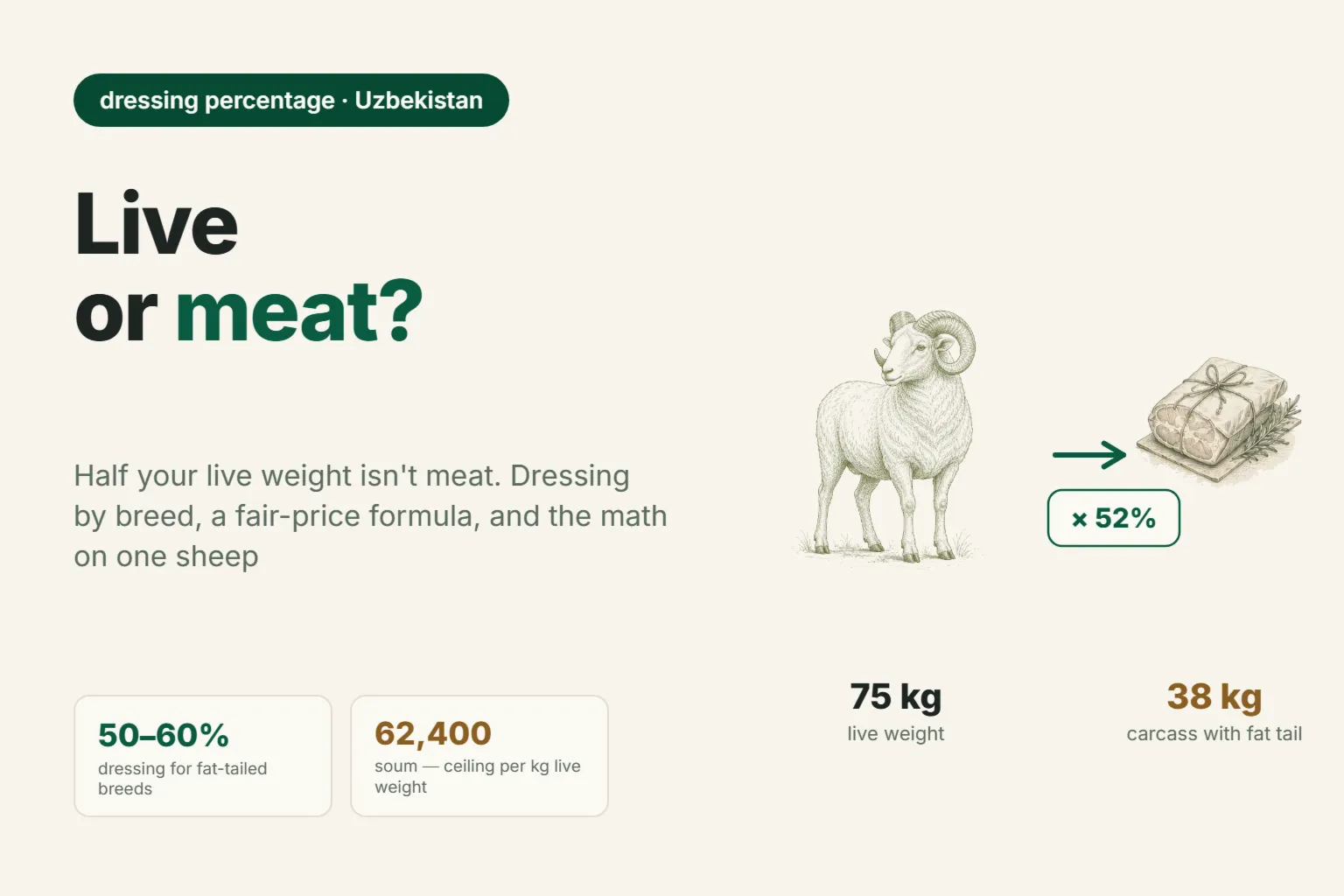
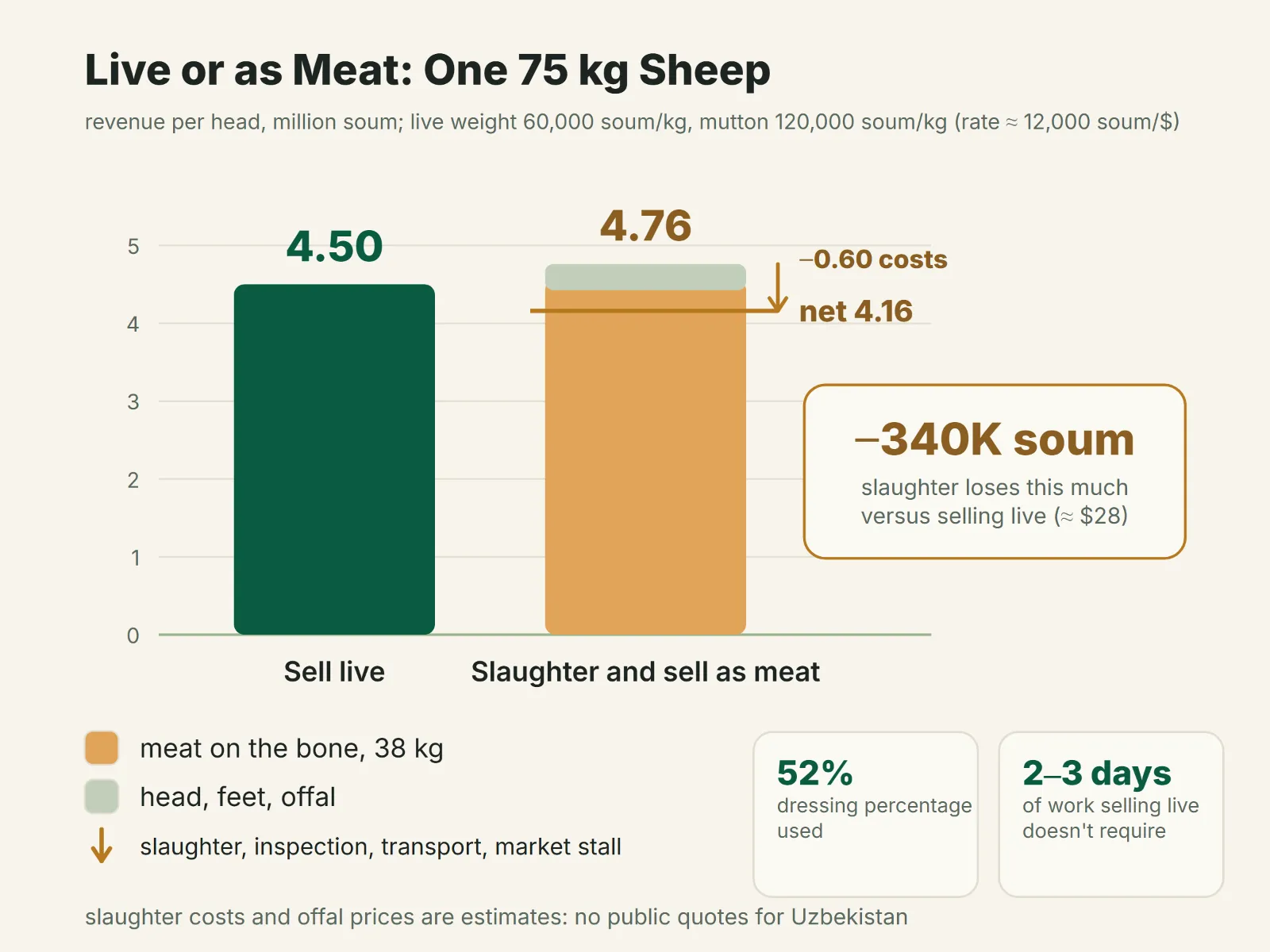
Take a well-finished fat-tailed sheep: live weight 75 kg, dressing percentage 52%. After a 24-hour fast, pre-slaughter weight is ~73 kg, and the carcass with fat tail comes to about 38 kg.
| Scenario | Calculation | Result |
|---|---|---|
| Sell live | 75 kg × 60,000 soum | 4.50 million soum ($375) |
| Slaughter and sell as meat | ||
| Meat on the bone | 38 kg × 120,000 soum | 4.56 million soum |
| Head, feet, offal* | +0.20 million soum | |
| Hide | practically worthless | ~0 |
| Slaughter, veterinary-sanitary inspection, transport, market stall* | −0.50…0.70 million soum | |
| Total as meat | 4.06–4.26 million soum ($338–355) |
* Estimate: there are no public Uzbek price listings for offal, hides, or slaughterhouse services — check with your own slaughterhouse and bazaar.
The result surprises a lot of people: slaughtering and selling as meat brings in less than selling live — and that's before you even count two or three days of your own labor. If you sell the carcass wholesale to a butcher (usually 8–12% below bazaar retail, around 110,000 soum/kg), the gap widens to 600 thousand soum against you.
Slaughtering only pays off in one case: when you get the retail price from the end buyer, not a wholesale price from a middleman. A carcass or half-carcass sold by pre-order to people you know, in your mahalla, or delivered into the city at 134,000 soum/kg comes to 5.29 million gross and about 4.7 million net. That's about 200,000 soum ($17) more than selling live. Notice: more, but not a goldmine — the work and responsibility have tripled.
You Can't Slaughter at Home and Sell at the Bazaar
This isn't a formality — it's the reason "I'll just slaughter it myself and sell it" often doesn't work. Under Cabinet of Ministers Resolution No. 386 of May 8, 2019, on streamlining the work of specialized livestock slaughter enterprises, meat products cannot be sold if:
- the slaughter took place outside a specialized slaughter facility;
- there are no veterinary documents for the meat, including a veterinary-sanitary inspection report;
- the meat was transported in unsuitable vehicles or kept on a counter at outdoor temperature.
Slaughter animals are entered into a unified electronic database, the meat is tagged, and anything a private individual brings to the market goes through a second veterinary-sanitary inspection at the market's own lab. Nobody's stopping you from slaughtering in your yard for yourself, your family, or Qurbon Hayit. Selling that meat — that's not allowed. The paperwork and slaughterhouse rates differ by region, so check with your district veterinary service before your first deal.
It is convenient to compare rates in advance, before the ram is even finished: slaughterhouse services differ between regions by one and a half to two times, and that feeds directly into the "live or carcass" decision.
Where the Real Money Actually Is
Since slaughter by itself doesn't add profit, here are three levers that do. All three work before the sheep leaves your yard.
1. Know the weight — don't just eyeball it. Eyeballing is always off, and in a negotiation that error rarely works in your favor. A miss of just 10% on a 75 kg sheep is 7.5 kg, meaning 450,000 soum ($38) per head; on a batch of 20 head, that's 9 million soum ($750). A scale pays for itself on the very first batch; if you don't have one, a measuring tape and a formula work too — we covered this in "How to Determine Sheep Weight Without Scales".
2. Bring up the condition before you sell. Those same Hissar ram lambs gained 8 kg of live weight over 60 days of pasture finishing, but carcass weight grew by 5.2 kg, and dressing percentage went from 49.8% to 53.0%. Sold live, those two months are worth about 480,000 soum ($40) in gains; converted to meat value, it's over 600,000. Just don't overfeed — we worked out the point where feed stops paying for itself in "How Much a Kilogram of Weight Gain Costs".
3. Choose the breed for meat. The dressing-percentage gap between a fat-tailed meat-fat breed and a wool crossbred is 10–15 percentage points. On every sheep, that's about 10 kg of meat — roughly 1.2 million soum ($100). For a comparison of breeds by weight and dressing percentage, see "The Largest Sheep Breed".
In a ram weighing log, every sheep's weighings and weight gains are stored right on your phone: you can see who's in condition and who's ready to sell. And you can list an animal for sale on the sheep sale listings board — with the weight shown right away, so the haggling is about price, not about how much your sheep weighs.
A separate question is where to take that ram: where to sell a ram in Uzbekistan — a breakdown of the sales channels and what each one costs.
The Short Version
- Dressing percentage for fat-tailed breeds is 50–60%, for wool crossbreds, 35–45%. Everything you see on the counter is roughly half the live weight.
- A one-minute price check: meat price × dressing percentage. At 120,000 soum/kg and a 52% dressing percentage, the live-weight ceiling is 62,400 soum.
- Selling as meat only pays better if you have a direct buyer at retail price. Selling wholesale to a butcher is almost always worse than selling live.
- Slaughter for resale only at a licensed slaughterhouse, with veterinary documents.
- The real money comes from scales, condition, and breed — not the knife.
Prices and figures are reference points for summer 2026, based on public listings, market surveys, and zootechnical studies of fat-tailed breeds. Check your own bazaar's prices before making a deal.
Manage your flock in QoyHunterCRM for sheep farmers: livestock, health, weighing, finance and analytics — in the app and a Telegram bot.All features →