How to Sell a Ram Online in Uzbekistan in 2026: What to Write So the Buyer Messages You First
Ram listings get found by filters, not fancy words: without breed, sex, age, and live weight, a card simply won't show up. What to write in the headline, price, and description, how many photos you need, and where to post the listing — with real examples from August 2026.
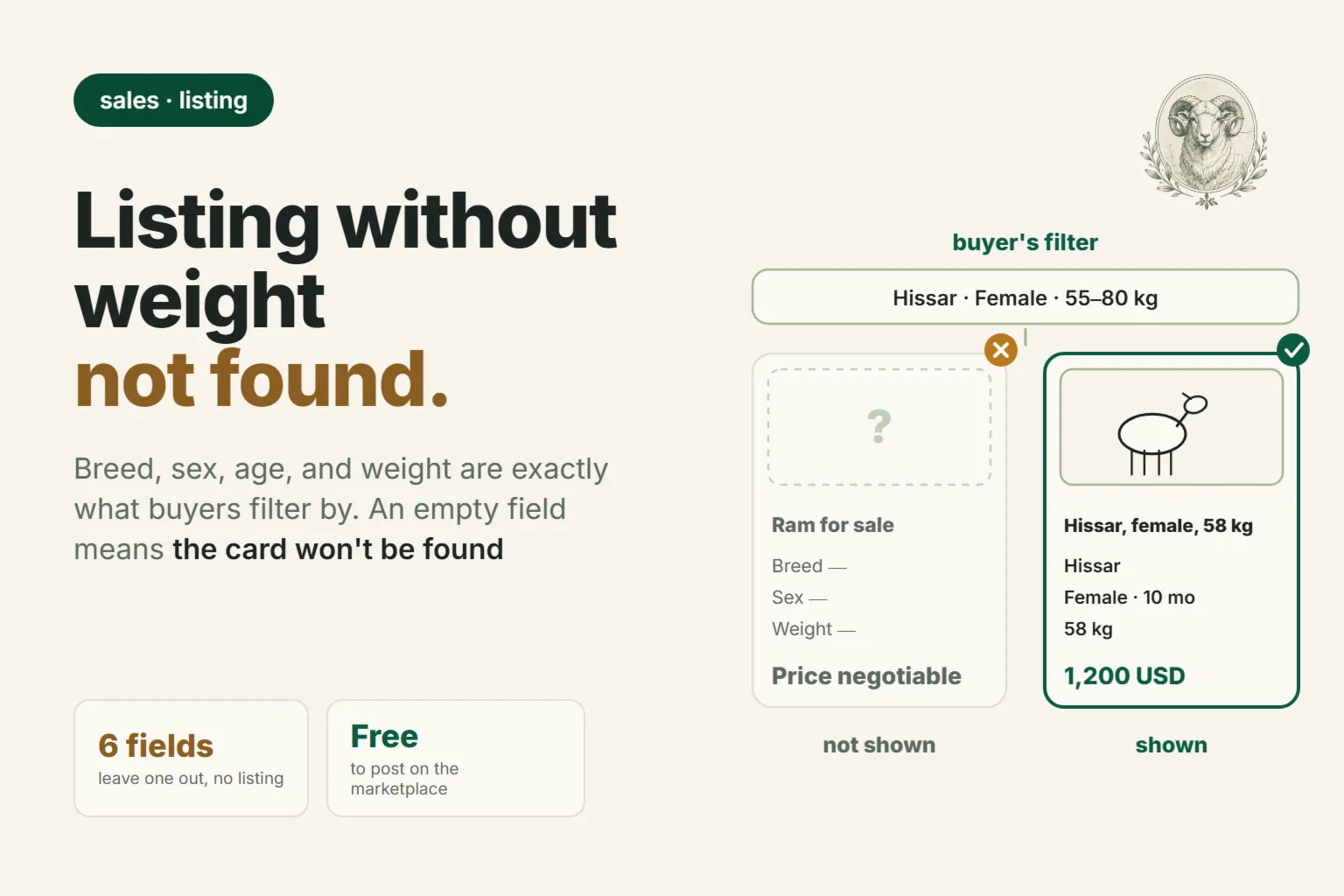
To sell a ram through a listing, six things need to be filled in on the card: breed, sex, age in months, live weight in kilograms, price, and location — district and region. Without weight and breed, the listing usually won't show up at all: a buyer doesn't scroll the feed top to bottom, they set filters and look only at the cards that match. Everything else — photos, description, and how fast you reply — decides whether they message you or the next listing over.
Live weight is the animal's weight on the scale before slaughter, as opposed to dressed weight — the weight of the cooled carcass. Listings for sheep and rams in Uzbekistan price by live weight, and buyers search by it too.
Below is a field-by-field breakdown, an honest comparison of the platforms where you can post it, and a short checklist before you publish.
Why doesn't anyone find a listing without weight and breed?
Because a livestock marketplace runs on filters, not text. A buyer opens it on their phone, sets breed, sex, and a weight range — and gets a short list of matching cards. A listing with an empty field never makes that list: there's nothing for the system to compare against the filter.
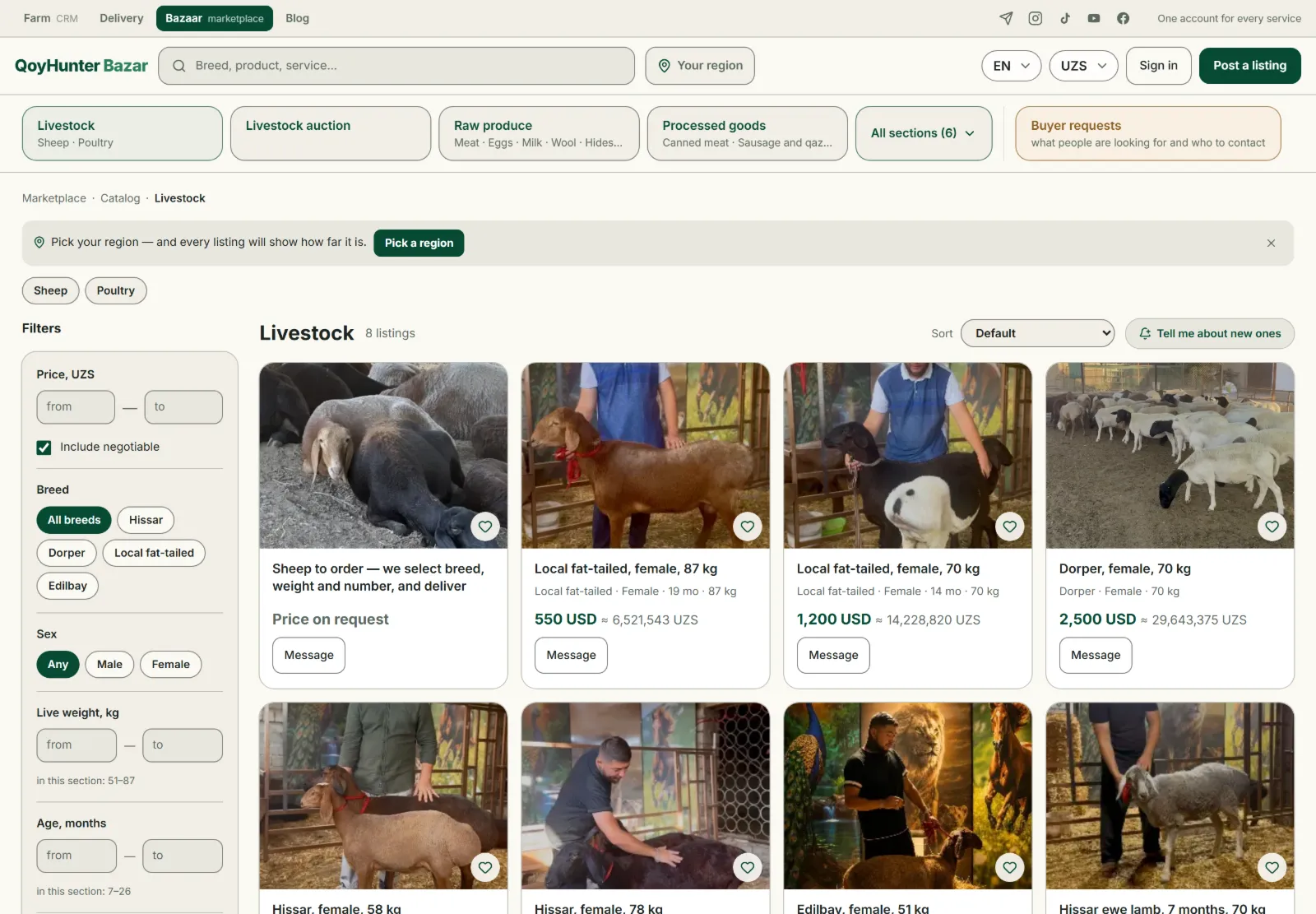
Here's how a buyer uses each field — based on the Sheep section of our marketplace as it looked on August 18, 2026:
| Field | How the buyer uses it | What happens if you leave it blank |
|---|---|---|
| Breed | Filter: Hissar, Dorper, Local fat-tailed, Edilbay | The card drops out of breed search results — the ones viewed most often |
| Sex | "Male / Female" filter | Missed by buyers looking for ewe lambs for breeding or ram lambs for fattening |
| Live weight, kg | "From–to" range plus "Heaviest first / Lightest first" sorting | The listing doesn't turn up in any weight-based search |
| Age, months | Range plus "Youngest first / Oldest first" sorting | Won't be picked up for either fattening or breeding |
| Price | Range plus "Cheapest first / Most expensive first" sorting | Filtered out if the buyer unchecks "Include negotiable" |
| Vaccination and vet certificate | Separate filters: "Vaccinated only" and "Only with a vet certificate checked by us" | Won't reach buyers who only take animals with paperwork |
| Region | The distance to the buyer is shown next to the listing | The buyer can't tell if it's a one-hour drive or a five-hour one |
You can check this right on the marketplace: on August 18, 2026, the live-weight filter in the section offered a range of 51–87 kg, and the age filter, 7–26 months. Those aren't arbitrary limits — they're the weight and age of what's actually listed. So a 62 kg, 9-month-old ram with blank fields falls outside both ranges, even though it fits comfortably inside each one.
What should the headline of a ram listing say?
The headline follows a formula: breed + sex + live weight, then optionally age and purpose. These are exactly the words a buyer searches with, and exactly what they see in the list without opening the card.
| Weak headline | Why it's weak | Strong headline |
|---|---|---|
| "Ram for sale" | No breed, no weight — nothing to compare against neighboring cards | "Hissar, female, 58 kg" |
| "Urgent! Cheap!" | Words like "urgent" read as a problem with the animal | "Edilbay, female, 51 kg" |
| "Rams for fattening, call me" | A phone number in the headline doesn't help you get found — it rushes people to skip the card | "Hissar ewe lamb, 7 months, 70 kg — for breeding or fattening" |
The three strong headlines on the right are real listings from the marketplace. None of them use adjectives like "excellent" or "elite" — everyone writes those, and they don't make your card stand out from any other.
A word about breed specifically. It's the first thing buyers narrow their search by, and there are dedicated pages for it too: a buyer who wants a Hissar specifically would rather open Hissar sheep listings than scroll through the whole marketplace. Write "local mix" instead of "Local fat-tailed" as the breed, and you simply won't show up on that page.
What price should you set, and is it worth writing "negotiable"?
Price isn't set per head — it's calculated from live weight in kilograms. In the summer of 2026, meat rams in Uzbekistan go for roughly 55,000–65,000 UZS per kilogram (≈4.6–5.4 \(at an exchange rate around 12,000 UZS to the dollar) — see the channel-by-channel breakdown with calculations in [where to sell a ram in Uzbekistan](https://blog.qoyhunter.com/en/p/bazar-sell-sheep). For a 75 kg ram, that's 4.1–4.9 mln UZS (≈345–405\)). If you price above that range, explain why in the description: breeding pedigree, weight gain, paperwork.
"Price negotiable" isn't a free option — it comes with a cost of its own. The price filter has a separate checkbox, "Include negotiable"; a buyer who sets a price range can uncheck it, and every listing without a number disappears from their results at once. On top of that, the "Cheapest first" and "Most expensive first" sorts simply can't rank a listing like that.
Negotiable pricing makes sense in exactly one case: when you're not selling one animal but putting together a custom order — a batch of different breeds and weights. For a single ram, a real number works better almost every time.
You don't need to convert currencies by hand: the price shows in whatever currency the buyer picked, with the conversion right next to it — for example, "550 USD ≈ 6,521,543 UZS."
How many photos do you need, and what should they show?
A buyer can't walk up and check the animal by hand, so photos are their inspection. A reasonable minimum is 4–6 shots, and they should answer the questions you'd get asked in chat anyway:
- full-length side view, the animal standing on level ground, entirely in frame;
- from behind — the fat tail and hind-leg stance;
- head-on — this is how buyers judge breed type and age;
- hooves and legs up close — the first thing checked before a purchase;
- the scale with the number showing, if you weighed the animal;
- one wide shot of the flock — it shows what kind of hands the animal grew up in.
What doesn't work: collages with pictures pulled off the internet, shots through the pen fencing, night photos with flash, and "animal somewhere in the flock" pictures. A short video of the ram walking answers half the questions at once — there's room for it on the card.
What should the listing description say?
The description isn't there to sound nice — it's there so buyers arrive with their mind already made up. A structure that works is five lines:
- what the animal is and what condition it's in;
- what it was fed and how it was kept;
- paperwork: vaccinations, vet certificate;
- where to view it — district and region;
- how to take it away: pickup, delivery, help with loading.
Here's how it looks in a real listing from the marketplace: "Hissar ewe lamb, age 7 months, live weight 70 kg. Vaccinated, growing steadily, eating well — bought both for breeding and for fattening ahead of Qurban Hayit. You can view her on-site in the Tashkent region (Yangiyul); by arrangement we'll issue a vet certificate and deliver with our own livestock truck around Tashkent and the region." Five sentences cover almost everything you'd be asked in chat.
What shouldn't be in the description: "great ram, call me" without a single number; "I'll give the price in DMs" — a line like that is exactly why nobody messages you; and text copied from someone else's listing, weight included.
Vet certificates and vaccinations: what do they do for a listing?
Two things show up in the filters: "Vaccinated only" and "Only with a vet certificate checked by us." A buyer taking animals for breeding, or moving them to another region, usually turns these on right away — and the whole results list shrinks down to listings with paperwork.
There's a catch that trips people up: attaching the certificate to the listing isn't enough — you need to submit it for the platform to check, or the listing won't show up in that results list. And the certificate doesn't carry over automatically from the animal's record in your herd management — that's a separate step.
Where to post the listing: the mahalla, Telegram, classifieds, and a dedicated marketplace
A listing isn't a channel by itself. It lives wherever you put it, and every place has its own cost.
| Where | What it takes from you | What you pay with | Who it suits |
|---|---|---|---|
| Neighbors and the mahalla | Nothing but your reputation | A channel that never grows | Two or three head a year, to people you've known a long time |
| A weekend livestock bazaar | Going in person, getting up before dawn | The trip, your whole day, and weight lost in transit | A batch of animals, when the trip is cheap |
| Telegram groups | Reposting every day | Your time: a listing sinks within an hour or two | A quick sell-off, if you stay active in the group |
| General classifieds sites | Writing the text yourself | The fact that buyers search there by words, not by weight and breed filters | A one-off sale, if you're good at writing copy |
| A dedicated livestock marketplace | Filling in the fields once | Audience size: smaller than a general classifieds site | People who sell regularly and don't want to post every day |
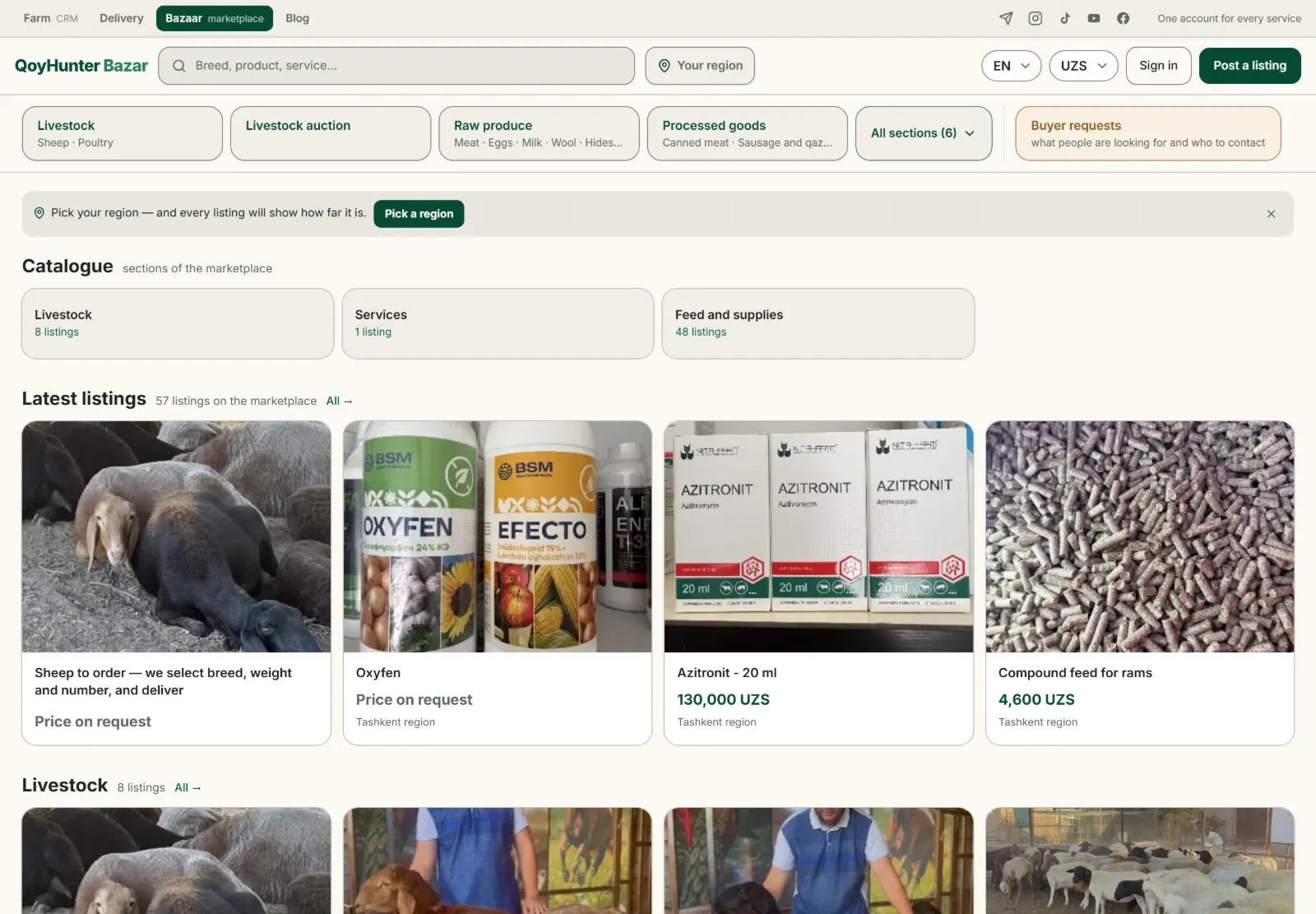
Let's be honest about the marketplace's size: as of August 18, 2026, it had 57 listings — 8 in the Livestock section, 48 in feed and equipment, and one in services. There isn't yet the kind of buyer traffic you'd get at a weekend bazaar, and promising that would be a lie. The strength lies elsewhere: posting is free, the listing stays up without any effort from you while you're busy with the flock, the buyer messages the owner directly with no middleman, and the fields and filters are built for livestock, not furniture. See what's listed and at what price right now in sheep and rams for sale in Uzbekistan.
This is a good place to say who we are: QoyHunter is a CRM for sheep record-keeping and the marketplace at bazar.qoyhunter.com.
How much does it cost to post a listing, and how do you post one from your phone?
Posting is free. You can post a listing straight from your phone through @qoyhunter_bot: photo, weight, breed — and the card is live on the marketplace. If your farm already keeps records, an animal goes up for sale straight from its record card, and breed, sex, age, and weight are filled in automatically from that same record — no need to retype them by hand.
What selling from your records looks like step by step — a fresh weighing before listing, the three form fields, the seller cabinet, and marking the sale so the listing closes itself — is covered in how to sell a ram online straight from your farm records.
A single listing is shown in three languages — Russian, Uzbek, and English — so you don't need to write three separate versions yourself.
How should you reply to messages so the deal doesn't fall through?
Reply the same day. Buyers message three or four sellers at once, and whoever answers first usually makes the sale.
Quote weight from the scale, not by eye. An experienced buyer often estimates more accurately than the owner, and the error rarely works in your favor; if you don't have a scale, measure with a tape — see how to estimate a ram's weight without a scale. A mismatch between the listed weight and the weight on-site is one of the main reasons deals fall through.
Remember, the platform isn't a party to the deal: payment and delivery are worked out directly with the buyer, off the marketplace. That means weighing the animal in front of the buyer and letting them inspect it on your farm are on you. If the buyer is from another region and has no vehicle, a livestock truck with loading around Tashkent and the region can help move the animal.
Checklist before you publish
- breed is written using the reference name, not "local mix";
- sex is specified;
- live weight in kilograms — from a scale or a tape measurement;
- age in months, not "young";
- price as a number; "negotiable" only for putting together a batch order;
- 4–6 photos: side, rear, head, hooves, scale, flock;
- description has five lines: condition, feeding, paperwork, district, pickup;
- region is set — the buyer can see the distance;
- vet certificate submitted for review, if you have one;
- phone within reach: you need to reply the same day.
FAQ
How much does it cost to post a ram listing?
Posting on the QoyHunter marketplace is free — for your first listing and your tenth. The platform doesn't take a commission on the sale either: payment is worked out directly between you and the buyer, off the site.
What should I put for price if I don't want to state a number upfront?
You can set it to "negotiable," but keep in mind: a buyer who sets a price range can turn off listings like that, and you'll disappear from their results. Price-based sorting won't rank a listing like that either. Negotiable pricing makes sense when you're not selling a single animal but putting together a batch order.
Do I need a vet certificate to list a ram for sale?
Not just to post a listing, no. But the marketplace has "Vaccinated only" and "Only with a vet certificate checked by us" filters, and buyers moving animals to another region often use them. If you have a certificate, submit it for the platform to check: until it's verified, your listing won't show up in that results list.
How many photos does a sheep listing need?
A reasonable minimum is 4–6: the animal full-length from the side, from behind (fat tail and leg stance), head-on, and hooves up close. If you weighed it, add a shot of the scale with the number showing. Skip collages and pictures pulled from the internet — they raise suspicion, not interest.
How fast does a ram sell through a listing?
Nobody can give you a timeline, and promising one would be dishonest: speed depends on price, season, and how completely the card is filled in. Demand spikes several times over ahead of Qurban Hayit and drops in winter. One thing is certain: a listing without weight, breed, and price doesn't sell at all, because it simply doesn't show up in filtered results.
Manage your flock in QoyHunterCRM for sheep farmers: livestock, health, weighing, finance and analytics — in the app and a Telegram bot.All features →