Who to Sell Rams in Bulk to in Uzbekistan in 2026: Wholesale Buyer, Slaughterhouse, Toʻyxonas, or a Direct Buyer
Wholesale channels for selling a batch of rams: the wholesale buyer at the gate, the slaughterhouse, the toʻyxona, another farmer, and a listing. We run the math on a 30-head batch — what the wholesale discount actually costs, and why you should be looking for a buyer ahead of time.
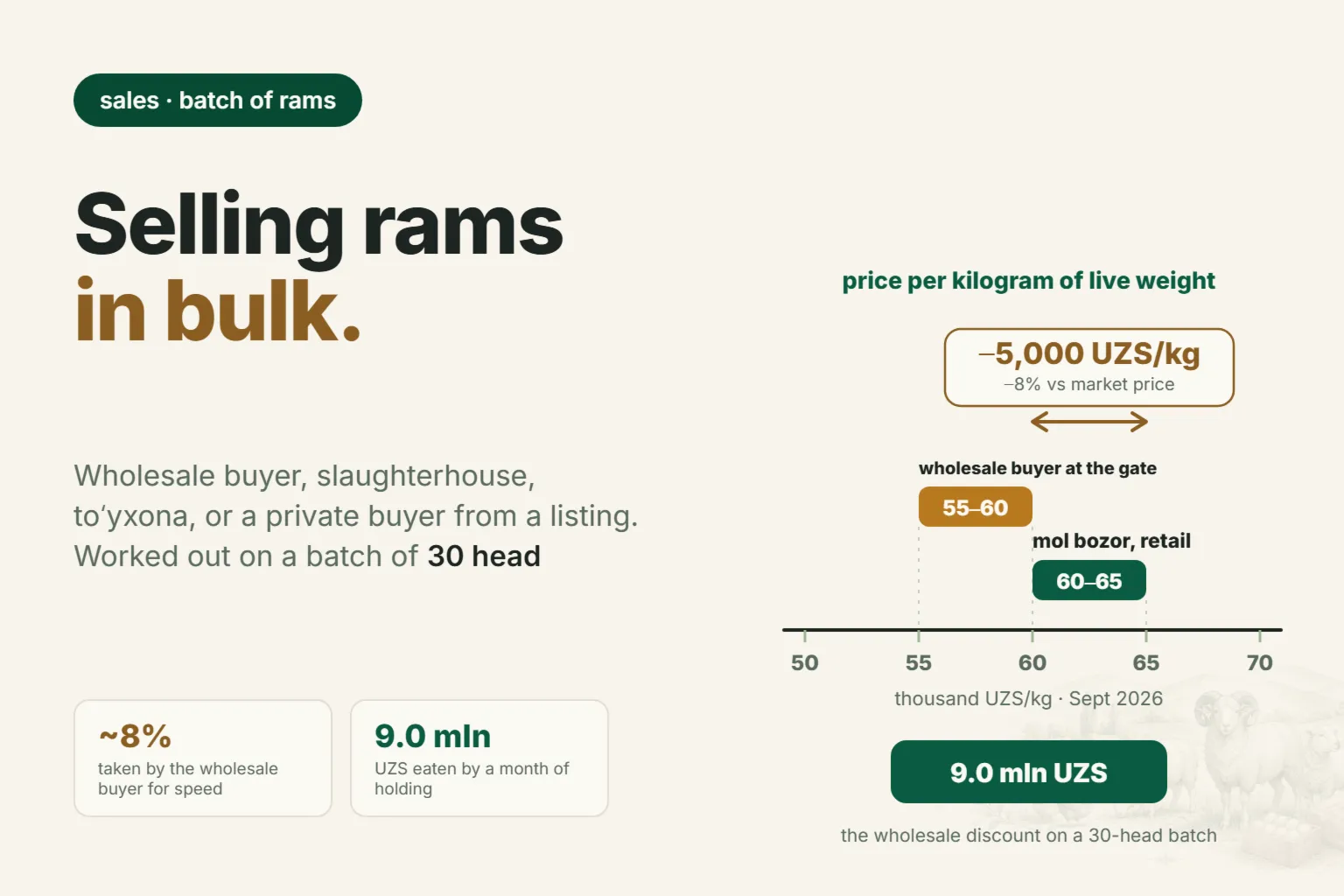
Who buys rams in bulk in Uzbekistan in 2026 comes down not to price, but to timing. A batch of twenty head or more is realistically bought by five kinds of buyers: a wholesale buyer at the gate, a slaughterhouse, a toʻyxona or choyxona, another farmer looking to grow the animals on, and a private buyer through a listing. The wholesale buyer pays fastest and takes about 8% of the price for it — roughly 5,000 UZS (≈$0.42) off every kilogram of live weight. The rest pay more, but you have to find them in advance: on a batch of 30 head, a month of waiting eats up exactly as much as the entire wholesale discount.
In sheep farming, wholesale usually means a batch of 20 head or more that a buyer takes in a single deal and a single pickup.
All figures below are for September 2026, based on the live-weight price range of 55,000–65,000 UZS per kilogram, which has held in Uzbekistan since summer. The exchange rate used for conversion is 11,840 UZS per dollar (the official rate of the Central Bank of Uzbekistan on September 19, 2026).
Why does a batch of rams sell for less per head than a single ram?
A wholesale buyer isn't paying for the animals — he's paying to skip the hassle: he takes everything at once, in one haul, and from then on carries the risk of unsold stock himself. The discount for that in Uzbekistan is roughly the same as for selling a single head to a middleman at the gate — about 5,000 UZS per kilogram of live weight, or 8% off the market price.
There's a second loss that rarely gets counted. A wholesale buyer looks at the whole batch and prices it by its weakest part: if the weight across thirty head swings from 45 to 80 kg, he'll quote the per-kilogram price at the low end. An even batch — 30 rams in the 55–65 kg range — trades higher than the same batch in a jumble: the wholesaler doesn't have to price in the weak animals he'll later have to place himself.
Who buys rams in bulk: five kinds of buyers
The wholesale buyer at the gate
He comes to you, takes the whole batch, and pays cash on the day of the deal. No road, no shrinkage, no risk of hauling the animals back. The price is 55,000–60,000 UZS per kilogram of live weight (≈$4.6–5.1), more often toward the lower end in autumn: after summer, the market is full of livestock.
For a farm that needs money now, this is a normal working channel, and there's nothing to be ashamed of. The main loss here isn't the percentage — it's selling "by eye": the wholesale buyer estimates weight more accurately than the owner does, and the error is rarely in your favor. Weigh the batch before he arrives — for how to work by weight, see where to sell a ram in Uzbekistan.
The slaughterhouse and processor
Wholesale meat goes 8–12% below the bazaar retail price: at a retail price of about 120,000 UZS per kilogram, that works out to roughly 110,000 UZS.
The math for a 60 kg ram with a 52% dressing percentage: 31.2 kg of meat × 110,000 = 3.43 mln UZS (≈$290). The same ram sold live at 60,000 UZS per kilogram comes to 3.6 mln UZS (≈$304). Selling live pays more, and that's before the cost of slaughter and cutting; the hide, offal, and fat tail don't close the gap. For the full breakdown, see dressing percentage in rams.
The takeaway is simple: a slaughterhouse makes sense when you're selling the meat yourself, at retail, not handing over the carcass wholesale.
Toʻyxonas, choyxonas, and restaurants
A toʻyxona is a wedding hall that buys rams for every feast it caters. Buyers like this take small batches of 2–10 head regularly and pay closer to the top of the range: they care about consistency more than about haggling. Demand picks up in autumn, with the wedding and toʻy season, and rises again in spring towards Qurban Hayit — in 2027 it's expected around May 16–17.
This is the best-paying channel and the most demanding when it comes to discipline: it needs the same weight, the same body condition every time, and a call a week ahead — not "showed up with whatever I had."
Another farmer: for growing on or breeding
Young stock at 30–45 kg, ewe lambs, and breeding rams go not to slaughter but to another farm. The price per kilogram is lower than the meat price, but the buyer takes the whole age group at once and isn't tied to a holiday: feedlots are stocked year-round.
This channel needs numbers for every animal — age, weight, weight gain, parentage. A farm with records sells young stock for more than a farm with the same flock but no records.
A private buyer through a listing
He comes to you and pays with no middleman, so the price here is yours to set, not the wholesale buyer's. The cost is time: answering calls, showing the animals, and waiting.
What a month spent waiting for a buyer costs: the math on a 30-head batch
Take a batch of 30 rams at 60 kg each — 1,800 kg of live weight.
| Sale option | Calculation | Revenue |
|---|---|---|
| Wholesale buyer picks up at the yard | 1,800 kg × 60,000 UZS | 108.0 mln UZS (≈$9,122) |
| Mol bozor (livestock market), retail, with 3% shrinkage | 1,746 kg × 65,000 UZS | 113.49 mln UZS (≈$9,585) |
| Difference in favor of the market | 5.49 mln UZS (≈$464) |
The mol bozor is a livestock market where animals are sold by hand, haggled over per head; each district has its own market day, usually a weekend. A batch of 30 head doesn't normally sell in one morning there: it takes two to four trips, and each trip means its own road and its own shrinkage. An animal doesn't eat or drink in transit and weighs in lighter on the scale: for a trip under six hours, the loss runs 1–4% of live weight, according to the University of Wyoming Extension.
On paper, the gap between the bazaar and the farm gate looks bigger: 5,000 UZS per kilogram, which is 9.0 mln UZS (≈$760) across the whole batch. But a 3% shrink takes 54 kg of live weight — that's 3.51 mln UZS — and of those nine million, five and a half are what actually reach your pocket. And that's before fuel, a hired truck, and your own market days.
Now the cost of waiting. Holding the batch an extra month while you look for a better-paying buyer costs feed:
| Group | Daily feed cost | 30 head for a month |
|---|---|---|
| Young stock on a winter holding ration | 4,920 UZS | 4.43 mln UZS (≈$374) |
| Finished feedlot stock on a finishing ration | 8,900 UZS | 8.01 mln UZS (≈$677) |
The bottom row is costed at July feed prices; on winter hay, the same ration runs about 10,000 UZS a day, which is 9.0 mln UZS a month for a batch of 30 head.
Here's the main takeaway you can't see without doing the math: a month of holding the batch costs exactly as much as the entire wholesaler's discount. Waiting for a better-paying buyer only makes sense when you know he's coming — not on the hope that somebody will call.
Worse, past the point where a ram is ready to come off feed, weight gain turns into a loss: at the finishing stage, a kilogram of gain costs around 64,000 UZS, while a kilogram of live weight sells for 55,000–65,000. Every extra month of holding a ram heavier than 60 kg turns into a net loss of 35–40 thousand UZS per head — the gain no longer covers what the animal eats. For the full math, see the cost of weight gain in rams.
How to line up a wholesale buyer before the batch is ready
Which gives you the rule: look for a buyer for the batch a month to a month and a half before the sale date, while the rams are still putting on weight — not on the day they've reached it. That way you don't need the discount for speed — you're already on schedule.
There are three ways to do this, and they're not mutually exclusive.
Regular buyers. A toʻyxona, a choyxona, a neighboring feedlot — you find them once and keep the contact for years. A call in August saying "there'll be thirty head at 60 kg in October" works better than a call in October saying "come get them, urgent."
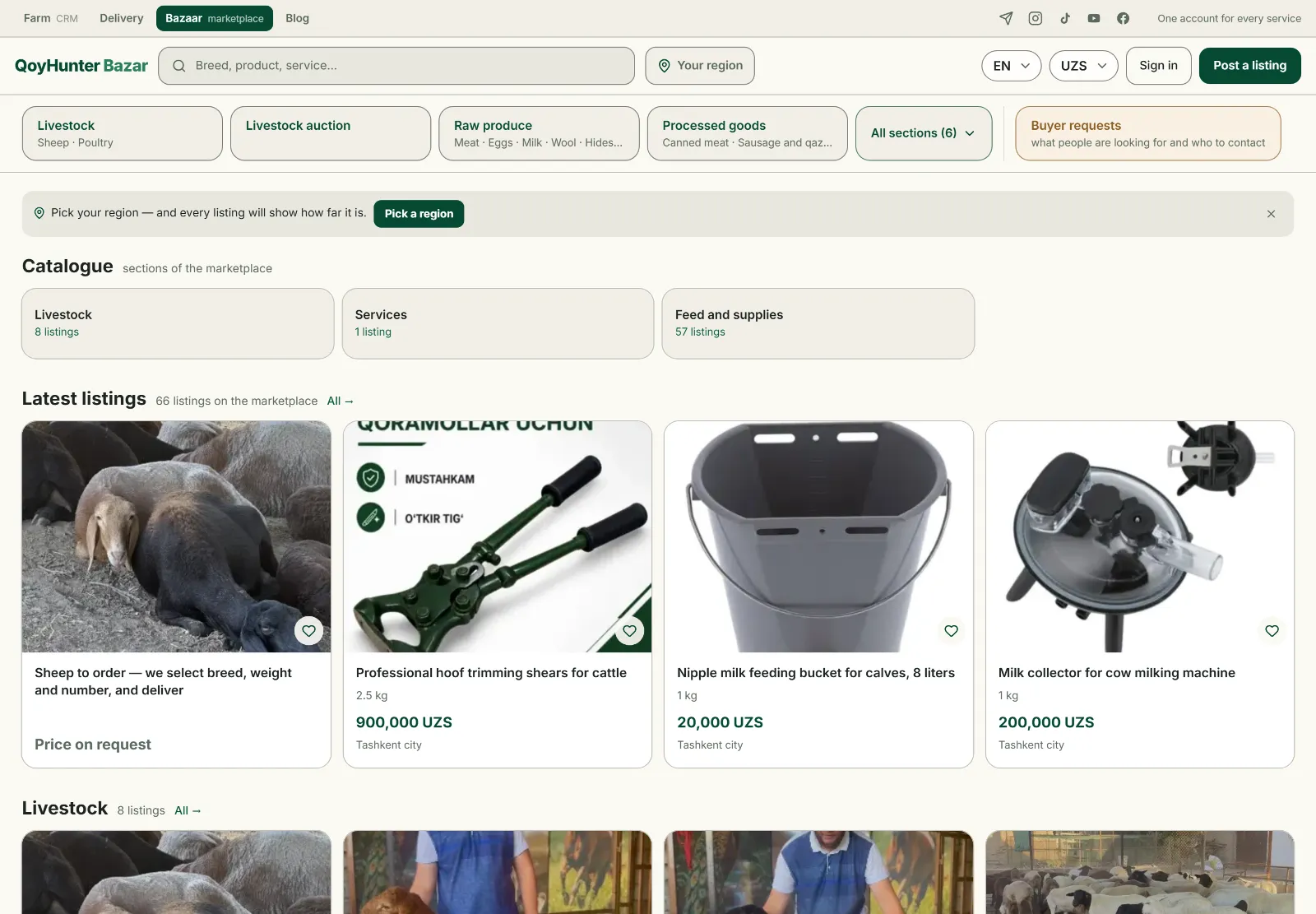
A listing ahead of time. You can put the batch up a month before it's ready, stating the date: "thirty head, 55–65 kg, available in October." The listing goes through moderation and then onto the marketplace; posting is free, and the inquiry reaches the owner directly, with no middleman. You can see what live listings look like in sheep and rams for sale in Uzbekistan.
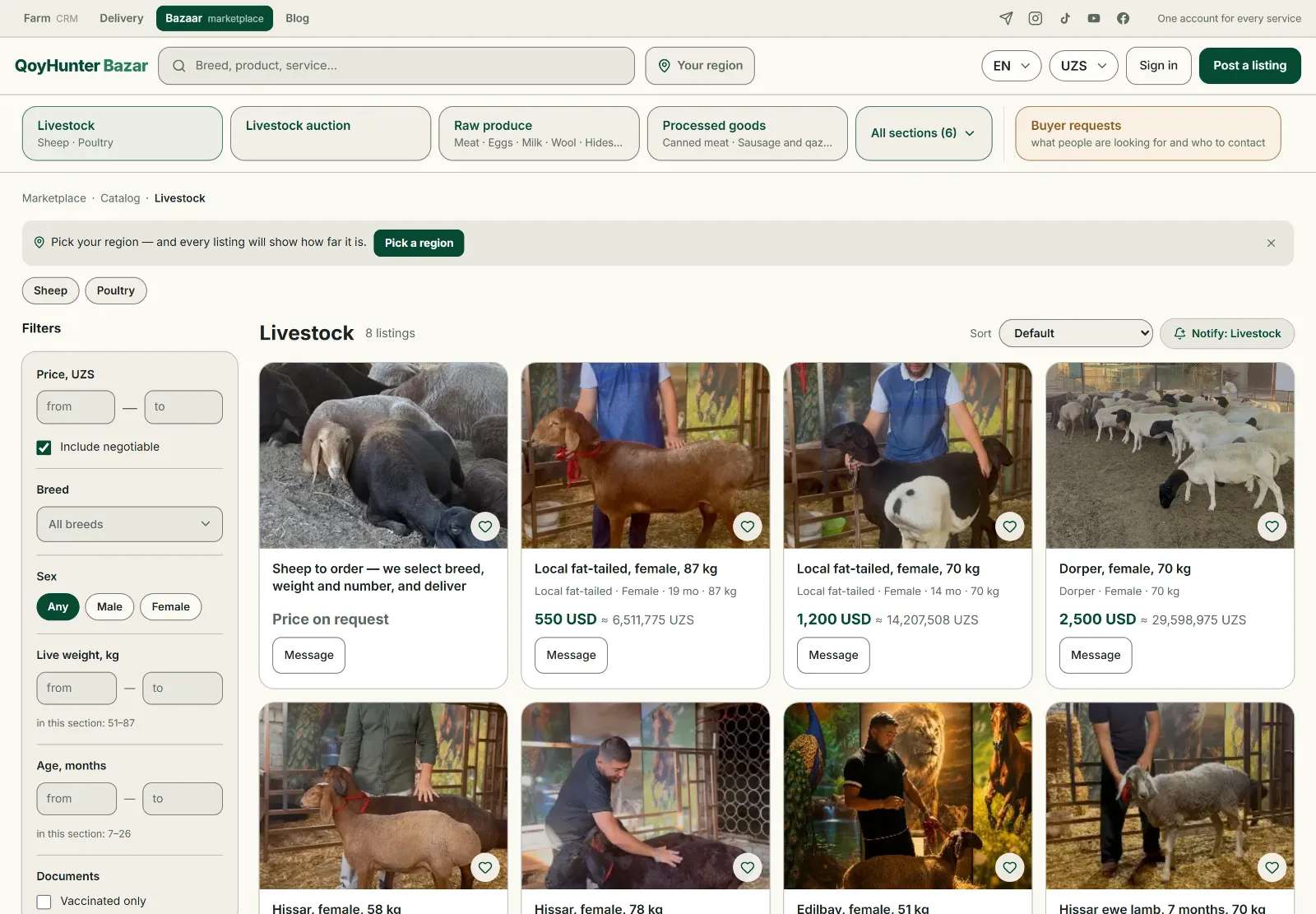
Reverse search. The marketplace has a section where the buyer describes what he's looking for and sellers respond with a price. For a batch, the convenient part is that you answer demand that already exists instead of hunting for it. The section is young — as of September 21, 2026, it holds a single request, and that one is for feed — but any seller can respond to a new one, with no fee and no queue: buyer requests.
This is a good place to say who's writing this: QoyHunter is a CRM for sheep record-keeping and a marketplace at bazar.qoyhunter.com. We run our own flock, and we count by the same prices you do.
What to ask a wholesale buyer before the deal
Five questions that head off almost every dispute at loading time:
- Whose weight are we using — your scale or his estimate, and where do you weigh: at your yard or after unloading.
- Whose transport, and who pays for the road. A livestock truck with loading takes 30–80 head per trip: expensive per trip, cheap per head. In Tashkent and the region, you can book one through livestock truck with loading.
- When you get paid — on loading day, cash or bank transfer, whether there's a deposit on the batch.
- Taking everything or picking and choosing. "I'll take the better ones" on a wholesale deal means the weaker half stays with you, while you've already agreed on a price for the whole batch.
- Paperwork. The buyer needs a veterinary certificate for transport and ear tags, and it's the seller who's answerable for them: for breaching veterinary rules, Article 109 of the Code of Administrative Liability sets a fine of 1–3 base calculation units for a private person and 3–5 for an official. As of September 1, 2026, the base calculation unit is 440,000 UZS, so for an owner that means 440,000–1,320,000 UZS (≈$37–111).
What decides which channel to pick
| Channel | Price per kg live weight | When you get paid | What you pay for speed |
|---|---|---|---|
| Wholesale buyer at the gate | 55,000–60,000 UZS | on the day of the deal | ~8% of the price, best animals picked out |
| Mol bozor, retail | up to 65,000 UZS | over 2–4 market days | the road, 1–4% shrinkage per trip, your time |
| Slaughterhouse | priced off the meat, wholesale 8–12% below retail | by agreement | slaughter, cutting, paperwork |
| Toʻyxona and choyxona | top of the price range | on delivery | even weight and calling ahead |
| Farmer growing stock on | below meat price | by agreement | records needed for every animal |
| Listing and requests | your price | whenever a buyer turns up | time spent answering and showing |
If you need the money this week, the wholesale buyer is more honest than any alternative: for 8%, he takes the road, the shrinkage, and the risk off your hands. If you've got a month to a month and a half before the deadline, that same 8% stays in your pocket, and it's worth looking for a buyer yourself. Whether it pays more to sell in autumn or hold until spring is covered separately in selling a ram in autumn or holding until spring.
FAQ
How many head counts as wholesale when selling rams?
Wholesale usually means a batch of 20 head or more that a buyer takes in a single deal and hauls away in one trip. From about 10 head on, it's already worth negotiating a price per kilogram instead of a price per head, but a wholesale buyer asks for the full discount specifically on larger batches.
Who will take the whole batch at once and pay the same day?
A wholesale buyer who comes to your yard. As of September 2026, he pays 55,000–60,000 UZS per kilogram of live weight, which is 8–15% below the mol bozor price, depending on the condition of the batch. That gap is what you pay for speed: he takes everything, weak animals included, and hauls them onward himself.
How much does it cost to list rams for sale?
Listing on the QoyHunter marketplace is free, and there's no sales commission. The platform isn't a party to the deal and doesn't handle payments: the buyer's inquiry goes straight to the owner, and you agree on price and pickup between yourselves.
Do you need paperwork for rams in a wholesale sale?
Yes. The animals have to be identified: under law ZRU-1079, sheep are subject to identification and registration from the 14th day of life, and it has to be completed no later than a month after that point. Transport requires a veterinary certificate. For breaching veterinary rules, a private person faces a fine of 1–3 base calculation units (Article 109 of the Code of Administrative Liability); at a base unit of 440,000 UZS, that's 440,000–1,320,000 UZS.
When should you start looking for a buyer for a batch of rams?
A month to six weeks before the batch reaches weight. A month of holding 30 head costs 4.4–9.0 mln UZS in feed — the same as the entire wholesale discount on that batch — so a buyer lined up in advance pays for himself in full.
Manage your flock in QoyHunterCRM for sheep farmers: livestock, health, weighing, finance and analytics — in the app and a Telegram bot.All features →