
Online ram auctions in Uzbekistan: when bidding beats the weekend market
How online ram auctions work in Uzbekistan — starting price, bid step, auction extensions and what to do after you win. A look at which animals earn a price premium at auction, and when a meat ram sells for the same price per kilogram as at the mol bozor. Figures as of September 2026.
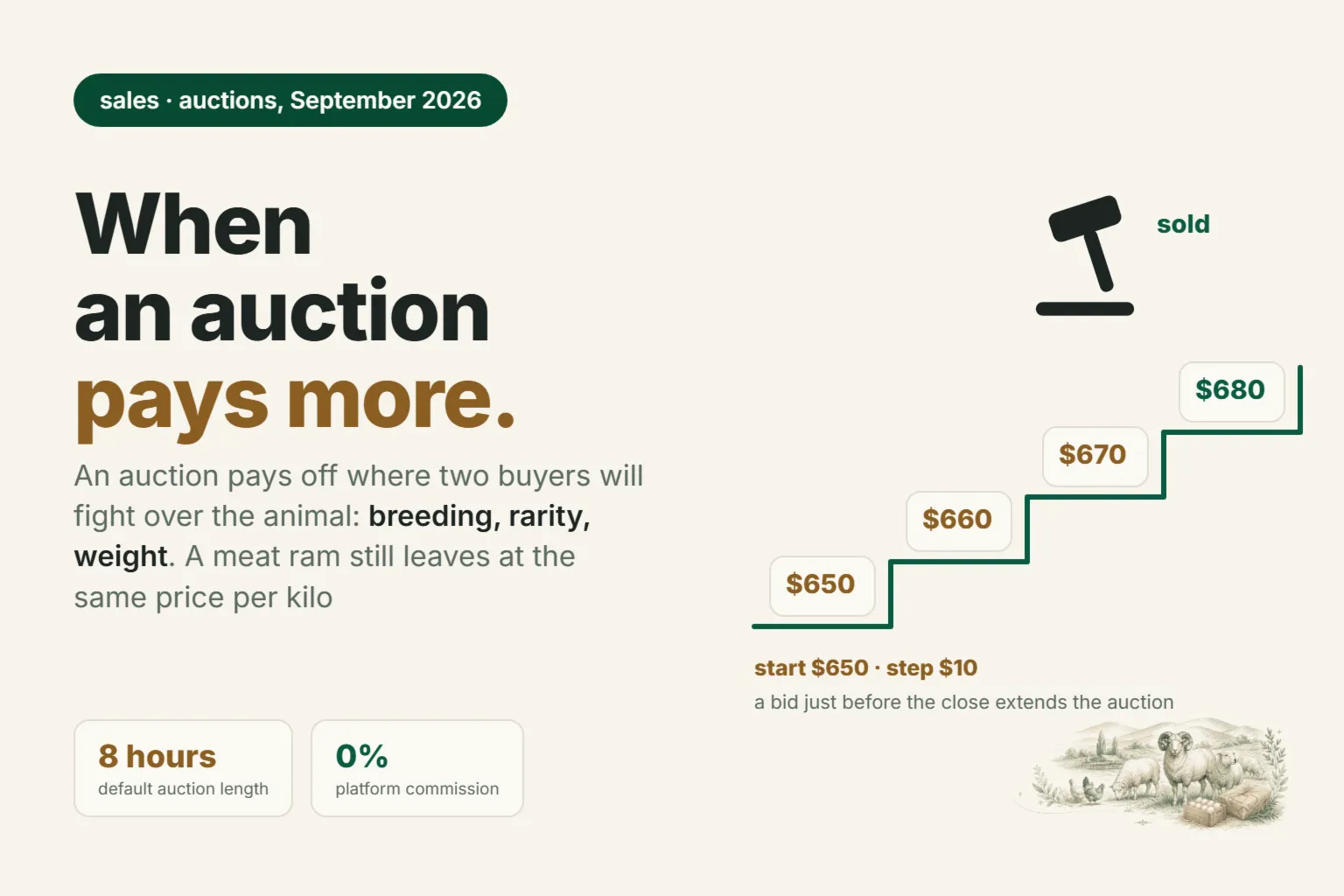
Online ram auctions in Uzbekistan beat the weekend market in exactly one case: when an animal's price is set by buyer competition, not by live weight. That's a breeding ram, a large fat-tailed ram, a rare breed. For an ordinary meat ram, bidding adds no premium — its price still comes down to the same rate per kilogram of live weight as at the mol bozor.
Below is how online bidding works under the rules, what counts under each point, and when it's worth the effort. Figures are as of 4 September 2026; the Central Bank of Uzbekistan's rate on that date was 11,795 soum per dollar, and I round to 12,000 in the calculations.
What is an online ram auction, and how is it different from the market?
An online ram auction is bidding on a single animal over a set time window: the seller announces a starting price and a bid step, buyers push the price up until the window closes, and the lot goes to whoever's bid was the last one accepted. The animal doesn't go anywhere — it stays in its own pen until the bidding ends.
The difference from a mol bozor (the weekend livestock market) isn't the internet — it's who's talking to whom. At a mol bozor, you haggle with one buyer at a time, and they don't know what the previous one offered. At an auction, every buyer sees the current price and bids against each other — what does the work isn't your haggling skill, but their competition.
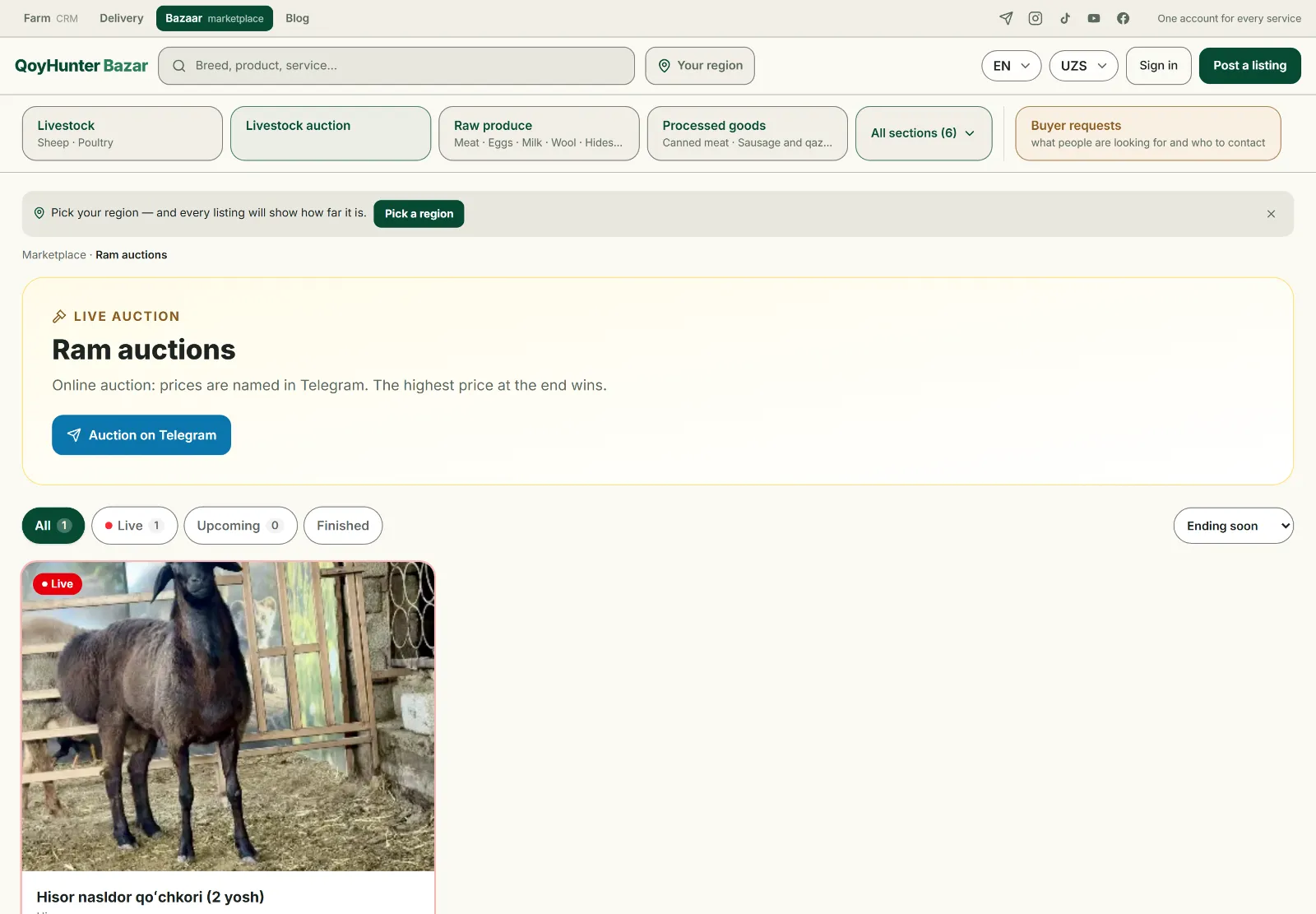
We're QoyHunter, a flock-management CRM and the bazar.qoyhunter.com marketplace; auctions live in the bidding section of the marketplace and in the auction's Telegram channel. You can name a price three equivalent ways: the button on the lot page, through the Telegram bot, or as a comment in the discussion group under the lot's post — just typing the number is enough.
When does an auction beat the weekend market?
The rule in one line: an auction pays off where two or more buyers might want the same animal. If the animal is interchangeable — meaning the buyer doesn't care whether it's your ram or your neighbour's of the same weight — nobody will bid against anyone else, and the price will stop at the first bid.
| What you're selling | What sets the price | Where it pays better |
|---|---|---|
| A meat ram, 70–80 kg, standard condition | live weight × price per kilogram | a reseller, mol bozor, an ordinary listing |
| A batch of 10–30 head for meat | weight and volume, price drops for bulk | a direct deal with a butcher or a bulk buyer |
| A breeding ram | future offspring, not meat | an auction |
| A large fat-tailed ram of exceptional weight | how rare the animal is | an auction |
| A ram for Qurban Hayit or a toi | timing and looks | a listing 2–3 weeks before the date |
Let's work out a meat ram. In Uzbekistan, live weight is priced at 55,000–65,000 soum per kilogram: the low end is a sale right at your gate, the high end is the mol bozor on a good day. At 75 kg and a rate of 60,000 soum, that's 4,500,000 soum (≈$375) — you'd get roughly the same at auction, because the buyer works from the same formula. The real difference between sales channels for a meat ram isn't the method of sale, it's the travel and the weight lost on the way: how much you lose on each sales channel works through the weight loss in transit.
Now take a breeding lot. On 4 September 2026, one lot was live on the platform — a two-year-old Hissar breeding ram, starting price $650 (≈7.8 million soum), bid step $10. For comparison: an adult Hissar ram weighs 130–140 kg, and at the meat rate of 60,000 soum per kilogram, that's 7.8–8.4 million soum. In other words, the starting price is set at the level of the meat price, not above it: the premium for breeding value has to come from the bidding itself, not from the starting figure. How to work out whether an animal like this pays off is covered separately in how to choose a breeding ram.
To see what's happening right now, check the live ram auctions page.
How long does bidding last, and how are the starting price and bid step set?
The mechanics of bidding on the platform are set out in the auction rules (version 1.0). The essentials are in the table below.
| Parameter | How it works |
|---|---|
| Starting price | Also the minimum sale price. There's no reserve price: the first accepted bid at the starting price sells the lot, if nobody's bid higher |
| Bid step | Set by the seller when submitting the lot, along with the starting price and currency; the platform can adjust the step if it makes bidding impossible or pointless — for example, if it's out of proportion to the starting price |
| Duration | 8 hours by default. Can be different, but no shorter than 10 minutes and no longer than 30 days; the platform sets the time when it approves the lot |
| Lot currency | Soum, US dollar, Russian rouble, euro, tenge. Bids are only accepted in the lot's currency; the converted figure shown in the interface is for reference only |
| Extension (anti-snipe) | A bid placed within the extension window before closing pushes back the closing time; the platform sets the length of the window. There's no limit on the number of extensions |
| Platform commission | None. There are no payments on the platform: buyer and seller settle directly between themselves |
That table leads to the main piece of advice for sellers: the starting price is your floor, not bait. Setting it low "to get people bidding" is risky for exactly the reason there's no reserve price: one bid at the starting price, and the lot is sold for that amount. Set it at the lowest sum you'd actually accept.
The auction extension protects you as the seller. Without it, a buyer could name their price right before closing, and everyone else would simply run out of time to respond. With the extension, the closing time is counted from the moment of the last bid, and the lot sells at the price buyers actually reached.
What should you know before your first bid?
A bid at auction isn't an offer to negotiate — it's a commitment to buy at the price you named. Six things from the rules are worth remembering.
- You accept the rules before your first bid. On the website, that's a checkbox in the form — without it, your bid won't go through; in the bot and in comments, placing a bid itself counts as accepting the rules.
- You can't withdraw a bid. The price you named can't be cancelled or lowered. It only loses force if it's outbid, the auction is cancelled, the platform annuls the bid, or an administrator closes the lot.
- You can't outbid yourself. The current leader can't raise their own price until someone else outbids it.
- You can't raise the price above a set ceiling in one go — this guards against typos in the numbers. If a bid is rejected, the bot tells you the highest amount you can place right now.
- You need a phone number before your first bid. Without one, your bid won't be accepted — not through the bot, not on the website, not as a comment; bidding requires an Uzbek number (+998). Once bidding ends, the platform gives the seller the phone number and display name of whoever gets the right to buy — otherwise the seller has no one to contact.
- The leader's name is public. On the website it's shortened to something like "Az***", while in the auction's Telegram channel and discussion group it's published in full.
If the winner doesn't get in touch, the lot isn't lost: the right to buy passes to the next participant in the candidate queue, at their own price, not the winner's price. Non-performance counts as a default: two uncontested defaults in 12 months means a 90-day suspension from bidding, three or more means suspension until the case is reviewed. If the right to buy reaches you more than 72 hours after bidding closed, you can decline without consequences — by then, both the animal's condition and the price could have changed.
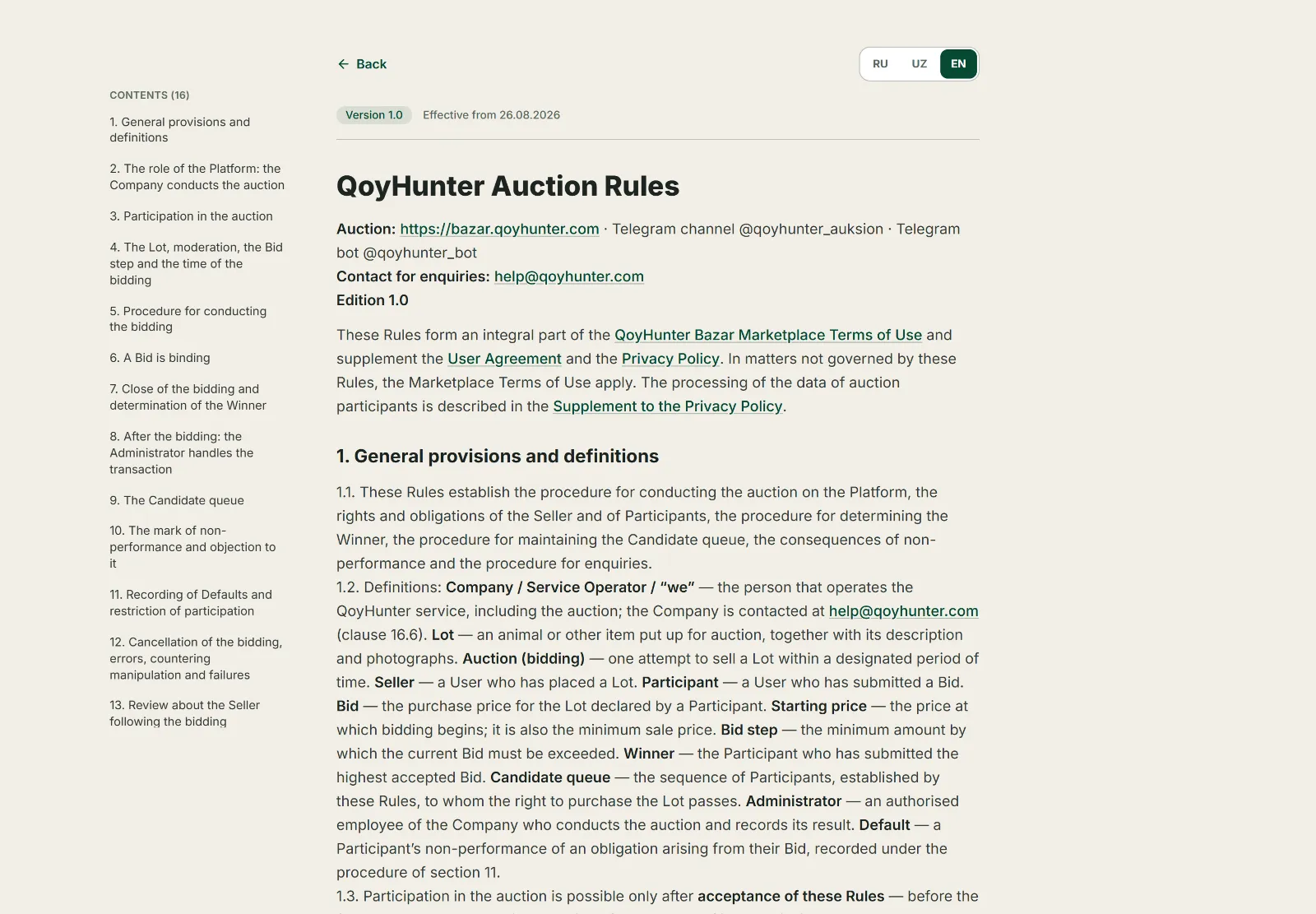
The full text is on the auction rules page — 16 sections, with a breakdown of disputed situations.
How do you put your ram up for auction?
You submit a lot from the QoyHunter mini app inside Telegram or through the bot: photos, weight, age, starting price and bid step. The lot then goes through moderation, the platform sets the date and time for bidding and publishes it in the auction channel; you can ask for a copy of the lot to go out in your own group too. Listing is free, and there's no commission on the auction result.
What's worth preparing ahead of time:
- Weigh the animal rather than guessing by eye. The weight in the description is the first thing a buyer uses to work out their price.
- Take 3–5 photos in daylight: full-length from the side, the fat tail, the head, the legs. A dark photo in the pen makes it hard for the buyer to judge the animal: at auction, they rely only on what you've shown them.
- State the age and origin if the animal is a breeding one. That's exactly what buyers pay extra for at auction.
- Decide your price floor and set it as the starting price.
If you don't need an auction and just need a buyer, an ordinary free listing works just as well: sheep and rams for sale in Uzbekistan go up on the same terms, and enquiries reach the owner directly, without a reseller.
When don't you need an auction?
Being honest about the limits, because they exist.
If you need the money today — an auction isn't for that. Bidding runs for hours, and after it closes there's still contact with the winner, payment and pickup. A reseller at the gate pays cash the same day, and for one or two head for meat, that's still a perfectly workable channel.
If you have no photos and no weight — the lot won't attract bids. Buyers can't feel the animal at auction, and they won't name a price blind.
The auction section is young. On 4 September 2026, one lot was live on the platform, and that's an honest picture of where things stand today, not "hundreds of auctions." Don't expect buyer competition on every lot on any given day just yet: if you need to sell fast and predictably, an ordinary listing or the mol bozor is more reliable, and an auction is worth setting up for a specific animal that buyers will genuinely compete over.
FAQ
How much does it cost to take part in an auction?
Nothing. The platform doesn't charge for submitting a lot or for taking part in bidding, and it doesn't take a commission on the result. There are no payments through the platform at all: buyer and seller settle directly between themselves, just as with an ordinary listing.
Can you withdraw your bid if you change your mind?
No. The price you name is irreversible from the moment the bot accepts it — the whole bidding process depends on that. That's why the bot double-checks with a separate button if your sum is noticeably above the minimum, and why you can't raise the price above a set ceiling in one go: it's a safeguard against a typo, not a limit on your budget.
What happens if the winner doesn't get in touch?
The lot passes to the next participant in the candidate queue, and they buy the animal at their own price, not the winner's price. The winner, meanwhile, is recorded with a default: two uncontested defaults in 12 months close off bidding for 90 days. If someone declines honestly and straight away, that counts as a less serious breach than going silent.
How do you put your ram up for auction?
Through the QoyHunter mini app in Telegram or through the bot: photos, weight, age, starting price and bid step. The lot goes through moderation, after which the platform sets the bidding time — 8 hours by default — and publishes the lot in the auction channel. Set your starting price at the level below which you won't sell: there's no reserve price, and the very first bid at the starting price sells the animal.
Auction or ordinary listing — which should you choose?
An ordinary listing works almost every time: it's free, it stays up as long as you need, and it doesn't require you to be by the phone at specific hours. Choose an auction when two or more buyers will genuinely compete for the animal — a breeding ram, a rare breed, a large fat-tailed ram. For an ordinary meat ram, there'll be no price difference between the two methods.
Manage your flock in QoyHunterCRM for sheep farmers: livestock, health, weighing, finance and analytics — in the app and a Telegram bot.All features →