Buying a Ram in Tashkent With Delivery in 2026: Where to Look and What to Check Before You Pay
There are four ways to buy a ram in Tashkent with delivery: the mol bozori, a middleman, direct from a farm, or an online listing. We break down each channel, the pre-payment inspection checklist, veterinary paperwork, how to convert price to per-kilogram live weight, and quarantine after purchase.
There are four ways to buy a ram in Tashkent with delivery in 2026: head to the mol bozori, buy from a middleman, deal directly with a farm, or find an animal through an online listing and order a livestock truck separately. The price gap between these channels rarely reaches 10%, but a single mistake at inspection can cost up to half the animal's value: an old ewe, mange, or lameness eats up more than any haggling ever saves. So this article isn't about "where it's cheapest" — it's about what you need to check before the money changes hands.
Mol bozori — the livestock market, where animals are sold hand to hand and haggled over per head; in most districts of Uzbekistan it runs on its own market day, usually a weekend, and haggling starts before dawn.
All prices are as of August 2026. Dollar conversions use the Central Bank of Uzbekistan's rate on 21 August 2026: 11,847 soum per dollar.
Where to buy a ram in Tashkent and the region: four channels
Mol bozori
The main advantage: in one morning you see dozens of animals in person and can haggle. The main drawback: it's mixed livestock from across the region, standing shoulder to shoulder — mange mites and respiratory infections spread fastest here. Nobody will tell you the animal's history, you won't be able to track down the seller after the deal, and there's no taking a ram back.
Middleman (dealer)
He'll deliver it himself, sell fast, and take cash on the spot. But you see the animal for the first time as it's unloaded, usually in the evening and in a hurry — the worst possible conditions for an inspection. A dealer buys "by eye" and sells "by eye," so the weight he quotes is almost always a guess, and almost always rounded up.
Direct from a farm
The most informative channel for a buyer. You can see the conditions the animal grew up in, what it was fed, who its mother is, and whether the farm has any sick stock. This is the only sensible way to buy a breeding ewe lamb. A farm will usually weigh the animal in front of you and issue veterinary paperwork, and a good farmer is someone you can come back to next year.
Online listings
Telegram groups, classified boards, and specialised marketplaces. You filter before you ever leave home: breed, sex, age, live weight, and price are all on screen. The weak point is that you only see the animal in photos, and how well this channel works for you depends entirely on how disciplined you are about vetting the seller before the trip.
| Channel | What you see before paying | Paperwork | Delivery | Best for |
|---|---|---|---|---|
| Mol bozori | Many animals in person, but no history | Usually none | Your own vehicle or hired on site | Buyers who know how to judge livestock, taking 1–3 head |
| Middleman | One or two animals, already at your gate | Usually none | Included in the price | Buyers who need it fast, without a trip |
| Direct from a farm | The animal, its mother, conditions, history | Farm arranges it | By agreement | Breeding stock, batches, repeat purchases |
| Online listing | Breed, sex, age, weight, price, photos — before the trip | As agreed | Separate, by livestock truck | Buyers who shortlist by criteria in advance |
How much should a ram cost: work out the price per kilogram of live weight
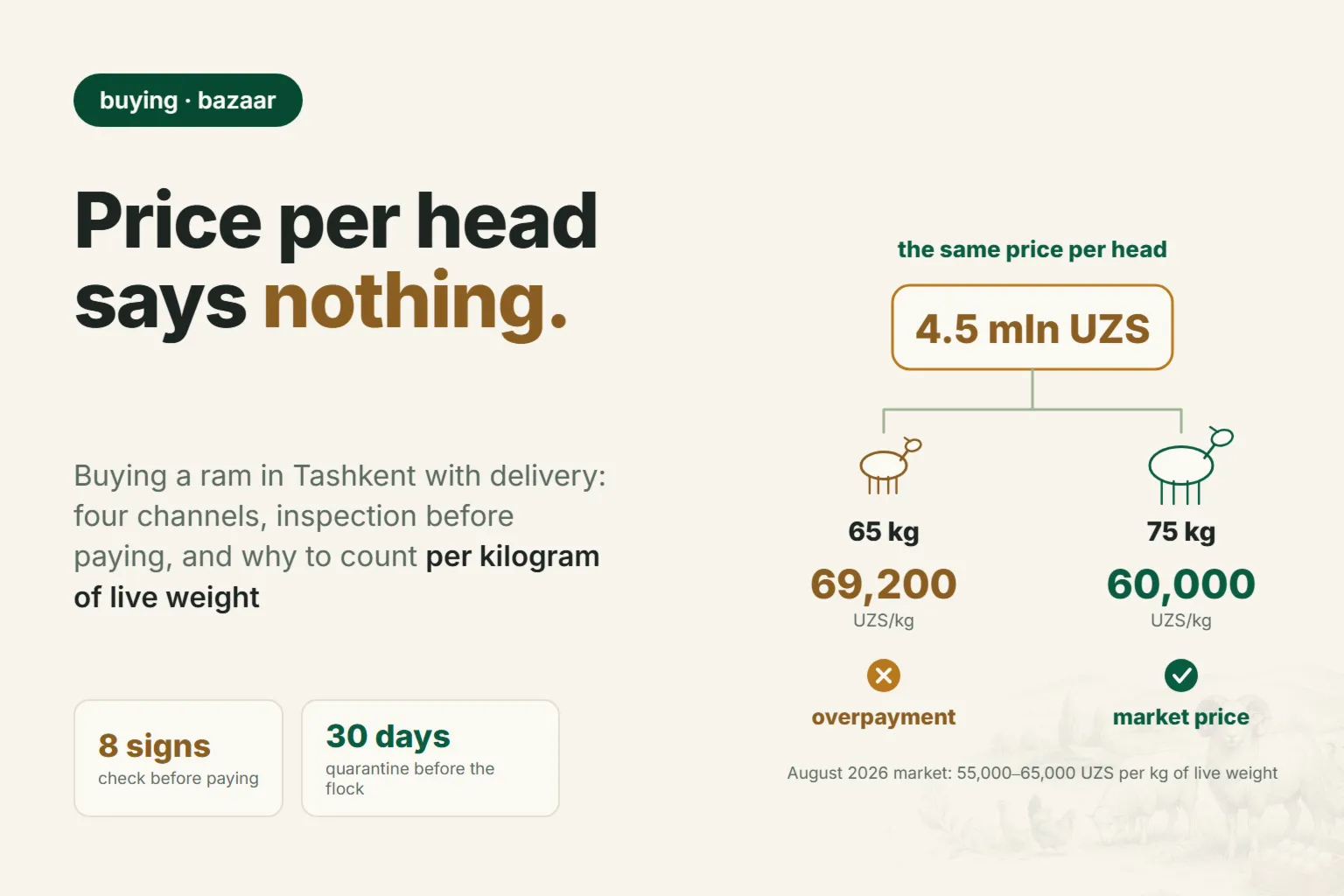
On any channel, haggling happens per head: "how much for this one?" That's bargaining blind. The only figure you can actually compare is the price per kilogram of live weight, and you get it by dividing: price ÷ live weight.
In the summer of 2026, meat rams in Uzbekistan are going for roughly 55,000–65,000 soum per kilogram of live weight (≈$4.6–5.5). That figure is only a rough guide: mutton prices in Uzbekistan are climbing fast — according to the Central Bank of Uzbekistan, by July 2026 lamb and mutton had risen almost 21% year on year. Check the current benchmark at your specific market on the day you buy, not against numbers from the internet.
The method itself doesn't change. Say a seller is asking 4,500,000 soum (≈$380) for a ram:
| Ram's live weight | Price per kilogram | Verdict |
|---|---|---|
| 65 kg | 69,200 soum (≈$5.8) | Expensive — overpaying by 0.3–0.9 million soum |
| 75 kg | 60,000 soum (≈$5.1) | Right in the middle of the range |
| 85 kg | 52,900 soum (≈$4.5) | Below market — a good buy |
The exact same sum can be a rip-off or a bargain — it all hinges on the weight, which you don't actually know. Hence the first question to ask the seller: how much does the animal weigh, and on what scale was it weighed. No scale on hand — measure with a tape: heart girth behind the shoulder blades and body length plug into the live-weight formula. A measuring tape costs next to nothing and pays for itself on the very first deal.
Breeding animals are a separate case: they cost several times more than meat animals, and pricing them per kilogram makes no sense. On our marketplace as of 22 August 2026, listings in the "Animals" section range from $450 to $2,500 per head — the top of that range is breeding stock, not meat.
What to check on a ram before handing over money: the inspection checklist
The inspection takes five minutes and is worth more than any haggling. Check in daylight, and before the money changes hands.
| What to check | Normal | Warning sign | What it means |
|---|---|---|---|
| Lower incisors | Even, firm, no gaps | Worn down, loose, gaps between teeth | The animal is old, with little productive life left |
| Lower eyelid membrane | Bright pink | Pale, almost white | Anemia from worms |
| Under the lower jaw | Dry and firm | Soft swelling, "bottle jaw" | Advanced worm infestation |
| Coat on the back and sides | Even, no bald patches | Scratch marks, bald spots, crusts | Mange — it will spread through your whole flock |
| Hooves and gait | Stands square on all four, walks evenly | Limping, foul smell | Foot rot |
| Nose and breathing | Even breathing, no wheezing | Discharge, coughing, rapid breathing | Pneumonia |
| Under the tail | Clean and dry | Signs of diarrhoea | Worms, coccidiosis |
| Testicles on a ram | Both even and firm | Asymmetry, lumps, undersized | Infertility — a lost breeding season |
Two things almost nobody bothers to do, and each takes a minute. Walk the animal 20–30 steps: you can't spot lameness or shortness of breath in a standing ram, but they show up instantly once it moves. Offer a handful of feed: a healthy animal eats eagerly, and refusing feed in front of a live buyer is reason enough to walk away.
The most costly hidden defect is age. An old ewe can easily pass for a young one on condition alone, and her teeth give a far more accurate reading than anything the seller tells you: how to tell a sheep's age by its teeth breaks it down year by year, with a table of incisor changes.
What paperwork should come with the animal when you buy it?
Veterinary accompanying documents are issued by the veterinary service where the animal is kept, not by the buyer at the destination. Moving an animal outside the district requires a veterinary certificate; moving it within the district usually only needs a note from the local district vet. Check the exact current requirements with your district veterinary station — the rules change from time to time, and a seller who brings this up unprompted is usually more trustworthy than one who brushes it off.
Other things to ask the seller:
- What vaccinations were given, and when — exactly what for, and in which month. An answer like "we did all of them" without dates is the same as "we did none of them."
- Was it treated for worms — with what date and what product.
- Does it have an ear tag, and does the number match what's in the paperwork.
- Why it's being sold — an awkward question, but a useful one: selling a ewe in the middle of breeding season almost always means she's barren.
A veterinary certificate is not a guarantee of health — it only confirms the animal was examined on a given day. It replaces neither your own inspection nor quarantine.
How to transport a purchased ram, and who pays for the weight lost on the way?
Live animals are moved in a livestock truck with proper loading. In a car boot or on a trailer without side rails, the animal gets injured; in a closed van in summer, it can die of heatstroke within hours.
One important detail to agree on in advance: where the scale is. According to the University of Wyoming Extension, on trips under six hours a sheep loses 1–4% of its live weight, and on longer hauls, up to 6–12%. On an 85 kg ram, three percent is 2.55 kg — around 166,000 soum (≈$14) at 65,000 soum per kilogram. If you pay based on a weighing at your own place, the seller absorbs that loss; if you weighed it at his, you do. The argument tends to start after the animal is already unloaded, when it's too late to settle it.
If you don't have your own vehicle, there's a dedicated service for that: livestock delivery across Tashkent and the region — a livestock truck with loading included, booked after the price is already agreed.
What to move them in, how much live weight goes missing on the road, and how to load so you lose less is covered separately in ram delivery across Tashkent and the region.
How to buy a ram through an online listing without losing your money
The rules are simple, and they're all about the order of operations, not about trust.
- Check the fields, not the text. Breed, sex, age in months, live weight — if a field is blank, ask before you make the trip. A seller who doesn't know his ram's weight doesn't know much else about it either.
- Ask for a recent video. Not old photos — a video of the animal on its feet, filmed today. A refusal to send video is reason enough not to go.
- Check the seller's profile: how long they've been on the platform, and how many listings they have. An account created yesterday for a single ram calls for caution.
- No prepayment, ever. Money changes hands on site, with the animal present, after inspection. This rule holds on every platform: online marketplaces are information intermediaries — they don't process payments and aren't a party to the deal, so there's nowhere you can get a transfer "through the platform" refunded.
An online marketplace differs from a Telegram group in that sellers fill in structured fields instead of free text, and buyers filter animals by those fields. That's how our marketplace works too. QoyHunter is a flock-management CRM and the bazar.qoyhunter.com marketplace: listing is free, the owner sets the price, and enquiries go straight to them, with no middleman.
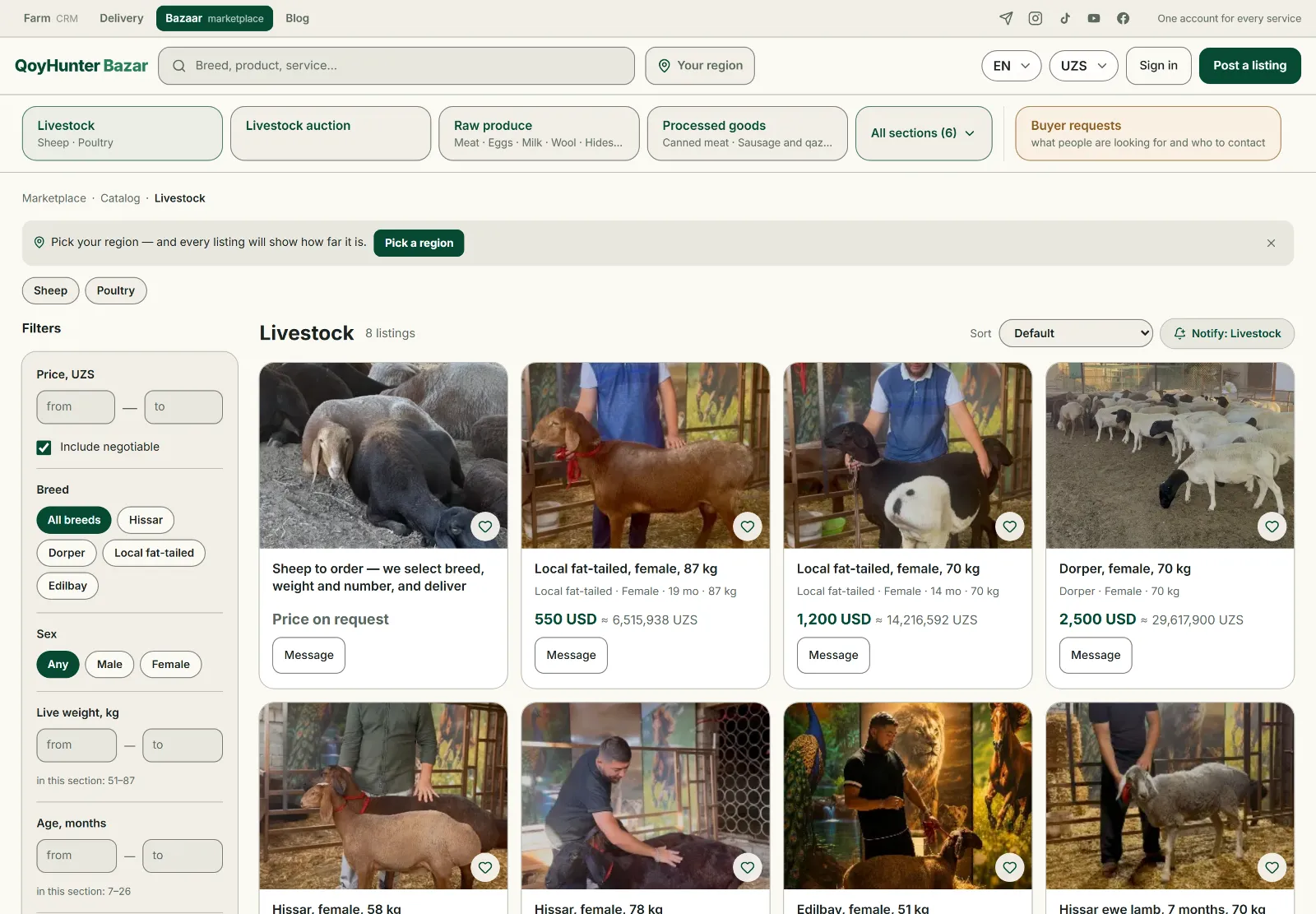
Four things here are useful for a buyer: filters by breed, sex, live weight, age, and price; separate "vaccinated only" and "vet certificate verified by the platform" filters; setting your own region, after which the distance shows next to every listing; and a "Message" button right on the listing card, so you're messaging the animal's owner directly.
About the size of the marketplace, we'll be straight with you. As of 22 August 2026, there are 57 listings: 8 in the "Animals" section, 48 for feed and equipment, and 1 for services. There isn't yet the kind of buyer and seller traffic you'd get at a weekend market — the platform is young. Its strength lies elsewhere: a listing costs nothing, stays up without any effort on your part, and you can shortlist an animal by its parameters without ever leaving your yard.
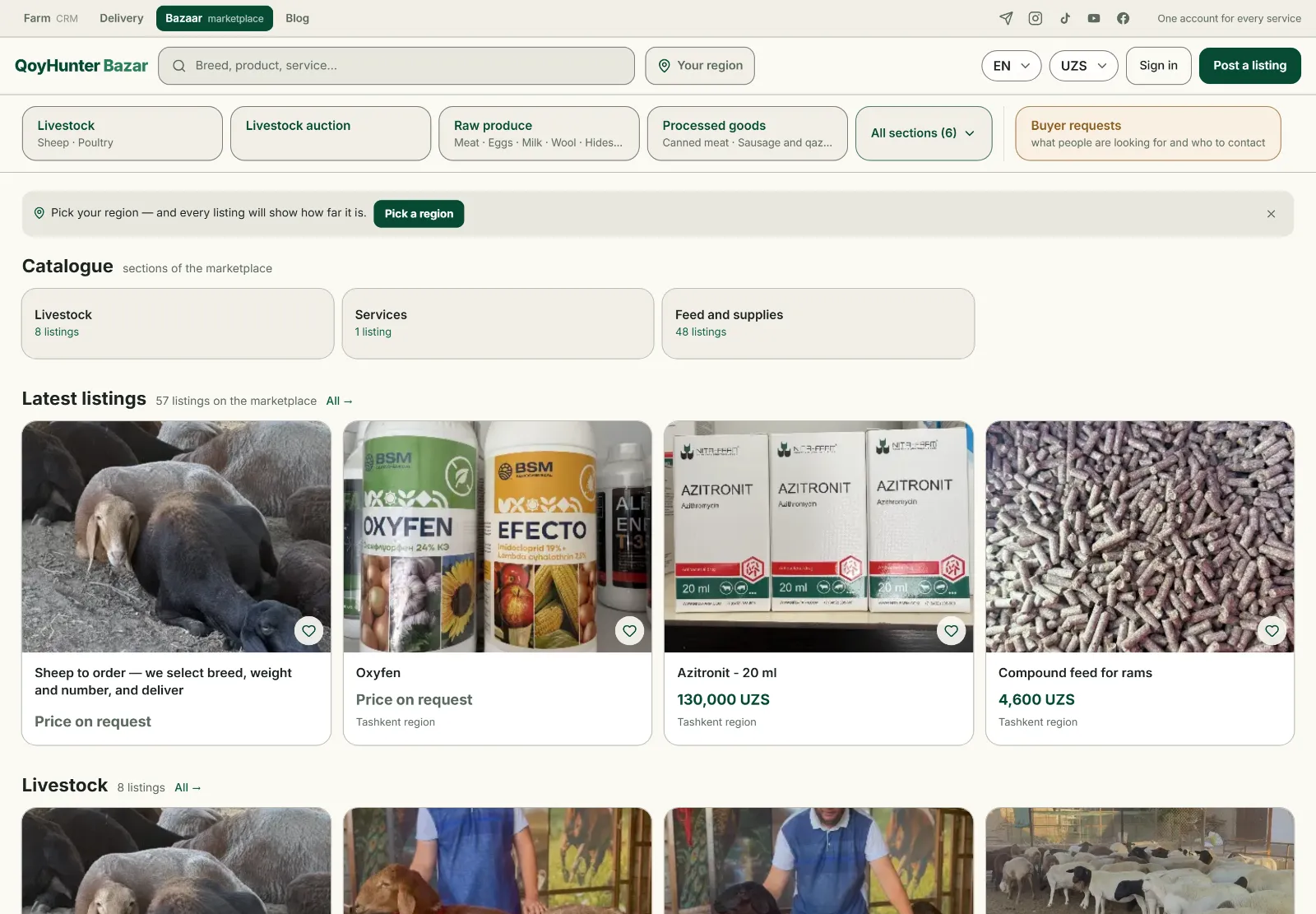
You can see what's listed right now in the rams and ewes for sale section. There's also a dedicated page for Hissar rams and ewe lambs listed for sale — as of 22 August 2026, it has three listings.
What to do with a purchased ram during the first month?
A new animal doesn't go straight into the main flock on the day you buy it, no matter how healthy it looks. Mange takes two to three weeks to show; worms may not show at all until animals start dying. A separate pen, its own feeder and water trough, parasite treatment, and observation — only then the shared herd. For a week-by-week breakdown of exactly what to do: quarantine for new sheep.
A mistake here costs more than any saving from a good deal: one mangy ram bought without quarantine can cost the whole flock its weight gain for the winter.
FAQ
Where to buy a ram in Tashkent with delivery?
Four working options: the mol bozori (open on weekends in most districts), a middleman who delivers the animal himself, buying direct from a farm, and an online listing with a livestock truck booked separately. Delivery of live animals across Tashkent and the Tashkent region is booked as a separate service after the price is agreed — a live ram doesn't travel in a car.
How much does a ram cost in Uzbekistan in August 2026?
The benchmark for a meat ram is 55,000–65,000 soum per kilogram of live weight (≈$4.6–5.5 at the Central Bank of Uzbekistan's rate of 11,847 soum per dollar on 21 August 2026). That puts an 85 kg ram at around 4.7–5.5 million soum (≈$395–466). The range keeps moving: mutton prices have risen almost 21% over the year, so check your own benchmark at the market on the day you buy. Breeding animals are priced separately and cost several times more. And always convert a price quoted per head into a price per kilogram of live weight — without that, comparing offers is impossible.
How do you tell a ram's age when buying?
By the lower incisors: milk teeth are replaced by permanent ones in pairs, and the number of permanent pairs gives you the age accurate to roughly six months. In an old animal, the incisors are worn down, gaps appear between them, and teeth loosen or fall out. That's how you check a seller's claim about age — not by appearance: a well-fed old ewe can look younger than she is.
What paperwork do you need to buy and transport a ram?
Veterinary accompanying documents are issued by the veterinary service where the animal is located: moving it outside the district requires a veterinary certificate, while moving it within the district usually only needs a note from the local district vet. Check the exact requirements with your district veterinary station. Separately, ask for the dates of vaccinations and the last worm treatment — treat an answer without dates as a "no."
Can you send a prepayment to a seller from an online listing?
No. Money changes hands on site, with the animal present, after inspection. Online marketplaces are information intermediaries: they don't process payments and aren't a party to the deal, so a transfer can't be refunded through the platform. A request for prepayment on an animal you haven't seen yet is reason enough to end the conversation.
Manage your flock in QoyHunterCRM for sheep farmers: livestock, health, weighing, finance and analytics — in the app and a Telegram bot.All features →