How Much Does a Sheep Cost in Uzbekistan in 2026: Live Animal and Mutton Prices
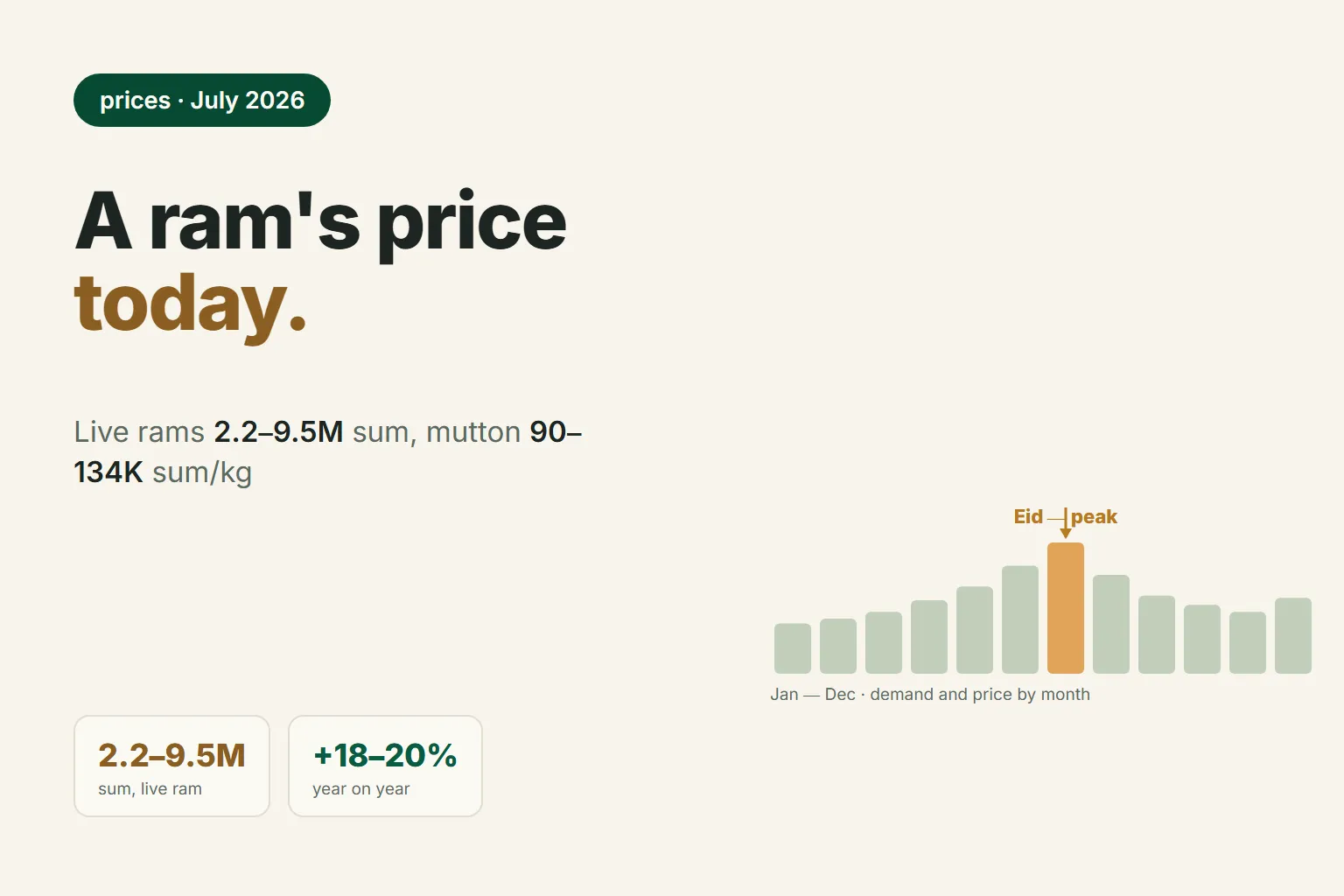
Fresh July 2026 prices: live sheep from 2.2 to 9.5 mln UZS, mutton at 90–134k UZS/kg. Why meat prices grow 18–20% a year and when to buy and sell.
Sheep prices in Uzbekistan have multiplied over the past few years, and "how much is a ram right now" is a question that concerns buyers and farmers deciding when to sell alike. We gathered fresh numbers for summer 2026 — marketplace listings, bazaar meat prices, official statistics — and explain where the market is heading.
The Key Numbers: July 2026
| What | Price range |
|---|---|
| Lamb / young ram | 2.2–3.4 mln UZS |
| Adult ram | 4.5–9.5 mln UZS |
| Ewe | ~2.8 mln UZS |
| Mutton at the bazaar | 90,000–120,000 UZS/kg |
This is a snapshot of real listings and market reports as of July 2026. Note: live-animal prices are asking prices — the final figure at the bazaar is almost always born in haggling.
Live Sheep Prices
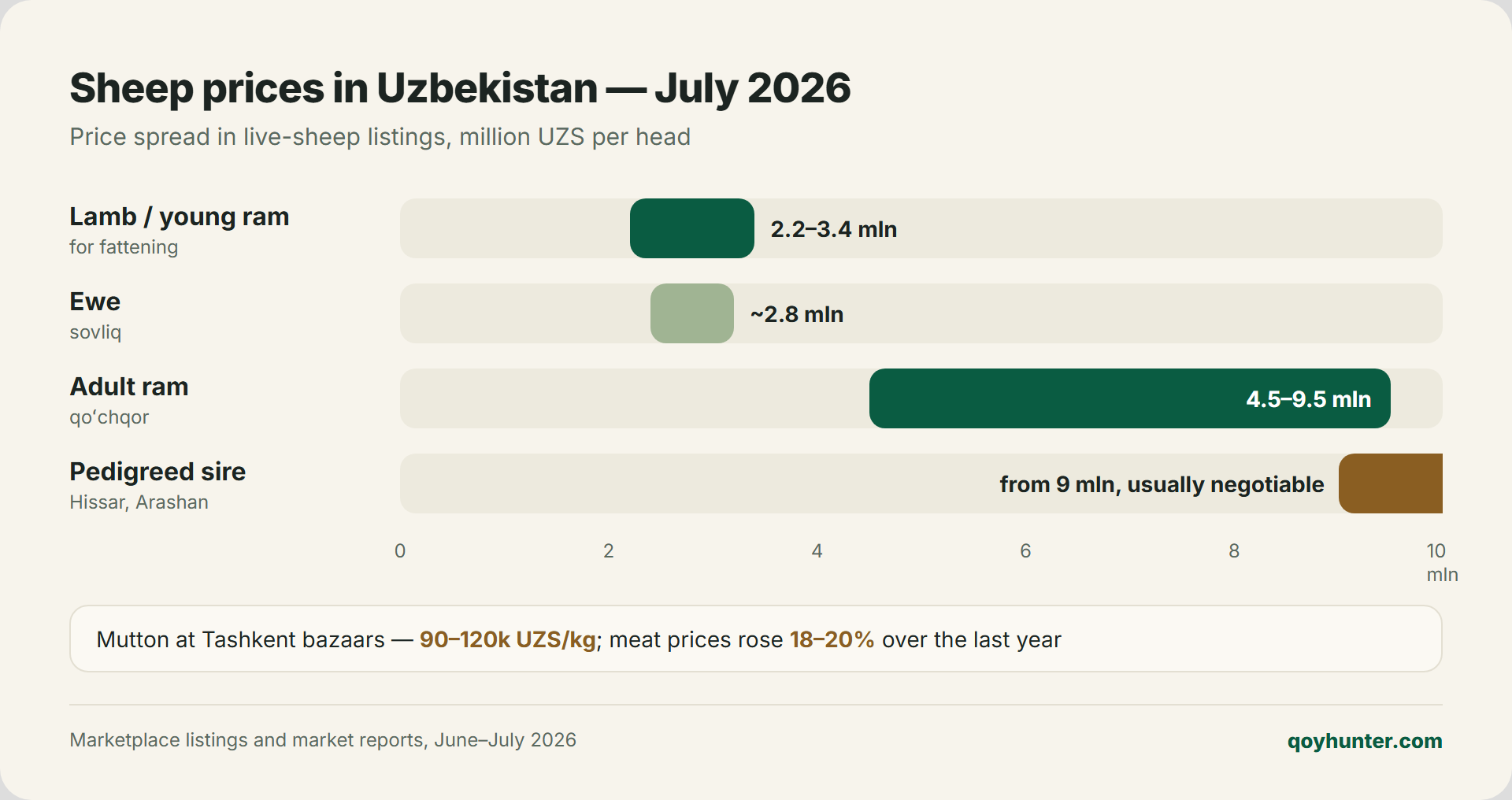
Across Uzbekistan's marketplaces in summer 2026 the spread looks like this:
- Lambs and young stock — from 2.2 to 3.4 mln UZS. The hottest commodity for fattening buyers.
- Adult rams — from 4.5 mln UZS, with large meat-type animals up to 9–9.5 mln.
- Pedigreed sires — "price negotiable," limited only by the buyer's wallet: outstanding Hissar and Arashan rams command sums several times the average market price.
It is these that hold the top of the range: what a Hissar ram costs today is worth checking separately from the general catalogue — both weight and price are of a different order.
An animal's price is always weight × condition × breed. One large, well-fattened fat-tailed ram is worth more than two skinny ones — selling an unweighed, unfattened animal means gifting your margin to a middleman. We wrote a separate guide to fattening rams for sale.
Mutton at the Bazaar: 90,000–134,000 per Kilogram
In June 2026, mutton at Tashkent's markets (Chorsu / Eski Juva) sold for 90,000–120,000 UZS/kg, versus 75,000–100,000 for beef. The price agency Narxtahlil puts the nationwide average at about 134,000 UZS/kg.
For perspective: in 2019, mutton at Tashkent's dehkan markets cost 32,000–36,000 UZS/kg. The price has roughly tripled in seven years — including 18–20% growth in the last year alone.
Seasonality: When to Buy and When to Sell
The market's annual cycle is remarkably stable:
- Prices peak at Qurban Hayit (in 2026 the holiday fell on May 27). In the weeks before it, sacrificial rams gain tens of percent in price.
- Summer after the holiday — the market cools: the best time to buy lambs for fattening.
- Autumn — the season for selling stock fattened over summer; meat demand stays high.
- Winter — feed costs rise; weaker animals are better sold before the cold.
A simple strategy for a small farm: buy lambs cheap in early summer, fatten them on inexpensive summer feed, and sell in autumn–winter — or hold the best ones until the next Qurban Hayit, when the market peaks.
Why Prices Keep Rising
- Demand outpaces supply. Uzbekistan's sheep and goat population at the start of 2025 was about 25 million head, up just 1.4% in a year — while meat demand grows faster.
- Feed and upkeep are getting dearer — cost inflation passes straight into meat prices.
- Overall food inflation: meat prices rise 18–20% a year, with mutton leading the pack.
The state is responding with an ambitious program: the sheep and goat population is planned to reach 30 million head by the end of 2028, imports of breeding animals are VAT-exempt until 2029, and concessional credit lines for livestock farms have been launched. For a farmer this means two things: competition will grow, but entering the industry is also easier than ever.
What This Means for a Farmer
- Keep weight under control. An animal's price is, above all, kilograms. Regular weighings show whether feed pays off in gains and signal the best moment to sell.
- Sell condition, not "as is." The difference between a skinny and a fattened ram is millions of soums, at a feed cost of hundreds of thousands.
- Watch the calendar. Buying in summer and selling in autumn or before Qurban Hayit is the most reliable margin on this market.
With flock weight and gain tracking you can track your flock from your phone for free: weighings, gains, and treatments. And you can list a ram for sale on the ram sale listings site — buyers across Uzbekistan will see it.
Now that you know the price, the next question is the channel: where to sell a ram for the best price — mol bozori, middleman and listing compared on a 75 kg ram.
Prices in this article are reference points from open listings and market reports for June–July 2026; check current prices at your local bazaar before any deal.
Manage your flock in QoyHunterCRM for sheep farmers: livestock, health, weighing, finance and analytics — in the app and a Telegram bot.All features →