
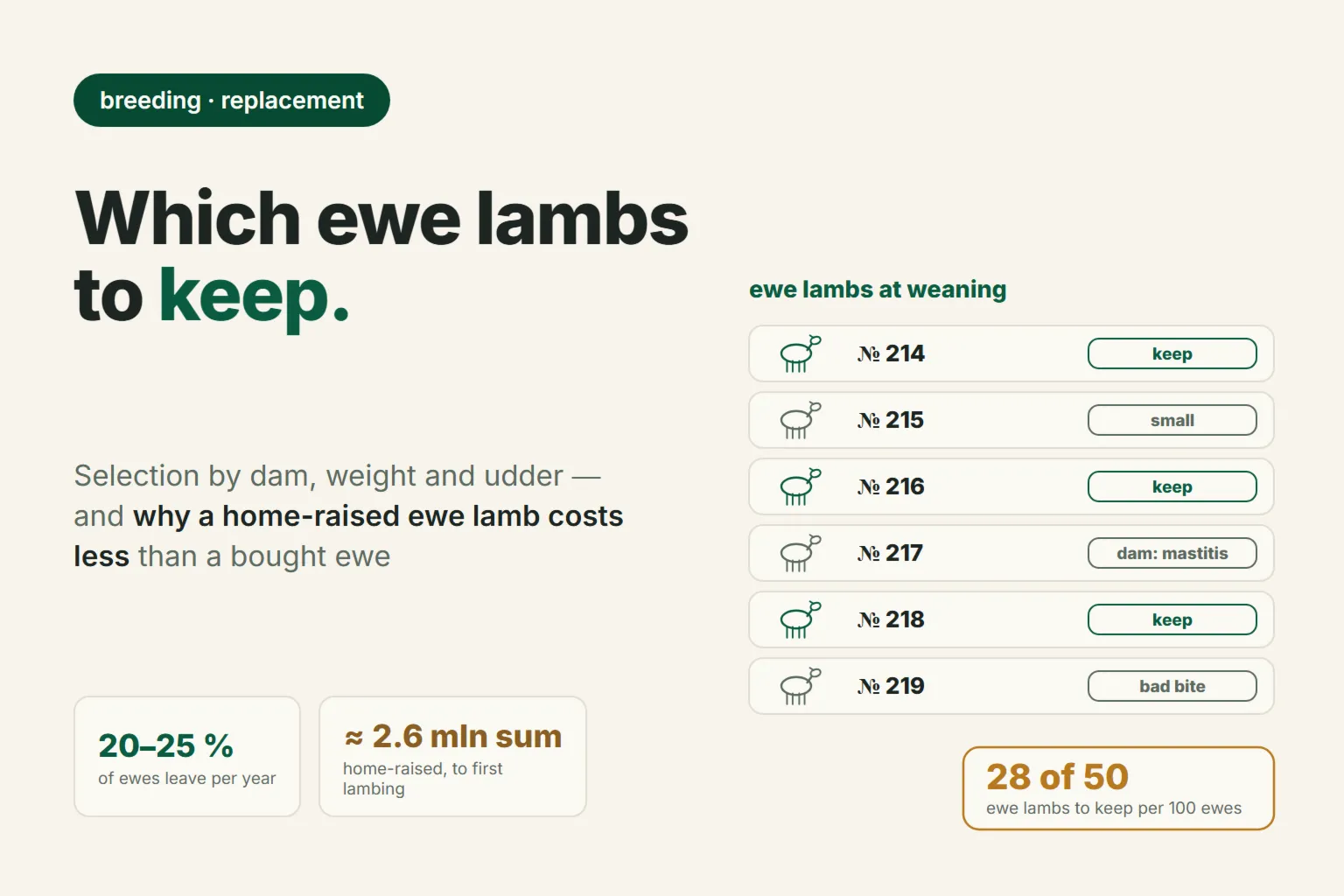
Selecting Replacement Ewe Lambs: Which to Keep and the Cost
Choosing replacement ewe lambs: how many to keep per 100 ewes, how to pick on dam, weight and udder, and what a home-raised ewe lamb costs versus a bought ewe in Nov 2026.
Replacement ewe lambs are chosen at weaning on three things: their dam, their weight against age-mates, and a sound udder, jaw and legs. Out of every 100 ewes, 20–25 head leave the flock in a year, so at weaning you keep 25–30 ewe lambs: a quarter more than you need, because some will fail selection before breeding. A home-raised ewe lamb costs about 2.6 million sum (≈ $217) up to her first lambing, while a young ewe in autumn 2026 listings costs 3–6.5 million sum (≈ $250–540).
Below are the selection rules, the numbers for a flock of 100 ewes, and a comparison of a home-raised ewe lamb with a bought ewe. Prices are for November 2026, at the Central Bank of Uzbekistan rate of 7 November 2026: 11,987 sum to the dollar.
What is flock replacement in sheep and why count it?
A replacement ewe lamb is a young female the farmer keeps from the flock's own lamb crop to take the place of a culled or dead ewe. Flock replacement is the whole cycle: cull the weak ewes, raise their replacements and bring them into the flock for breeding.
Your replacement choices decide whether the flock will produce more lambs in five years' time or fewer. If you keep every ewe lamb without picking, the daughters of the worst ewes join the flock and the lambing rate slowly drops. If you keep none, the flock gets older, and you have to buy replacements at a higher price and at the risk of bringing in disease from other flocks.
How many ewes leave a flock in a year?
In an ordinary flock, 20–25 % of ewes leave in a year. Most of that is planned culling, 15–20 %: old ewes with worn teeth, ewes that have had mastitis, ewes empty two years running, lame ewes. Another 3–5 % is deaths of adult sheep. According to the British industry body AHDB, flocks on average replace the same 20–25 % of ewes a year.
A ewe usually stays in the flock for 4–6 lambings. By 6–7 years old her incisors fall out or wear down, she can't eat properly and can't hold her body condition, so she goes for meat. How to tell age by the teeth and when to replace your own ewes is covered in detail in the article how to age a sheep by its teeth.
Which ewes should you cull every autumn?
Replacement starts not with the ewe lambs but with the ewes. A check before breeding shows how many places will open up in the flock and how many ewe lambs you will need.
| What you see in the ewe | Why she goes |
|---|---|
| Incisors lost or worn down | can't eat properly, is thin by lambing, the lamb is born weak |
| Mastitis, a hard lump or only one working half of the udder | the lamb won't get enough milk, mastitis tends to come back |
| Empty two years running | a year of feed without a lamb, about 1 million sum |
| Vaginal prolapse at the last lambing | high risk of it happening again in the next pregnancy |
| Chronically lame, feet won't heal | can't get to the feeder or out to pasture |
| Body condition score never gets above 2 | most likely a chronic disease or bad teeth |
A thin cull ewe with sound teeth is worth feeding up for 45–60 days before sale: a well-fleshed ewe sells at the top price per kilogram. A ewe with worn teeth is sold straight away.
How many ewe lambs to keep per 100 ewes?
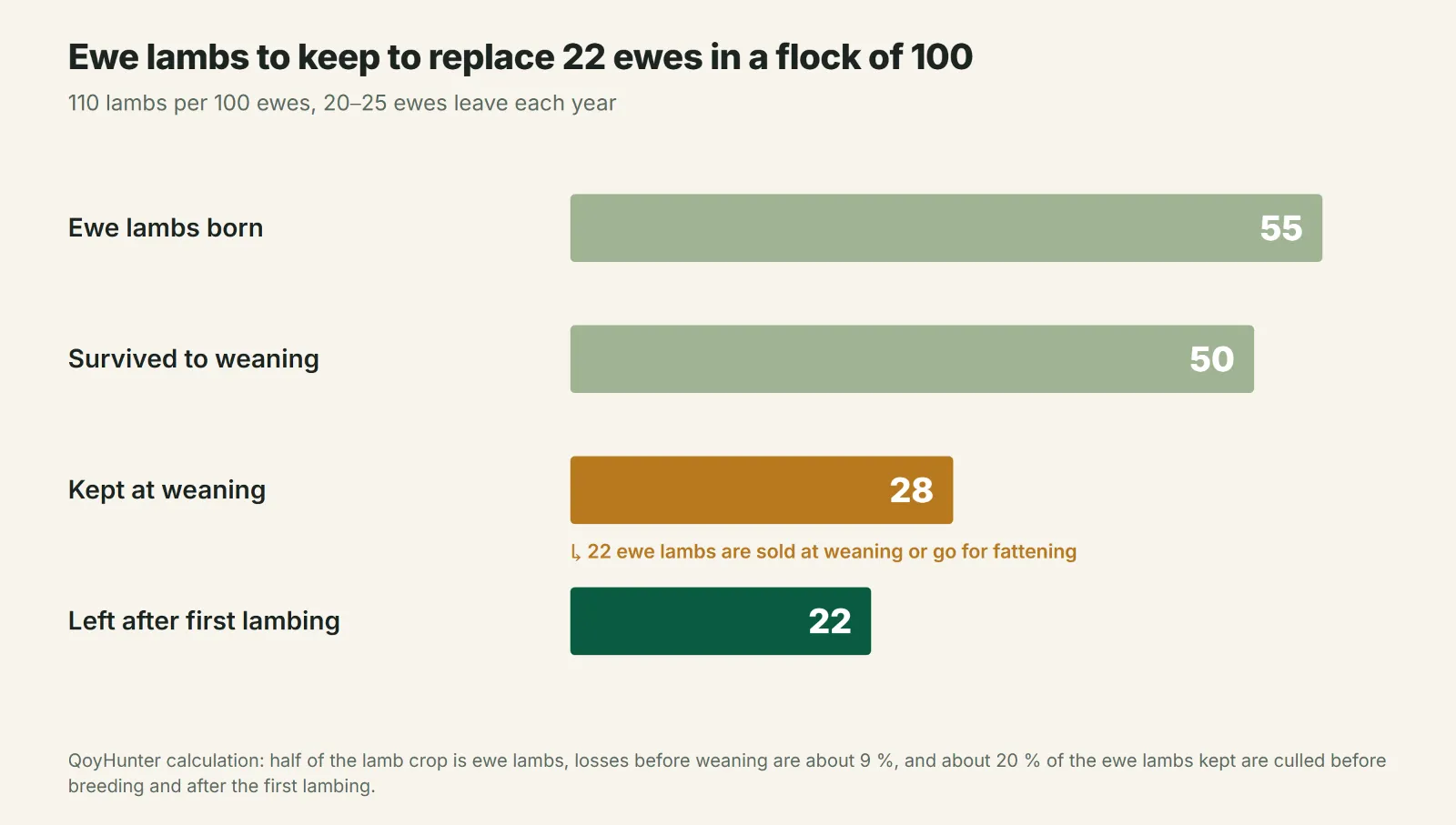
To bring 22 young ewes into the flock, you need to keep about 28 ewe lambs at weaning. The extra covers the ones that drop out at selection before breeding: not every ewe lamb reaches the target weight, and some turn out to have udder or jaw faults.
The numbers for a flock of 100 ewes with a lambing rate of 110 lambs per 100 ewes:
- about 55 ewe lambs are born, half of the lamb crop;
- about 50 survive to weaning, if lamb losses are about 9 %;
- at weaning you keep the 28 best, and the other 22 are sold or go for fattening;
- 23–24 ewe lambs pass selection before breeding, and after the first lambing about 22 remain to replace the ewes that went out.
The key point of this calculation: you only get a real choice when the lambing rate is good. If the flock produces 85 lambs per 100 ewes, about 42 ewe lambs are born, 38 survive to weaning, and you have to keep nearly three quarters of them, with no real selection.
Which ewe lambs should you keep for breeding?
A replacement ewe lamb is chosen on her dam, her weight and her health. Looks at weaning are deceptive: a big single often looks better than a twin ewe lamb, even though a ewe that rears twins is worth more to the flock.
By the dam. The best ewe lambs come from ewes that lambed without help, reared their lambs themselves and never had mastitis. A ewe lamb from a ewe that prolapsed is not kept as a replacement: vets believe the tendency can be inherited.
By weaning weight. In sheep breeding studies, the heritability of weaning weight is estimated at about 0.2, which means a heavy ewe lamb tends to produce heavy lambs. Compare age-mates raised in the same conditions: a twin ewe lamb is usually 15–20 %, or 4–6 kg, lighter than a single at weaning, so twins are compared with twins.
By early birth. Ewe lambs born in the first three weeks of lambing are heavier by November than later-born ones and reach breeding weight sooner.
By udder, jaw and legs. Two teats with no extras, a soft udder, a correct bite with no undershot or overshot jaw, straight legs. No amount of feed will fix a ewe lamb with a fault.
Prolificacy (the tendency to have twins) is only weakly inherited: its heritability is estimated at about 0.1. A twin ewe lamb has twins slightly more often, but twinning depends mostly on feeding before breeding and the age of the ewe.
Selection by weight only works if you record weights. You can weigh the ewe lambs at weaning and before breeding and compare each ewe lamb's weight gain in a notebook, but in a flock of a hundred head, dam records usually get lost by the third year.
When to select replacement ewe lambs?
Ewe lambs are selected in three rounds, and some drop out at each one.
| When | What you check | How many are culled |
|---|---|---|
| At weaning, at 3.5–4 months | dam, weight, udder, bite, legs | about 45 % of ewe lambs |
| Before breeding, in October–November | weight at least 65 % of mature ewe weight, body condition, health | about 15 % of those kept |
| After the first lambing | how she lambed, whether she has milk, whether she reared her lamb | 5–10 % |
The second round comes down to weight. A ewe lamb goes in with the ram once she has reached 65–70 % of the mature weight of her breed: for the Hissar, about 55 kg, for the Edilbay, about 45 kg. How to get ewe lambs to that threshold by November is worked out in the article what age to breed a ewe lamb.
What does a home-raised ewe lamb cost up to her first lambing?
A home-raised ewe lamb costs the farm about 2.6 million sum (≈ $217) up to her first lambing. Most of that is not feed but the money you give up by keeping her instead of selling her.
| Item | Calculation | Sum | ≈ $ |
|---|---|---|---|
| Ewe lamb not sold at weaning | 35 kg × 55,000 sum | 1,925,000 | 161 |
| Keep from weaning to lambing | 270 days × 2,100 sum | 567,000 | 47 |
| Extra feed before first breeding | 0.4 kg barley × 80 days × 3,500 sum | 112,000 | 9 |
| Total | 2,604,000 | 217 |
A ewe lamb's keep is taken as three quarters of an adult ewe's: by our calculation of a sheep's yearly keep, an adult ewe costs 2,800 sum a day. The calculation is for a ewe lamb born in March, weaned in July and bred in November: her first lamb comes in April.
If the ewe lamb is bred not at 8–10 months but at a year and a half, about 240 more days of keep go on the bill, roughly 0.5 million sum, and the ewe has one lambing fewer in her lifetime.
A bought replacement costs more. According to olx.uz listings for October to early November 2026, a young ewe costs 3–6.5 million sum per head (≈ $250–540), and an in-lamb ewe costs more. On top of the price come transport and 30 days of quarantine with a blood test for brucellosis and treatment for scab, and there is still a risk of bringing a disease into the flock. If you replace 22 ewes with bought ones at 4 million sum each, it comes out about 30 million sum (≈ $2,560) more than raising your own ewe lambs.
Buying still makes sense in two cases: when you are just starting a flock and when you want to bring in new blood through good ewes from another line. Then it pays to look through ewes and ewe lambs for sale well before the breeding season and buy with time to spare for quarantine.
Which ram to put your own ewe lambs to?
Never put ewe lambs back to their own sire. Mating a sire to his daughter gives an inbreeding coefficient of 25 %, and inbred lambs have poorer survival and growth.
With early breeding this comes up a year after the ewe lamb is born, so you have to plan ahead. There are three options:
- breed the replacement ewe lambs as a separate group with a different ram;
- change the breeding ram every two seasons;
- borrow a ram for the season from a neighbor whose flock is unrelated.
To know each ewe lamb's parents, record the sire and dam at lambing. In a notebook that is one line per lamb, and in an animal card with a pedigree the sire and dam link to their own cards, so you can see which ewe a ewe lamb came from and how that ewe lambed.
How to keep records for flock replacement?
Flock replacement rests on three records for every ewe: how many lambs she had, how many she reared and what illnesses she had. Without them, selecting ewe lambs "by the dam" turns into selecting by eye.
For a flock of 30–40 ewes a notebook is enough: one page per ewe, with the ewe lamb's tag number written next to her dam's. In a flock of 100 head or more, records start getting lost, and then a program that shows the dam as soon as you look up a ewe lamb's tag is more convenient.
FAQ
How many ewe lambs to keep per 100 ewes?
Keep 25–30 ewe lambs at weaning per 100 ewes. In a year 20–25 ewes leave the flock, deaths included, and about 20 % of the ewe lambs you keep are culled before breeding and after the first lambing on weight, health and milk. That is why you keep a quarter more ewe lambs than the number of ewes to replace.
Which ewe lambs to keep for breeding and which to sell?
Keep ewe lambs from ewes that lambed without help, reared their lambs and never had mastitis, with a good weaning weight among their age-mates, a correct bite, two teats and straight legs. Sell small and late-born ewe lambs, those with udder or jaw faults, and ewe lambs from ewes that prolapsed.
What pays better: raising your own ewe lamb or buying a ewe?
A home-raised ewe lamb costs about 2.6 million sum (≈ $217) up to her first lambing at November 2026 prices, including the money you give up by not selling her at weaning. A young ewe in autumn 2026 listings costs 3–6.5 million sum (≈ $250–540), plus quarantine and the risk of disease. Buying pays when you are just starting a flock or need new blood.
Can you breed a ewe lamb to her sire?
No. Mating a sire to his daughter gives 25 % inbreeding, and such lambs have poorer survival and growth. Breed replacement ewe lambs to a different ram or change the breeding ram every two seasons.
At what age to cull a ewe?
Usually at 6–7 years, when the incisors fall out or wear down and the ewe can no longer hold her condition. Ewes with mastitis, chronic lameness or a prolapse, and those empty two years running, are culled earlier.
Manage your flock in QoyHunterCRM for sheep farmers: livestock, health, weighing, finance and analytics — in the app and a Telegram bot.All features →