How to Tell a Sheep's Age by Its Teeth: Avoid an Old Ewe and Know When to Replace Your Own
One pair of permanent incisors means a year to a year and a half old, a full mouth means 3.5–4 years, and gaps between the teeth show up by six to seven years. A table for reading a sheep's age by its teeth, five culling signs besides age, and what an extra year with an old ewe actually costs.
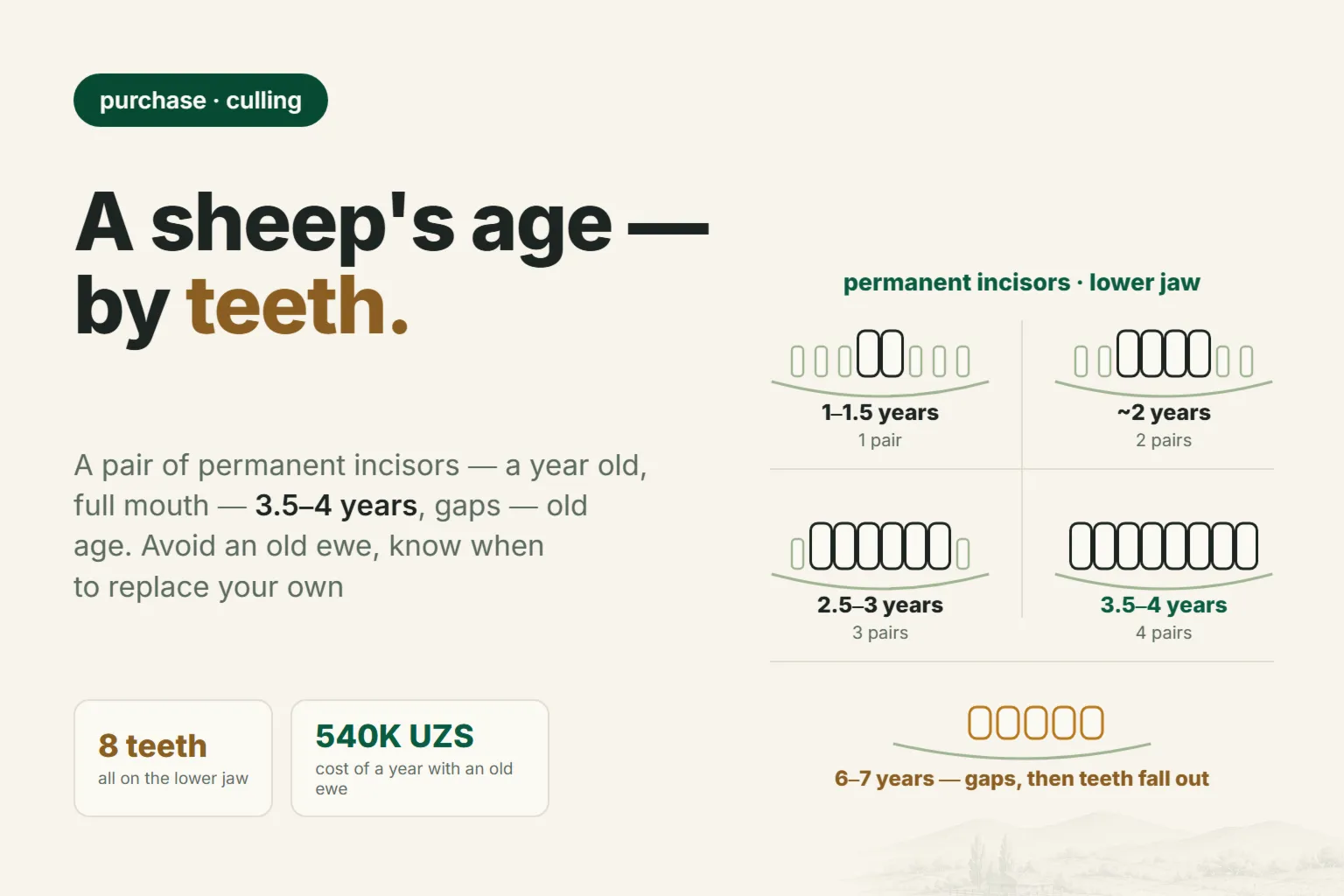
You tell a sheep's age from the incisors on its lower jaw: one pair of large permanent teeth means the animal is about a year to a year and a half old; two pairs, around two years; three pairs, 2.5–3 years; a full mouth of four pairs, 3.5–4 years. Past four years you stop counting teeth and start reading wear instead: gaps between the incisors show up by six to seven years, and teeth start falling out after seven.
It's the only age check you can actually run right at the market: a privately owned animal usually comes with no papers, and without an examination all you have is the seller's word. The same check tells you when your own ewe has done her time. Getting it wrong either way costs money: a "three-year-old" that's really seven will give you two lambings at best, while a broken-mouth ewe of your own eats a year's worth of feed and produces fewer lambs than a ewe lamb would in her place. Prices and calculations below are for August 2026, exchange rate for conversion ≈ 11,900–12,000 sum per dollar.
How to tell a sheep's age by its teeth
A sheep has 32 teeth, but only eight matter for aging — the incisors, and every one of them sits on the lower jaw. There are no incisors up top at all — just a hard, toothless pad that the sheep presses grass against. The incisors are counted in pairs from the middle out: the pinchers, the first intermediates, the second intermediates, and the corners.
A lamb is born with milk incisors, or grows them in the first few days; by a month old, the full milk set is in. Milk teeth are small, narrow, white and set close together. Permanent incisors are noticeably wider, bigger and yellower — hard to mistake for milk teeth; the difference is obvious at first glance, even the first time you ever look in a sheep's mouth.
| What you see in the mouth | Sheep's age |
|---|---|
| Eight small milk incisors | under 1 year |
| 1 pair of large permanent incisors (the pinchers) | 1–1.5 years |
| 2 pairs of permanent incisors | 1.5–2 years |
| 3 pairs of permanent incisors | 2.5–3 years |
| 4 pairs — full mouth of permanent incisors | 3.5–4 years |
| Full mouth, teeth visibly worn, standing tight | 4–6 years |
| Gaps appearing between incisors, crowns short | 6–7 years |
| Teeth loose, some missing ("broken mouth") | 7 years and older |
The timing in the table is the average from livestock reference guides. In fast-maturing meat-and-fat breeds such as Gissar and Edilbay, well-raised animals usually run ahead of this schedule — a full mouth can already show up by three years old. An animal raised on poor pasture, on the other hand, changes teeth later. So teeth give you the age to within about six months, not to the month, and past four years old the accuracy drops further still: at that point it's the pasture, even more than the breed, that decides the pace — teeth wear faster on sand and coarse grass than on irrigated alfalfa.
How to check teeth without making a mistake
Stand the sheep facing you, hold it under the lower jaw with one hand, and pull the lower lip down with the thumb of your other hand. The incisors are now fully exposed, and there are two things to check: how many pairs of large permanent teeth there are, and whether there are gaps between them.
Three things buyers most often get wrong at the mol bozor — the weekend livestock market:
- Checking the upper jaw. There are no incisors up there on a young sheep or an old one, and age can't be read from it at all.
- Counting every tooth, not just the permanent ones. A full mouth of milk teeth on an eight-month-old lamb is easy to mistake for an adult animal. The simple rule of thumb: permanent incisors are roughly twice as wide as milk teeth.
- Skipping the gap check. A full mouth shows up at both four years old and seven. The difference is that at four the teeth stand wall to wall, while at seven a matchstick fits between them and the crowns are worn down almost to the gum.
Check separately whether the teeth have been filed down. It's rare, but a filed incisor has a flat, dull edge with none of the enamel's natural shine, and its shape doesn't match the teeth next to it.
Check age when you're buying off a listing too, not just at the market: among sheep and rams for sale in Uzbekistan, the age comes from the seller, and until you've looked in the mouth, that's just their word. The check takes twenty seconds, and the difference in payoff is large: a four-year-old ewe still has three or four more lambings left in her; a seven-year-old has one. At the prices in this article, every lambing you miss out on is roughly 1.9 million sum of lamb you never got to sell.
How many lambings does a ewe give, and when does the decline start?
A ewe doesn't hit her peak right away. Her first lambing, at 1.5–2 years old, is the weakest one: the ewe lamb is still growing herself, so the lamb comes out smaller and there's less milk. The peak runs from the second through the fifth lambing — that's ages 3–6. After six a decline sets in, and it runs along three lines at once.
| Ewe's age | Lambs per 100 ewes | What's happening |
|---|---|---|
| 1.5–2 years (first lambing) | 90–100 | Ewe lamb still growing, lamb comes out smaller |
| 3–6 years (peak) | 110–120 | Peak prolificacy and milk yield |
| 6–7 years | 95–105 | Teeth worn, harder to hold condition in winter |
| 7 years and older | 70–90 | Higher barrenness, weak lambs, risk of losing the ewe at lambing |
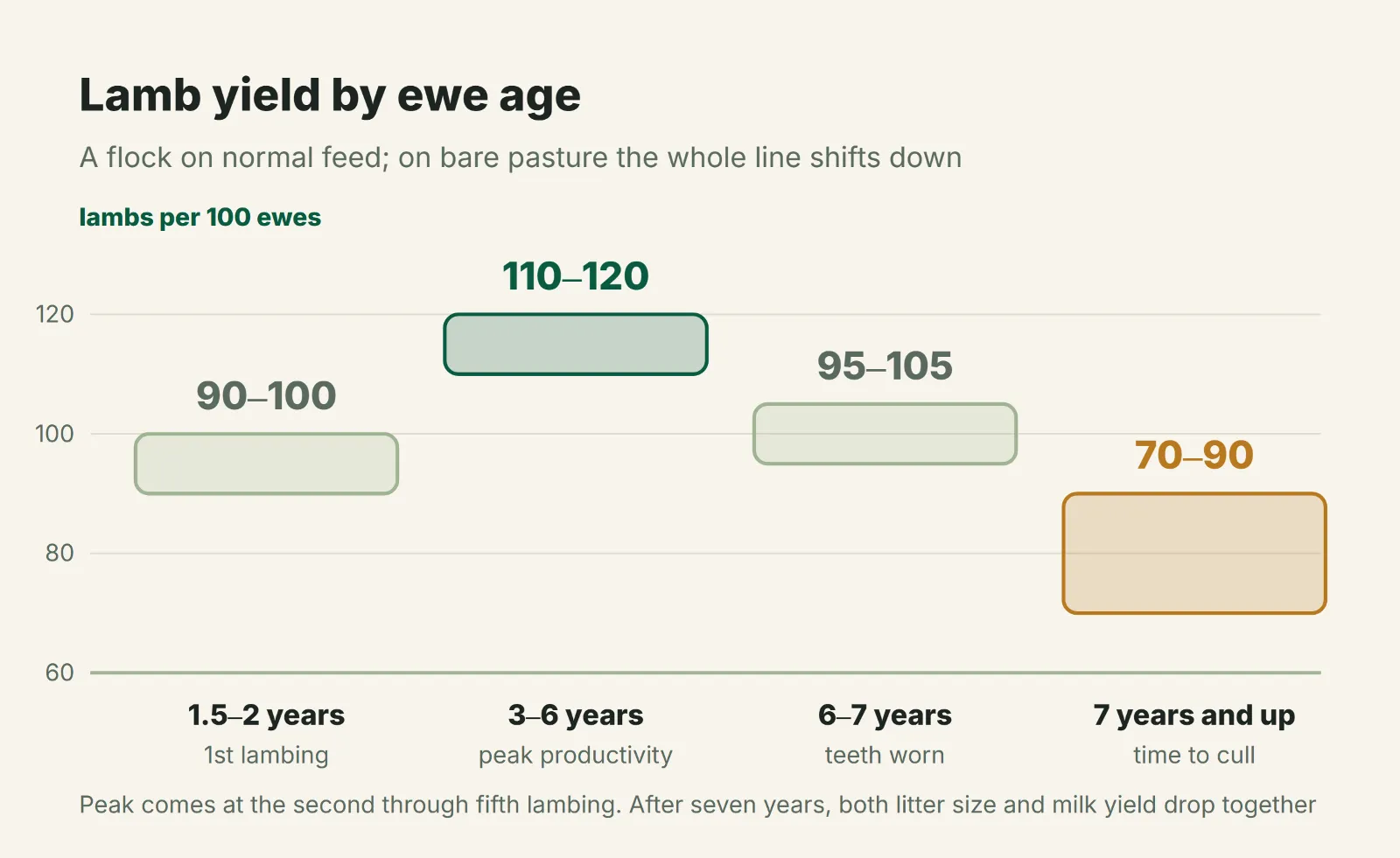
These numbers are a benchmark for a flock on decent feed; on bare pasture, the whole column shifts down. For a full breakdown of why a ewe stays barren, and how to work out the cost of that downtime, see our separate article on barren ewes.
The main driver of the decline is those same teeth. A ewe with missing incisors can't bite grass short on pasture and chews coarse hay poorly. In summer this barely shows; in winter she's the first to lose condition, goes into mating thin, and produces one lamb instead of two — or none at all.
What an extra year with an old ewe costs you
Let's compare two choices for ten ewes aged 7 and older: sell them now and replace them with your own ewe lambs, or keep them another year. The assumptions are simple, and you can check them: a ewe weighing 55 kg live; a culled adult ewe sells for 40,000–48,000 sum per kilogram of live weight (cheaper than a fattened ram, which goes for 55,000); a lamb weighs 35 kg by 6–7 months old and is worth about 1.9 million sum; keeping one head costs 1.2 million sum a year (the figure comes from our breakdown of profit per head). For the larger Gissar and Edilbay ewes, live weight is higher, and revenue from selling them grows proportionally.
| What we're comparing | Sell now, replace with ewe lambs | Keep the old ewes another year |
|---|---|---|
| Revenue for 10 ewes (55 kg × 45,000 sum) | 24.8 million sum right away | 22.3 million sum a year from now |
| Lambs by next autumn | 9–10 (ewe lambs' first lambing) | 7–9 |
| Feed and upkeep for the year | 12 million sum | 12 million sum |
Feed doesn't count toward the difference — the farm pays for it either way, whether it's an old ewe or the ewe lamb taking her place. Only what's actually different goes into the comparison.
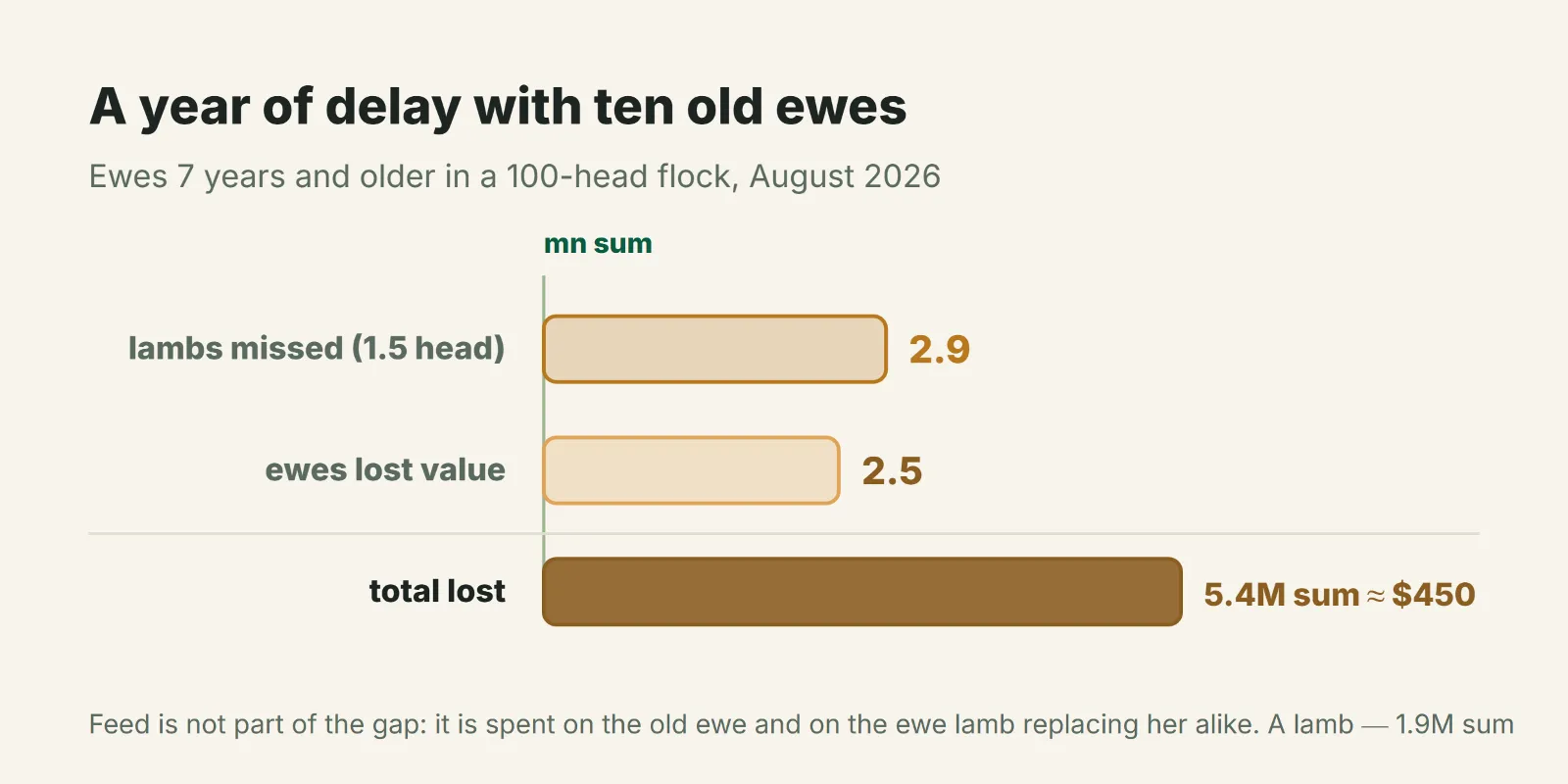
- Lambs you don't get: 2.9 million sum. One and a half fewer lambs across ten ewes (1.5 × 1.9 million).
- Ewes lose value: 2.5 million sum. Over winter each one loses 5–8 kg of live weight (10 × 5.5 kg × 45,000 sum).
Bottom line: a year's delay with ten old ewes costs 5.4 million sum (≈ $450), or about 540,000 sum per head. On top of the money there's the pen space: it's tied up, and the ewe lamb who could be standing there instead waits another year for her turn.
One honest caveat: if the farm has no ewe lambs of its own ready to step in, there's nobody to replace the old ewes with — buying in adult animals costs more than keeping your own for another year. That's exactly why culling and flock replacement are one decision, not two.
Who to cull: five signs besides age
Age is the first filter, but not the only one. Before mating, run the whole flock through all five checks at once, usually in August–September:
- Teeth. Gaps between the incisors and missing teeth mean culling, no matter what age the records say.
- Udder. Hard lumps, a blind quarter, an udder hanging down to the hock — a ewe like this won't raise a lamb even if she does conceive. How to feel the udder for trouble, and which findings mean culling, is covered in mastitis in sheep and the pre-breeding udder check.
- Barren two years running. One missed mating can happen to any ewe; two in a row is a systemic problem, and there's no point feeding her any further.
- Legs and hooves. Lameness, deformed hooves, a hoof wall destroyed by rot — a ewe like this won't make it to the far pasture and will be the first to fall behind the flock.
- Body condition below a score of 2 by the end of summer. If a ewe hasn't put on condition on summer feed, she'll spend the winter living off the farm's reserves and give you a weak lamb in spring.
Sell culled animals in autumn, after they've grazed up — that's when they're at their best weight of the year. A ewe held over "until spring" loses 5–8 kg over winter and sells for less, on top of eating her share of hay.
A thin cull ewe with sound teeth is worth more if you feed her for 45–60 days instead of selling her straight away: she moves up a condition grade, and every kilogram sells for more. A broken-mouthed ewe, on the other hand, should go at once. The numbers for both cases are in our piece on fattening cull ewes before sale.
How many ewe lambs to keep for flock replacement
Flock replacement is the annual job of swapping ewes that leave the flock for your own young ewe lambs. The norm is 15–20% of the ewe flock a year: at that pace a ewe stays in the flock five to six years — exactly her productive lifespan.
For a flock of 100 ewes, that means culling 15–20 head and putting the same number of ewe lambs in their place. Keep more for replacement than the count calls for — 22–25 ewe lambs — because some will drop out on health grounds, some won't conceive the first time, and some won't be developed enough. Pick replacements from February–March lambs out of your best ewes: they have time to reach weight for next autumn's mating.
It's worth counting the flock by age every year before mating. A flock where half the ewes are past seven years old can still look fine — no die-off, animals all present — but its lamb output has already dropped by around 15%, and you can't fix that in one season: a ewe lamb takes time to raise.
How to stop guessing by the teeth every year
Teeth are a method for someone else's animal. For your own, there's a more accurate one: a recorded birth date. If every ewe in the flock has a tag number and a date, the flock's age structure adds up in a minute before mating, instead of checking every mouth.
At QoyHunter — a CRM for sheep records and the bazar.qoyhunter.com marketplace — we keep age in the animal's card: the Animal card with age and weighing history shows the tag, sex, age, weight by date, pedigree, and status — in the flock, sold, or gone. A notebook works too: a ruled sheet with tag numbers and birth years does the same job while the headcount is small and one person keeps the records. The trouble starts once you're three years into record-keeping and the tags number a hundred and fifty: by then, finding the right page takes longer than checking the flock's mouths all over again.
Whichever you choose, the rule is the same: age gets recorded once, at birth or at purchase. Everything else is guesswork from worn teeth, and past four years old that guesswork gives you a spread of a year to a year and a half.
FAQ
How do you tell a sheep's age by its teeth once it's an adult?
Past four years old, counting pairs stops working — by then every permanent incisor is already in. Instead you read the wear: at 4–6 years the teeth stand in a tight wall but are visibly worn down; at 6–7 years gaps appear between them; past seven the incisors go loose and start falling out. This kind of estimate is accurate to within about a year, and it depends more on the pasture than on the breed — so an adult animal at the market should be assumed older than the seller says, not younger.
How many years do you keep a ewe in the flock?
Five to six lambings, so roughly to age 6–7. Peak productivity runs from 3 to 6 years old; past seven, lamb output drops to 70–90 per hundred ewes and the risk of losing a ewe at lambing goes up. A healthy ewe with intact teeth and a good udder can stay in for an eighth year, but check her every season.
Can you buy a sheep without checking its teeth if the seller states its age?
There's nothing to check the seller's word against: a privately owned animal usually has no papers, and the tag doesn't show age either. Checking the teeth takes twenty seconds and is the only free check you can run on the spot. A four-year-old ewe still has three or four lambings left in her for the new owner; a seven-year-old has one — and they sell for the same price at the market. Once the deal is done, it's too late to argue about it. With a QR tag the conversation is different: a scan opens a passport showing the breed, age and weight for the buyer — see our guide to tagging sheep and what a QR code on the tag gives you.
What do you do with culled ewes?
Sell them for meat in autumn, right after they've grazed up, when they're at their best weight of the year. An adult ewe sells cheaper than a fattened ram — roughly 40,000–48,000 sum per kilogram of live weight against 55,000 in August 2026 — but holding her over until spring costs more: over winter she loses 5–8 kg and eats her share of hay.
How many ewe lambs should you keep so the flock doesn't age?
Every year, keep 22–25 ewe lambs per 100 ewes for replacement, so that after culling for health and development, 15–20 head actually make it into the flock. That's the pace at which the flock's average age stays around 4 years and lamb output doesn't drop.
Manage your flock in QoyHunterCRM for sheep farmers: livestock, health, weighing, finance and analytics — in the app and a Telegram bot.All features →