What Age to Breed a Ewe Lamb: Why Weight Decides, Not Months
Ewe lambs go under the ram at 65–70% of adult ewe weight: 45 kg for Edilbay, 55 kg for Hissar. How to calculate the threshold for your own flock, whether young stock will reach it by November, and what early breeding is worth — a 50-ewe-lamb calculation at August 2026 prices.
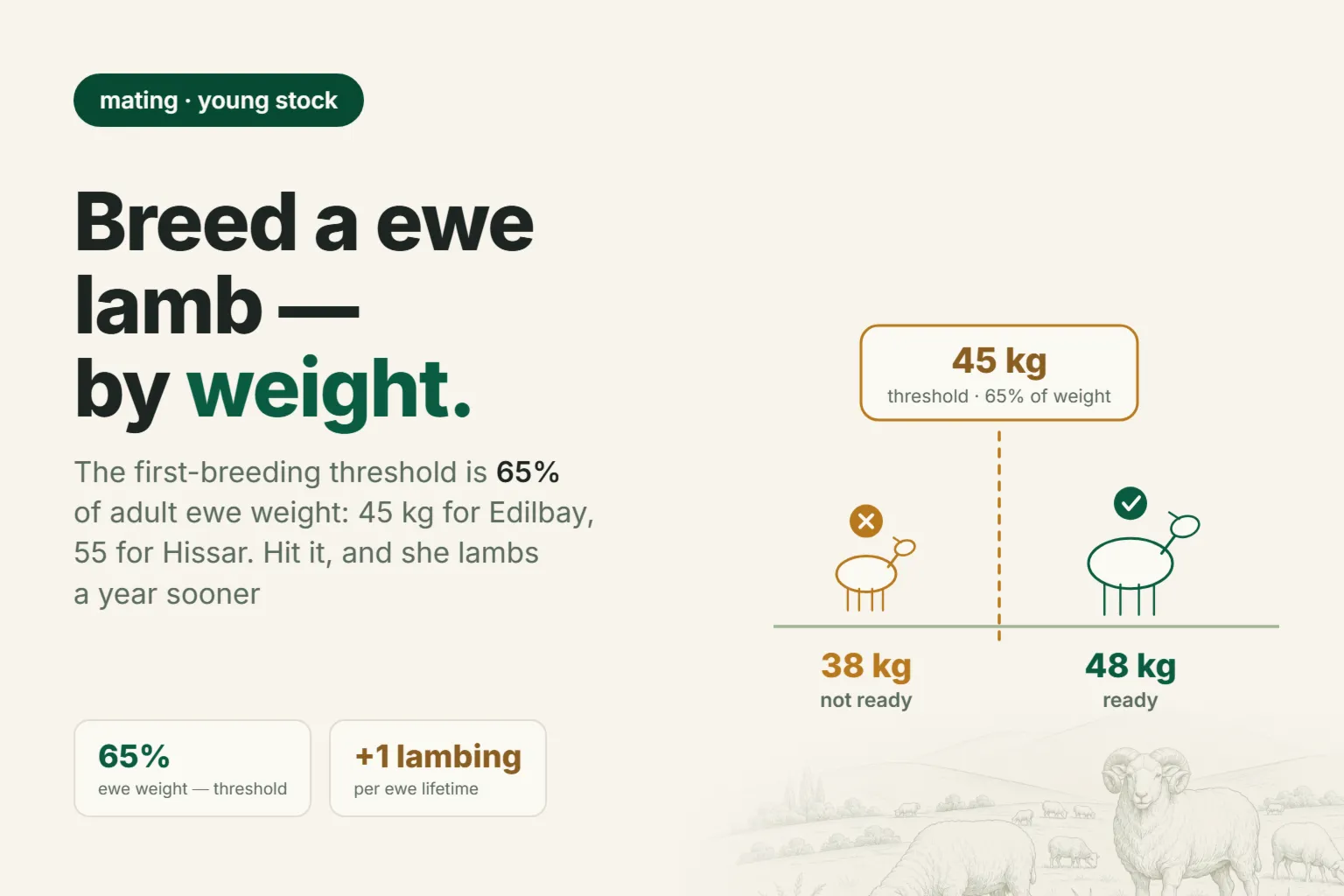
A ewe lamb goes under the ram once she has reached 65–70% of her breed's adult ewe weight — not once she has turned a year and a half. For an Edilbay ewe lamb that's roughly 45 kg, for a Hissar 55 kg, for a Jaidara 40 kg, for a Karakul 32 kg. On good feed a ewe lamb reaches that weight by 8–10 months, and then she delivers her first lamb a full year earlier than the schedule common in Uzbekistan.
It's August 2026 now — the breeding season starts in a few weeks, and the call on this year's ewe lambs has to be made right now. Prices in this article are August prices: live weight 55,000 so'm/kg, barley 3,800 so'm/kg, exchange rate for conversion ≈ 11,950 so'm per dollar.
What a ewe lamb is, and why she gets a separate conversation
A ewe lamb is a young female from weaning to her first lambing. In the flock she looks like a cost center: she eats as much as an adult ewe but gives neither a lamb nor wool of market quality. Keeping one head for a year on a Uzbek farm runs about 1.3 million so'm (≈ $110) — feed, treatments, a shepherd's share, and barn upkeep.
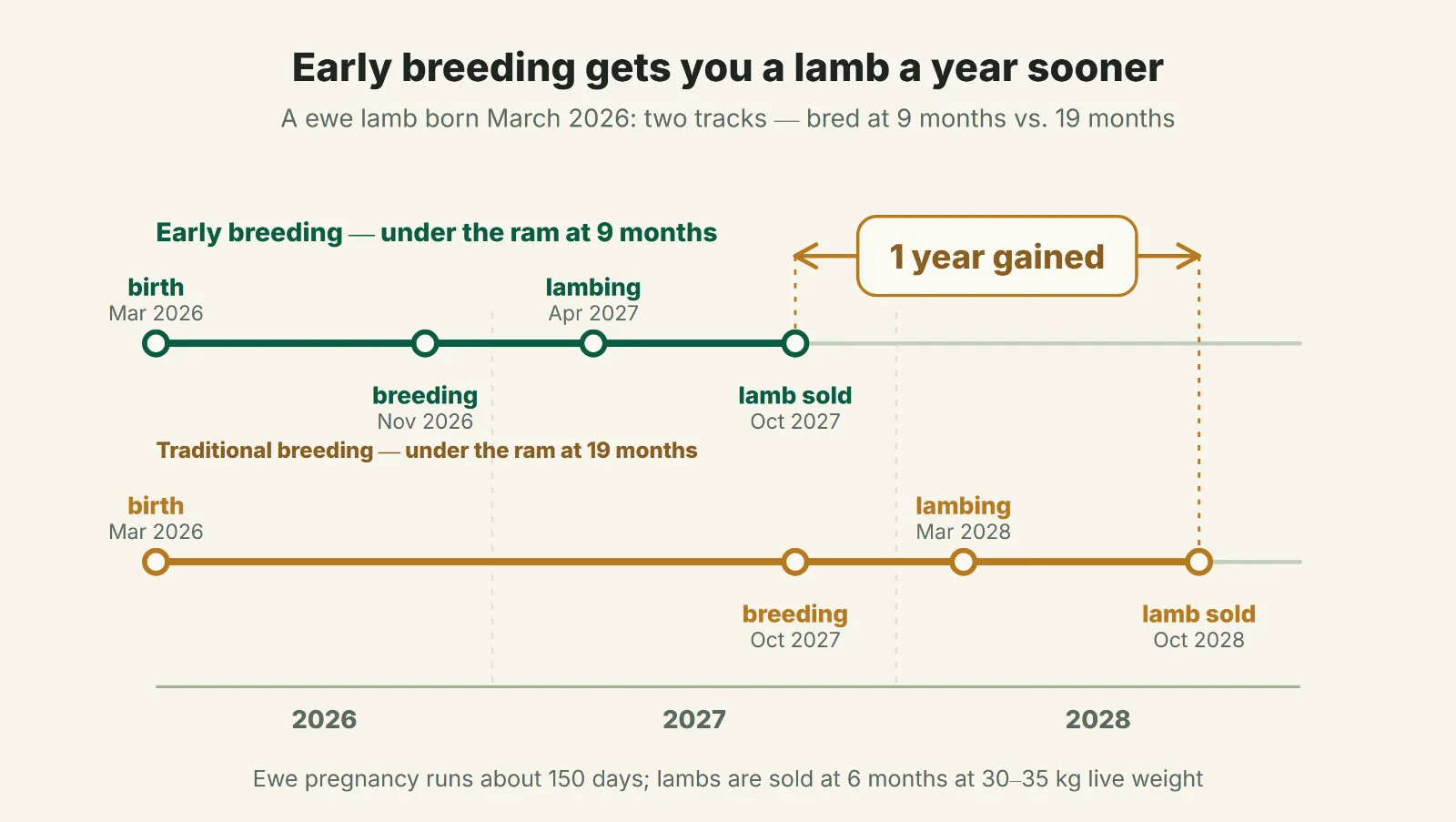
The arithmetic that follows is simple: a ewe lamb born in March 2026 and put under the ram at a year and a half — that is, in autumn 2027 — will deliver her first lamb in February–March 2028 and sell it in autumn 2028. A ewe lamb bred at 9 months, in November 2026, will lamb in April 2027, and her lamb will already be sold by autumn 2027. The difference is exactly one year — and one extra lambing over the ewe's lifetime.
Why the threshold is measured in kilograms, not months
A ewe doesn't come into heat by the calendar — she comes into heat by body mass: a ewe lamb reaches sexual maturity once she hits roughly two-thirds of adult weight. That's why the zootechnical standard is written not as "at 18 months" but as "no less than 65–70% of adult ewe weight" — this is how it's framed both in classic Soviet-era sheep-breeding manuals and in current breeding guides from the US, Australia, and New Zealand, where early breeding of ewe lambs is standard practice. Sources vary between 60% and 75% depending on the breed: the UK's AHDB treats 60% as sufficient, US extension services cite 65%, and for late-maturing breeds the benchmark climbs to 70–75%.
Age is a secondary factor in this rule. Take two ewe lambs from the same lambing — one got supplemental feed after weaning, the other grazed a burned-out pasture — and by November they differ by 12–15 kg. The first is ready for the ram, the second isn't, even though their papers show the same birth date.
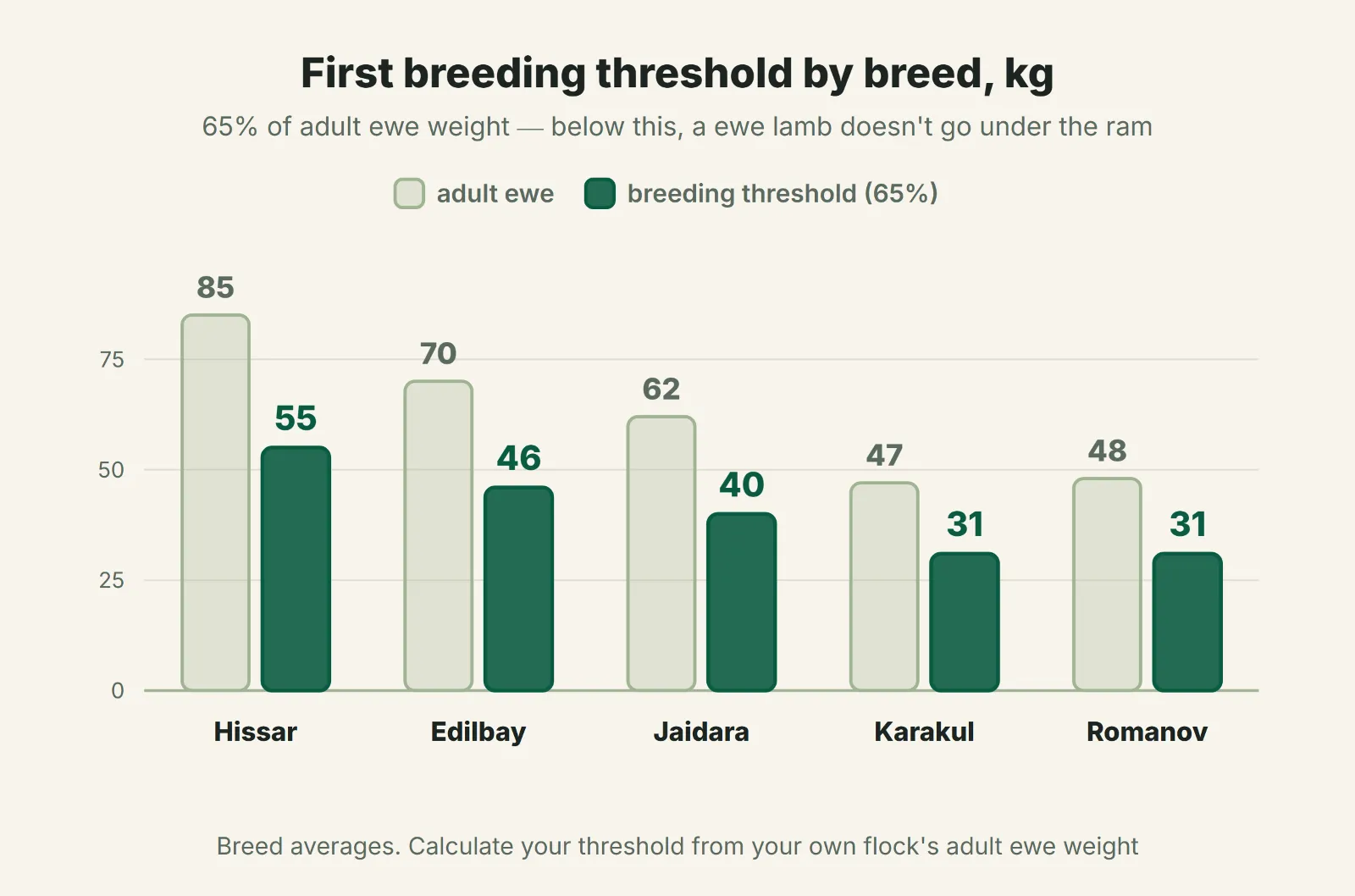
| Breed | Adult ewe, kg | Breeding threshold (65%), kg | Realistically reached |
|---|---|---|---|
| Hissar | 80–90 | 52–58 | 9–12 mo, only with supplemental feed |
| Edilbay | 65–75 | 42–49 | 9–12 mo |
| Jaidara | 60–65 | 39–42 | 8–10 mo |
| Karakul | 45–50 | 29–33 | 8–10 mo on good pasture |
| Romanov | 45–50 | 29–33 | 7–9 mo |
Uzbekistan's fat-tailed breeds grow fast in the first months: a Hissar lamb weighs 35–45 kg by weaning at 4 months. But after weaning, daily gain typically drops from 250–300 grams to 100–120, because the young stock moves onto shared pasture with no supplemental feed. It's exactly this stretch — July through November — where a ewe lamb loses her shot at early breeding.
Will your ewe lamb reach the threshold by November?
You check this with a scale, not by eye. Take a sample of ten ewe lambs, weigh them, and work out how many kilograms short of the threshold they are and how many days remain before breeding.
Take an Edilbay flock as an example. It's mid-August now, the ewe lambs average 38 kg, the threshold is 45 kg. About 80 days remain until breeding in early November. They're short 7 kg, which means they need a gain of at least 90 grams a day above what the pasture alone provides. On burned-out August pasture a sheep gains 50–80 grams on its own, so 300–400 grams of barley or cracked corn a day closes the gap.
The cost is modest: 0.4 kg of barley × 80 days × 3,800 so'm = 121,600 so'm per head (≈ $10). Barley, corn, and cottonseed meal are worth stocking up on ahead of the season — where to buy barley and cottonseed meal for supplemental feed is easy to find among the listings in the feed section.
It's worth logging weights per ewe lamb rather than eyeballing the flock as a whole — that way, by November you have a list of which ones cleared the threshold instead of a general impression. In the weighing and gain log it's two minutes per head, but a notebook works just as well if the flock is small and you keep it up honestly.
What a farm loses by breeding an underweight ewe lamb
Breeding a ewe lamb who hasn't cleared the threshold isn't "a bit worse" — it's a loss that follows her for life. Her body diverts nutrients to the fetus at the expense of her own growth, and she stays small for good.
- Adult weight is 5–8 kg lower — permanently. A small ewe eats less, but she also produces a smaller lamb.
- The lamb is 0.2–0.5 kg lighter at birth, and a light lamb copes worse with the first three days after lambing — exactly the window where a farm loses three-quarters of all lamb deaths.
- Difficult lambing. A narrow pelvis on a small first-time mother combined with a large fetus is a classic reason farms lose both the ewe and the lamb.
- Less milk, and the lamb falls 2–4 kg behind by weaning.
That gives a practical rule worth enforcing strictly: a ewe lamb below 60% of adult weight does not go under the ram, under any circumstances, even if she's already a year old. She simply grazes one more season and is bred the following autumn.
The second rule: don't pick the biggest ram for your ewe lambs. Put a mid-sized sire on first-time mothers — a half-kilogram difference in birth weight means nothing for an adult ewe, but for a small first-timer it means a difficult birth. Worth keeping in mind when buying a new sire — rams and sheep for sale in Uzbekistan usually list the animal's live weight, and for a first-timer flock you want it moderate.
What early breeding is worth in money: a 50-ewe-lamb calculation
We're calculating conservatively, adjusting for the fact that a first-timer isn't an adult ewe. Conception rates run lower in ewe lambs: of 50 head put under the ram, about 35 (70%) will conceive, twins are nearly nonexistent, and around 30 lambs will make it to the autumn sale.
| Item | Calculation | Amount |
|---|---|---|
| Supplemental feed for 50 ewe lambs to threshold | 0.4 kg × 80 days × 3,800 so'm × 50 head | −6.1 million so'm (≈ $510) |
| Feed for pregnant and nursing first-timers | 0.4 kg × 150 days × 3,800 so'm × 35 head | −8.0 million so'm (≈ $670) |
| 30 lambs a year early | 30 × 1.3 million so'm net | +39.0 million so'm (≈ $3,265) |
| Season total | +24.9 million so'm (≈ $2,085) |
That's about 500,000 so'm net per ewe lamb, against an outlay of 280,000. The net return is roughly 1.8 so'm per so'm invested, and it lands in a year, not three.
The figure "1.3 million so'm net per lamb" here is the same one we used in the cost per kilogram of lamb gain calculation: a 30–35 kg lamb at 55,000 so'm minus its own feed and treatments.
When early breeding is better left alone
The honest answer: it isn't for everyone, and there are three cases where you should skip it.
No winter feed or shelter. A pregnant first-timer eats for two through the winter while still growing herself. If hay and concentrate reserves are tight, early breeding means both the ewe lamb and the lamb come out of winter in poor shape. Count your hay reserve first, then decide on the young stock.
Open-range grazing on desert pasture. The Karakul flocks of Kyzylkum and Karnabchul physically can't put enough weight on a ewe lamb by her first autumn: pasture there sustains, it doesn't grow. There, breeding at a year and a half isn't falling behind — it's the correct call.
The flock is bred for breeding stock. If you're selling breeding young stock, chasing an extra lambing isn't worth it: buyers judge an animal's development, and an early-bred ewe lamb grows up smaller than her peers.
What to do in August and September
- Weigh every ewe lamb and log the weight per head, not a group average.
- Work out the threshold for your breed: 65% of the adult ewe weight in your own flock, not from a reference table.
- Split the young stock into two groups — "on track" and "not on track." The second group won't be bred this year, so there's no point spending on supplemental feed for them.
- Give the first group 300–400 grams of concentrate a day for 8–10 weeks before the ram, and keep it up for three more weeks after breeding starts.
- Run the ewe lambs as a separate group under a separate mid-sized ram — that way you know the lambing dates for certain and don't mix them in with the main flock prepped for breeding. Keep same-age ram lambs away from ewe lambs from 5 months on, or castrate the ones that stay in the mixed flock: an accidental breeding before the weight threshold throws off the whole calculation.
FAQ
At what age can a ewe lamb be bred for the first time?
Go by weight, not age: a ewe lamb is ready once she reaches 65–70% of her breed's adult ewe weight. For Edilbay that's about 45 kg, for Hissar 55 kg, for Karakul 32 kg. On normal feed that weight lands at 8–10 months; on thin pasture, not until a year and a half.
How much should a ewe lamb weigh before breeding?
Take the average weight of adult ewes in your flock and multiply by 0.65. For a typical Uzbek Edilbay flock that's 42–49 kg, for Hissar 52–58 kg, for Jaidara 39–42 kg. A ewe lamb under 60% of adult weight doesn't go under the ram under any circumstances.
Does early breeding really stunt a ewe?
It's not early breeding that stunts her — it's breeding an underweight ewe lamb. An animal bred before reaching two-thirds of adult weight stays small for good: adult weight ends up 5–8 kg lower, lambs are lighter, milk yield is lower. A ewe lamb who clears the threshold lambs normally and doesn't fall behind her peers afterward.
How many lambs does a first-timer produce?
Fewer than an adult ewe. Of 100 fat-tailed ewe lambs put under the ram, about 70 conceive, twins are rare, and roughly 60 lambs reach weaning. By comparison, a properly prepped adult flock delivers 105–115 lambs per 100 ewes.
When should the ram go in with the ewe lambs in Uzbekistan?
In early November, so lambing lands in April, when pasture growth is picking up. Breeding earlier pushes lambing into February–March, when a first-timer has neither the weight nor good feed available; breeding later means a May lambing and nursing on burned-out summer pasture.
Manage your flock in QoyHunterCRM for sheep farmers: livestock, health, weighing, finance and analytics — in the app and a Telegram bot.All features →