How Much Does It Cost to Keep a Sheep for a Year in Uzbekistan: The Full Cost Breakdown
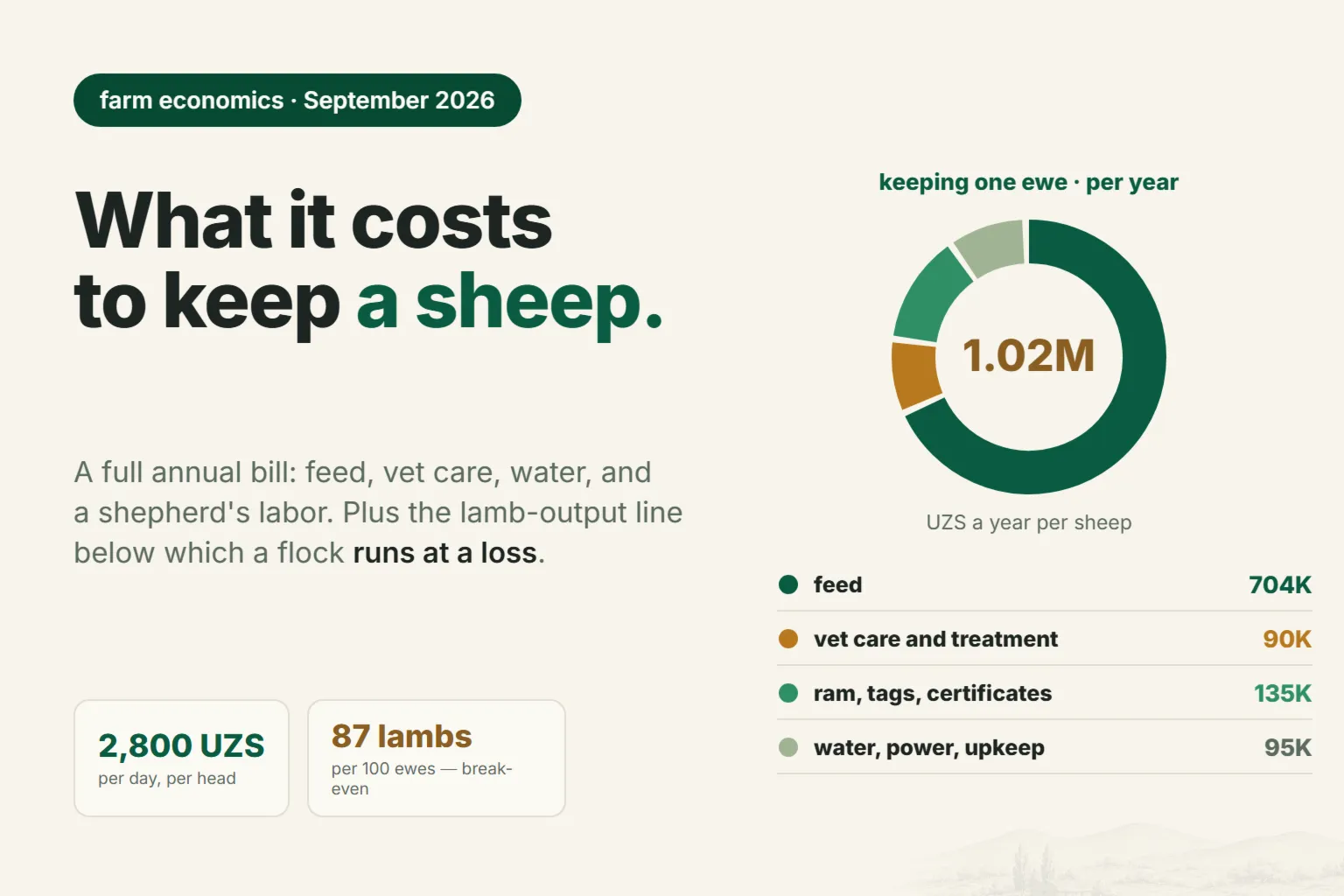
Keeping one ewe costs 1.02 million UZS a year (≈$87) on your own, and 1.20 million UZS with a hired shepherd. A full cost breakdown at September 2026 prices, plus the lamb output at which a flock breaks even.
Keeping one adult ewe in Uzbekistan runs to about 1.02 million UZS a year (≈$87) if you run the flock yourself, and 1.20 million UZS (≈$101) if a hired shepherd is on the payroll. Broken down to a daily rate, that's 2,800–3,280 UZS per head. Feed makes up a bit more than two-thirds of that sum; the rest is veterinary care, water, ear tags, and a share of the breeding ram — and, in the hired-shepherd version, labor on top of that. Those are exactly the line items most farms never add up.
Below is the full line-by-line breakdown at September 2026 prices, the daily and monthly cost per head, and the main takeaway: at what lamb output a ewe stops just feeding herself and starts feeding the farm. The exchange rate used here is 11,810 UZS per dollar (the official rate of the Central Bank of Uzbekistan on September 22, 2026).
How Much Does It Cost to Keep a Sheep for a Year in Uzbekistan?
We're costing an adult ewe of a fat-tailed breed (Hissar, Edilbay, Jaydara) on a lowland farm in Uzbekistan: 135 days of stall feeding, pasture the rest of the year. The stall-feeding period is the part of the year when pasture no longer feeds the flock and the owner supplies all the feed.
| Cost item per ewe | Calculation | UZS per year | ≈$ |
|---|---|---|---|
| Alfalfa hay | 300 kg × 1,300 UZS | 390,000 | 33 |
| Straw | 60 kg × 600 UZS | 36,000 | 3 |
| Concentrates (cottonseed meal, barley) | 45 kg × 3,500 UZS | 158,000 | 13 |
| Summer supplement feed and hay hauled to burned-out pasture | 16 kg concentrates + 30 kg hay | 95,000 | 8 |
| Salt, mineral lick, mineral supplement | year-round | 25,000 | 2 |
| Feed, total | 704,000 | 60 | |
| Vaccinations and deworming | 2 treatments a year | 50,000 | 4 |
| Reserve for treatment and vet call-outs | 40,000 | 3 | |
| Water and electricity | 60,000 | 5 | |
| Depreciation of the shed, feeders, waterers, scale | 35,000 | 3 | |
| Breeding ram: feed and depreciation | per 35 ewes | 65,000 | 6 |
| Ear tags, vet certificates, transport, supplies | 70,000 | 6 | |
| Total, own labor | 1,024,000 | 87 | |
| Hired shepherd: share of the position's cost | 52 mln UZS ÷ 300 ewes | 173,000 | 15 |
| Total, with hired shepherd | 1,197,000 | 101 |
A few notes on these line items. Straw is costed at 600 UZS/kg — that's your own straw or straw taken from the field in summer; a pressed bale from September 2026 listings runs higher, around 720 UZS/kg. Concentrates are taken at the lower end, priced as cottonseed meal: barley in September 2026 costs 3,800 UZS/kg. Ear tags aren't an optional expense: under Law of the Republic of Uzbekistan ZRU-1079, an animal must be identified within 14 days. The feed-stock norms come from our breakdown of winter feed reserves — the 300 kg of hay per adult head there is already calculated with a 20% buffer for storage and feeding losses. The full cost of a shepherd's position — 52 million UZS a year for a flock of 300 ewes — comes from the breakdown of shepherd's pay: the wage itself makes up less than 70% of that, the rest is food, housing at the sheep shed, phone and transport, and guard dogs.
If you've read our piece on what one barren ewe costs you, the annual bill there was almost half this — 590,000 UZS. There's no contradiction: that count covered only direct costs, feed and veterinary treatments. Here the count is wider — water, depreciation, a share of the ram, ear tags, and summer supplement feed are added in, and hay itself has gone up from 1,100 to 1,300 UZS per kilogram since July.
Prices in your own region will differ. Before you calculate your wintering costs, check hay, straw and cottonseed meal prices and plug your own numbers into the table: the spread between regions alone can swing the feed line by ±15%.
How Much Does It Cost to Keep a Sheep Per Month and Per Day?
An annual figure is hard to picture. A daily one isn't.
| Period | Own labor | Hired shepherd |
|---|---|---|
| Day | 2,800 UZS ($0.24) | 3,280 UZS ($0.28) |
| Month | 85,000 UZS ($7.2) | 100,000 UZS ($8.5) |
| Year | 1,024,000 UZS ($87) | 1,197,000 UZS ($101) |
Spending isn't even across months. During the stall-feeding period, one ewe costs around 5,300 UZS a day: nearly all the hay, all the straw, and almost all the concentrates land in those 135 days. On summer pasture, the same ewe costs about 1,350 UZS a day — salt, water, and a share of the fixed costs. That's exactly why you should buy your winter stock in summer, not scramble for it in December.
At What Lamb Output Does a Ewe Pay for Herself?
Lamb output per 100 ewes is how many lambs a farm got and kept alive to weaning, per hundred ewes put into mating. It's this number, not headcount, that decides whether a farm makes money or just eats through its own feed.
A ewe with a lamb weaned at 3.5–4 months produces offspring weighing 26–31 kg. Taking the midpoint — 28 kg — and a conservative autumn 2026 live-weight price of 55,000 UZS/kg, a lamb at weaning is worth 1.54 million UZS. But you need to subtract what the lamb ate along with its mother: extra feed for the nursing ewe (around 250,000 UZS) and the lamb's own starter feed (around 110,000 UZS). We worked out these figures in that same breakdown of the cost of a barren ewe. Net, one lamb at weaning brings in 1.18 million UZS ($100) — and that's the figure to set against a ewe's annual keep.
| Lamb output per 100 ewes | Net revenue per ewe | Result, own labor | Result, with shepherd |
|---|---|---|---|
| 70 | 0.83 mln UZS ($70) | −0.20 mln (−$17) | −0.37 mln (−$31) |
| 85 | 1.00 mln UZS ($85) | −0.02 mln (−$2) | −0.19 mln (−$16) |
| 100 | 1.18 mln UZS ($100) | +0.16 mln (+$13) | −0.02 mln (−$1) |
| 110 | 1.30 mln UZS ($110) | +0.27 mln (+$23) | +0.10 mln (+$9) |
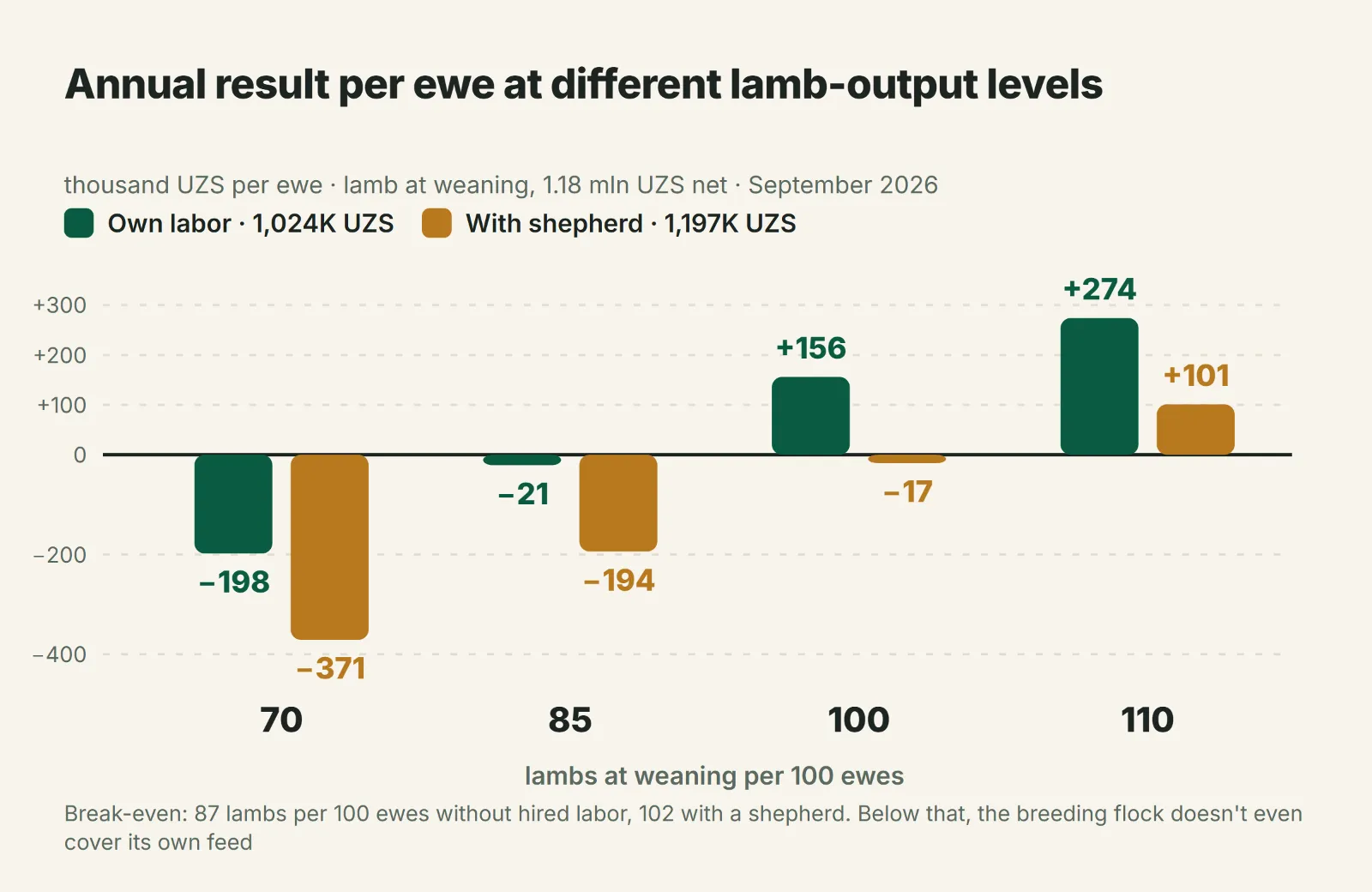
The break-even point: 87 lambs per 100 ewes for a farm without hired labor, and 102 lambs per 100 ewes with a shepherd. Anything below that, and you're feeding the flock out of your own pocket.
That's the main takeaway of this whole calculation, and it's harsher than most people assume. Where mating is left to chance, output sits at 70–85 lambs per 100 ewes — a flock like that doesn't even cover its own feed, and with a hired shepherd it loses 190,000 to 370,000 UZS per ewe a year. A well-run operation gets 105–115 lambs, and the gap between it and its neighbor isn't about breed or feed — it's about how many ewes went into mating barren and how many lambs made it to weaning.
An important caveat: weaning isn't the finish line. Most farms don't sell a lamb at 4 months — they finish it to 40–60 kg, and that's where the real earnings come from. What the calculation above shows is different: the breeding flock on its own barely covers itself, and a farm actually lives on what happens to the young stock after weaning.
What Adds More Money: Saving on Feed or More Lambs?
Three levers a farm can actually pull to move this number, all in the same unit: UZS per ewe per year.
| Lever | What you do | UZS per ewe per year |
|---|---|---|
| Lamb output up from 85 to 110 per 100 ewes | controlled mating, culling barren ewes, better lamb survival | +295,000 |
| Hay bought in summer, not in January | 300 kg at 1,300 UZS instead of 1,800 UZS | +150,000 |
| A third of roughage as urea-treated straw | 70 kg of hay replaced with straw for barren ewes and in early pregnancy | +49,000 |
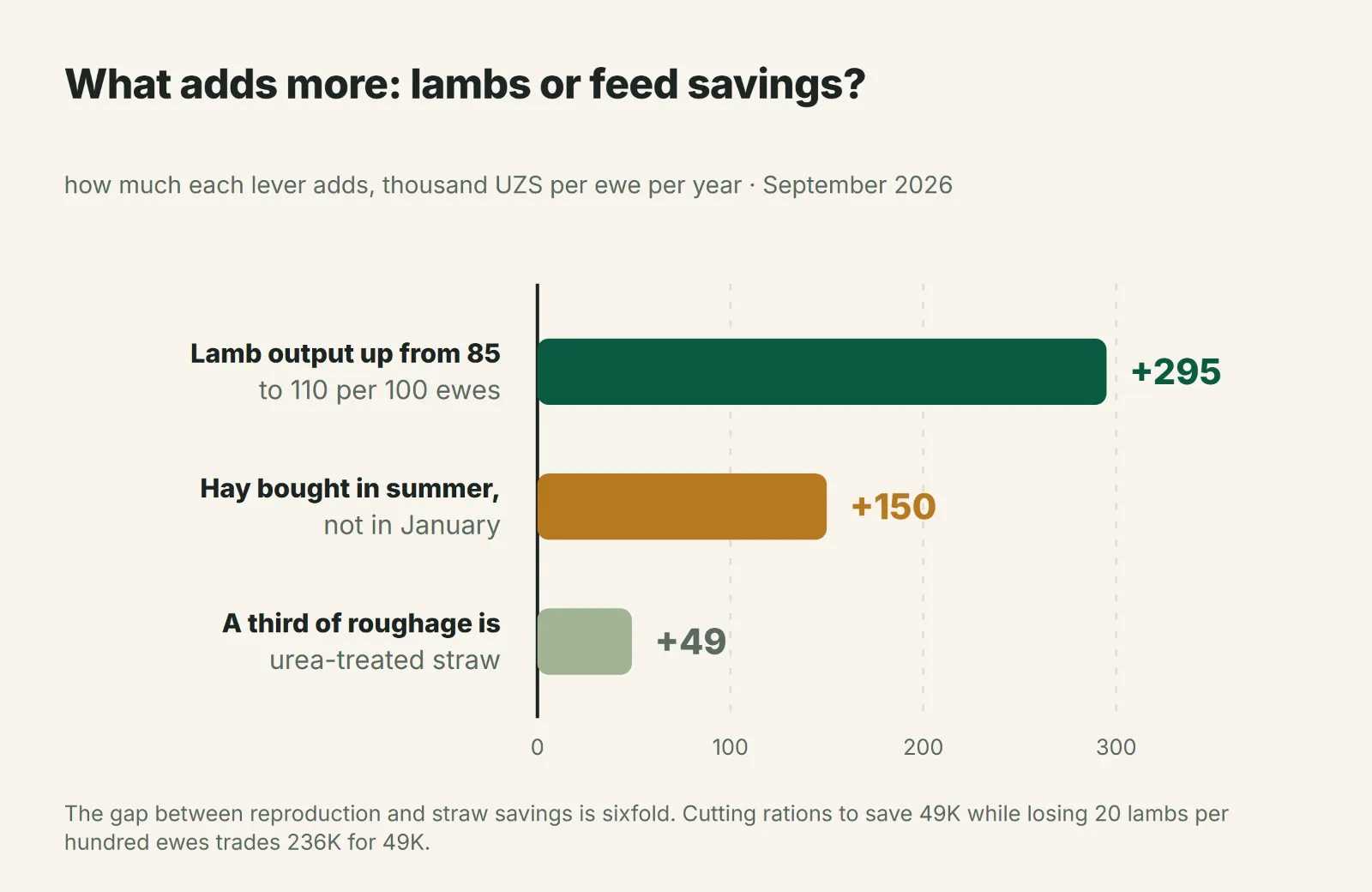
The gap between the first and third row is sixfold. Saving on feed is worthwhile, but it plays out in tens of thousands of UZS per ewe, while reproduction plays out in hundreds of thousands — which, across a flock of a hundred head, turns into tens of millions. A farm that cuts rations all winter to save 49,000 UZS per head — and loses 20 lambs per hundred ewes in the process — is trading 236,000 for forty-nine thousand.
The winter hay price is taken at 1,800 UZS per kilogram — the figure we quoted for January. The saving on treated straw is costed at the price of your own straw plus urea, around 600 UZS per kilogram — the treatment breakdown is covered separately.
What This Calculation Doesn't Cover
The figures above are the cost of keeping an adult ewe — nothing more. Three more line items fall outside this count, and you need to calculate them separately.
- Finishing a lamb after weaning. That's exactly where a farm actually makes money — but it comes with its own costs: young stock eats its own feed, and each kilogram of gain gets more expensive by the month. The phase-by-phase math, and the point past which feeding stops paying off, are in our breakdown of the cost of live-weight gain.
- Buying breeding stock and building a shed. That's a start-up investment, not an annual cost: it spreads out over years, and only shows up in the daily cost of a sheep as depreciation.
- Your own labor. In the "own labor" row, it costs zero — but that's a zero only on paper. If you spend three hours a day on the flock, an honest comparison of farm income isn't against zero, but against what those hours could earn elsewhere.
Worth remembering separately: a ewe works through 4–5 lambings and goes to slaughter at 5–6 years old, returning part of what was invested in her as live weight, though at a lower price than young stock. For a sense of the numbers, see sheep and ram prices in the listings.
How to Calculate This for Your Own Flock, Not Someone Else's Table
Everything above is a model. You have your own hay, your own watering point, your own shepherd, and your own lamb output, and the only way to find your real cost per head is to record spending by category all year round, not reconstruct it from memory in December. A notebook works fine while your numbers are small: a line for "bought 40 bales of hay" and a line for "paid the vet" add up by hand without much trouble over a year.
The complexity starts once you need to break spending down by animal group and compare two years side by side. That's where an operations log with categories helps — it's how expense tracking works in QoyHunter, a CRM for sheep record-keeping, and the bazar.qoyhunter.com marketplace; more on the page farm income and expense tracking.
FAQ
How much does it cost to keep one sheep per month?
Around 85,000 UZS a month ($7.2) without hired labor, and around 100,000 UZS ($8.5) if a shepherd works the flock. That's the average across the year: during the stall-feeding period, cost per head runs up to about 160,000 UZS a month, and falls to about 40,000 UZS on summer pasture.
Is it more profitable to keep 10 sheep or 100?
Per head, a hundred wins — but the gain is smaller than people assume. Economies of scale here only apply to the cost items that don't grow with headcount. The main example is the breeding ram: with ten ewes, he costs around 230,000 UZS per head a year; with thirty-five or more, it drops to 65,000 UZS — 3.5 times cheaper. Scales, waterers, and vet call-outs behave the same way. Feed, ear tags, and vet treatments, on the other hand, don't get any cheaper per head at all. Where a small operation wins is elsewhere: ten sheep are genuinely manageable with your own labor, no hired help — three hundred, no longer.
Can you keep a sheep for less than a million UZS a year?
Yes, if you have your own hay and full pasture access. The 704,000 UZS feed line is for feed bought at market price. Your own alfalfa and good pasture cut that roughly in half, dropping the annual cost per head to 650,000–700,000 UZS. But veterinary care, water, ear tags, and depreciation stay regardless.
How much does it cost to keep a breeding ram per year?
About 775,000 UZS ($66) on feed alone: a ram needs around 360 kg of hay and 70 kg of concentrates for the winter, plus straw and salt — noticeably more than a ewe. Add depreciation: a good breeding ram costs from 6 million UZS and works for 4 seasons. Spread across ewes at a ratio of 35 head per ram, that's the same 65,000 UZS a year you saw earlier.
What's the single biggest cost in keeping a sheep?
Hay. One line item — 390,000 UZS out of 1.02 million — makes up 38% of the entire annual cost per head. That's why the price you paid for your winter stock, and the month you bought it in, move a farm's economics more than any other single purchase all year.
Manage your flock in QoyHunterCRM for sheep farmers: livestock, health, weighing, finance and analytics — in the app and a Telegram bot.All features →