Sheep Vaccination Calendar: Month-by-Month Vaccination and Deworming Schedule
Prevention costs pennies; death loss costs millions. A year-round veterinary calendar for Uzbekistan: what the state vaccinates for free, when to deworm and when to vaccinate ewes, so you stop losing lambs and ewes.
Flock health is cheap for a farmer, if you pay for it in advance. A single dose of vaccine and dewormer costs a few thousand som per head, while one dead lamb or ewe costs 2–3 million som ($180–280) that you will never get back. The trouble is that a sheep hides illness until the very end, and clostridial diseases can kill within hours without a single symptom. That is why sheep farming runs not on treatment but on a calendar: a schedule of vaccinations and treatments known well in advance, keeping the flock protected all year round. We put it together for conditions in Uzbekistan, broken down by month, so you do not miss anything.
Why vaccination is cheaper than treatment
- A sheep hides illness. By the time the signs become obvious, treatment is often too late; we covered the symptoms in detail in the guide to sheep diseases.
- Clostridial diseases kill without warning. Enterotoxaemia ("pulpy kidney disease") and braxy often run their course so quietly that the animal is simply found dead. There is effectively no cure, only a vaccine.
- Worms do not kill outright, but they quietly eat into your profit. In an infested flock, daily weight gain drops by 20–40%, lambs are born smaller, and abortion and infertility rates rise. Fascioliasis (liver fluke) alone can cost a lamb up to 4 kg of weight gain a year.
- An infected animal responds poorly to vaccination; lasting immunity does not form. That is why treatments follow each other in a set order (more on this below).
What the state vaccinates for free
In Uzbekistan, vaccination against especially dangerous infectious diseases is mandatory and free for the owner: vaccines are purchased from the state budget, and the shots are given by the district veterinary team under the supervision of the State Committee for Veterinary and Livestock Development. Your job is simply not to miss the campaign and to keep your animals available on those days.
Such a program usually covers:
- Anthrax: typically once a year (twice a year in anthrax-prone zones); young animals start at 3 months.
- Sheep pox: a serious risk in our region (it causes abortion in pregnant ewes); lambs are vaccinated from 3 months, then annually.
- Brucellosis: on the veterinary service's schedule (it is also dangerous for humans and causes abortion).
- Foot-and-mouth disease (FMD) and peste des petits ruminants (PPR): timing depends on the epizootic situation. In spring 2026, due to an FMD threat, the country declared a livestock sanitary month (18 April – 18 May): FMD was recorded in 48 countries worldwide in 2025–2026.
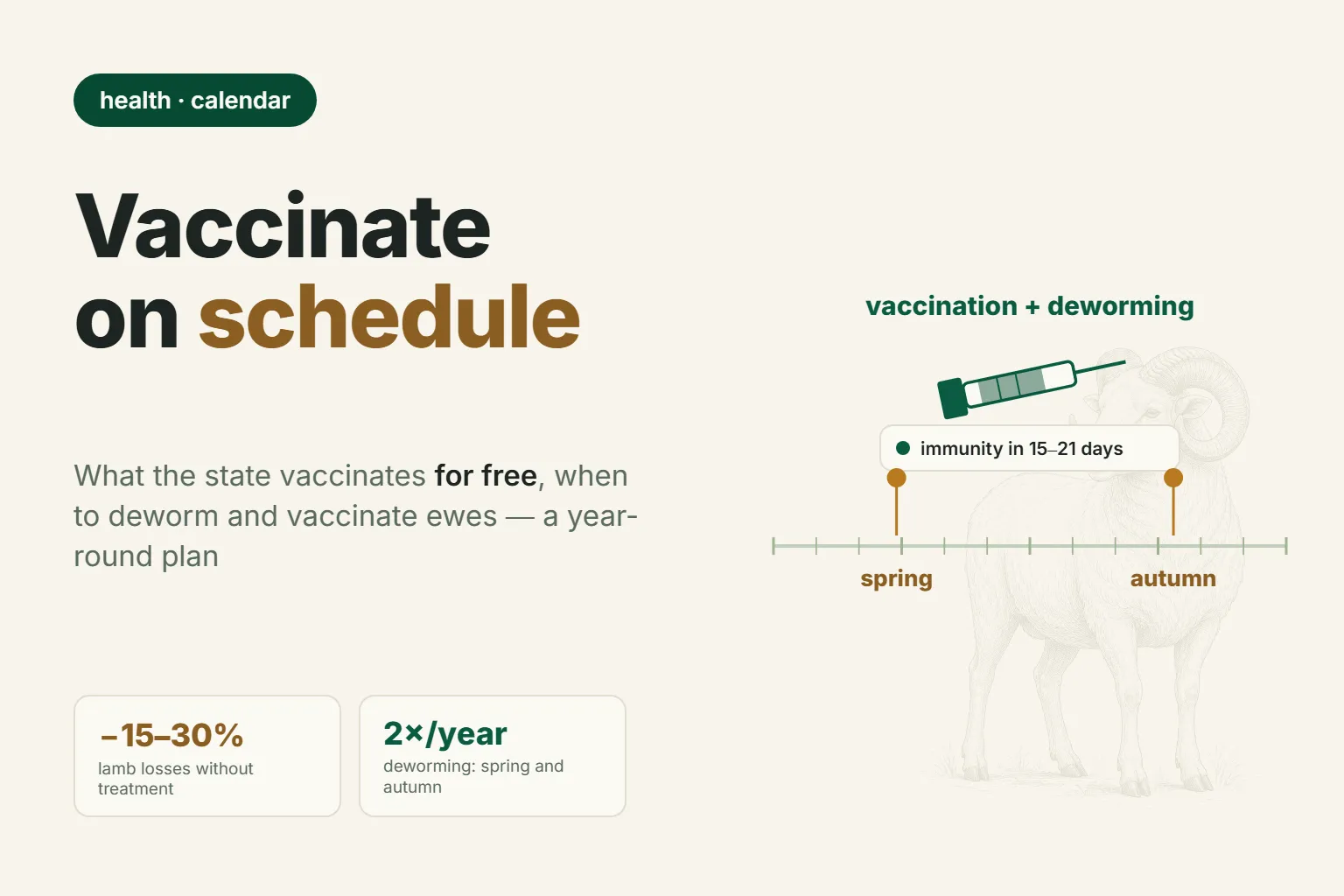
Immunity develops 15–21 days after vaccination; plan mating, sales, and transport with that in mind. Check with your district veterinary station for the dates of the spring and autumn campaigns and put them in your calendar: an animal that misses the campaign will have to be vaccinated separately, at your own expense.
What sheep pox looks like day by day, how to tell it from orf and what an outbreak costs an unvaccinated flock is covered in a separate article: sheep pox — signs, vaccination and the cost of an outbreak.
What is left to you: clostridial diseases and worms
Two treatments the state usually does not cover, but which cause the most frequent losses, are the farmer's responsibility:
- Clostridial vaccine (enterotoxaemia, braxy, malignant edema, lamb dysentery). One polyvalent vaccine covers the whole group. It matters most where animals are switched abruptly to rich feed (grain, lush grass, heavy milk intake): that kind of jump is exactly what triggers enterotoxaemia.
- Deworming: against gastrointestinal nematodes and fascioliasis.
Both cost pennies per head and pay for themselves with a single loss avoided.
How clostridial disease shows up in autumn feedlot lambs, and why the best-conditioned lamb dies first, is covered separately: enterotoxemia in sheep — signs, a pre-feedlot vaccination schedule and the cost of losses.
Deworming: when, with what, and in what order
The basic schedule is twice a year:
- In spring, before turnout to pasture (March–April), so the pasture is not seeded with worm eggs.
- In autumn, when animals go to the barn (October–November), to clear parasites picked up over the season.
On damp, contaminated pasture or under crowded housing, treat more often, up to 3–4 times a year, based on faecal test results. Fascioliasis on wet pasture and near water is a separate target: treat in autumn, about a month after the animals go to the barn, with a product that specifically targets liver fluke.
Three rules without which treatment does not work:
- Dose strictly by weight. Underdose and the parasite survives and grows resistant to the drug; overdose and you risk poisoning, which is especially dangerous for pregnant ewes. You can estimate live weight quickly with a tape; here is how.
- Rotate the active ingredient every 1–2 years (for example, alternating albendazole and ivermectin), otherwise worms build up resistance and the drug stops working.
- Worms first, then vaccine. In an infected animal, the vaccine does not produce lasting immunity, so deworming is done 2–3 weeks before vaccination.
The specific drug, dose, and schedule should always be confirmed by a veterinarian; this calendar shows when, but it does not replace a prescription.
Every date in this schedule needs lead time: you still have to buy the drug, book the vet, gather the group. That's why the reminder goes up before treatment day, not on it — how many days ahead to flag each deadline is covered in our article on 50 deadlines a year for a 50-ewe flock.
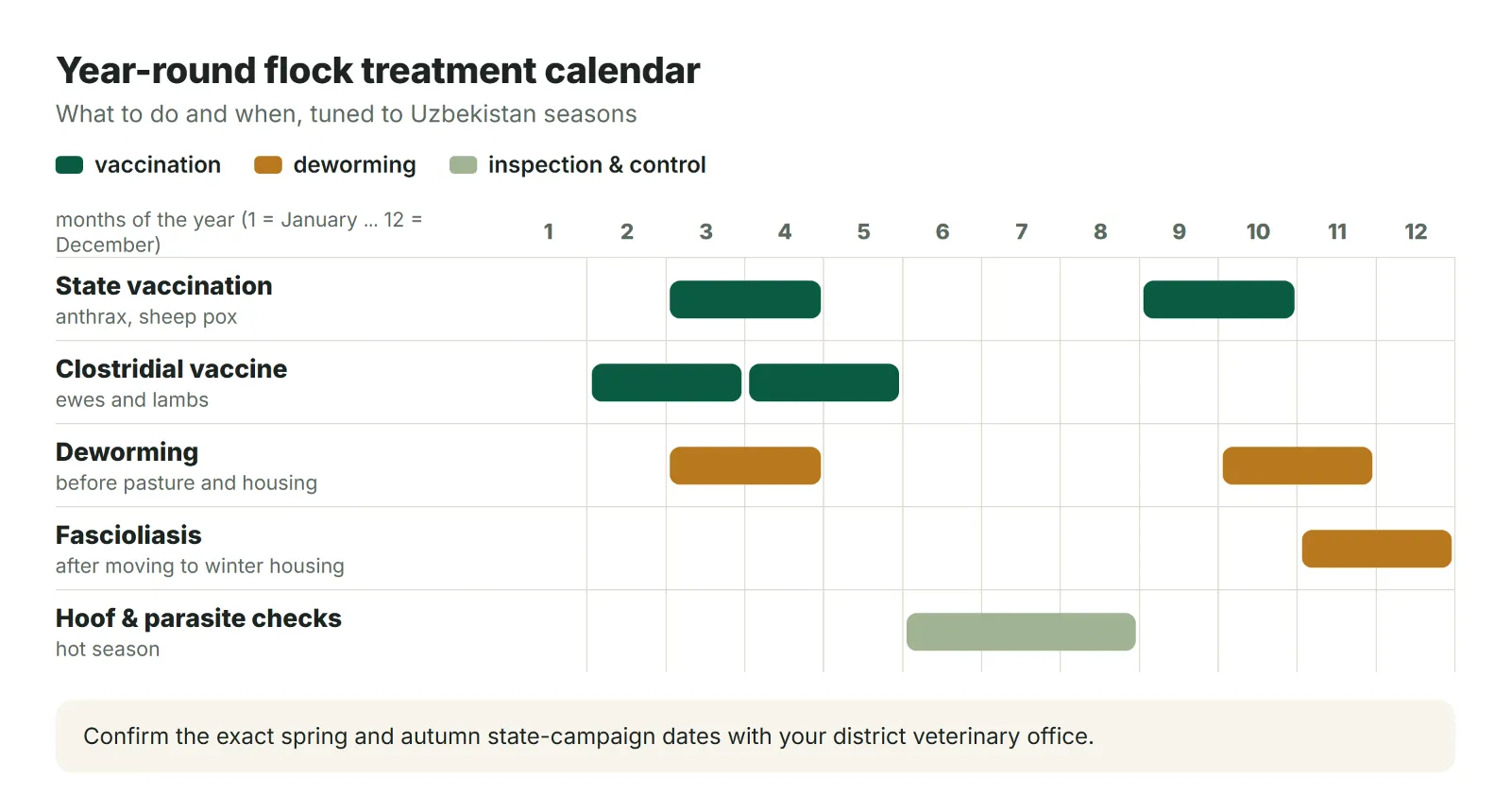
Month-by-month veterinary treatment calendar
| Period | What to do |
|---|---|
| February–March | Clostridial vaccine for pregnant ewes, 1.5–2 months before lambing |
| March–April | Deworming of the whole flock before pasture; spring state campaign (anthrax, sheep pox) |
| April–May | Lambing; first clostridial vaccination for lambs from 1.5 months, with a booster 3–4 weeks later |
| June–August | Check hooves and external parasites; on contaminated pasture, control deworming based on test results |
| September–October | Deworming before barn housing and mating; autumn state campaign; booster for young stock |
| November–December | Fascioliasis treatment about a month after barn housing begins; check winter housing conditions |
| Year-round | Quarantine new animals for 21–30 days; isolate sick animals; keep a record of treatment dates for each animal |
The veterinary service sets the dates of the spring and autumn state campaigns in your district; build the rest of your schedule around them, not the other way around.
A calendar only works while you're looking at it. To keep a date from getting lost in the day's work, it gets turned into a reminder: how vaccination and treatment notifications land straight in the chat is covered in our piece on the Telegram bot for farmers.
Why ordinary albendazole is no use against liver fluke in autumn, and how to spread three fluke treatments across the months, is explained in fasciolosis in sheep: how to treat liver fluke.
Pregnant ewe and lamb: the critical points
The most vulnerable members of the flock are the young stock, and protecting a lamb starts before it is even born.
- Pregnant ewe. The clostridial vaccine is given to the ewe 1.5–2 months before lambing (no later than 2–3 weeks before). This way the lamb gets ready-made immunity through the colostrum for its first, most dangerous weeks of life; it is the cheapest way to protect the offspring. It is best to deworm the ewe before mating and again before lambing.
- Lamb. The first clostridial vaccination should not come earlier than 1.5 months, with a booster 3–4 weeks later. Anthrax and sheep pox are given from 3 months, on the veterinary service's schedule. The first deworming of young stock is usually timed to weaning.
For lambing itself and care of newborn lambs, see our separate step-by-step guide.
What it costs NOT to vaccinate
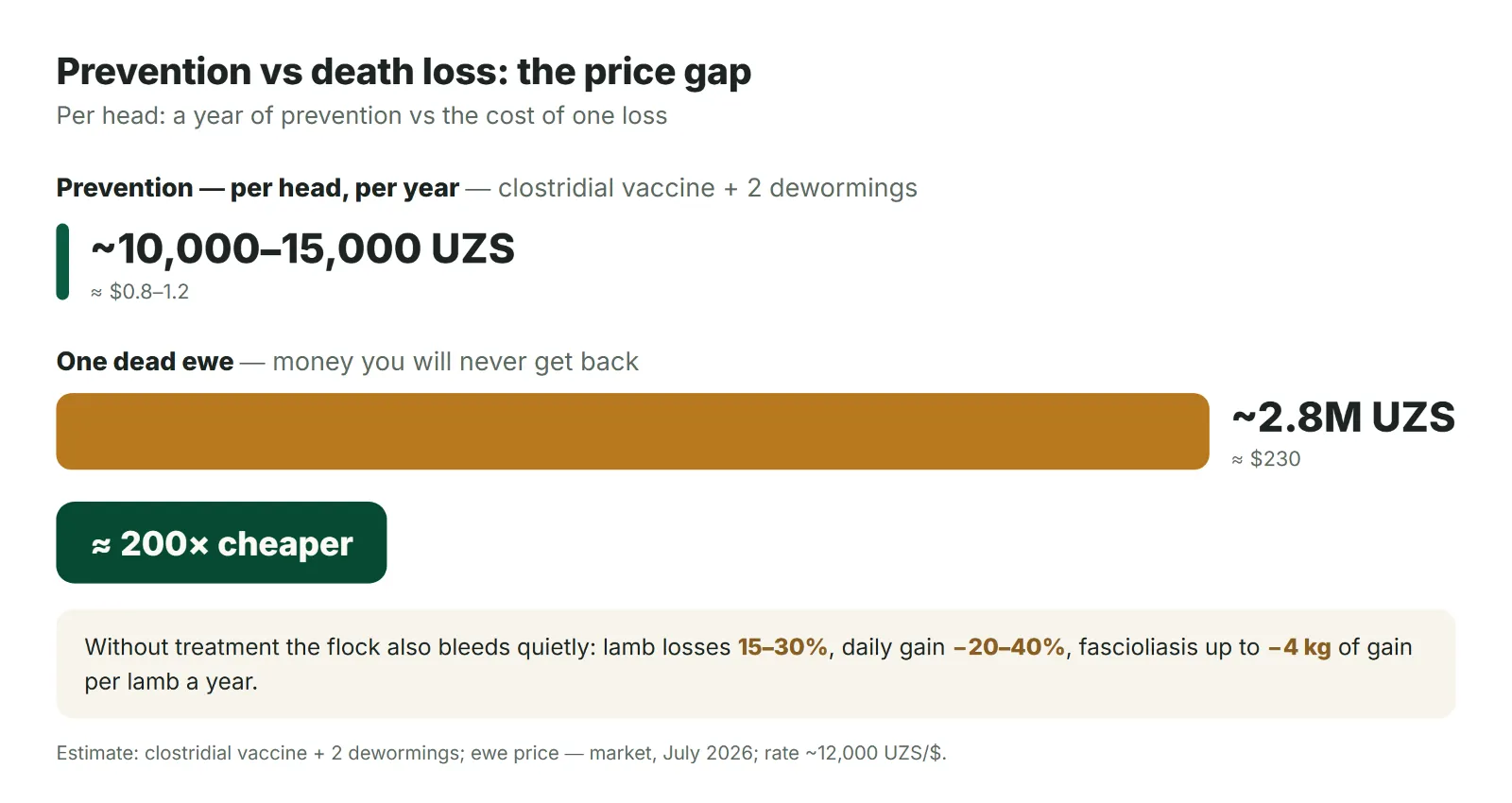
Let's calculate for a flock of 100 head (at roughly 12,000 som/$).
- Prevention. A clostridial vaccine plus two dewormings cost around 10,000–15,000 som per head a year ($0.8–1.2). For the whole flock, that is roughly 1–1.5 million som ($85–125) a year.
- The cost of a mistake. One dead ewe costs around 2.8 million som ($230), a lamb 2.2–3.4 million ($180–280). In an unvaccinated flock, during a clostridial outbreak or a severe worm infestation, losses among young stock can reach 15–30%. For prices on live animals, see our separate breakdown.
- Quiet losses even without any deaths. A 20–40% drop in daily weight gain in an infested flock, plus up to 4 kg of lost weight gain per lamb a year, adds up to millions of som in lost income across the flock, not just hundreds of thousands.
In other words, a year of prevention for the whole flock is often cheaper than a single dead animal. It is not an expense; it is insurance that pays for itself many times over.
In short: the annual checklist
- Find out the dates of the spring and autumn state campaigns from your district veterinary station (anthrax, sheep pox, and depending on the situation, FMD and PPR) and do not miss them; they are free.
- Spring: deworm before pasture turnout; give pregnant ewes the clostridial vaccine 1.5–2 months before lambing; start vaccinating lambs from 1.5 months.
- Summer: watch hooves and external parasites; on contaminated pasture, do a control treatment.
- Autumn: deworm when moving to the barn, plus a separate fascioliasis treatment; give young stock their booster.
- Year-round: quarantine new animals for 21–30 days, keep sick ones separate; dose by weight; rotate the active ingredient.
- Record treatment dates for every animal; otherwise, six months from now you will not remember who was vaccinated and when. How this kind of log works and what a missed treatment actually costs — in the article «How to Track Sheep Vaccinations and Treatments».
A calendar like this is easy to keep in a sheep vaccination calendar, a free flock record app for your phone: vaccinations, dewormings, and reminders about the next treatment for every animal. And if you are restocking or upgrading your flock, you can buy and sell healthy animals on healthy sheep for sale listings.
The calendar shouldn't be just for sheep: skip treating the farm dogs, and gid and echinococcosis come back to the flock every season — why lambs walk in circles and what to do about it.
In autumn, when young stock come off pasture and move into the shed, one more line joins the calendar — respiratory disease: why lambs cough in autumn and what it costs the flock.
Manage your flock in QoyHunterCRM for sheep farmers: livestock, health, weighing, finance and analytics — in the app and a Telegram bot.All features →