Lamb Pneumonia: Why Lambs Cough in Autumn and What It Costs the Flock
Lamb pneumonia hits fast after weaning, housing, or transport, and antibiotics only work if you catch it early. Learn to tell pasteurella pneumonia apart from lungworm and chronic pneumonia by temperature and breathing alone, what to do in the first 24 hours, and how much an autumn outbreak really costs — about 6.26m UZS per 100 weaned lambs.
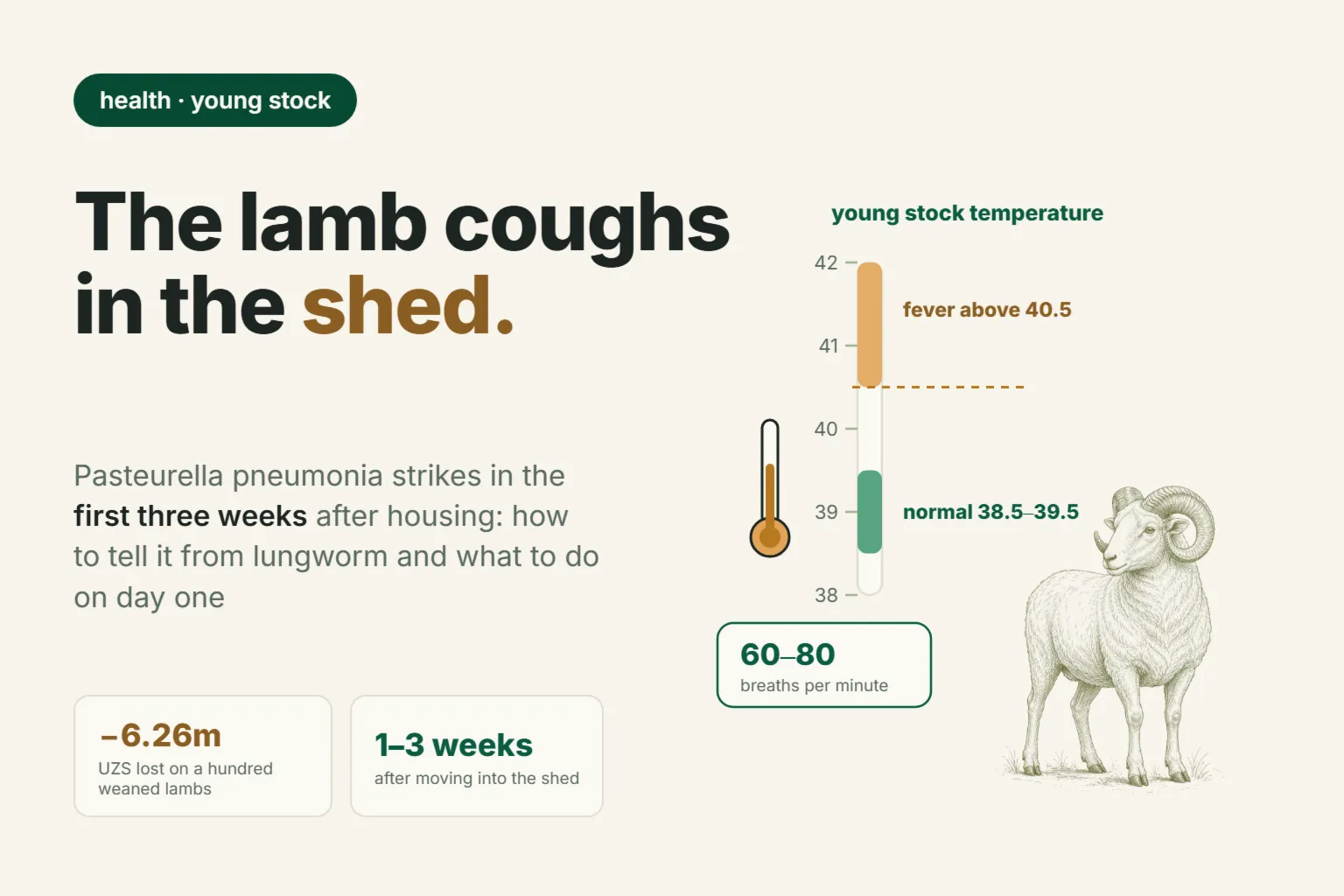
Lamb pneumonia usually starts in the first weeks after lambs get grouped together: brought back from pasture and housed, transported, bought for fattening, or weaned. A sick lamb falls behind the flock, stands with its neck stretched out, and breathes fast and hard — rectal temperature above 40.5 °C. That's acute pasteurella pneumonia, and it's a race against the clock: the later treatment starts, the higher the risk of losing the animal, and the acute form can sometimes kill before the signs even become obvious. A cough without fever is almost always something else — usually lungworm, and antibiotics won't touch it.
Below: how to tell them apart in five minutes in the pen, what to do in the first 24 hours, and what an autumn outbreak costs per 100 weaned lambs. Calculations use September 2026 prices; the Central Bank of Uzbekistan exchange rate on September 9, 2026 was 11,813 UZS per dollar.
Why lambs cough in autumn
Pasteurella pneumonia is an acute lung infection caused by the bacteria Mannheimia haemolytica, Bibersteinia trehalosi, and Pasteurella multocida. They live in the nasal passages of healthy sheep and only turn dangerous once the animal's defenses are down — on their own, they don't trigger disease. Pure pasteurellosis is rare: usually a virus or Mycoplasma ovipneumoniae damages the lung first, and the bacteria move in on already-weakened tissue.
What actually breaks down that defense is the autumn farm routine. According to the MSD Veterinary Manual, the disease most often flares up after recent stress — transport, weaning, a sudden feed change, or mixing animals from different farms. In September and October in Uzbekistan, all of this piles up at once:
- Housing. Lambs move from pasture into the sheep shed — feed changes, air changes;
- Temperature swings. In early September, daytime temperatures in the Tashkent region are still +28…+32 °C, but by month's end nights drop to +11…+13 °C — a daily swing of 15–17 degrees is normal here;
- Crowding. Lambs get penned together more densely than adult sheep;
- Ammonia and dust. In a closed sheep shed without ventilation, ammonia from the bedding burns the airway lining, clearing the way for bacteria;
- Transport and market purchases. An animal bought from another flock brings its own microflora with it;
- Late weaning. The lamb loses its mother's milk and the last of her passive immunity all at once.
That gives us the main practical rule for autumn: don't stack stresses. Space weaning, moving, transport, feed changes, and vaccination two to three weeks apart — don't cram them into the same day just because you finally got around to it.
How to tell lamb pneumonia from lungworm
In autumn, a coughing lamb in Uzbekistan usually has one of three different causes, and the treatment differs for each. Dictyocaulosis is a lungworm infection (Dictyocaulus filaria) picked up on damp pastures and near irrigation ditches; antibiotics do nothing against it.
| Sign | Acute pasteurella pneumonia | Chronic (enzootic) pneumonia | Lungworm (dictyocaulosis) |
|---|---|---|---|
| When | first weeks after housing, transport, or mixing groups | drags on for weeks in the sheep shed | late summer and autumn, after damp pastures and irrigation ditches; on lowland farms the risk continues into winter |
| Temperature | above 40.5 °C | 39.5–40.5 °C or normal | usually normal |
| Breathing at rest | markedly faster, belly moves with the chest | speeds up when driven | usually normal |
| Cough | rare, animal is listless | dry cough when driven | in fits, when driven and at night |
| Appetite | disappears immediately | preserved, animal "just falls behind" | preserved, but the lamb loses weight |
| Treatment | antibiotic and anti-inflammatory urgently, by veterinary prescription | antibiotic by prescription plus ventilation | dewormer: ivermectin, levamisole, albendazole |
If a lot of animals in the flock are coughing but everyone's temperature is normal, start with a fecal larvae test and deworming — we covered the drug classes and seasonal schedule in our article on worms and parasites in sheep. But chronic pneumonia also drags on without fever, so if the cough doesn't clear up after deworming, the lamb needs a re-check, not a second round of dewormer. If instead one or two lambs drop out of the group with fever and labored breathing, that's pasteurellosis, and it can't wait until tomorrow.
Signs you can't afford to miss
Take measurements in the morning, before moving the animals: after being driven around the pen, temperature and breathing rate rise even in a healthy animal.
- Rectal temperature. Normal for sheep is 38.3–39.9 °C (MSD Veterinary Manual). There's no separate reference range for lambs, so a reading at the upper end in an active, alert lamb shouldn't worry you. Fever is above 40.5 °C.
- Breathing at rest. Normal for sheep is 16–34 breaths per minute. Lambs breathe faster, but there's no exact reference range — compare against the same animal's usual state. With pneumonia, breathing speeds up noticeably, often above 60 per minute, and the belly moves with the chest.
- Appetite. With pasteurellosis, it disappears before the cough shows up. A lamb that skips the feeder matters more than one that coughs once.
- Behavior. Falls behind the group, stands with head down and neck stretched out, ears drooping.
- Nose and eyes. Mucous or foamy discharge that thickens by evening.
The sudden death of a well-fed 4–10-month-old lamb with no prior signs is also pasteurellosis — just the systemic form (Bibersteinia trehalosi). It hits recently weaned lambs hardest, peaking from September through December.
What lamb pneumonia costs the flock
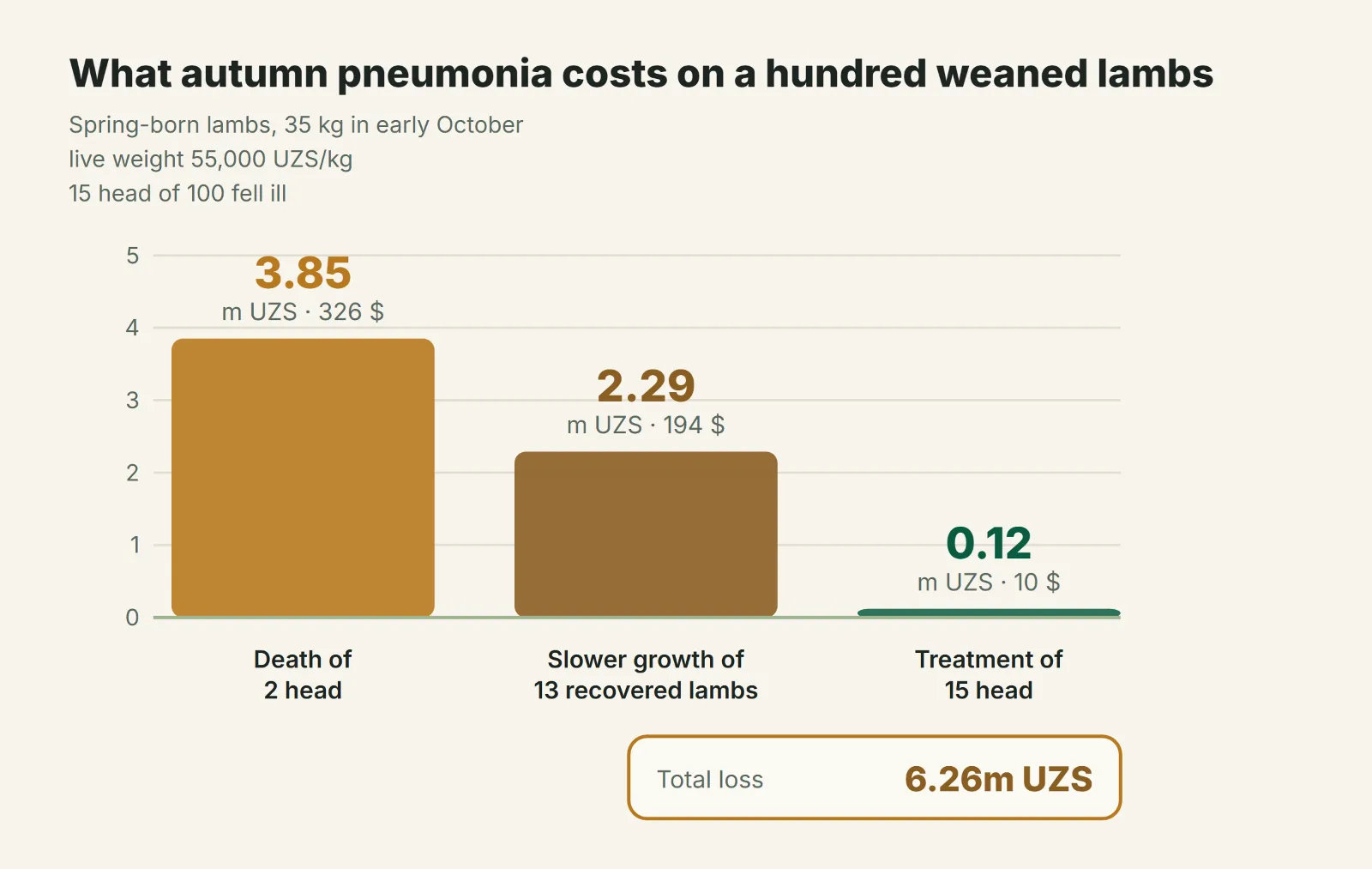
Let's run the numbers for 100 spring-born weaned lambs. By early October, such a lamb weighs around 35 kg, and at 55,000 UZS per kilogram of live weight — the low end of the autumn range of 55,000–65,000 UZS — it's worth 1.93m UZS (≈ $163).
Take a conservative scenario: 15 out of 100 get sick, two are lost, and the remaining thirteen recover but fall behind in growth.
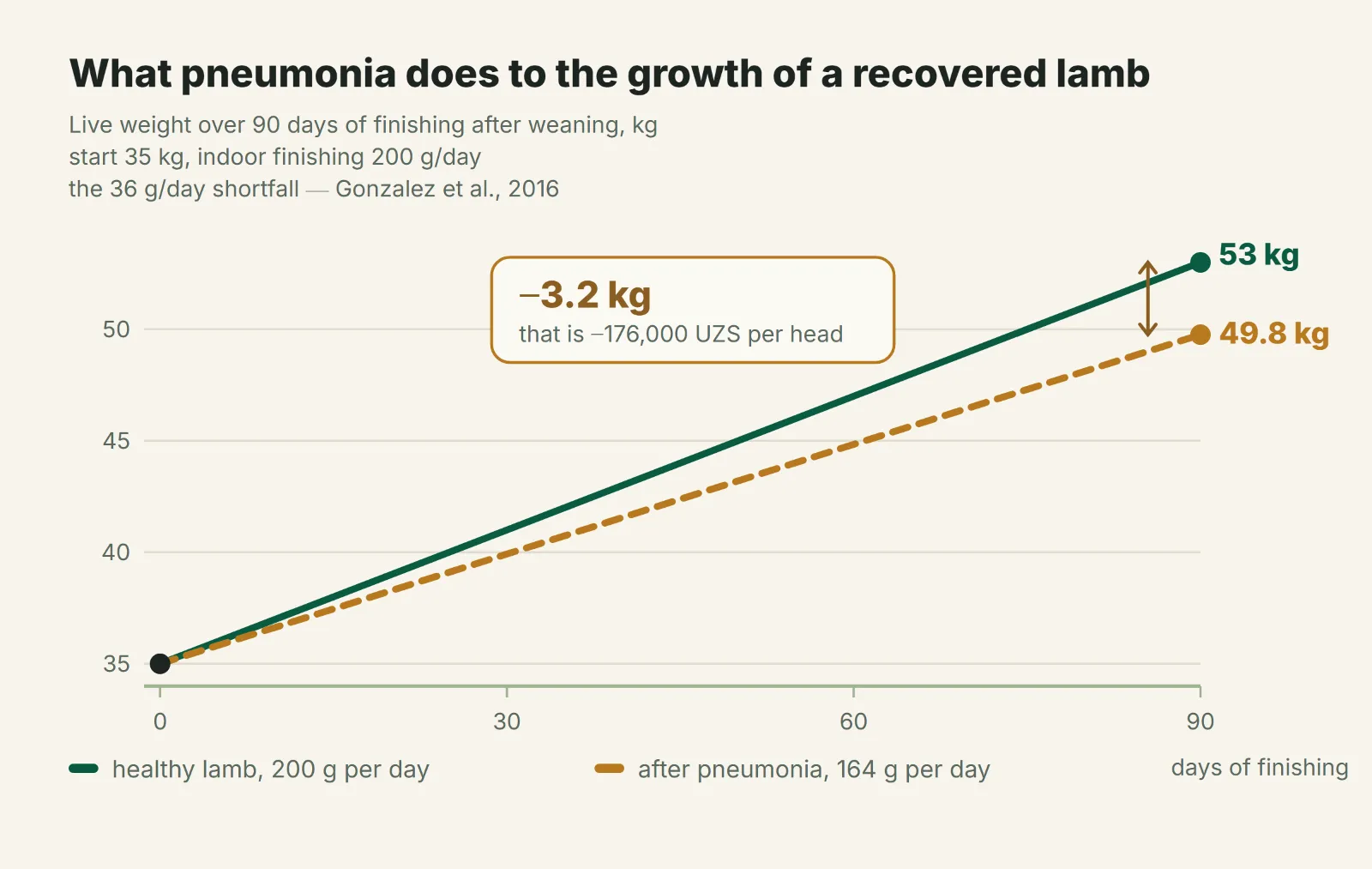
We don't eyeball the growth setback. Spanish research (González et al., 2016) found lambs with lung lesions gained on average 36 grams a day less than healthy ones, while work from Massey University in New Zealand (Alley, 1987; confirmed by Goodwin-Ray et al., 2004) puts the loss at around 1 kilogram a month for every 10% of lung surface affected. We use the conservative figure — 36 grams a day over the remaining 90 days of fattening.
| Loss item | Calculation | Amount |
|---|---|---|
| Death of 2 lambs | 2 × 1.93m UZS | 3.85m UZS ($326) |
| Growth lag in 13 survivors | 13 × 3.2 kg × 55,000 UZS | 2.29m UZS ($194) |
| Treatment for 15 lambs | 15 × 8,000 UZS | 0.12m UZS ($10) |
| Total per 100 weaned lambs | ≈ 6.26m UZS ($530) |
Materials for a full course — antibiotic plus anti-inflammatory — run about 6,000–10,000 UZS per head if the owner gives the injection; add a vet visit separately if you call one in. Notice the proportion: treatment costs just two percent of the total loss. What's expensive isn't the bottle of antibiotic — it's the lamb noticed too late and the quiet drop in liveweight gain among the survivors.
What to do in the first 24 hours
- Isolate the sick lamb. A dry spot, no draft, water nearby. One lamb with pasteurellosis in a shared pen will infect its neighbors.
- Check the temperature of the whole group. Look for fever, not cough — the number of sick animals is usually higher than the number coughing.
- Antibiotic — by veterinary prescription and strictly by the animal's weight. Per the MSD Veterinary Manual, working protocols are: long-acting oxytetracycline 20 mg/kg once (or 10 mg/kg every 24 hours), or florfenicol 20 mg/kg every 48 hours. For a 35 kg lamb, the dose of 20% oxytetracycline is about 3.5 ml — that's 1 ml per 10 kg of live weight; with a 30% formulation, the same math gives 1 ml per 15 kg. Never eyeball the dose: too little won't treat the infection, and too much damages the kidneys.
- Anti-inflammatory (flunixin, ketoprofen, meloxicam) in the first 24 hours brings down fever and labored breathing — the animal starts drinking and eating again.
- Reassess after 24–48 hours. If the fever hasn't dropped, the vet changes the protocol — the owner doesn't just add a second antibiotic on top of the first.
- Write down the injection date and the withdrawal period. The meat withdrawal period for these antibiotics isn't a few days — it's about a month or more: roughly 28–35 days for long-acting oxytetracycline, up to 39 for florfenicol. The exact figure is always on the label of the product you bought.
How to prevent an outbreak before the cold sets in
- Ventilation in the sheep shed. Air needs to rise and vent out, with no draft at the animals' back level; we worked out the numbers on floor space, ventilation, and bedding in our guide to sheep sheds.
- Dry bedding. Damp bedding produces ammonia, and ammonia opens the door to bacteria. Add fresh straw whenever your hand comes away dry from the bedding; stock up on hay, straw, and feed for winter through hay, straw and feed listings.
- Density. Keep lambs grouped by age and weight, not all together.
- Autumn deworming at housing time — it also clears out lungworm.
- Quarantine purchased animals for 21–30 days, separate from the flock.
- Pasteurella vaccine — only if given early. With two-dose vaccines, protection kicks in no sooner than two weeks after the second shot — roughly 6–8 weeks from the first injection (the interval between doses is 4–6 weeks). Single-dose vaccines, common across the CIS, claim immunity by day 10–15 with annual revaccination. This vaccine isn't part of Uzbekistan's mandatory state vaccination schedule, so check availability and the protocol with your district veterinary office.
- Keep records. Who got sick, what they were treated with and when, when the withdrawal period ends — without a record, all of this is forgotten within a week. At QoyHunter, our sheep management CRM and marketplace at bazar.qoyhunter.com, we keep this in a treatment log: drug, dose, and injection date, with a reminder set for the end of the withdrawal period. See how to keep a sheep vaccination and treatment log on the feature page.
Autumn pneumonia in lambs isn't bad luck — it's a scheduling problem. Space out housing, weaning, and transport, open up the ventilation, keep the bedding dry, and take the temperature of a lagging lamb the same day it falls behind — and that six million UZS stays in your pocket.
Doses, drug choice, and timing are always the vet's call. This article helps you catch the disease in time — it doesn't replace an exam.
FAQ
How can I tell if a lamb has pneumonia and not just a cough?
Look at temperature and breathing, not the cough. With pneumonia, rectal temperature is above 40.5 °C against a normal range of 38.3–39.9 °C, breathing at rest is noticeably faster than the usual 16–34 per minute, the belly moves with the chest, and the lamb stops eating. A cough with normal temperature and a good appetite is more often lungworm or dust, and it's treated with a dewormer, not an antibiotic.
What treats pneumonia in lambs?
An antibiotic prescribed by a vet, dosed strictly by the animal's weight. Working protocols from the MSD Veterinary Manual are long-acting oxytetracycline at 20 mg/kg once, or florfenicol at 20 mg/kg every 48 hours, along with an anti-inflammatory in the first 24 hours. For a 35 kg lamb, that's about 3.5 ml of 20% oxytetracycline. Check for improvement after 24–48 hours; if the fever persists, the vet changes the protocol.
Do I need to treat the whole group if one lamb is coughing?
Not the whole group — but you do need to check every animal that same day, thermometer in hand. Treat the ones with a temperature above 40.5 °C, even if they aren't coughing yet. Blanket antibiotic prophylaxis without a clear reason just breeds bacterial resistance and wastes money.
How many days after an antibiotic injection can the meat be sold?
Not before the withdrawal period on the product label has passed, and for these antibiotics it's long: roughly 28–35 days for long-acting oxytetracycline, up to 39 for florfenicol. Write down the injection date and the drug name — you won't reconstruct that from memory, and missing the withdrawal period means both meat quality complaints and a damaged reputation with your buyer.
Does the pasteurella vaccine actually help?
Yes, but only if given ahead of time. With two-dose vaccines, protection appears roughly 6–8 weeks after the first shot: two injections 4–6 weeks apart, plus two more weeks after the second one. Vaccinating in the middle of an outbreak is pointless — at that point it's the antibiotic and reducing crowding in the sheep shed that do the work. Check vaccine availability and the protocol with your district veterinary office; it isn't part of the mandatory state vaccination schedule.
Manage your flock in QoyHunterCRM for sheep farmers: livestock, health, weighing, finance and analytics — in the app and a Telegram bot.All features →