Gid in sheep: why a lamb walks in circles, and what an untreated dog costs the flock
Gid in sheep is coenurosis: the larva of a dog's tapeworm grows inside a lamb's brain. We break down the infection cycle, symptoms by stage, the cost of losses in so'm, and a farm-dog deworming schedule that shuts down both gid and echinococcosis at once.
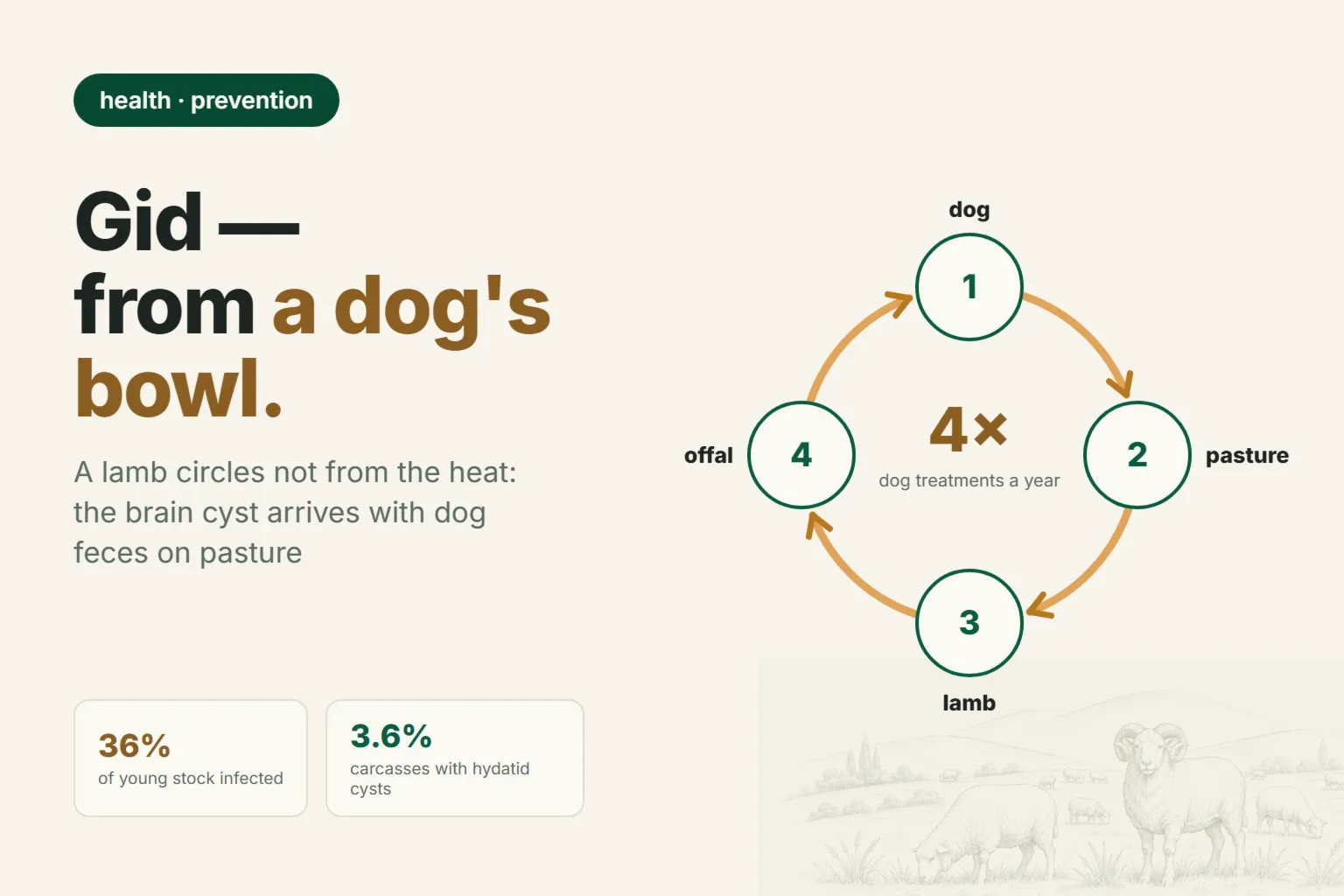
Gid in sheep is coenurosis: a cyst grows in the animal's brain — the larva of a tapeworm that lives in a dog's gut. A lamb walks in circles, presses its forehead against a wall, and goes blind not from heat and not "from nerves" — there's a mass in its brain anywhere from walnut-sized to the size of a chicken egg. It gets infected on pasture by swallowing the worm's eggs in dog feces, and the dog gets infected by eating the brain or offal of a dead sheep. The cycle closes at the barn, and there's exactly one place to break it — the dog.
What is gid (coenurosis) in sheep, and where does it come from?
Coenurosis (gid) is a disease of sheep in which a coenurus — the bladder-like larva of the tapeworm Taenia (Multiceps) multiceps — develops in the brain or spinal cord. The adult worm doesn't parasitize the sheep; it lives in the small intestine of the dog, wolf, jackal, or fox.
The infection cycle has four steps:
- A dog eats the head, brain, or offal of a dead or slaughtered sheep that had a cyst in it.
- In the dog's gut, an adult tapeworm grows in about a month and starts shedding eggs.
- The dog scatters eggs with its feces — on pasture, by the feed trough, in water, on hay drying in the yard.
- A sheep or lamb swallows the eggs along with grass and water. The larva breaks through the gut wall, travels through the blood to the brain, and over 2–3 months grows into a cyst filled with clear fluid.
The key thing to grasp right away: a sick sheep doesn't infect other sheep. It's the end of the line. An entire outbreak in a flock rests on one or two dogs fed raw offal, and on carcasses left lying in the field.
Why a lamb walks in circles: signs by stage
Gid in sheep unfolds in two waves, and in between, farms usually manage to forget about it entirely.
Early phase — 2–3 weeks after infection. The lamb is listless, falls behind the flock, its temperature rises, and there are sometimes convulsions and the head thrown back. Some of the weakest lambs die right here, and the deaths usually get written off as a cold or poisoning. The rest appear to recover.
Hidden phase — 2 to 6 months. The animal looks healthy but grows and eats worse than its peers. The cyst keeps growing during this time.
Overt phase — what people actually call gid. The signs depend on where the cyst sits:
- walking in circles toward the same side, always the same one — the most recognizable sign;
- pressing its head against a wall, feeder, or post and standing like that for several minutes;
- a head thrown back or drooping, an unsteady gait, stumbling on level ground;
- blindness in one eye — the animal bumps into things on that side;
- falling behind the flock, wasting away on normal feed, then lying down and dying.
Other diseases look similar: listeriosis, oestrosis (sheep botfly larvae in the nasal passages), poisoning, thiamine (B1) deficiency. You can't tell them apart by eye — a vet makes the diagnosis, and the diagnosis is what decides whether doing anything makes sense at all.
Who gets gid more often — lambs or adult sheep?
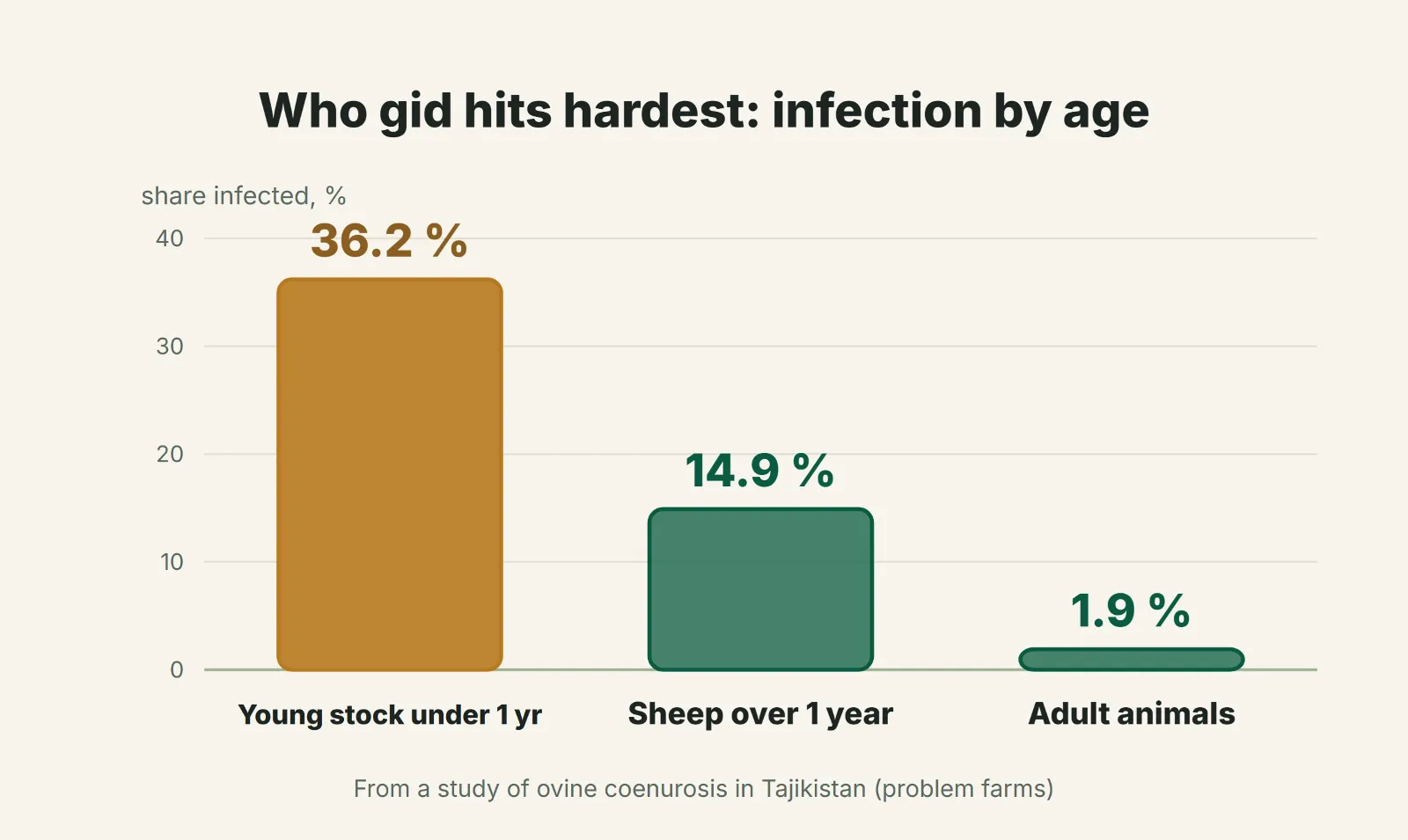
Gid is a disease of young stock. According to a study of ovine coenurosis in Tajikistan (where transhumant sheep-herding conditions are close to Uzbekistan's — the same pastures, the same farm dogs), infection rates by age break down like this:
| Sheep age | Share infected |
|---|---|
| Young stock under 1 year | 36.2% |
| Sheep over 1 year | 14.9% |
| Adult animals | 1.9% |
Overall infection rates in Tajikistan's central districts reached 26.5%, and 17% in the south. This is data from problem farms, not a national average: where dogs are dewormed and carcasses are cleared away, the numbers are an order of magnitude lower.
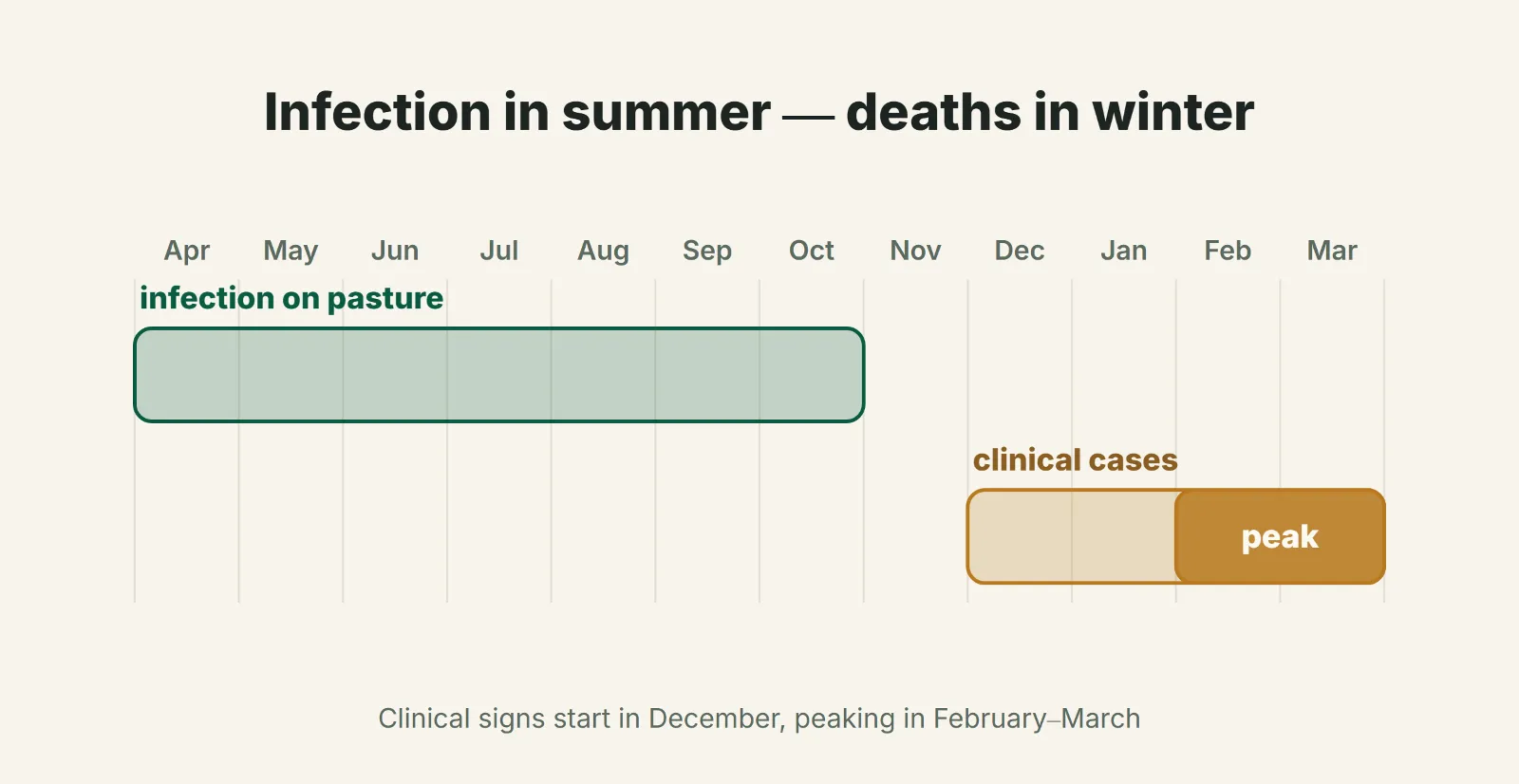
There's seasonality too. Lambs swallow the eggs during the grazing season, while clinical signs in the same study began to appear from December, peaking in February–March. In other words, the farm pays in winter for what it didn't do in spring and summer.
What gid costs the flock: a calculation for 100 ewes
Take a farm with 100 ewes that got 100 lambs. Per summer 2026 listings, young stock in Uzbekistan runs 2.2–3.4 million so'm (≈ $185–285), and a kilogram of live weight for a meat sheep is 55,000–65,000 so'm (≈ $4.6–5.5). The conversion rate is about 11,900 so'm per dollar (Central Bank rate as of August 18, 2026).
| Loss item | What happens | Money |
|---|---|---|
| Young stock deaths | 3 lambs reached the overt stage and died | 6.6–10.2 million so'm (≈ $555–860) |
| Weight shortfall | 5 lagging animals each lost 4 kg of live weight | 1.1–1.3 million so'm (≈ $92–109) |
| Organ disposal at slaughter | cyst-riddled liver and lungs go to waste | offal price + inspection |
| Care and treatment | separate housing, vet call-outs, surgery | at actual cost |
Three dead lambs is a conservative estimate: in a problem flock, where young-stock infection runs into the tens of percent, the count doesn't stop at three head. But even this minimal version costs the farm from 7.7 million so'm (≈ $650) a season — when all of it is prevented with a handful of pills for the dogs.
Can gid in sheep be cured?
The only method that actually works is surgery: the vet locates the cyst by symptoms and by softening of the skull bone, opens the skull, and removes the coenurus. Per the same Tajik study, the success rate of the operation is 84.6%. That's a high number, but it belongs to a surgeon's hands, not a farmyard: without diagnostics, sterile conditions, and skill, the intervention ends with the animal's death.
Medication protocols (high-dose praziquantel, albendazole, fenbendazole) are used, but they mainly work in the early stage, while the cyst is still small, and only a vet should prescribe them — by weight, with the timing worked out. Once a ewe has been walking in circles for a month, treatment is usually more expensive than the animal, and the farm settles the matter with a forced slaughter. That animal's head must not be given to dogs in any form — that exact move is how the farm starts a new cycle.
Echinococcosis: the same cycle, but it hits people too
The dog's gut isn't home to just one worm that's dangerous for the flock. The second is echinococcus (Echinococcus granulosus), and its cycle is exactly the same: the dog eats raw offal, the sheep swallows eggs on pasture, and cysts grow in its liver and lungs.
How common this is in Uzbekistan was shown by an inspection at a Tashkent slaughterhouse: per a published study of echinococcus infection in Uzbekistan, from July 2009 through June 2010 veterinarians examined 22,939 sheep, finding cysts in the liver in 2.1% (479 head) and in the lungs in 1.5% (340 head) — a total of 3.6% of animals affected. Every liver like that goes to waste.
And the key difference between echinococcosis and gid: it's dangerous to people. Per the same study, from 2002 to 2010, 14 emergency-care hospitals in Uzbekistan performed 8,014 operations for echinococcosis; the liver is affected most often, followed by the lungs. WHO estimates that in endemic areas, human cystic echinococcosis incidence exceeds 50 cases per 100,000 people a year, and in some parts of Central Asia infection levels reach 5–10%. People don't get infected from the sheep or from mutton, but from the dog — through eggs that land on hands, in water, or on food.
How to break the cycle: a dog-deworming schedule and rules for dead animals
Everything you need to do fits into five points. None of them cost much.
1. Deworm the farm dogs on a schedule. Praziquantel works against tapeworms; for dogs it's dosed at 5 mg per kg of body weight — per Companion Animal Parasite Council guidance, this dose clears the intestinal stages of echinococcus. The standard schedule for guard and shepherd dogs is at least 4 times a year. Where dogs regularly get at offal, the interval is cut to 6 weeks: that's exactly how long it takes echinococcus to go from ingestion to the first eggs, and at that interval, a control program in Uruguay broke parasite transmission completely. The specific drug, the dose by the dog's weight, and the interval should be set by a vet.
| When | What you do |
|---|---|
| March, before heading out to pasture | treat all the flock's dogs |
| June | repeat treatment mid-grazing-season |
| September, on return from summer pasture | treat alongside the flock's fall deworming |
| December, when settling in for winter | treat before the barn period |
2. No raw meat or offal for dogs. The head, brain, liver, and lungs of a dead or slaughtered ewe are exactly the path the worm takes back to you. Dogs should only get thoroughly boiled feed.
3. Dead animals aren't left in the field. The Republic of Uzbekistan's Law "On Veterinary Medicine" classifies animal carcasses as biological waste, and permits their handling and disposal only based on a veterinary-sanitary examination (Article 23) — meaning the state veterinary service handles it, not a shovel behind the barn. A carcass on pasture isn't something "nature will take care of" — it's a free dining hall for dogs and jackals for the whole area.
4. Slaughter under veterinary inspection. Checking the liver and lungs at the slaughterhouse catches echinococcus cysts, and at the same time shows you the real picture for your own flock.
5. Keep a count of the dogs. The more dogs there are, and the more strays among them near the barn, the more densely "seeded" the pasture becomes. Stray dogs shouldn't be allowed near feeders or water troughs.
All of this only works once the treatments stop getting lost: dogs get treated four times a year, not "we gave something back in spring, I think." A notebook doesn't hold up for that, so at QoyHunter — a record-keeping CRM for sheep, plus the marketplace at bazar.qoyhunter.com — we built it so treatments sit on a calendar and remind you on their own: the flock vaccination and treatment log keeps both dates and past drugs on record. We covered the flock's own seasonal deworming schedule in detail in our article on worms and parasites in sheep, and vaccination timing in the vaccination calendar.
Which is cheaper — prevention or losses?
The comparison is simple. On one side — three to four dog treatments a year and a ban on raw offal. That's the price of a few pills from the vet pharmacy, which, by the way, also stocks the rest of the flock's medications: it's easy to pick them up through veterinary-supply listings instead of driving to the district center.
On the other — from 7.7 million so'm (≈ $650) a season on just three lambs, plus liver and lungs disposed of at slaughter, plus the risk of surgery for someone in the family. The gap between those two columns is exactly the price of discipline: not feeding dogs raw offal, clearing away the dead, and never skipping a treatment.
FAQ
Why does a lamb walk in circles in one direction?
Most often it's gid — coenurosis. The cyst-larva presses on one hemisphere of the brain, and the animal keeps turning toward the side opposite the lesion. Listeriosis and other brain conditions produce the same sign, which is why a vet has to make the diagnosis: it determines whether you treat the animal or send it for forced slaughter.
Can dogs be given the heads and offal of slaughtered sheep?
No — not raw, and not "lightly boiled" either. The head and internal organs are exactly where the dog picks up the cyst, and within about a month it starts shedding eggs across the whole pasture. Dogs should get only thoroughly boiled feed, and the head and organs of a slaughtered animal should be disposed of.
How many times a year should farm dogs be treated?
At least four times a year — usually in March, June, September, and December. On a problem farm that's already had an infection, the interval is cut to 6 weeks. Praziquantel is used against tapeworms at 5 mg per kg of the dog's weight; the drug, exact dose, and schedule should be set by a vet — you can't handle this by self-medicating the farm dogs.
Can gid spread from one sheep to another?
No. A sheep is a dead-end host: it doesn't pass the disease to other sheep through contact or through feed. New cases in the flock only appear through dog feces, so isolating a sick ewe doesn't stop an outbreak — treating the dogs and clearing away dead animals does.
Is the disease dangerous for people?
Coenurosis is extremely rare in people, but echinococcus, which lives in the dog right alongside it, is genuinely dangerous: from 2002 to 2010, Uzbekistan's emergency-care hospitals performed 8,014 operations for it. People get infected not from the meat but from the parasite's eggs: after contact with a dog they end up on hands, in water, and on food. Hence the simple rules: wash your hands after handling dogs, keep children away from untreated farm dogs, and don't feed those dogs raw offal.
Manage your flock in QoyHunterCRM for sheep farmers: livestock, health, weighing, finance and analytics — in the app and a Telegram bot.All features →