How to Track Sheep Vaccinations and Treatments: A Log, Due Dates, and the Cost of a Missed Vaccination
A flock health log: what to record, why a notebook falls short of a spreadsheet or an app, and how much one missed treatment actually costs. A calculation for 100 head at August 2026 prices.
How do you track sheep vaccinations and treatments? Keep a log where every animal has a record of what it was given, which drug, on what date, and when the next treatment is due. You can keep it in a notebook, a spreadsheet on your phone, or an app — the format matters less than three things: the record is tied to a specific sheep, it has a due date for the next treatment, and the cost of the drug lands in your farm's expenses.
This isn't about paperwork for its own sake. In Uzbekistan in 2026, a single dose of dewormer costs a few hundred sum per head, while one dead ewe costs 2–3 million sum (≈ $170–250 at the Central Bank's rate of 11,891 sum per dollar on August 17, 2026). A log exists for exactly one reason: so the first number never turns into the second.
What a Flock Loses When a Treatment Is Missed
A missed treatment rarely looks like a disaster. It looks like: "the lambs just aren't gaining well this year."
Let's break this down for a flock of 100 ewes and 40 lambs on feed. In a flock with intestinal worms, daily weight gain drops by 20–40% — we cover this in detail in our article on worms and parasites in sheep. Let's take a cautious middle figure, 25%:
| Metric | Treatment done | Treatment missed |
|---|---|---|
| Lamb weight gain | 200 g/day | 150 g/day |
| Over 90 days on feed | 18 kg | 13.5 kg |
| Across 40 head | 720 kg | 540 kg |
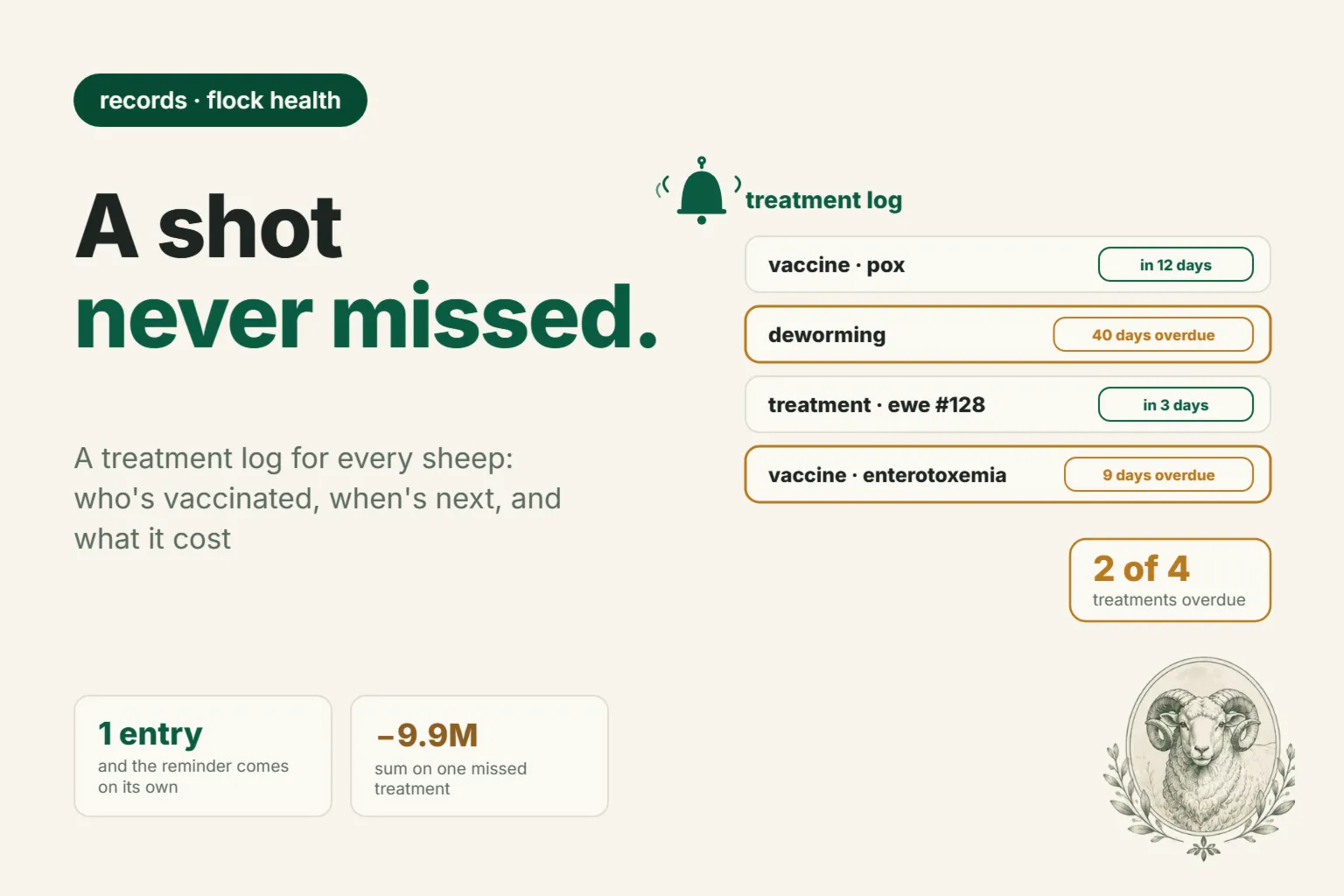
| Difference in money (55,000 sum/kg live weight) | — | −9.9 million sum (≈ −$830) |
The treatment itself would have cost about 140 head × roughly 300 sum = 42,000 sum (≈ $3.5). Based on 1% ivermectin: a 100 ml bottle listed on bazar.qoyhunter.com on August 17, 2026 costs 30,000 sum, and per the label, a 50 kg adult sheep needs about 1 ml.
That's the price of one forgotten line in a calendar. The second scenario is faster and far more costly: clostridial diseases (enterotoxemia, braxy) can kill a sheep within hours, and there's effectively no cure — only a timely vaccine. A missed vaccination here costs you the whole animal.
There's a third effect, one people only think of at sale time. Buyers and traders ask what the animal was treated with and when. A farm that can answer "here's the record: July 29, the whole flock was dewormed" negotiates with a lot more confidence than one that answers "I think we did something back in spring."
Why a Notebook Breaks Down Specifically on Health Records
A notebook is a perfectly fine tool, and for 10–15 head it's honestly enough — the owner recognizes every sheep by sight, and there's not much to write down. The trouble doesn't start with the number of head; it starts with the nature of veterinary care itself.
- A notebook is organized by date, but you need the history by animal. To find out whether ewe #128 has been vaccinated and what she was treated with for lameness back in May, you'd have to flip through six months of entries. In practice, nobody flips back — they just ask the vet again or give the shot a second time.
- Every treatment has a "tail," and it lives in your head. Immunity after a vaccination builds up over 15–21 days, deworming happens twice a year, a course of treatment runs several days in a row, and young stock need a booster shot a month later. A notebook doesn't remind you of any of this — it just sits closed.
- Vet spending never adds up. One bottle bought in March, another in July, the vet called out in May — most farms don't even have a rough idea of what they spent on flock health over the year. And that's usually the second or third biggest expense line after feed.
- Only one person writes anything down. The shepherd treats the flock out in a distant pen and mentions it out loud that evening — and it makes it into the notebook maybe two times out of three.
A spreadsheet on your phone solves the first problem and half of the third: you can filter by animal number, and the totals add up. But a spreadsheet can't remind you of anything, and filling it in one-handed inside a sheepfold is an acquired taste.
Notebook, Spreadsheet, or App: What Fits Your Flock Size
| What you need from a log | Notebook | Spreadsheet (Excel / Google) | App with a health log |
|---|---|---|---|
| Find one sheep's full history | flip through by hand | filter by tag | filter by animal |
| Remind you of a due date | no | no | yes, ahead of time |
| Add up medicine costs | by hand | with a formula | automatically, in overall finances |
| Log it in the sheepfold from your phone | yes (if it's not raining) | awkward | yes |
| Visible to two people — owner and worker | no | if you set up access | yes, by role |
| Price | a few thousand sum | 0 sum | from 0 sum |
Honest bottom line: up to 20–30 head, you won't feel the difference — use whatever's already at hand. Beyond that, it's not convenience that decides, it's memory: the more head you have and the more different due dates you're tracking, the higher the odds that one treatment slips through. And that's the one that ends up costing the most.
What Belongs in a Treatment Record
This list is useful no matter where you keep your log — you can rule these same columns into a notebook too. Six fields are enough:
- Date — when it was done.
- Type — vaccination, treatment, check-up, or deworming. The type later shows you what your flock is short on.
- Who it was applied to — a specific animal by tag, or the whole farm at once (deworming is usually done for the whole flock, treatment for one sheep).
- Drug and dose — the name of the vaccine or medicine. A year from now you won't remember exactly what was given, and that's the vet's first question.
- Cost — so vet spending shows up as its own line, not dissolved into "miscellaneous."
- Due date for the next treatment — the single most important field. A record without it doesn't work: it tells you about the past and says nothing about the future.
Government vaccinations are worth logging separately too. In Uzbekistan, vaccines against especially dangerous diseases — anthrax, sheep pox, brucellosis — are usually administered at the state's expense by the district veterinary service, and you find out the campaign dates from your local vet station. But the list of vaccinated animals is on you to track. If an animal was out at pasture that day, you'll have to vaccinate it separately, at your own expense. The full month-by-month schedule is in our sheep vaccination calendar.
How the Health Log Works in QoyHunter
QoyHunter is a CRM for tracking sheep, paired with the bazar.qoyhunter.com marketplace. The Health section in the CRM covers exactly the six fields above, plus something neither a notebook nor a spreadsheet can give you — a reminder ahead of the due date.
The Health screen holds two logs at once: medications and vet events. The first covers drugs: date, medicine, type, animal, dose, note. The second covers the treatments themselves: date, type, animal, description, next due date, vet, and cost.
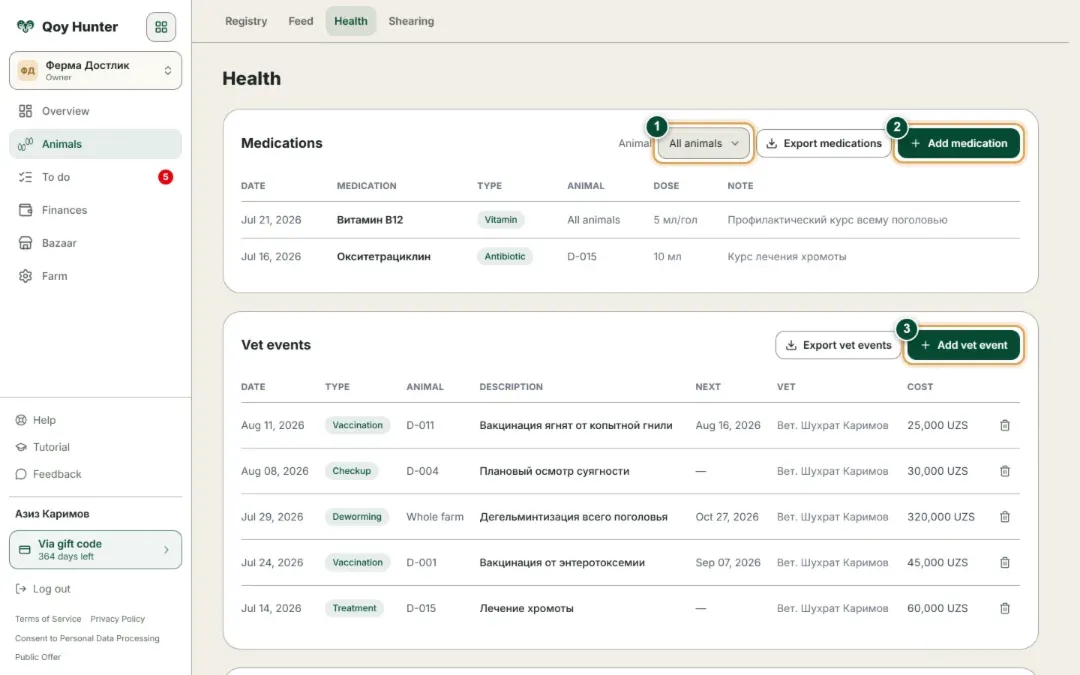
The Animal filter shows the full health history of one sheep: every vaccination, treatment, and procedure under that tag, no flipping through pages. The Add medication button logs the drug, dose, and cost, and the expense goes straight into your farm finances — no separate tally needed.
A new vet event is entered in one window: who it's for (the whole farm or a specific animal), the type (vaccination, treatment, check-up, or deworming), the drug or vaccine, the vet, the cost, and the due date for the next treatment.
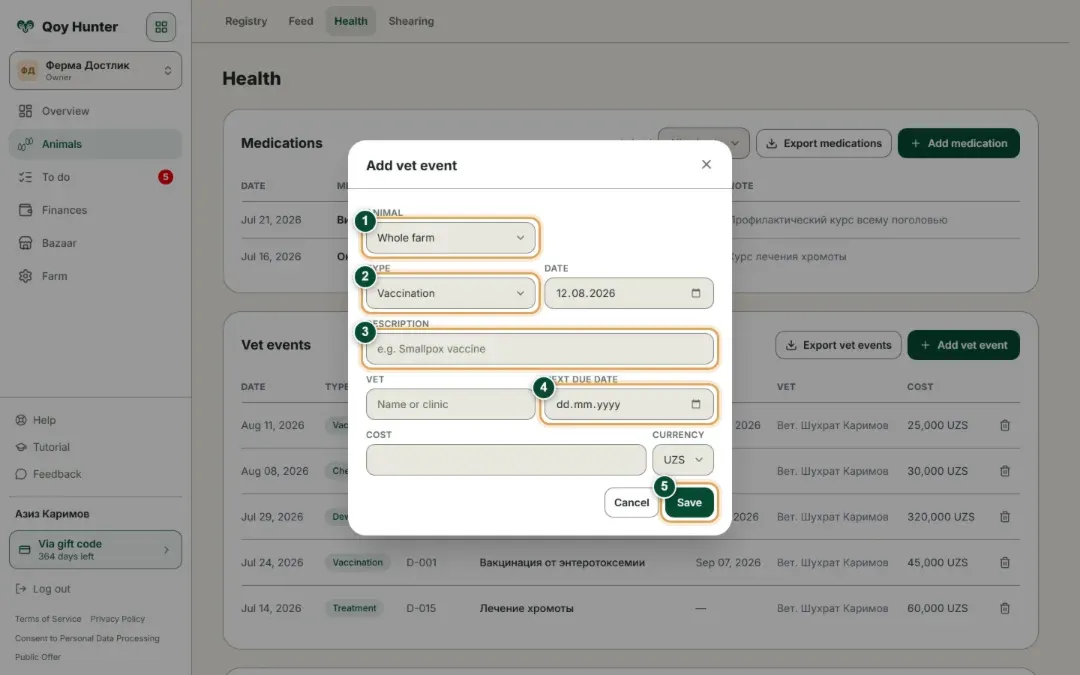
Then the key part kicks in: the app reminds you ahead of time, before the due date arrives. That's the real difference between "I keep a log" and "the treatment got done on time." For the full walkthrough of the screens, see sheep vaccination and treatment records.
What the app doesn't do: it doesn't diagnose anything and doesn't pick a dose. The drug, the weight-based dosage, and the treatment schedule are the vet's call — the log just remembers what was done, when, and what it cost.
You can check the log and get reminders without logging into the system: your farm report, your tasks, and deadline notifications all arrive in the messenger app — the details are in our breakdown of keeping sheep records through Telegram.
What It Costs the Farm
It's easiest to think about this by flock size. QoyHunter's free plan (0 sum) covers up to 30 animals and one team member, and it includes herd records, health tracking, and Telegram reminders. The "Pro" plan is 49,000 sum a month (≈ $4.1) for up to 500 animals and five team members; the "Farm" plan is 149,000 sum (≈ $12.5) with no cap on headcount.
Compare that with the calculation at the start of this article: one missed autumn treatment on 40 lambs cost almost 10 million sum. A full year of the "Pro" plan is 588,000 sum — less than a third of the cost of a single dead ewe.
The drugs themselves are a separate expense line, and there's a place to compare prices on those too: vet medicines and feed with delivery are sold on the marketplace straight from suppliers, with no middleman markup.
What to Do This Week
- Write down on paper every treatment your flock has had since the start of 2026, and when. Usually, this step alone turns up one you'd forgotten.
- Add a due date for the next treatment next to each one — based on the vaccination calendar or your vet's instructions.
- Pick where this will live going forward: a notebook for up to 20–30 head, or a spreadsheet or an app with reminders once you have more head and more treatments to track.
- Build the habit of logging on the day of the treatment, not "later tonight." Later tonight almost never happens.
FAQ
How do you track vaccinations if you have more than a hundred sheep?
By animal, not by date: every sheep has its own tag, and all its records attach to that tag. In a notebook, a flock that size falls apart within about six months — you'll need to switch to a spreadsheet or an app with a filter by animal and a due-date reminder. Mass treatments (deworming, vaccinating the whole flock) can be logged against the whole farm at once instead of animal by animal.
Do you need to log government vaccinations?
Yes. Vaccinations against especially dangerous diseases — anthrax, sheep pox, brucellosis — are usually given in Uzbekistan at the state's expense by the district veterinary service, and you can confirm campaign dates at your local vet station. But the list of vaccinated animals remains your responsibility to track. An animal that was out at pasture or on another grazing ground that day will have to be vaccinated separately and at your own expense, and the only way to find that animal is through your own records.
What do you do if a treatment is already overdue?
Don't try to "catch up" with a double dose — that's dangerous. Contact your vet: they'll tell you whether the treatment can be done now or you need to wait for the next window, and which step of the schedule to restart from. Then set a new due date right away, or the same thing will happen again. And check the log for the rest of the flock: a missed treatment is rarely just one animal — usually a whole group slips through, the ones that were off-site that day.
How much does it cost to track flock health in an app?
Up to 30 animals — 0 sum on QoyHunter's free plan, which includes herd records, health tracking, and Telegram reminders. For farms with up to 500 head, the "Pro" plan costs 49,000 sum a month (≈ $4.1) as of August 2026; for larger farms, it's 149,000 sum. Plan prices are listed on qoyhunter.com and may change, while a notebook costs a few thousand sum and isn't about to get more expensive — for a small flock, it's still a workable option.
How do you log a treatment right in the sheepfold, without internet access?
Log it on the spot, even in your phone's notes app, but with the full set: date, animal or "whole farm," drug, dose, cost, and when the next one is due. The key part is moving it into your main log that same day, while you still remember the dose. Experience shows a simple pattern: a record put off "until tonight" turns into "I think we did it sometime at the end of July."
Manage your flock in QoyHunterCRM for sheep farmers: livestock, health, weighing, finance and analytics — in the app and a Telegram bot.All features →