Enterotoxemia in Sheep: Why the Fattest Feedlot Lambs Suddenly Die, and How to Protect Them
Enterotoxemia in sheep kills within hours and picks off the biggest lambs on grain, while treatment barely helps at all. Signs and how it differs from acidosis, what to do after the first death, a pre-feedlot vaccination schedule, and the math for 100 lambs: vaccination costs 1m UZS, a 3% death rate costs 7.4m UZS.
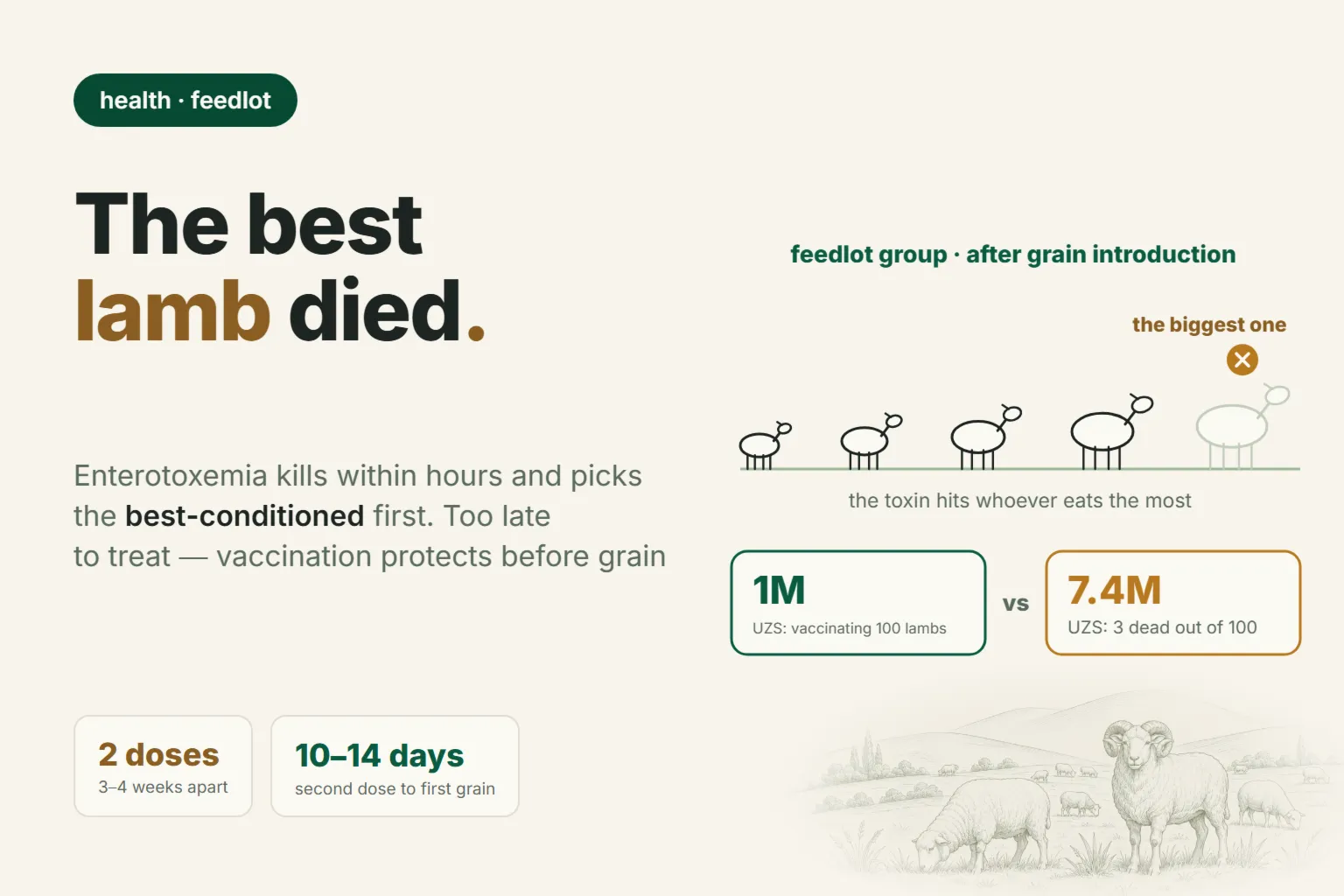
Enterotoxemia in sheep is toxin poisoning from a bacterium that multiplies in a lamb's gut when it suddenly gets too much grain or lush feed. The disease kills within hours and picks off the fattest, fastest-growing lambs, so on a feedlot it's often noticed only from the first lamb to drop — the best one in the group. Treatment almost never saves the animal; what protects the group is a two-dose vaccination given before the move to grain, plus a slow introduction of concentrate.
Below: how to recognize enterotoxemia and tell it apart from acidosis and poisoning, what to do in the first hours after a death, what schedule to vaccinate lambs on before fattening, and what vaccination costs against the losses in a 100-head group. Prices are as of September 2026; the Central Bank of Uzbekistan's rate for September 11, 2026 is 11,783 UZS per dollar.
What Is Enterotoxemia, and Why Do the Biggest Lambs Die First?
Enterotoxemia (veterinary manuals also call it "pulpy kidney disease") is caused by the bacterium Clostridium perfringens type D. It lives in small numbers in the gut of healthy sheep too, and on its own it isn't dangerous.
What makes it dangerous is starch. When a lamb suddenly gets a lot of grain, lush grass, or milk, undigested starch moves out of the rumen and into the gut, the bacteria multiply rapidly, and they release epsilon toxin. The toxin is absorbed into the blood and damages blood vessels, especially in the brain. Per the MSD Veterinary Manual, the first sign of enterotoxemia in a group is usually sudden death among the best-conditioned lambs.
The logic is simple: the biggest, greediest lamb eats the most feed, so it's the first to get a starch overload. That's why enterotoxemia hits your most valuable animals — the ones you've almost finished fattening.
When Is the Risk of Enterotoxemia Highest?
It isn't the feed itself that triggers the disease — it's a sudden change in it. In Uzbekistan, autumn brings several of these changes at once:
- putting young stock on feed — lambs go straight onto barley and corn right after weaning or purchase;
- a sharp jump in concentrate — "pushing" the group before a sale;
- switching grain batches, or moving from barley to corn and wheat;
- a feeding lapse — lambs go a day without feed, then get a double portion;
- grazing alfalfa regrowth, or a harvested field with a lot of leftover grain;
- nursing lambs on heavy-milking ewes — the same mechanism, just triggered by milk instead of grain.
Per the MSD Manual, lambs under two weeks old and weaned lambs on high-grain feedlot rations get sick most often. For autumn fattening, the main risk window is the first weeks after the switch to concentrate.
How Do You Recognize Enterotoxemia and Not Mistake It for Acidosis?
Most of the time, no one sees any signs at all: the lamb turns up dead in the morning, even though it ate better than anyone the night before. If you do catch the disease in progress, the picture looks like this: excitement, staggering, convulsions, the head thrown back, the animal circling or pressing its head against a wall; sometimes diarrhea sets in. Death follows within hours. After death, the kidney softens quickly — hence the disease's folk name. One more sign a vet checks for: sugar in the urine of a dead or sick lamb.
Sudden deaths on a feedlot have other causes too, so only a vet can confirm the diagnosis, and only after a necropsy.
| Sign | Enterotoxemia | Acute rumen acidosis | Pasture poisoning |
|---|---|---|---|
| Who gets sick | 1–2 of the best-conditioned lambs | several head after a grain increase | a group that grazed the same spot |
| Time from the trigger | hours, often with no visible signs | 12–48 hours | 1–2 hours |
| What you see | convulsions, head thrown back, circling | going off feed, staggering, watery sour-smelling diarrhea | many head at once, discolored mucous membranes |
| Treatment | almost always hopeless | a chance, if the vet arrives in time | depends on the poison |
We cover acidosis and urinary calculi on grain feedlots separately: why rams die on grain feedlots, and how to introduce barley.
What Do You Do if a Lamb Suddenly Dies on the Feedlot?
There's nothing left to treat in the dead lamb — you need to save the rest of the group. The steps for the first few hours:
- Don't cut the carcass open yourself, and don't use it for meat. Anthrax also causes sudden death with no prior signs. Per the MSD Manual, if anthrax is suspected, skip the necropsy entirely: exposure to air turns the bacteria into spores that survive in the soil for years. Call your district vet, cover the carcass, and keep dogs away from it.
- Cut concentrate immediately and give hay free-choice. Per the MSD Manual, in a feedlot group, enterotoxemia is held back specifically by cutting concentrate in the ration — that's the first move, while the vaccine hasn't kicked in yet.
- Vaccinate the whole group if it isn't vaccinated. If deaths continue, a vet may give an antitoxin serum: it protects right away, but only for 2–3 weeks. How to combine it with the vaccine is the vet's call, based on the product labels.
- Treat sick animals only on a vet's orders. Antitoxin and penicillin-class antibiotics are sometimes tried, but the odds are low.
- Write down what changed over the last three days: more grain, a batch switch, turnout on regrowth. Skip this, and the cause repeats itself within a month.
How Do You Vaccinate Lambs Against Enterotoxemia Before Fattening?
The enterotoxemia vaccine is inactivated: it contains no live bacteria, and it teaches the body to neutralize the toxin. Lambs with no prior vaccination get a two-dose course — one dose alone doesn't give reliable protection. Clostridial diseases are usually covered by a multivalent vaccine — one shot covers braxy, enterotoxemia, malignant edema, and lamb dysentery all at once.
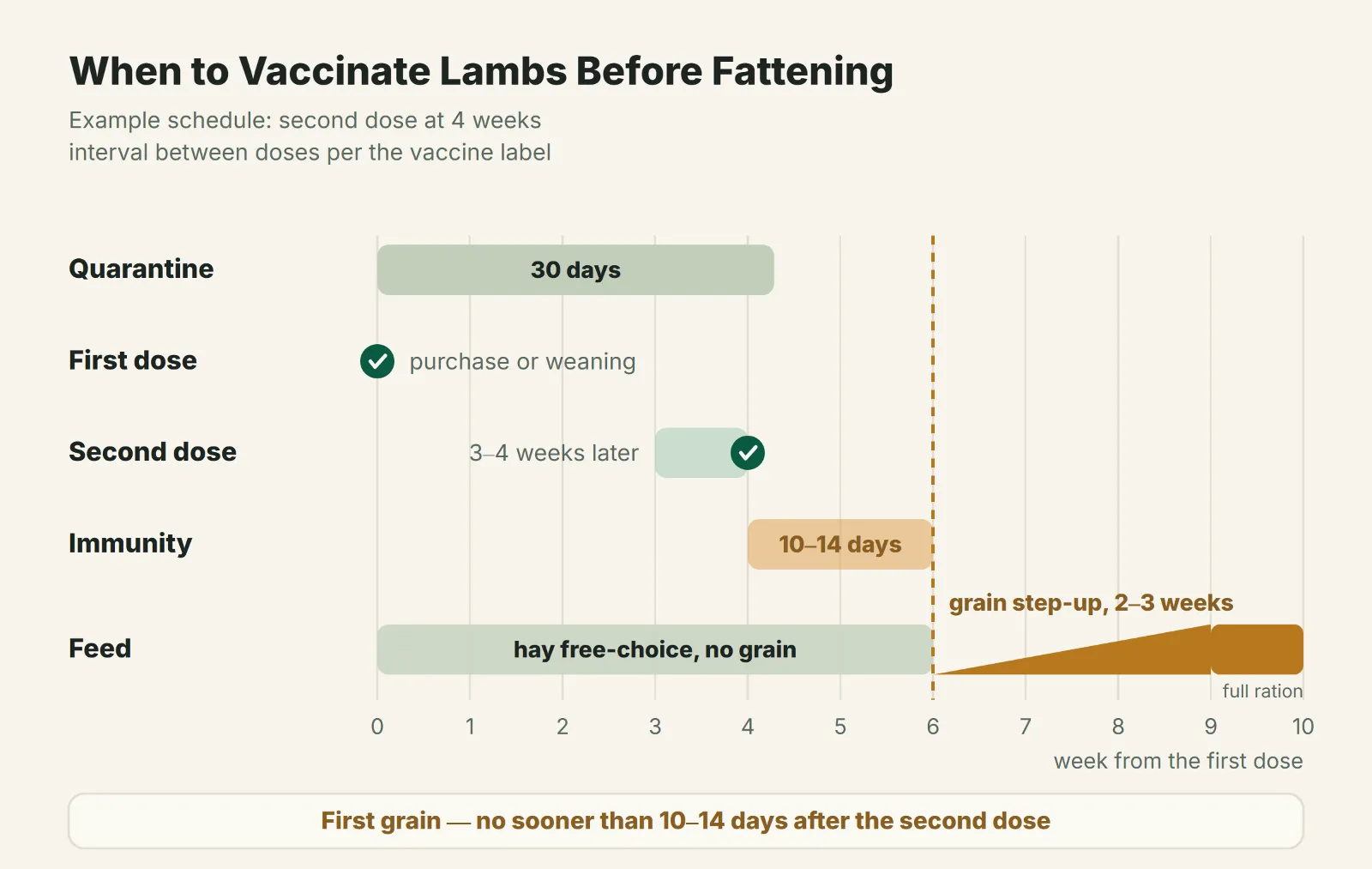
A working schedule for lambs going on feed when it's unknown whether they were vaccinated before:
| Step | When | Why |
|---|---|---|
| First dose | at purchase or weaning, while lambs are still on hay | starts the immune response |
| Second dose | 3–4 weeks later, per the vaccine label | one dose alone doesn't give reliable protection |
| Grain | no sooner than 10–14 days after the second dose | immunity builds up in that window |
| Concentrate ramp-up | 2–3 weeks, 5–10% of the ration every 3–5 days | the rumen and gut adjust to starch |
The interval between doses is set by the label of the specific vaccine, and it varies. Per the maker's description of a multivalent vaccine against braxy, enterotoxemia, malignant edema, and lamb dysentery that's common across the CIS, immunity forms 10–12 days after the second shot and lasts up to 5 months; if the group stays together longer than that, a booster follows the label. Lambs bought at the bazaar also mean a 30-day quarantine: it's convenient to give the first dose on quarantine's first day and the second 3–4 weeks later, at the end of it, then start grain 10–14 days after that. The exact vaccine, dose, and interval are always a vet's call: this schedule shows the order of steps, not a substitute for one.
Vaccination isn't just for feedlot lambs. Ewes get a booster a few weeks before lambing, so the lamb picks up antibodies through the colostrum, and rams get one once a year. Where this vaccination fits among the year's other treatments is covered in our month-by-month sheep vaccination calendar.
The schedule only works if you don't forget the second dose. It's easiest to track both dates in a vaccination log with reminders for the next booster: QoyHunter, a CRM for sheep record-keeping and the bazar.qoyhunter.com marketplace, logs a treatment for the whole flock or for one animal, keeps the planned date for the next one, and reminds you ahead of time.
How Much Does Vaccination Cost, and How Much Does an Unvaccinated Group Lose?
Let's run the numbers for a 100-lamb feedlot group. The dead lamb weighs 45 kg — the biggest in the group. Live weight sells at 55,000 UZS per kg, a cautious low estimate for autumn 2026. That makes one dead lamb worth 2,475,000 UZS (≈ $210), not counting the feed it already ate.
We take the vaccine price with some room to spare: 5,000 UZS a dose, or 10,000 UZS for the two-dose course per head. Prices vary by district — check with your own vet pharmacy — but that doesn't change the bottom line here.
Per New Mexico State University, unvaccinated feedlot groups lose at least about 1% of lambs to enterotoxemia, 2–3% on average, and 10% to 40% in a severe outbreak.
| Scenario for 100 lambs | Dead lambs | Cost to the farm |
|---|---|---|
| Vaccinate the whole group, two doses | 0 | 1,000,000 UZS (≈ $85) |
| No vaccine, minimum 1% | 1 | 2,475,000 UZS (≈ $210) |
| No vaccine, average 3% | 3 | 7,425,000 UZS (≈ $630) |
| Severe outbreak, 10% | 10 | 24,750,000 UZS (≈ $2,100) |
| Severe outbreak, 40% | 40 | 99,000,000 UZS (≈ $8,400) |
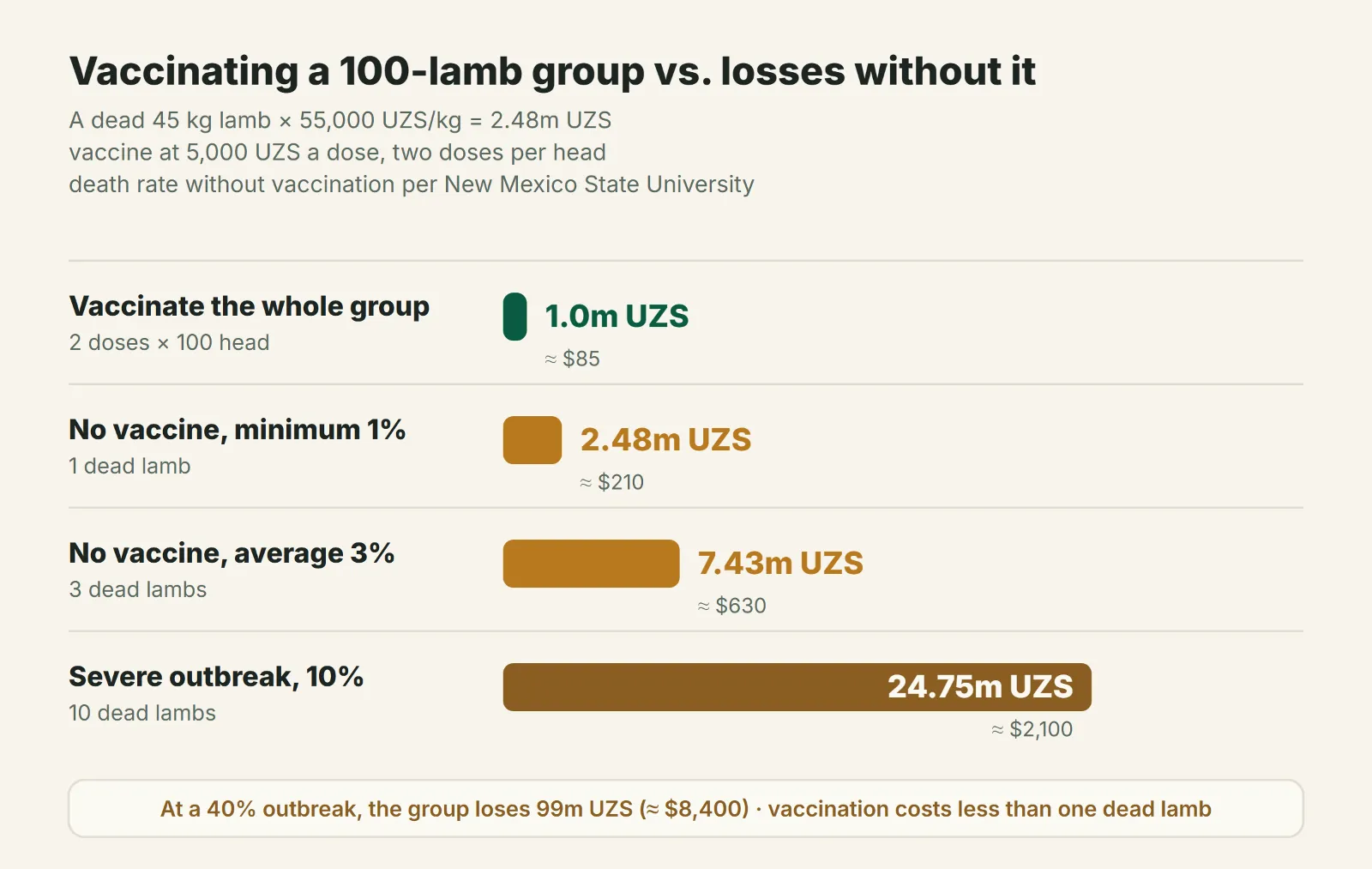
Vaccinating the whole group costs less than one dead lamb. Even at the minimum loss rate it pays for itself 2.5 times over, and at the average rate, 7 times over. And that's without counting the feed the dead lambs already ate, or the weight gain the group loses while the owner is busy dealing with the deaths.
When you're buying young stock, ask the seller whether the lambs are vaccinated, with what vaccine, and when. A vaccination backed by a record or a vet's certificate is as much a bargaining point as weight and age. You can find feeder lambs in listings of lambs for sale with weight and age — and ask the seller these three questions right away.
How Do You Introduce Grain Without Triggering Enterotoxemia?
Vaccination doesn't replace correct feeding: with a sharp grain ramp-up, lambs can still get sick — acidosis, if not enterotoxemia. The rules are the same as for any grain feedlot:
- stretch the concentrate ramp-up over 2–3 weeks, adding 5–10% of the ration every 3–5 days;
- never pull the roughage out of the feeder — a ration heavy on grain and light on hay is named outright among the disease's causes;
- split the daily grain ration into 2–3 feedings, not one big dump;
- after a grain batch switch, step back a couple of stages;
- don't allow hungry gaps: a lamb that goes a day without feed eats a double portion;
- keep the storage shed locked — a lamb that gets into a sack gets a lethal dose of starch in one sitting.
It's best to buy grain for the whole fattening period in one batch: switching batches partway through is one more change for the rumen and gut to handle. Barley, corn, and veterinary supplies for the feedlot group are worth lining up ahead of time, before lambs go on grain.
FAQ
Why did my biggest lamb die with no signs of illness at all?
Most often, it's enterotoxemia. The bacterium Clostridium perfringens type D multiplies in a lamb's gut when it suddenly eats a lot of grain or lush feed, and releases a toxin that kills within hours. The biggest lamb eats the most, so it dies first. Only a vet can confirm the diagnosis, and only after a necropsy: anthrax also causes sudden death, so don't cut the carcass open yourself.
Can enterotoxemia in sheep be treated?
Almost never. The disease runs its course in hours, and by the time signs show up, the toxin has already damaged the brain. A vet can give antitoxin and antibiotics, but the odds are low. You need to save the rest of the group instead: cut the grain, give hay free-choice, and vaccinate every unvaccinated lamb with two doses.
How many times do you vaccinate lambs against enterotoxemia before fattening?
Twice. The second dose comes 3–4 weeks after the first; the exact interval is on the label of the specific vaccine. Grain isn't given until at least 10–14 days after the second dose: per the maker's description of the multivalent vaccine, that's how long it takes for immunity to build up, and it lasts up to 5 months. One dose without a booster doesn't give reliable protection.
Is it worth vaccinating feedlot lambs if there hasn't been a death yet?
Yes. For a 100-lamb group, the two-dose course runs about 1m UZS (≈ $85) at a vaccine price of 5,000 UZS a dose. One dead 45 kg lamb, at 55,000 UZS per kg of live weight, is worth 2.48m UZS (≈ $210). Per New Mexico State University, unvaccinated feedlots lose 2–3% of lambs to enterotoxemia on average — that's 4.95m–7.4m UZS in losses per hundred head.
One lamb already died of enterotoxemia — what do I do with the rest?
Cut concentrate immediately and give hay free-choice, call your district vet, and vaccinate the whole unvaccinated group. If deaths continue, the vet may give an antitoxin serum, which protects right away but only for 2–3 weeks. Write down what changed in feeding over the last three days — more grain, a batch switch, or turnout on regrowth — and don't repeat the mistake.
Manage your flock in QoyHunterCRM for sheep farmers: livestock, health, weighing, finance and analytics — in the app and a Telegram bot.All features →