
Telegram Bot for Farmers: Farm Reports and Deadline Reminders Right in the Chat
How to check your farm's financial report, your tasks, and the income chart right in Telegram, without logging into the system — and why a deadline reminder saves money: a missed treatment on a group of 40 head costs 9.9 million so'm, while the treatment itself costs 12,000. With a comparison table of notebook, alarm clock and bot, plus answers to frequent questions.
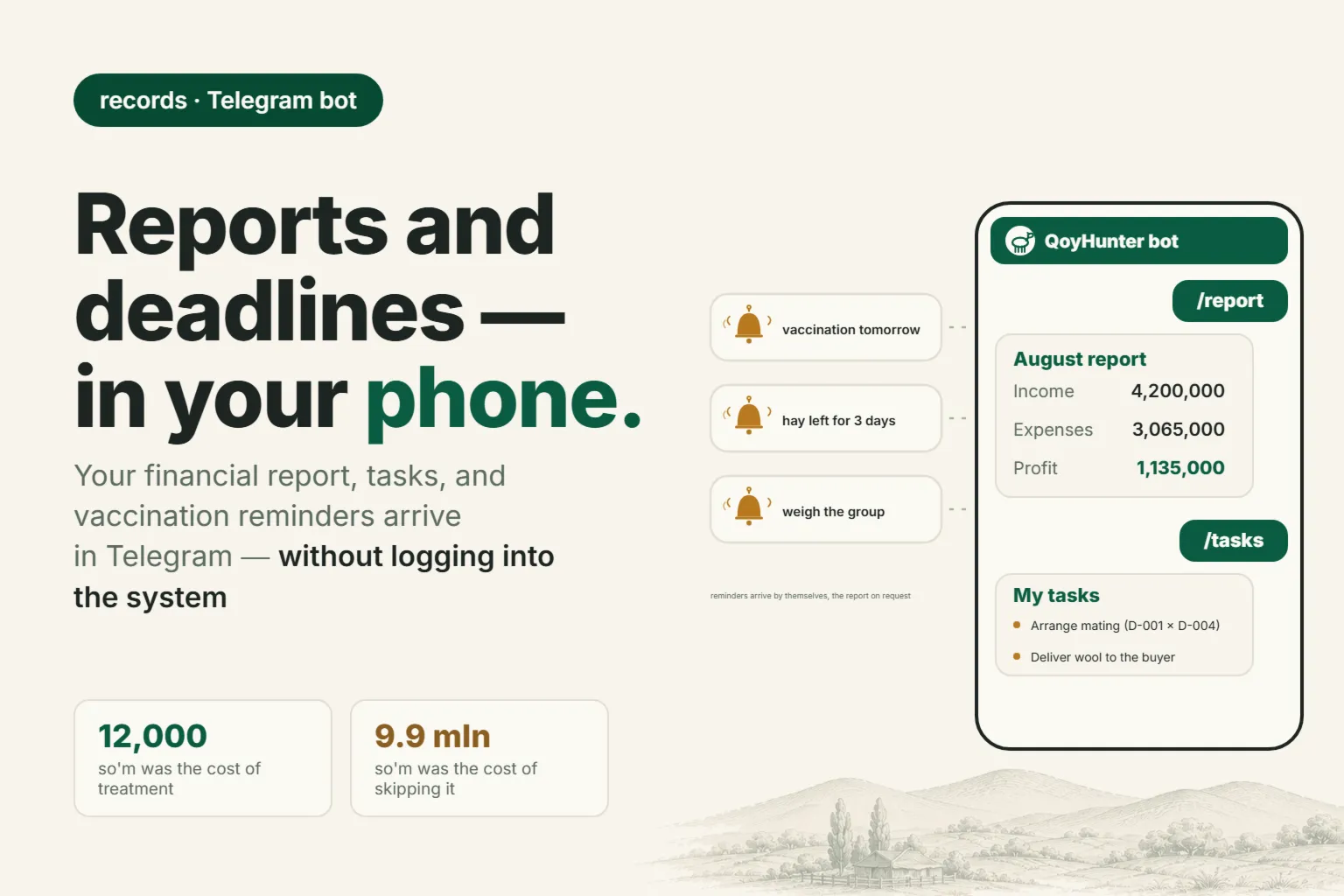
A Telegram bot for farmers is a way to check on your farm's affairs and get deadline reminders right in the chat, without logging into the system. In the QoyHunter bot, the /report command opens the monthly financial report, and /tasks opens your list of tasks; from the same chat you can also request the income and expense chart and export your animals to CSV. Reminders about tasks, vaccinations and low feed stock arrive on their own. That's how sheep record-keeping stops being something you have to sit down at a computer for.
Below: why deadlines slip even for a careful farm owner, what one missed day actually costs, and how a reminder in a messenger app differs from an alarm on your phone. The figures use September 2026 prices, with a conversion rate of 11,795 so'm per dollar (Central Bank of Uzbekistan, September 4, 2026).
Why deadlines get missed even when everything is written down
A notebook is memory, not a watchdog. It faithfully keeps whatever you wrote down: the mating date, the drug dose, the weight from the last weigh-in. But it will never tell you "tomorrow," and that's the whole difference.
A shepherd's work is made up of tasks with a deadline, and that deadline arrives weeks after you wrote it down:
- deworming — twice a year, in spring before turning the flock out to pasture and in autumn when it's brought back into the barn;
- vaccination against clostridial diseases — on a schedule, with a booster at the right interval;
- weighing the control group — every 21–30 days, or there's nothing to compare the weight gain against;
- lambing — 145–155 days after mating, and you need to prepare ahead of time;
- buying feed — before the storeroom runs out, not on the day it does.
None of these tasks announce themselves. A sheep doesn't look sick when it has worms; a storeroom doesn't look empty when there are only two days of feed left. The problem shows up in money — on the scale and in the sale price — two or three months after the deadline was missed.
What one missed deadline actually costs
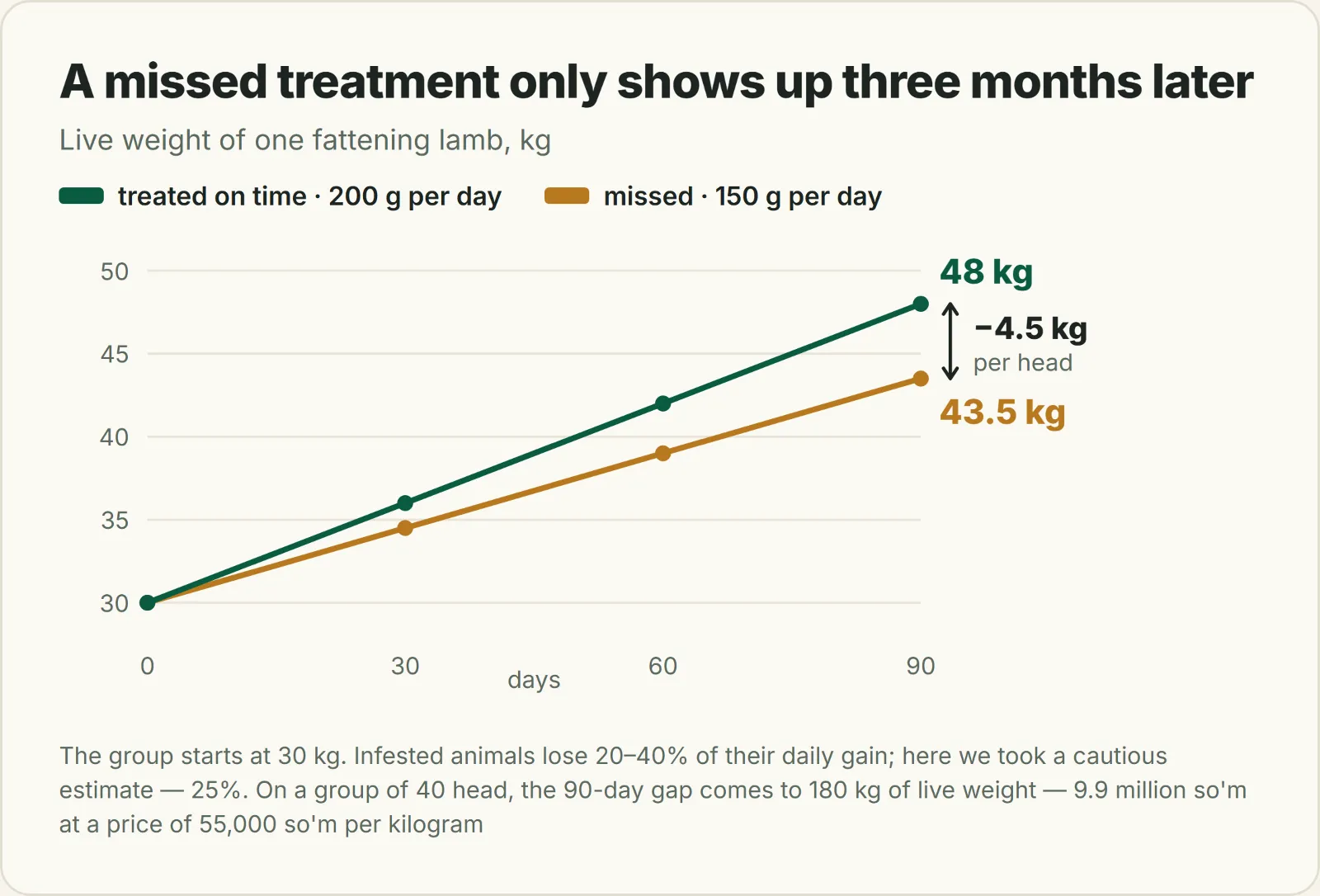
Take the most ordinary kind of slip-up: a group of 40 fattening lambs whose autumn deworming didn't happen on schedule, but "whenever there was time" — three months later.
Infested animals lose 20–40% of their daily weight gain. Let's take a cautious estimate — 25%: gain drops from 200 to 150 grams per day.
| What we're calculating | Treated on time | Missed by 90 days |
|---|---|---|
| Average daily gain | 200 g | 150 g |
| Gain over 90 days per head | 18 kg | 13.5 kg |
| For a group of 40 head | 720 kg | 540 kg |
| Difference in live weight | — | −180 kg |
| In money at 55,000 so'm/kg (≈ $4.7) | — | −9.9 million so'm (≈ $840) |
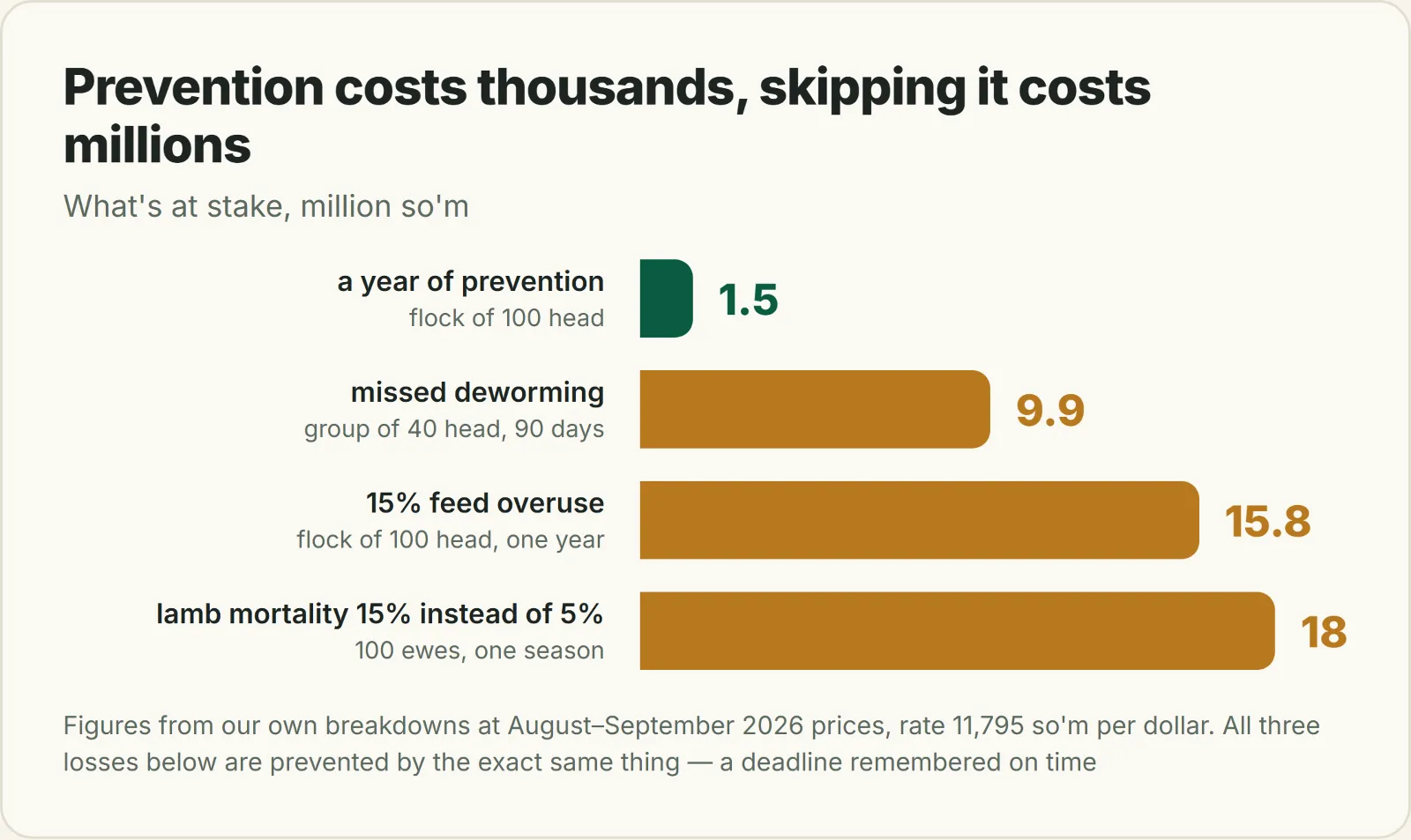
The treatment itself would have cost 12,000 so'm (≈ $1): 40 head at 300 so'm of ivermectin each — the drug and the schedule are worked out with a vet, and in autumn a fascioliasis treatment is usually added alongside the ivermectin. In other words, the missed deadline ended up costing roughly 825 times more than the action that would have prevented it. And notice: there's no gap in knowledge here. The owner knew the treatment needed to be done. He simply didn't remember it on the day it needed to be done.
The same arithmetic shows up elsewhere. A barren ewe eats about 590,000 so'm (≈ $50) of feed and treatments a year and brings in nothing — a gap of roughly 1.3 million so'm (≈ $110) per head compared to a ewe that raises a lamb. Lamb mortality of 15% instead of 5% across a hundred ewes means 18 million so'm (≈ $1,526) of lost revenue, and about three-quarters of that loss happens during lambing itself and the first three days after it — the exact days you need to be ready for in advance.
How a Telegram reminder differs from an alarm on your phone
An alarm knows how to do one thing — ring at a set time. It doesn't know which animal you set that treatment for, what the group weighed a month ago, or how much hay is left in the storeroom. That's why an alarm works fine as long as you've got two or three tasks and they're all in your head.
Here's an honest comparison of what sheep farmers actually use in practice.
| Method | Reminds you of the deadline | Shows the numbers | Works for |
|---|---|---|---|
| Memory | No | No | 10–15 head, everything in plain sight |
| Notebook | No | Only if you calculate by hand | A small operation, one person |
| Alarm, phone notes | Yes, but without context | No | 2–3 recurring tasks |
| Excel on a computer | No | Yes, if you keep the spreadsheet up | Someone who's at a computer every day |
| An arrangement with a shepherd | However it works out | No | As long as the person is on-site |
| CRM with a messenger bot | Yes, with the task's name and deadline | Yes, report and chart | 30–50+ head, and when more than one person works the farm |
For an operation with a dozen or so sheep, a notebook really is enough, and there's no reason to move it into an app — we'll say that honestly. The difference kicks in once you're past fifty head, the tasks number in the dozens, and it's not just the owner working the farm.
The second argument for a messenger app is that it's where the farmer already is. According to DataReportal ("Digital 2026: Uzbekistan," data as of end of 2025), Uzbekistan has 33.9 million mobile connections — that's 91% of the population, though what's being counted is connections, not people. Telegram, meanwhile, remains the country's most widely used messenger: estimates vary, from 18 to 27 million users, and there's no official statistic for it. An app that you have to specifically open and remember a password for loses to a chat that's already open twenty times a day.
What the QoyHunter Telegram bot shows you
QoyHunter is a CRM for sheep record-keeping plus the bazar.qoyhunter.com marketplace; the bot is part of that same record-keeping system, and it works with data your farm has already entered. Here's what's available right from the chat.
A monthly financial report with the /report command. It arrives as a summary: income, expenses and profit for the period. It looks like this:
📊 July report
Income: 4,200,000 so'm
Expenses: 3,065,000 so'm
Profit: 1,135,000 so'm
Your tasks with the /tasks command. A list of what's assigned to you, with the task's name and deadline: "Arrange mating (D-001 × D-004)," "Deliver wool to the buyer." A task arrives exactly as it was named when it was created — animal numbers show up in it only if you typed them in yourself.
The income and expense chart. You request it from the bot, and it comes back as an image in the chat, so you can see the trend, not just a single month's number.
Exporting your animal list to CSV. The file lands in the chat, and from there you can open it in Excel — say, to hand the list to a vet or check the headcount before a reconciliation. The export is included in the paid plans.
Reminders arrive on their own: about tasks, vaccinations and low feed stock. That's the real difference from a notebook — a notebook waits for you to open it, while a reminder shows up on the day the task actually needs doing.
The low feed stock reminder deserves its own mention. A mixed flock of 100 head — 70 ewes, 25 young stock and 5 rams — eats 166 kg of hay and 29 kg of concentrate a day, and the reorder threshold is calculated as daily consumption times delivery time, plus three days of buffer. During mating, the last weeks of pregnancy, and while ewes are nursing, the norm goes up, and the threshold needs to be recalculated. A low-stock reminder buys you exactly those extra days to shop calmly on the feed and grain listings instead of taking whatever gets delivered tomorrow. We covered how to calculate the threshold for your own flock in our article on keeping feed records on the farm.
The full list of what the bot can do, and how to connect it, is on the Telegram bot and notifications page.
How to start using the bot
It's simple, four steps:
- Open the QoyHunter bot in Telegram.
- Check your tasks and financial report right in the chat.
- Request the income and expense chart or export your animals to CSV.
- Get reminders about tasks, vaccinations and low feed stock.
You link Telegram to your profile in the app once — after that, you don't need to log into the system at all, and that's the whole point: out in the field, in the barn, or on the road, you always have your phone, and there's no time to sit down at a computer.
What the bot doesn't do
Honestly, about the limits, so there are no surprises later.
The bot only shows what's been recorded. If you don't log weigh-ins, the weight gain won't show up in the report or the reminder. If you don't log an expense, the profit in /report will look better than it does in real life. You still have to keep records — the bot removes the need to open the app just to check something, not the record-keeping itself.
The bot doesn't replace staying up through the night for lambing. It'll tell you the date — lambing comes 145–155 days after mating — but a person still has to dry off the lamb and get it onto the udder. Those first three days, where most of the mortality happens, call for someone present, not a notification.
The bot doesn't make diagnoses. A calendar vaccination reminder is a schedule, not veterinary advice. Work out the treatment plan for your specific district with a vet; we put together the general month-by-month schedule in the sheep vaccination calendar.
FAQ
How much does the Telegram bot for sheep record-keeping cost?
The bot comes with your QoyHunter account and isn't billed separately. On the free plan — 0 so'm a month, up to 30 animals and one employee — Telegram notifications are already included. The "Pro" plan costs 49,000 so'm a month (≈ $4.2) and covers 500 animals and 5 employees; "Farm" costs 149,000 so'm a month (≈ $12.6) with no limit on headcount. Exporting your animal list to a file is included in the paid plans. Check qoyhunter.com for current pricing.
Can you keep sheep records using only the bot, without the app?
Not entirely. From the bot you can check your tasks and financial report, request the income and expense chart, and export your animal list to CSV — everything on the viewing side. Adding animals and logging weigh-ins, treatments and expenses still has to happen in the app itself. In practice, that works out to entering data every few days in one sitting, while checking it every day from the chat.
Will a reminder arrive if there's no internet in the barn?
The message will land in the chat and wait for you: Telegram delivers it the moment your phone catches a signal, exactly like an ordinary message from a person. It won't disappear from the chat, unlike an alarm that went off while you were out in the field and got silenced on the way past.
Why is a reminder from the app better than an alarm on your phone?
Because it's tied to the task and its deadline, not to a time of day. An alarm at 8:00 rings the same whether it's treatment day or a day with nothing scheduled: it won't tell you what actually needs doing or what else is on the list — while the bot shows you the whole list on command. And you have to set the alarm by hand for every single task — while deadlines on a farm are counted from events: 145–155 days from mating to lambing, 21–30 days between weigh-ins, twice a year for deworming.
How many sheep do you need for this to be worth it?
As a rule of thumb, 30–50 head and up, especially if it's not just the owner working the farm. With a dozen or so sheep, everything is visible without any records — a notebook and memory are enough, and that's perfectly fine. At fifty head, you no longer remember which ewe lambed twice in a row and which one has been barren for a second season — and that kind of forgetting costs about 1.3 million so'm (≈ $110) a year for every barren head.
Manage your flock in QoyHunterCRM for sheep farmers: livestock, health, weighing, finance and analytics — in the app and a Telegram bot.All features →