How Not to Miss Sheep Vaccinations and Treatments: 50 Deadlines a Year for a 50-Ewe Flock
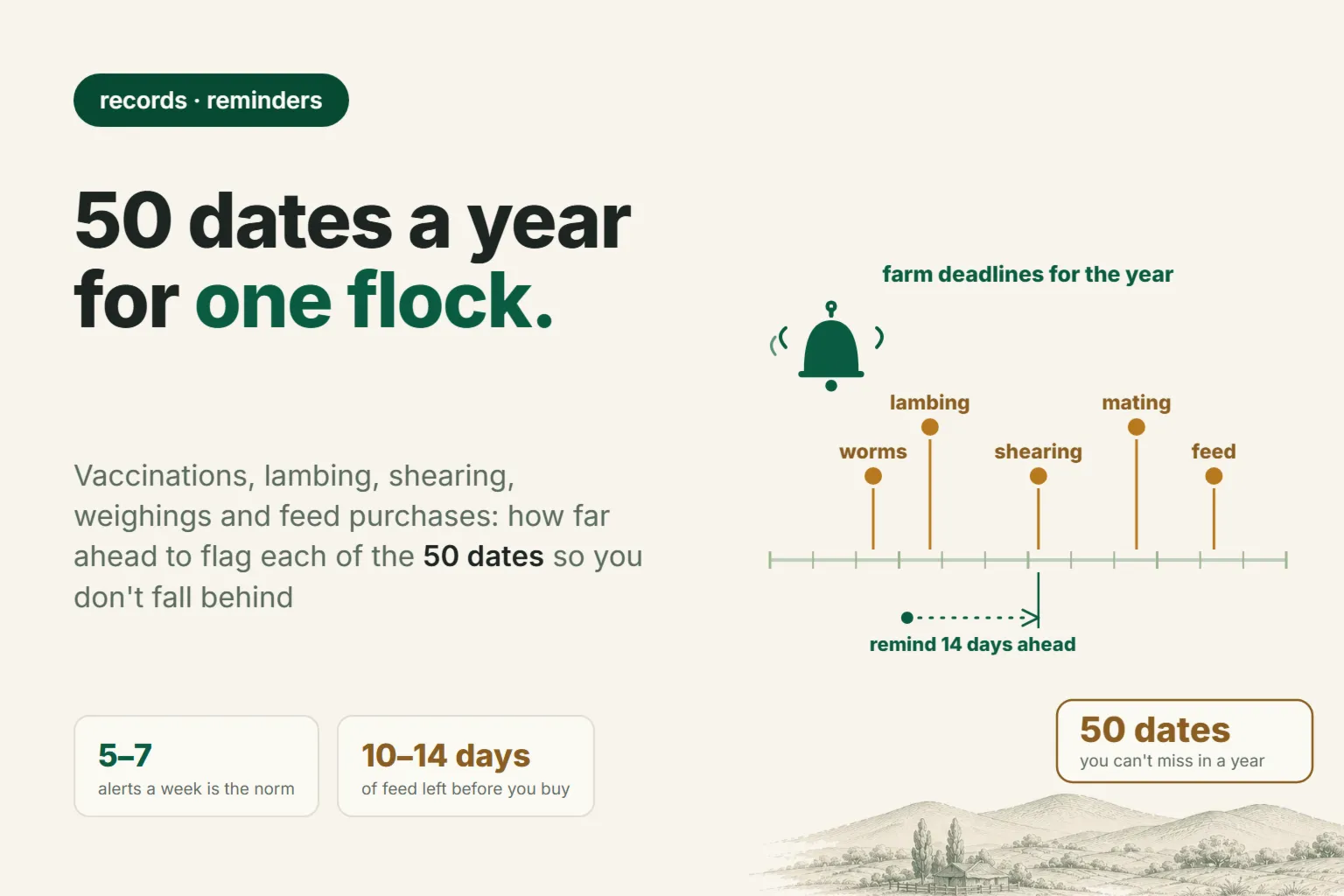
A farm with 50 ewes racks up 50 dates a year that can't be missed: vaccinations, two deworming rounds, mating, lambing, shearings, weighings, feed purchases and settling up with the shepherd. How many days ahead to flag each deadline, why a reminder on the day itself is already too late, how a wall calendar differs from a Telegram notification, and how to set up alerts so they don't turn into noise.
Staying on top of farm deadlines takes three things: a list of recurring jobs, a reminder that lands early — one to two weeks before the deadline, not on the day itself — and a single channel where those reminders arrive. A farm with 50 ewes racks up 50 dates a year that can't be missed: vaccinations, two deworming rounds, mating, lambing, weaning, shearings, control weighings, feed purchases and settling up with the shepherd. A notebook holds these dates; it just doesn't remind you of them. That's the whole difference.
Below: how many deadlines an average flock has in a year, how many days ahead to flag each one, why notifications stop working once there are too many of them, and how reminders are set up in QoyHunter. Figures are based on September 2026 prices, converted at 11,789 so'm to the dollar (Central Bank of Uzbekistan, 8 September 2026).
How many dates a 50-ewe farm has to keep in its head
Take a typical farm in Tashkent region: 50 ewes, one breeding ram, lambs on feedlot, one hired shepherd. Here's what that farm's calendar looks like over a year.
| Task | Times a year |
|---|---|
| Clostridial vaccine for pregnant ewes | 1 |
| Clostridial vaccine for lambs: first dose and booster | 2 |
| Deworming: spring before pasture and autumn at the barn | 2 |
| Fascioliasis treatment (for flocks grazing near canals and damp ground) | 1 |
| State campaigns: spring and autumn | 2 |
| External parasite treatment | 2 |
| Shearing: spring and autumn | 2 |
| Hoof trimming | 2 |
| Mating: start and end of season | 2 |
| Lambing: estimated date by ewe | 1 |
| Weaning lambs | 1 |
| Control weighing of the group | 12 |
| Feed purchase | 8 |
| Settling up with the shepherd | 12 |
| Total | 50 |
Fifty dates works out to one task roughly every seven or eight days. None of them announce themselves: a sheep doesn't look sick when it has worms, and a storeroom doesn't look empty when there's only two days of feed left. The problem shows up in money — on the scales and in the sale price — two or three months after the missed deadline. We ran the numbers on one real group: missing one autumn treatment on 40 head cost 9.9 million so'm (≈ $840), against a treatment that itself cost 12,000 so'm (≈ $1).
How many days' notice you actually need
The most common mistake with reminders is setting them for the day of the task itself. A reminder on the day is already too late — you still need to buy the drug, book the vet, find transport. Lead time is the gap between the reminder and the deadline, and it should equal however long the prep actually takes.
| Task | When to be reminded | Why that lead time |
|---|---|---|
| Deworming before vaccination | 2–3 weeks before the shot | a wormy animal doesn't build lasting immunity from the vaccine |
| Clostridial vaccine for ewes | 10–14 days before the due date (the shot itself is given 1.5–2 months before lambing; check the specific vaccine's label, as the window may be narrower) | time to find a vet, buy the vaccine, gather the group |
| Sale and transport after vaccination | on vaccination day — flagging the "ready by" date | immunity takes 15–21 days to build |
| Lambing | 2 weeks before the estimated date | lambing follows mating by 145–155 days: get the barn, bedding and warm water ready |
| Weaning | a week ahead | set up a separate pen and a feeding area (starter feed itself begins 2–3 months earlier) |
| Shearing | 2 weeks ahead | shearers get booked up fast in season |
| Feed purchase | when what's left will last 10–14 days | time to shop around, negotiate, wait for delivery |
| Control weighing | every 21–30 days | any less often and there's nothing to compare the gain against |
When exactly to shear — in spring before the heat, in autumn before the cold — and what to do before and after is covered in when to shear sheep and how to prepare the flock.
A word on feed specifically. The "10–14 days left" threshold isn't arbitrary — that's how long it takes to shop around, negotiate and get delivery. More precisely, it's worked out as "daily use × (delivery time + 3 days of safety stock)", and in winter you add another 3–5 days on top — which is how you land on roughly two weeks. Whoever notices only once the hay's actually run out ends up buying at whatever price, whatever's on offer. The gap between summer and winter prices on an average flock runs into millions of so'm — we worked through that in our piece on winter hay reserves. When stock is running low, where to buy compound feed, grain and cottonseed meal should take one evening to figure out, not one day.
Why reminders stop working
The typical pattern: a farmer turns on every notification, reads them all in week one, skims past them in week two, and switches them off entirely by week three. It's not laziness — it's noise. A notification with nothing to actually do today isn't a reminder, it's just news, and it devalues the ones that do need action.
Four rules that keep notifications from becoming annoying:
- One notification, one action. If there's nothing you can do about it that day, the deadline is set wrong.
- Only turn on what you actually track. If you're not logging your feed stock, the low-stock alert will lie to you, because the figure in the app won't match what's in the barn.
- One deadline, one home. A date written in the notebook, the phone calendar and the app fires three times, and all three times it gets swiped away.
- Three misses in a row means it's time to fix it, not put up with it. Either the deadline is set on the wrong day, or that task doesn't need a reminder at all.
A sensible volume for a 50-ewe farm is five to seven notifications a week. The annual dates account for roughly one a week; the rest is day-to-day tasks and feeding. Anything above that just gets skimmed.
Who else should get the reminder besides the owner
The second source of missed deadlines is a task that's sort of assigned but not actually assigned to anyone in particular. The same reminder landing on both the owner and the shepherd usually means neither of them does the job — each assumes the other has it covered. So every deadline needs exactly one person responsible for it; everyone else should see that it's done, not get the same reminder themselves. How to hand jobs to specific people and check they have actually been done is covered in the article on the farm work plan.
The third source is language. If the son runs the farm's records in Russian while the shepherd who actually works the flock is more comfortable in Uzbek, a reminder in a language he doesn't read is the same as no reminder at all. Notifications need to reach each person in their own language, or half the team falls out of the system.
What to remind with: from a wall calendar to an app
An honest comparison of what sheep farmers actually use in practice.
| Method | Reminds ahead of time | Knows the context | Works for the whole team |
|---|---|---|---|
| Memory | No | — | No |
| Notebook and wall calendar | Only if you check it every day | No | Whoever walks into the house sees it |
| Phone notes and alarms | Yes, but with a single alert | No | No |
| Phone calendar | Yes, with repeats and lead time | No | Needs manual invites |
| CRM with messenger notifications | Yes, with the task name and group | Yes: feed stock, animal number, task deadline | Yes, each person gets their own, in their own language |
For a farm with 10–15 sheep, a phone calendar genuinely is enough — there's not much to track, everything's in plain sight, and there's no real reason to set up an app just for that; let's say it plainly. The difference kicks in once you're past fifty head, with dozens of tasks, and more than just the owner doing the work: a calendar can remind you of a date, but it has no idea how much feed is left or which group is due for weighing.
How reminders are set up in QoyHunter
QoyHunter is a CRM for sheep record-keeping, plus the bazar.qoyhunter.com marketplace. Reminders live in the "Settings" section — the same place you'll find your profile, interface language, and sign-in methods.
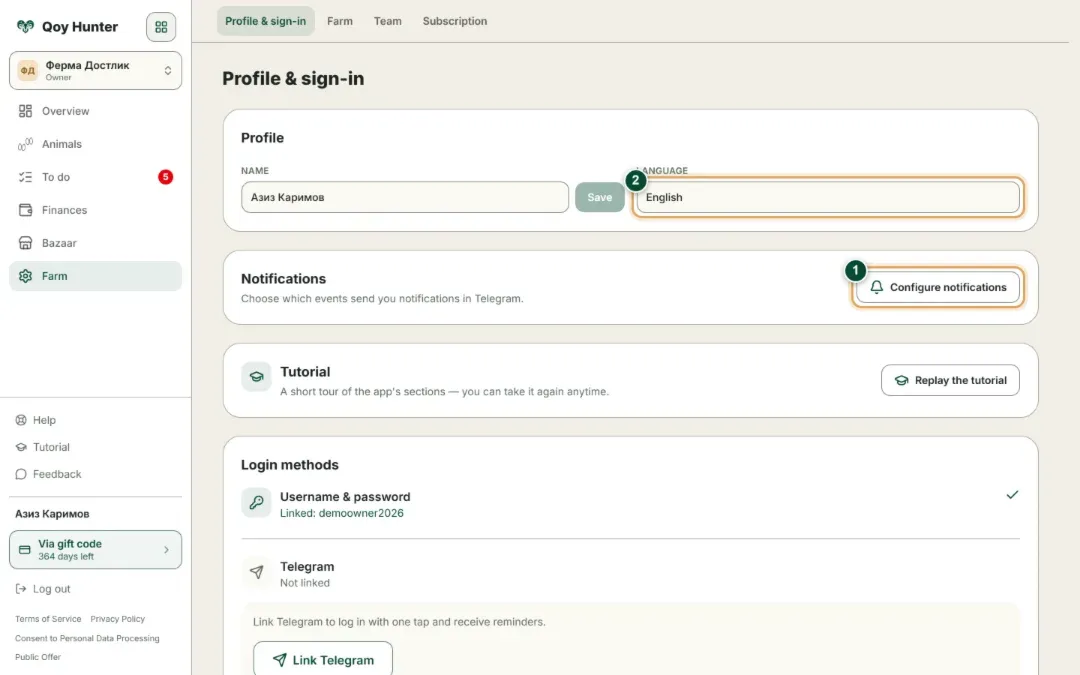
The "Configure notifications" button opens the "Notification settings" panel, where you switch on the alerts you need. Next to it is the choice of interface and notification language: Russian, Uzbek or English. Each team member picks their own language, so the shepherd gets the same reminder in Uzbek while the owner gets it in Russian.
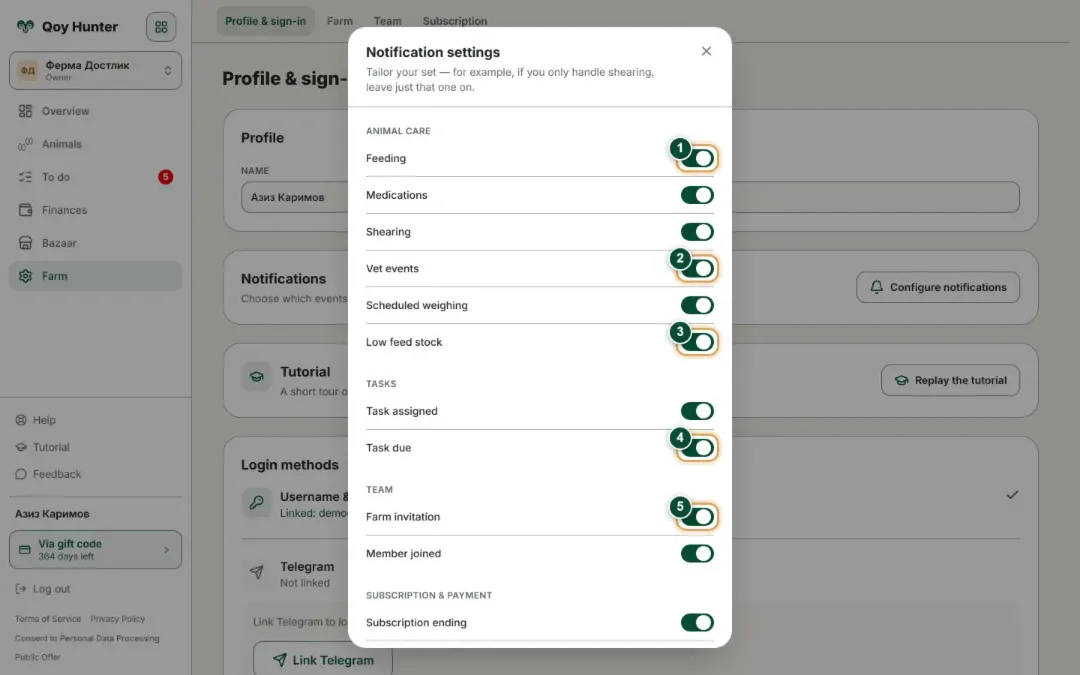
Alerts are grouped by event type and switched on individually, one toggle at a time:
- Animal care — "Feeding", "Medications", "Shearing", "Vet events", "Scheduled weighing", "Low feed stock". These are exactly the deadlines from the table above: vaccinations and treatments, shearing, control weighing, and the feed-stock threshold you need to buy before you hit it.
- Tasks — "Task assigned" and "Task due": a deadline reminder for anything you've logged, from ordering hay to settling up with the shepherd.
- Team — "Farm invitation" and "Member joined".
- Subscription & payment — "Subscription ending".
Reminders arrive in Telegram and inside the app itself. You don't need to switch on everything at once — the toggles exist to let you keep only the groups you actually use, so the rest never bothers you. We covered exactly what lands in the chat, and which reports you can pull from there with a command, in a separate article about the Telegram bot for farmers. For the full picture, see how to set up farm deadline reminders.
What to do this week
- Write out your recurring tasks for the year, using the table above as a template. Most farms end up with 40–60 dates.
- Set a lead time for each one — how many days' notice you need — and schedule the planned date with that buffer built in, not right on the day.
- Assign one person responsible for each task. Not two.
- Stick to one reminder channel and switch off anything you don't actually track there. Five to seven notifications a week is a workable norm; fifteen or more guarantees you'll turn it all off.
The specific drug, dose and treatment schedule always needs a vet's sign-off: the calendar shows you when, it doesn't replace a prescription. For a month-by-month vaccination and deworming schedule built for Uzbekistan's conditions, see our sheep vaccination and treatment calendar.
FAQ
How many days ahead should I set a vaccination reminder?
10–14 days before the vaccination itself. That's enough time to book the vet and buy the vaccine. If deworming needs to happen first, set that reminder even earlier — 2–3 weeks before the shot: a wormy animal doesn't build lasting immunity, and the vaccine goes to waste.
How do I avoid forgetting to buy feed?
The reminder should fire not when the feed runs out, but when there's 10–14 days of it left. That's enough time to compare prices, negotiate and wait for delivery. Anyone shopping for hay on the day the barn goes empty ends up paying whatever's asked — and the gap between summer and winter prices on an average flock runs into millions of so'm.
How many notifications a week is normal?
For a 50-ewe farm, five to seven. That covers the annual veterinary and farm deadlines plus day-to-day tasks. If you're getting more than fifteen, some alerts are switched on for no reason — you start skimming past all of them, important ones included.
Do I need reminders if I only have 15 sheep?
Probably not. With fifteen head, every animal is in plain sight, it's one person doing the work, and a notebook plus phone calendar covers it: the deadlines are much the same, but with no one else to share them with, you can genuinely keep them all in your head. An app starts paying for itself somewhere between thirty and fifty head, and once more than just the owner is working the farm.
What language do notifications reach workers in?
Whichever one each person picked for themselves: Russian, Uzbek or English. Notification language is tied to the person, not the farm, so the shepherd and the owner can read the exact same reminder each in their own language.
Manage your flock in QoyHunterCRM for sheep farmers: livestock, health, weighing, finance and analytics — in the app and a Telegram bot.All features →