Fasciolosis in sheep: signs, what to treat liver fluke with, and when to treat the flock in autumn
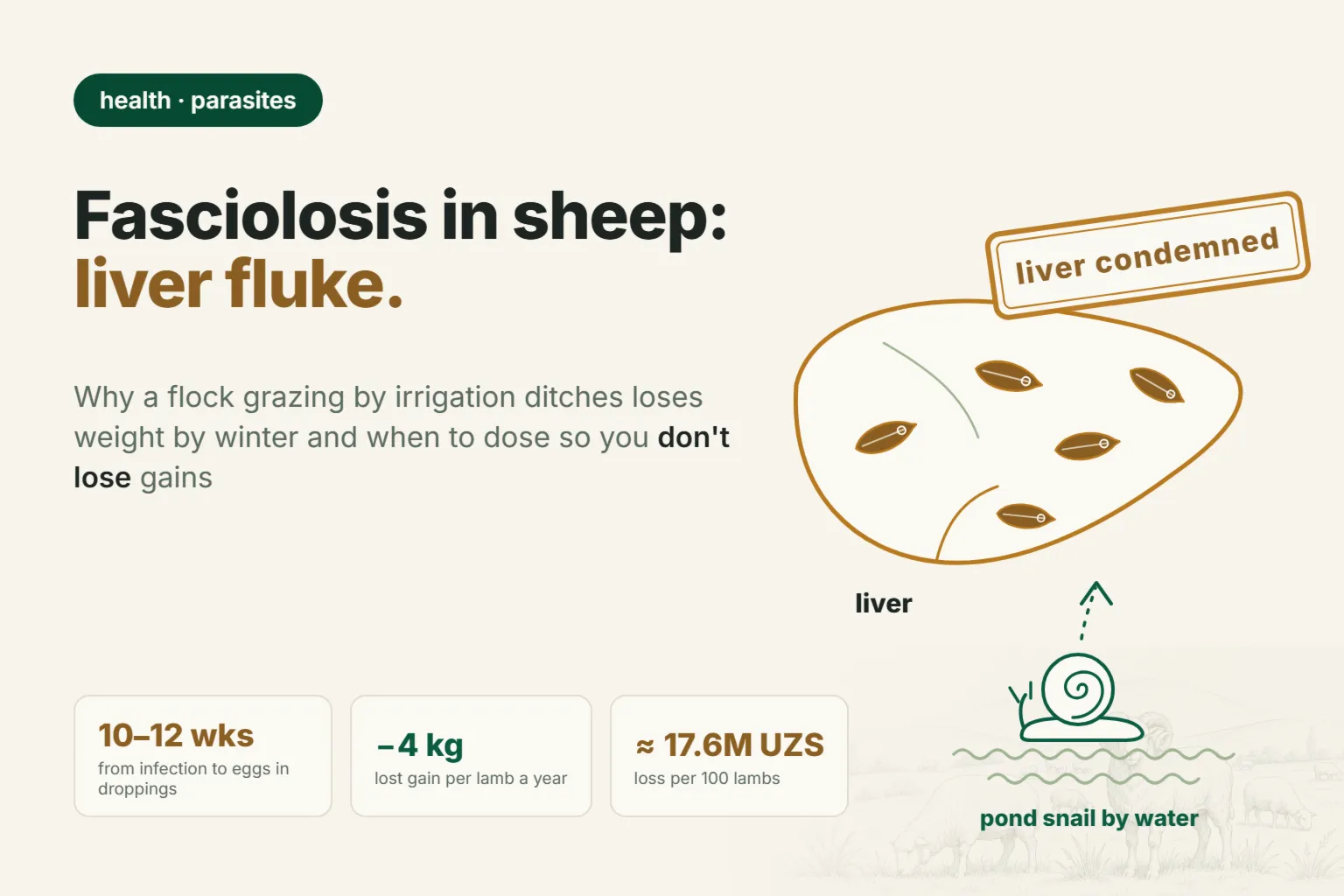
Fasciolosis (liver fluke) hits sheep on wet pastures beside irrigation ditches and rice paddies and shows up as thinness by winter. Signs by form, the fecal test, which drug kills flukes of which age (albendazole only adults), a yearly treatment schedule and the math: up to 17.6 million UZS (≈ $1,485) in losses on 100 lambs.
Fasciolosis in sheep is a liver disease caused by a parasite, the liver fluke (Fasciola). Sheep pick it up on wet pasture beside irrigation ditches, drainage collectors and rice paddies, and the signs (thinness, pallor, swelling under the jaw) show up 2–3 months later, usually by winter. It is treated with flukicides (drugs against the fluke), and the key is choosing a drug that kills the fluke at the right age: albendazole kills only adult parasites (older than 10–12 weeks) and only at a higher dose.
Below: how to tell whether your flock is infected, what to treat with and when in Uzbekistan, and how much money is lost if fasciolosis goes unnoticed.
What is fasciolosis and where do sheep get it?
Fasciolosis is a parasitic disease of the liver and bile ducts of sheep, goats and cattle. The cause is a flat worm 2–3 cm long (the common liver fluke Fasciola hepatica) or up to 7 cm (the giant Fasciola gigantica). According to Uzbek veterinary parasitologists, both species occur in Uzbekistan.
The fluke has an intermediate host, a small freshwater pond snail. The cycle goes like this:
- An adult fluke in the sheep's bile ducts lays eggs, which leave the body in the droppings.
- In water, a larva hatches from the egg and infects a pond snail.
- After 1.5–2 months, cercariae larvae leave the snail and attach to grass near the water, turning into cysts (metacercariae).
- The sheep eats grass with cysts. For 6–8 weeks the young flukes chew a tunnel through the liver tissue, then move into the bile ducts.
- 10–12 weeks after infection, eggs appear in the droppings again.
The timings are for the common fluke; the giant fluke develops more slowly, and eggs appear after about 13–16 weeks.
Hence the main rule: fasciolosis is a disease of wet places. A flock grazing on dry foothill pasture and drinking from a trough almost never catches the fluke. A flock that spends summer and autumn beside an irrigation ditch, a collector, a marshy meadow or the edge of a rice field is infected every year.
When do sheep get fasciolosis in Uzbekistan?
In the irrigated regions of Uzbekistan (Khorezm, Karakalpakstan, the Fergana Valley, the Syrdarya, Tashkent, Samarkand and Surkhandarya regions) the pond snail is active from spring to late autumn, as long as the water is warm. Most cysts build up on the grass in the second half of summer and in autumn. So:
- infection happens mainly from July to October–November;
- acute cases (sudden deaths) occur in autumn and early winter;
- chronic thinness shows in winter and spring, when the flock is already in the barn and it seems that "nothing happened".
That is exactly why October–November is the time to treat a flock that grazed near water.
What are the signs of fasciolosis in sheep?
The picture depends on how many cysts the sheep ate and how long ago.
| Form | When | What you see in the sheep |
|---|---|---|
| Acute | autumn to early winter, 2–6 weeks after mass infection | sudden death with no signs, weakness, pale mucous membranes, bloated painful belly; on post-mortem the liver is enlarged and full of hemorrhages |
| Subacute | 6–10 weeks after infection | rapid weight loss over 1–2 weeks, anemia, sometimes swelling under the jaw |
| Chronic | winter to spring, 3 months or more | gradual thinness with a normal appetite, pale eyes and gums, swelling under the jaw ("bottle jaw"), dull brittle wool, weak lambs from ewes |
Swelling under the jaw and pale mucous membranes also occur with haemonchosis (the blood-sucking stomach worm), and only a fecal test shows the difference. More on telling them apart in the article on bottle jaw in sheep.
A separate danger is infectious necrotic hepatitis ("black disease"). Young flukes damage the liver, and the clostridium Clostridium novyi multiplies in the damaged tissue. Such a sheep is often found dead, with no signs the day before. A polyvalent clostridial vaccine protects against it if its composition includes C. novyi, so check the label.
How do you know for sure that the flock has fasciolosis?
- A fecal test by the sedimentation method. Fluke eggs are heavy, and the ordinary flotation method used to look for roundworms often misses them. At the vet lab you need to ask specifically for a fasciolosis test. Limitation: eggs appear only 10–12 weeks after infection, so in autumn the test can be negative even when the flock is already sick.
- Post-mortem of a dead or slaughtered sheep. The fastest and most reliable way. In the chronic stage the bile ducts are thickened, whitish, crunch under the knife, and leaf-shaped parasites can be squeezed out of them. In the acute stage the liver is enlarged, soft, with tunnels and hemorrhages.
- Slaughter findings. If the liver of your rams is condemned at slaughter "because of parasites", that is your answer: there are flukes on the farm.
A good habit is to cut open the liver and check the ducts every time you slaughter for your own table. It is a free annual test for the whole flock.
What do you treat fasciolosis in sheep with?
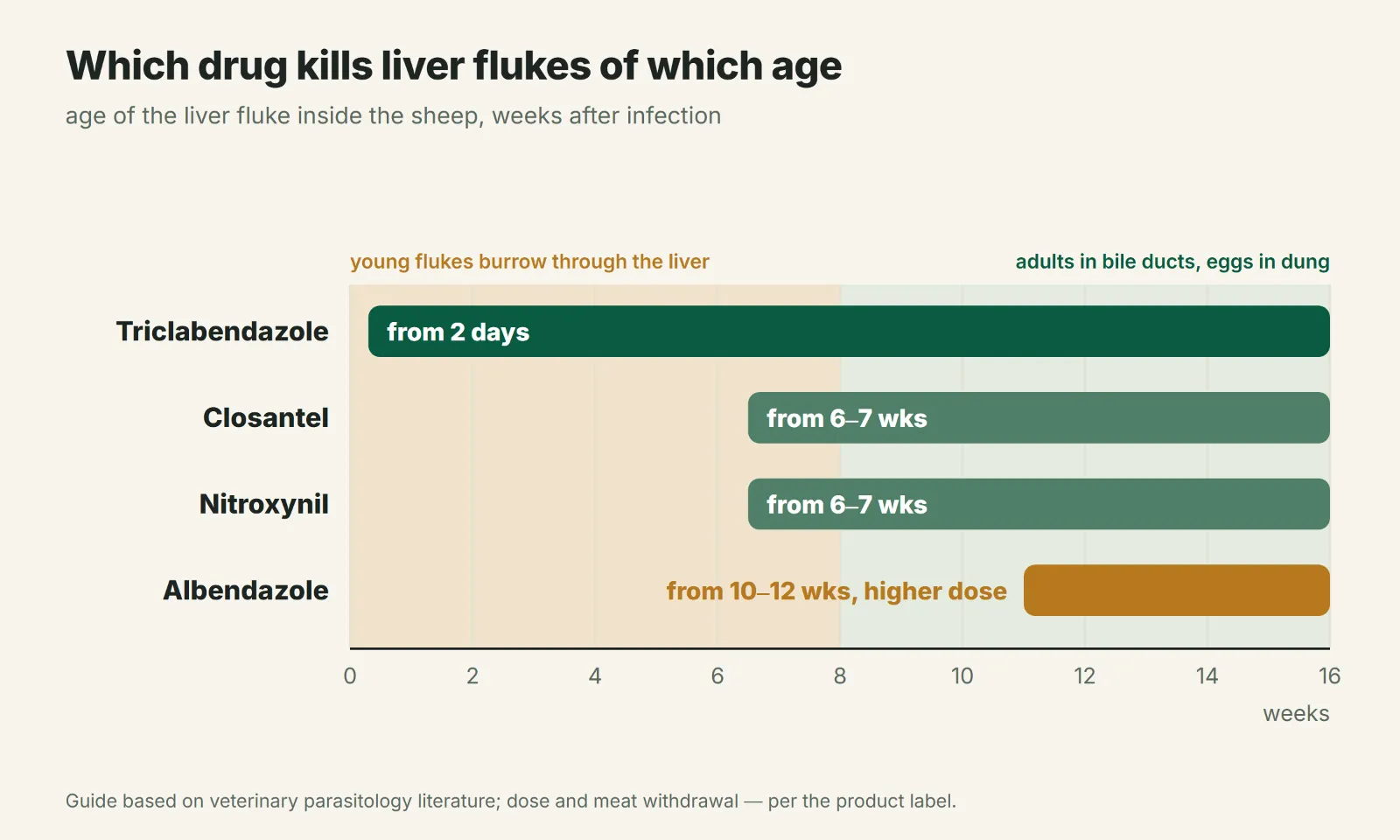
The main thing to know about the drugs: they kill flukes of different ages. Treating in autumn with the "wrong" drug leaves all the young parasites in the liver, and a month or two later the flock loses condition just as it would without treatment.
| Active ingredient | From what fluke age it works | When to use |
|---|---|---|
| Triclabendazole | from 2 days, from the youngest to adults | in autumn when acute disease is suspected, and as the main treatment; the only one that kills the youngest flukes |
| Closantel | from about 6–7 weeks | main treatment in late autumn to winter |
| Nitroxinil | from about 6–7 weeks | in winter, against adult and nearly adult flukes |
| Albendazole | adults only, from about 10–12 weeks, and only at the "anti-fluke" dose | in spring before turnout, or in winter when new infection is already ruled out; also expels roundworms |
Doses go strictly by the drug's instructions and by the weight of the heaviest sheep in the group: underdosing is the main reason a treatment "did not work". The albendazole dose against flukes is higher than against roundworms (per the instructions, 7.5 mg/kg instead of 5 mg/kg): the ordinary "dewormer" dose does not kill flukes. Albendazole at the anti-fluke dose must not be given to ewes at breeding or in the first month after it. Flukicides have a long withdrawal period before slaughter, and many must not be given to dairy sheep whose milk is consumed, so read the label, especially before Eid al-Adha (Kurban Hayit).
In Europe and Australia the fluke has already become resistant to triclabendazole where it was used often and alone for years. So it makes sense to keep triclabendazole for autumn and to use closantel or another drug in the winter and spring treatment: closantel does not kill young flukes, and in autumn it cannot replace triclabendazole.
When to treat the flock for fasciolosis: a yearly schedule
A schedule for a flock that grazes near water in summer and autumn in Uzbekistan. The timing is a guide; agree the specific drug and date with your district vet.
| When | What to do | Why |
|---|---|---|
| October to December: with triclabendazole, when the flock goes into the barn; with another drug, about a month after that | treat the whole flock | remove the flukes before they destroy the liver |
| December to January, 8–10 weeks after the first treatment | closantel or nitroxinil, or better, a sedimentation fecal test first | finish off survivors if the first treatment was done before grazing near water ended or triclabendazole works poorly on the farm |
| March to April, before turnout to pasture | albendazole or closantel | so adult flukes do not seed eggs on the spring pasture and infect snails |
The general calendar of deworming and vaccinations by month is in the article on the sheep vaccination calendar.
When there are many dates (three fasciolosis treatments, plus roundworm deworming and vaccinations), they are easy to mix up in a notebook. With QoyHunter, a sheep-records CRM and the bazar.qoyhunter.com marketplace, you log each treatment in the health journal for the flock or for a specific sheep, set the date of the next one, and the app reminds you in advance; the cost of the drug goes into the farm's finances on its own. How it works is on the page about sheep vaccination and treatment records.
How to keep fasciolosis out of the flock: prevention without drugs
- Do not graze near water from July to November. Edges of ditches and collectors, marshy low spots and the edges of rice paddies are the most dangerous areas. If you cannot avoid them, fence them off for that period.
- Water from troughs and drinkers, not from the ditch or standing puddles: cysts persist on the grass and at the water's edge.
- Treat purchased sheep in quarantine, especially if they come from Khorezm, Karakalpakstan or another rice-growing area. A month of quarantine apart from the flock is just the time for treatment. When buying a breeding ram or ewe lambs, ask the seller where the flock grazed and what it was treated with; you can calmly compare several offers in the sheep and rams for sale section.
- Do not throw infected liver into the ditch. Bury or burn it.
- Rotate the pasture near water into hay cutting: dried hay is far less dangerous than fresh grass.
The fluke also infects people, through unwashed greens and grass gathered near water, and through unboiled water from a ditch. That is one more reason not to keep the flock near drinking water.
What fasciolosis costs a farmer: a calculation for 100 lambs
By the estimate in our vaccination calendar, chronic fasciolosis takes up to 4 kg of weight gain a year from a lamb. Let's calculate for a batch of 100 fattening lambs that grazed near water and were not treated.
| Indicator | Value |
|---|---|
| Lost weight gain per lamb | up to 4 kg a year |
| Live weight price (conservative, September 2026) | 44,000 UZS/kg |
| Lost revenue per lamb | up to 176,000 UZS (≈ $15) |
| For 100 lambs | up to 17.6 million UZS (≈ $1,485) |
This does not count livers condemned at slaughter, weak lambs from sick ewes, poorer wool, and deaths in the acute form. The rate used is about 11,850 UZS per dollar.
The conclusion is simple: compare 176,000 UZS with the price of a flukicide per head at the nearest vet pharmacy. Treatment pays off as long as it costs less. What is expensive is not the drug but a missed deadline and a drug that does not kill flukes of the right age.
FAQ
Can fasciolosis in sheep be cured with albendazole?
Albendazole kills only adult flukes (roughly older than 10–12 weeks) and only at a higher dose: 7.5 mg/kg against 5 mg/kg for roundworms. If you treat the flock with it in October right after grazing by a ditch, the young parasites in the liver survive, and 1–2 months later the sheep start losing weight. Albendazole is suitable in spring before turnout or in winter, when new infection is ruled out; in autumn you need triclabendazole, which kills flukes from 2 days of age.
When should sheep be treated for liver fluke?
For a flock that grazes near water in Uzbekistan, the main treatment is in October–December: triclabendazole right when the flock goes into the barn, or another flukicide about a month after that. The second, if needed, is 8–10 weeks later, in December–January, with closantel or nitroxinil, preferably after a fecal test. The third is in March–April before turnout, so adult flukes do not infect the pasture.
How can I tell whether a sheep has liver fluke or ordinary worms?
For certain, only by a fecal sedimentation test or by examining the liver at post-mortem. An ordinary flotation test often misses fluke eggs. At post-mortem in fasciolosis the bile ducts of the liver are thickened, white, crunch under the knife, and contain leaf-shaped parasites 2–7 cm long.
Can you eat the meat and liver of a sheep with fasciolosis?
An infected liver is not used for food; it is condemned and destroyed. The meat of a carcass that looks healthy is usually allowed after a veterinary inspection, but with severe emaciation or edema the vet may condemn the whole carcass; the vet makes the decision at slaughter. The meat of a treated sheep may be sold only after the withdrawal period stated on the drug label.
Do sheep that graze on dry foothill pasture need treatment for fasciolosis?
If the flock grazes on dry pasture all season and drinks from troughs, the risk of fasciolosis is low, and a separate autumn treatment against the fluke is usually not needed. It is easy to check: cut open the liver at the next slaughter. If the ducts are clean and there were no sheep bought from wet regions in the flock, ordinary deworming against roundworms is enough.
Manage your flock in QoyHunterCRM for sheep farmers: livestock, health, weighing, finance and analytics — in the app and a Telegram bot.All features →