Why a Ewe Doesn't Lamb: Barren Ewes, What They Cost, and Who to Cull Before Breeding
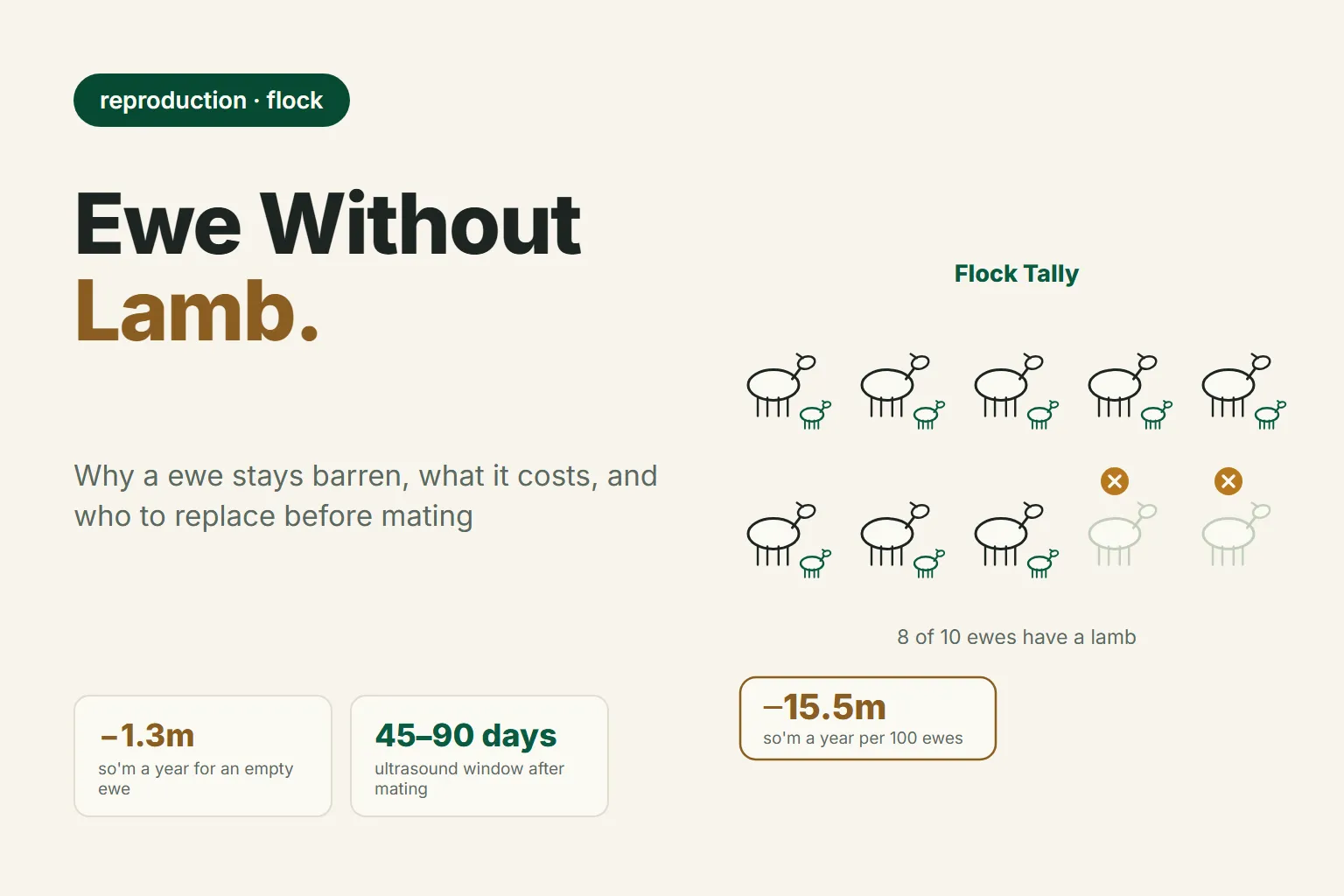
Up to one in five ewes can stay barren and eat feed all year for nothing. Here's why it happens, what it costs in so'm, how to find open ewes 45–90 days after mating, and who to cull before the breeding season.
A farmer counts heads: "I've got a hundred ewes." But a flock's money isn't counted in heads — it's counted in the lambs those ewes actually produced. Between "a hundred ewes" and "a hundred lambs," a decent sum disappears every year: some ewes stay barren. They eat the same hay, take up the same space in the barn, go through the same treatments — and give you nothing back.
Let's break it down in numbers: how many lambs a hundred ewes should produce, what one barren ewe costs you over a year, why she doesn't get pregnant, and how to find open ewes months before lambing — not in March, standing at the barn. Prices are for July 2026, exchange rate ≈ 12,050 so'm per dollar. This is a seasonal topic: mating runs in October–November here, but its outcome gets decided in August–September — which is right now.
The Benchmark: How Many Lambs Should a Hundred Ewes Produce
The main reproduction indicator is lamb output per 100 ewes: how many lambs you got and kept alive to weaning, per hundred ewes put into mating.
For Central Asian fat-tailed breeds — Hissar, Edilbay, Jaydara — twins are rare; a ewe usually raises a single lamb. Reference figures put Hissar sheep fertility at 115–120%, meaning roughly 115–120 lambs per hundred ewes that actually lambed; Edilbay and Jaydara give similar numbers. So the ceiling here is lower than for prolific breeds, and 105–115 lambs at weaning per 100 ewes put into mating already counts as a good result for a well-run flock.
And in reality? Where mating is left to chance, output often drops to 70–85 lambs per 100 ewes. The gap between 85 and 110 is 25 lambs per hundred ewes, and it comes from three leaks:
- the ewe never got pregnant at all (stayed barren);
- the ewe lost the pregnancy (abortion, hidden infection, poor condition);
- the lamb was born and died before weaning.
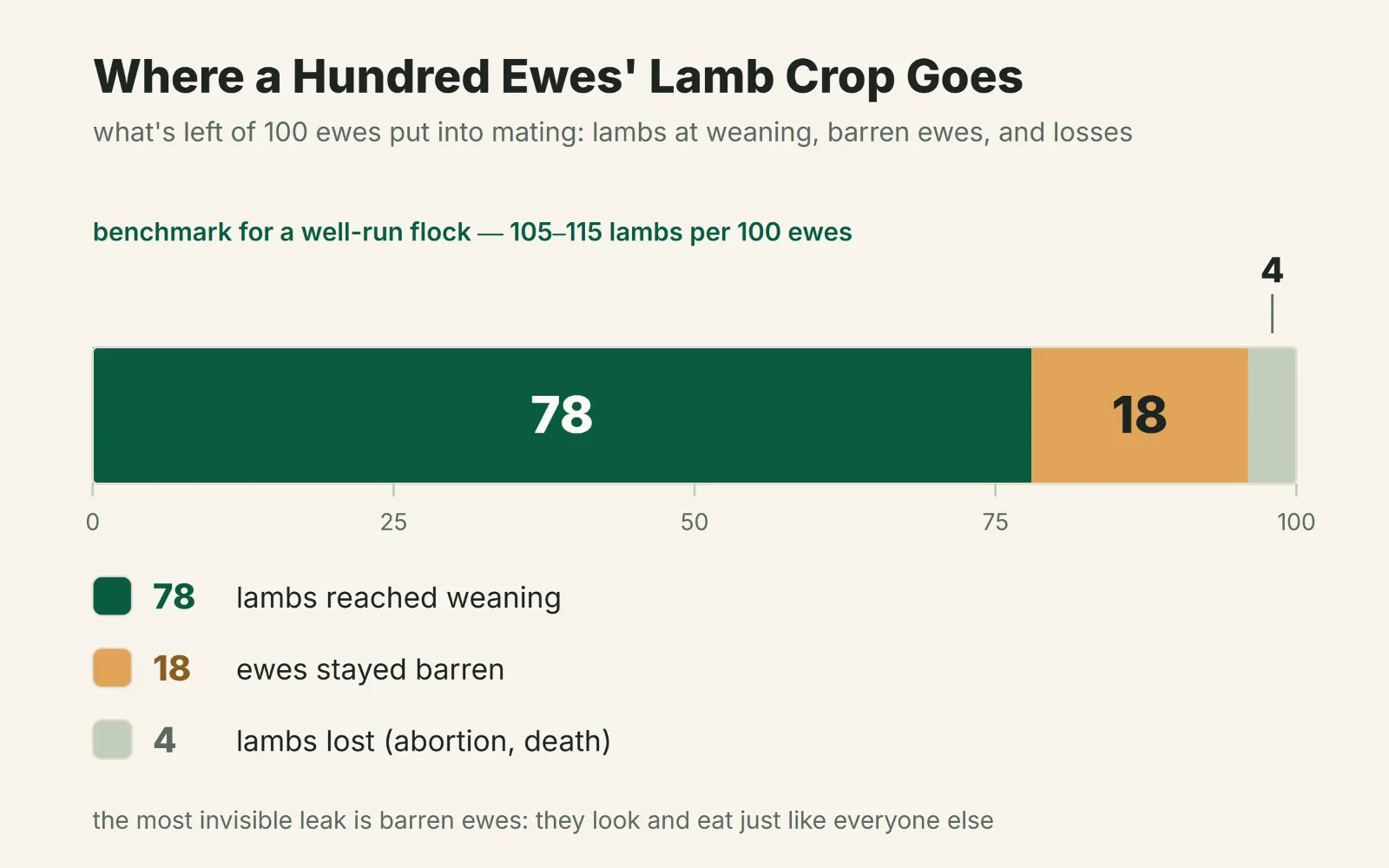
Almost nobody tracks the first leak, because it's invisible: a barren ewe looks like any other, eats like any other, and goes into winter with the rest of the flock.
What One Barren Ewe Costs You
Let's calculate using July 2026 prices. Feeding norms are from our breakdown of winter feed reserves, prices are from the article on the cost of live-weight gain.
What an adult ewe eats over a year (135 days of stall feeding, the rest on pasture):
| Item | Calculation | Cost |
|---|---|---|
| Alfalfa hay | ~300 kg × 1,100 so'm | 330,000 so'm ($27) |
| Straw | ~60 kg × 600 so'm | 36,000 so'm ($3) |
| Concentrates | ~45 kg × 3,300 so'm | 150,000 so'm ($12) |
| Salt, minerals, mineral lick | — | 20,000 so'm ($2) |
| Veterinary treatments, deworming | — | 50,000 so'm ($4) |
| Total direct costs per year | ≈ 590,000 so'm (≈ $49) |
We're not counting pasture — if it's your own, it's "free"; if it's rented or overgrazed, add that on top.
Now the other half of the ledger. A ewe with a lamb weaned at 3.5–4 months produces offspring weighing 26–31 kg (more on weaning). At a live-weight price of 55,000 so'm/kg, that's 1.4–1.7 million so'm ($116–141). From that, subtract the extra feed for the nursing ewe (~250,000 so'm) and the lamb's own supplement (~110,000 so'm).
| Indicator | Ewe with a lamb | Barren ewe |
|---|---|---|
| Annual revenue | 1.65 million so'm ($137) | 0 |
| Feed and treatments | −950,000 so'm ($79) | −590,000 so'm ($49) |
| Annual result | +700,000 so'm (+$58) | −590,000 so'm (−$49) |
The difference is around 1.3 million so'm (≈ $108) per barren head. That's the price of one empty ewe in the flock.
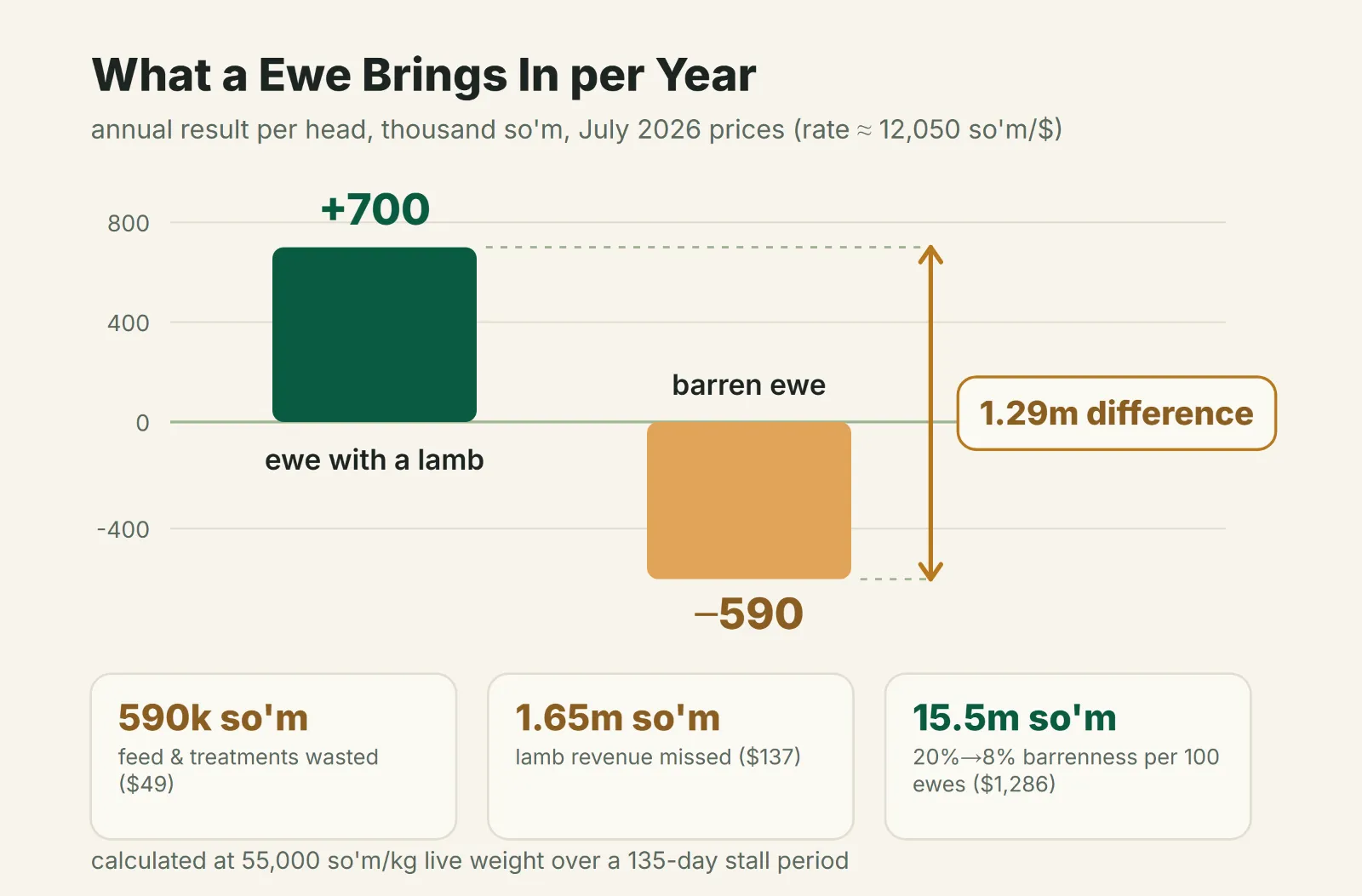
From there it's simple arithmetic. A flock of 100 ewes at 20% barrenness versus the same flock at 8%: the gap of 12 ewes comes to around 15.5 million so'm (≈ $1,280) a year. For the same feed, the same work, and the same pasture.
That's direct costs only. The full annual bill — with water, depreciation, a share of the breeding ram, ear tags, and a shepherd's labor — comes out to almost twice as much: how much it costs to keep a sheep for a year. It also works out the lamb output at which a breeding flock breaks even.
Why a Ewe Stays Barren
There aren't many causes, and almost all of them are within your control.
1. Body condition. A ewe that's too thin comes into heat poorly and conceives worse; too fat is just as bad. Going into mating, a ewe should be in average working condition: ribs palpable under a thin layer of fat, loin and tailhead filled out but not overloaded. Feel the loin on ten ewes from the flock — that's enough to get a picture of the whole group.
2. No flushing. 2–3 weeks before mating, ewes are switched to a boosted diet: the best pasture plus 300–500 g of concentrates per head a day, continued for another 2–3 weeks after mating starts. A ewe gaining condition comes into heat more evenly, and ovulation is more active. Important caveat: flushing works on ewes at average or below-average condition — on an already fat flock it won't add anything, just waste grain.
3. The ram. Half the outcome of mating rides on him alone, and we'll cover him separately below.
4. Infections. Mass abortions, stillbirths, weak lambs — that's not a "bad year," it's a warning sign. Behind it are usually brucellosis, campylobacteriosis, chlamydiosis, or toxoplasmosis. Take special care with brucellosis: it's transmissible to humans and classified as an especially dangerous disease, controlled by the state veterinary service. The rule is simple: if there's an abortion in the flock, don't handle the fetus and afterbirth with bare hands — isolate the ewe and call a vet. Mandatory vaccinations against especially dangerous diseases in Uzbekistan are given free of charge by the state vaccination team — more in the treatment calendar.
5. Parasites and minerals. A ewe infested with worms loses 20–40% of her weight gain, comes into heat worse, and aborts more often. Deworming before mating is a mandatory step; get the drug, dose, and timing from the label and your own vet, not from a neighbor's advice. A shortage of selenium, cobalt, and iodine also hurts reproduction: cover it with a mineral lick and mineral supplement. Be careful with copper: sheep are extremely sensitive to it and get poisoned by an excess — use mineral supplements made specifically for sheep, and never give them cattle premixes or mineral licks.
6. Age. By 5–7 years old (depending on breed and grazing conditions), a ewe wears out: her teeth wear down and fall out, she grazes worse, loses condition, and stays barren more often. It's not a disease — it's her service life. How to age a ewe by her teeth and how many replacement ewe lambs to keep is covered in culling old ewes.
The Ram — Half the Flock
One ram covers 25–50 ewes, so his personal problems instantly turn into barrenness across dozens of head. Check him now, not in October.
Heat. This is the biggest and most underrated factor in our conditions. The full cycle of sperm formation in a ram takes about seven weeks, and overheating during that period sharply degrades semen quality: motility drops and the share of defective sperm rises. A ram that goes through July–August heat with no shade can reach October's mating season with semen that barely fertilizes anything — and there's no outward sign of it: he walks with the flock and mounts ewes, they just stay empty. Recovery from heat stress takes weeks, so the rule is simple: 8–10 weeks before mating, the sire needs shade during the hottest hours, free access to cool water, and no transport in a scorching truck bed.
Condition and legs. A thin ram — or, just as bad, an overweight one — performs poorly. A lame ram doesn't work at all: he simply won't chase a ewe in heat. Inspect the hooves, trim them, and treat if needed.
Load and backup. One sire per 25–50 ewes under pasture mating, fewer for a young ram. Keeping a single ram for the whole flock is risky: if he turns out to be unfit, you'll only find out five months later — with an empty barn.
How to Find Open Ewes in Time
The point of early diagnosis is simple: an open ewe found in December is one less mouth to feed all winter, and money back in your pocket. The same ewe found in March has already eaten through your feed reserves for nothing.
- Marking the ram. A simple trick: paint or colored paste is applied to the ram's chest — a mounted ewe gets a mark on her back. That shows you who's being covered, and when. Change the color every 16–17 days (that's the length of a ewe's heat cycle): a ewe marked twice, one cycle apart, didn't conceive the first time.
- Return to heat. If a ewe comes back into heat after 16–17 days, the mating didn't take. One return is normal; mass returns are a red flag — check the ram.
- Ultrasound for pregnancy. The most reliable method. The optimal window is 45–90 days after mating: in this window, a transabdominal scan shows both pregnancy itself and the number of fetuses, with accuracy above 90% in studies. For a flock, that's a day or two of a vet's work, and the result is an exact list of who you don't need to feed all winter.
Record results for each ewe individually: mating date, ram number, ultrasound result, lambing outcome. In a paper notebook these records get lost between seasons, and by the second year nobody remembers who was open last year. In a digital ewe register, an animal's whole history lives in its card, so by the next mating season you can see who's stayed barren two years running — and that ewe is almost always a lost cause.
Which fields to keep for every ewe so the barren ones surface on their own is covered separately: what to record for every sheep.
Who to Cull Before Mating
Flock replacement is a normal annual job: 15–20% of ewes are replaced with young ewe lambs every year. Culling has to happen before mating, not after lambing, or you'll be feeding a cull for another year. Candidates for culling:
- barren two years in a row — almost always a lost cause;
- 5–7 years old or older, especially with worn or missing teeth: such a ewe can no longer hold her condition on pasture;
- diseased or damaged udder — mastitis, lumps, one non-working half: such a ewe won't be able to raise a lamb;
- chronic lameness and ruined hooves;
- a ewe that lost a lamb through no fault of yours — poor mothering ability gets passed on;
- an emaciated ewe that won't gain condition on a normal ration.
The cull list turns straight into a buying plan: buy replacement ewe lambs before September costs less than at the height of the mating season, and they have time to settle into the flock.
And the reverse rule: don't put a ewe lamb into mating until she's reached at least 70% of an adult ewe's weight — usually at 12–18 months of age. Mating too early leads to difficult births, weak lambs, and a ruined future ewe.
A barren ewe you have decided not to put to the ram does not have to be sold the same day. If she is thin but healthy, 45–60 days on hay and barley add 5–7 kg and lift the price per kilogram — what that brings per head, and which ewes are not worth feeding, is worked out in our piece on fattening cull ewes.
Your August–September Plan
- Check the ram: condition, hooves, no lameness. Provide shade and water through the rest of the heat — it pays off at October mating.
- Go through the flock by hand: condition, udders, teeth, hooves. Flag candidates for culling.
- Deworm the flock (agree on the schedule with your vet) and cover mineral supplementation — a sheep-specific mineral lick in the trough.
- 2–3 weeks before turning the ram in, start flushing: for October mating, that's late September; the best pasture plus 300–500 g of concentrates per ewe a day.
- Prepare marking gear for the ram and start a list of ewes for the mating season.
- Schedule an ultrasound for December — 45–60 days after mating starts.
In Short
A barren ewe doesn't look like a loss, but she costs your operation around 1.3 million so'm (≈ $108) a year — and keeps costing you for as long as you feed her. Cutting barrenness from 20% to 8% on a flock of a hundred head brings back around 15 million so'm (≈ $1,250), without a single new animal and without a new hectare of pasture.
It works not in October, once the ram is already in with the flock, but in August and September: shade for the sire, hands-on checks of the ewes' condition, deworming, flushing, and an honest list of who it's time to replace.
The same math applies to young stock: a ewe lamb kept until a year and a half instead of bred early eats through an extra year of feed. She can go under the ram once she reaches 65–70% of adult ewe weight — breed-by-breed thresholds are worked out in what age to breed a ewe lamb.
Manage your flock in QoyHunterCRM for sheep farmers: livestock, health, weighing, finance and analytics — in the app and a Telegram bot.All features →