Straw for Sheep: How Much to Feed, When It Is Cheaper Than Hay, and How to Treat It With Urea
Sheep can be fed straw only alongside hay: untreated straw covers up to a third of roughage, urea-treated about half. Field straw at 400 UZS/kg is 30% cheaper than hay by energy, while an 18 kg bale listed for 13,000 UZS is 25% more expensive. Urea doses, treatment timing for Uzbekistan, and a savings calculation for 100 ewes over winter.
You can feed sheep straw, but you cannot replace hay with it entirely: wheat straw has less than half the energy of alfalfa hay, and almost no protein. Untreated straw can cover up to a third of an adult sheep's roughage, and urea-treated straw about half: according to FAO data, treatment raises digestibility by 8–12 points and intake by 25–50%. Straw pays off for sheep only when it is cheap: your own, or taken from the field in summer.
Below: the price point at which straw is cheaper than hay in autumn 2026, a step-by-step urea treatment with doses and timing for Uzbekistan's climate, and how much this saves on a flock of 100 ewes over a winter. Prices are as of September 2026, at the Central Bank of Uzbekistan exchange rate for September 15, 2026 — 11,765 UZS per dollar.
Can sheep be fed straw instead of hay?
No, only alongside hay. Straw is what's left of cereal stalks after threshing: the grain is gone, most of the leaf has fallen off, and what remains is coarse stem. A kilogram of wheat straw has about 0.20 feed units and only 5–10 g of digestible protein; a kilogram of alfalfa hay has 0.45 feed units and about 100 g of protein. A feed unit is a conventional measure of feeding value equal to the nutritional value of 1 kg of average-quality oats (the oat feed unit).
So a flock kept on straw alone all winter fills its rumen but goes hungry for protein and energy. Pregnant ewes show this first: they lose condition by lambing time, give birth to weak lambs, and produce little milk. Straw belongs in the ration as a cheap roughage component, not as its base.
How much straw should a sheep get per day?
The straw ration for a sheep depends on the group and on whether the straw has been treated. Guidelines for the winter housing period, with total roughage of 1.8–2.0 kg per adult head per day:
| Group | Untreated straw | Urea-treated |
|---|---|---|
| Open ewe and first half of pregnancy | up to a third of roughage, 0.6 kg | up to half of roughage, 1.0 kg of straw weighed before treatment (about 1.5 kg wet) |
| Ewe in second half of pregnancy, and nursing ewe | small addition to hay, hay is the base | small addition, hay is the base |
| Breeding ram outside mating season | up to 1 kg | up to 1 kg |
| Lambs being fattened | filler alongside grain and meal | only for those already chewing the cud |
| Suckling lambs | not given | not given |
The last two months of pregnancy and the first weeks of lactation are when a ewe needs the most nutrient-dense feed, and cutting corners with straw here costs more than it looks: underfeeding in these weeks results in weak lambs. Detailed hay and concentrate rations by group are in our breakdown of winter sheep feeding.
At what price is straw cheaper than hay?
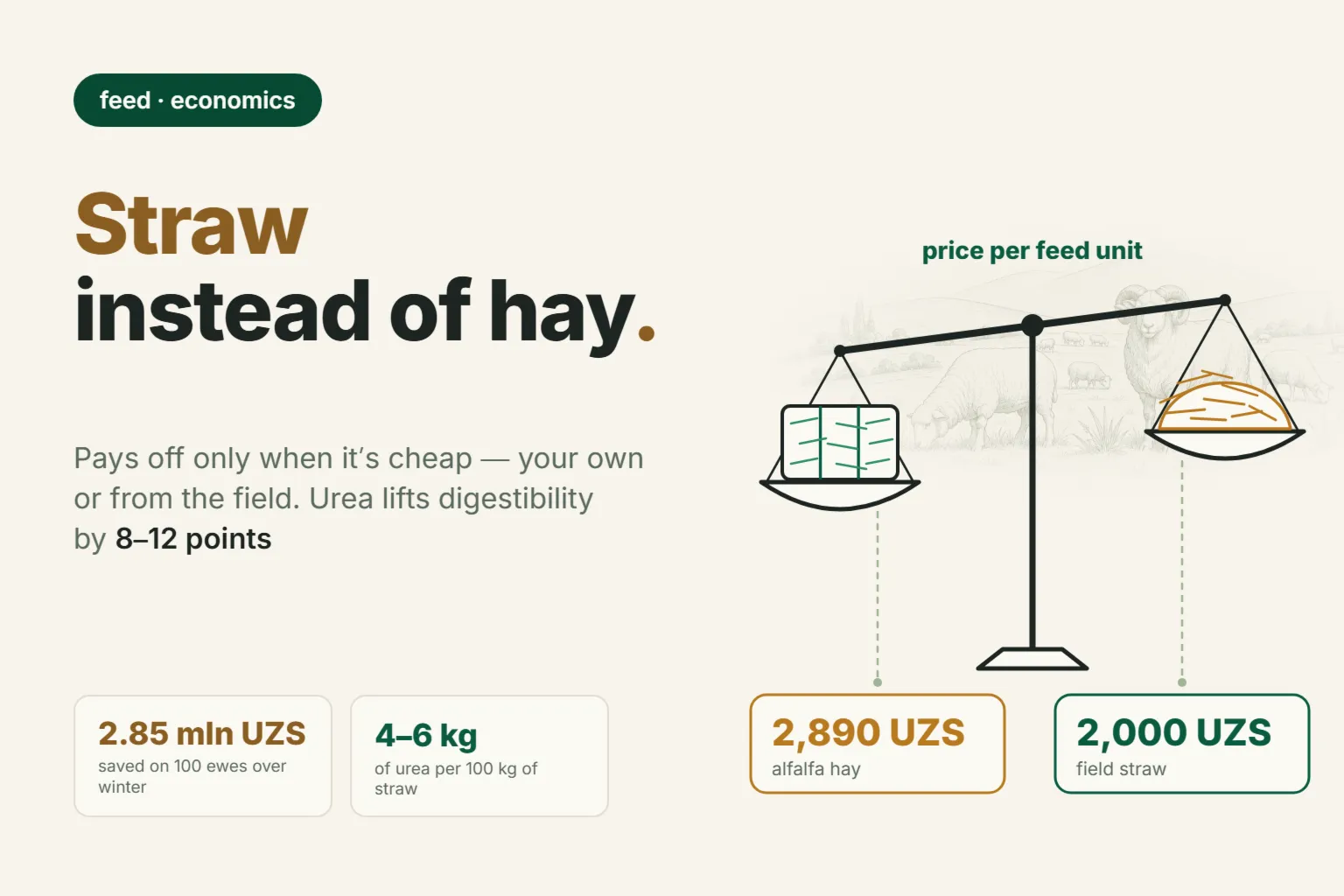
Comparing straw and hay by price per kilogram makes no sense: what you need to compare is the price of a feed unit. By energy, wheat straw is worth no more than 44% of hay's price per kilogram (0.20 versus 0.45 feed units). At hay priced at 1,300 UZS/kg, that's about 580 UZS per kilogram of straw — and that's without accounting for protein, of which straw has almost none. In practice, it makes sense to buy straw below 500 UZS/kg.
| Feed, September 2026 | Price, UZS/kg | Feed units per 1 kg | Digestible protein, g/kg | Price per feed unit |
|---|---|---|---|---|
| Alfalfa hay, bale for 26,000 UZS | 1,300 ($0.11) | 0.45 | 100 | 2,890 UZS |
| Wheat straw, own or from the field in summer | 400 ($0.03) | 0.20 | 5–10 | 2,000 UZS |
| Wheat straw, baled, from listings | ~720 ($0.06) | 0.20 | 5–10 | 3,600 UZS |
| Own straw, urea-treated | ~600 ($0.05) | 0.27–0.30 (estimate) | higher than untreated | 2,000–2,220 UZS |
| Barley | 3,800 ($0.32) | 1.15 | 85 | 3,300 UZS |
Hay, summer straw, and barley prices are the same as in our calculations of price per kilogram of protein in feed and hay selection. A baled straw listing on olx.uz in late August 2026 asked 13,000 UZS ($1.10); the bale weight was not stated there, so the price per kilogram in the table is calculated for an 18 kg bale — weigh your own with a hook scale before buying. The nutritional value of treated straw is an estimate based on the rise in digestibility from FAO data. The price and nutritional value of treated straw are given per kilogram of straw before treatment: once soaked with the solution, 100 kg of straw becomes about 150 kg of wet feed.
The takeaway from the table: field straw at 400 UZS is 30% cheaper than hay by energy, while an 18 kg bale for 13,000 UZS is 25% more expensive than hay. Buying baled straw in autumn only saves money if a 13,000 UZS bale weighs more than 26 kg, meaning a kilogram comes out cheaper than 500 UZS.
How to treat straw with urea: step by step
Urea treatment is the most accessible on-farm way to raise the value of straw. In moistened straw, urea breaks down into ammonia, the ammonia softens the stiff stem walls, and it becomes easier for rumen microbes to digest. Some of the nitrogen stays in the straw, so its crude protein content goes up. The doses below are from the FAO guide to using roughage in hot climates (Chenost and Kayouli, 1997).
- Solution. For every 100 kg of straw, dissolve 4–6 kg of urea in 50 L of water. Water can range from 40 to 80 L: the final moisture of the straw should be 30–50% — drier and the treatment doesn't work, wetter and the straw starts to rot.
- Stacking. The straw is laid in a trench, pit, or a stack on film, in layers; each layer is evenly soaked with the solution from a watering can and tamped down. Bales don't need to be broken apart: row by row, soak and pack them tightly.
- Covering. Cover the top and sides with polyethylene film and weigh it down with soil or tires so the ammonia doesn't escape. Silage-grade airtightness isn't needed here, but an open pile loses ammonia and does no good.
- Curing. The time depends on air temperature: at 30 °C and above, about a week; at 15–30 °C, one to four weeks; below 15 °C, about two months.
- Airing. After opening, air the straw for a while before feeding, over the course of a day, until the sharp ammonia smell is gone.
- Transition. Treated straw replaces regular roughage gradually, over about two weeks. A mineral supplement is mandatory: salt licks and a mineral mix.
For Uzbekistan, this means it pays most to lay down straw in September and the first half of October. In Tashkent, the average September temperature is about 21 °C, October about 14 °C, and November about 8 °C, so straw laid down in September is ready in 1–4 weeks, while straw laid down in November will take two months.
What the treatment costs: urea traded at around 4,200 UZS per kilogram on the Uzbek Republican Commodity Exchange in spring 2026, with retail bags costing more. At 5,000 UZS/kg ($0.42), 4 kg per 100 kg of straw costs 20,000 UZS ($1.70), or about 200 UZS per kilogram of straw, plus film, which lasts more than one season.
How much does treated straw save on a flock of 100 ewes?
Let's work out three rations for an open ewe or a ewe in the first half of pregnancy. All three have about the same amount of energy — around 1.1 feed units per day; wherever straw replaces part of the hay, the missing energy is made up with barley.
| Ration per head per day | Cost per day with straw at 400 UZS/kg | Cost per day with straw at 720 UZS/kg |
|---|---|---|
| Hay 1.8 kg + barley 0.25 kg | 3,290 UZS ($0.28) | 3,290 UZS |
| Hay 1.3 kg + straw 0.6 kg + barley 0.35 kg | 3,260 UZS ($0.28) | 3,452 UZS |
| Hay 0.9 kg + urea-treated straw 1.0 kg dry weight (about 1.5 kg wet) + barley 0.35 kg | 3,100 UZS ($0.26) | 3,420 UZS |
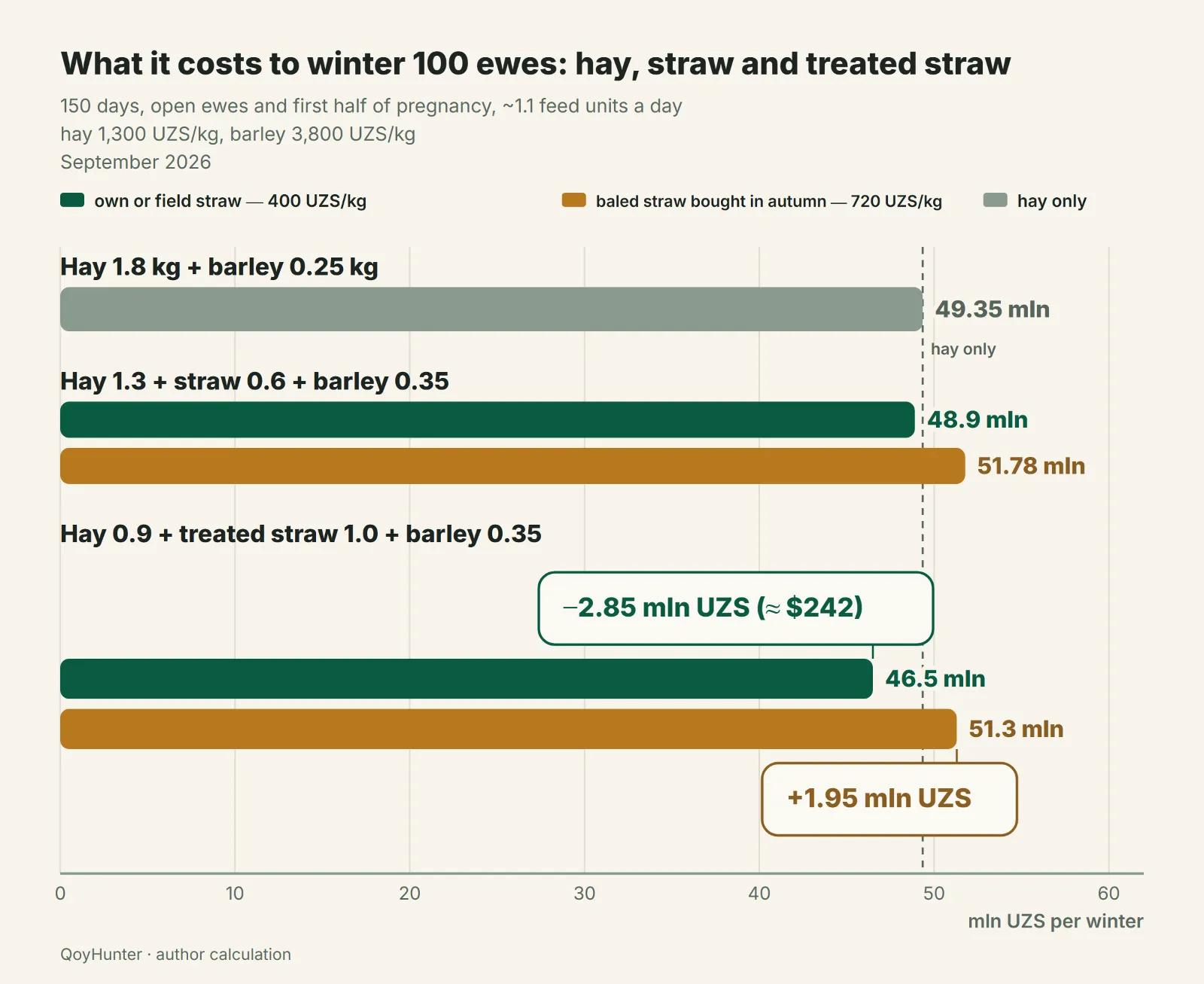
For a flock of 100 ewes over a 150-day winter, this looks like:
- hay-only ration — 49.35 mln UZS (≈ $4,195);
- a third of roughage as untreated straw at 400 UZS — 48.9 mln UZS, a saving of just 0.45 mln UZS (≈ $38);
- half the roughage as your own urea-treated straw — 46.5 mln UZS, a saving of 2.85 mln UZS (≈ $242);
- the same treatment, but with straw bought in bales at 720 UZS — 51.3 mln UZS, meaning 1.95 mln UZS (≈ $166) more than feeding hay alone.
Here's the main takeaway. By the price of a feed unit, treated straw is no cheaper than untreated (2,000–2,220 UZS versus 2,000): urea adds at least as much to the price as it adds in energy. The real gain is elsewhere — sheep eat it 25–50% more readily, and it can cover half the roughage instead of a third. It's replacing that second third of hay that produces the savings. And this only works with cheap straw: your own, from threshing on your own field, or bought straight from a dehkan farmer's field in summer.
The easiest way to check how this math applies to your flock is by real consumption: how many bales of hay and straw were bought, how many were written off for feeding, and how much is left. QoyHunter, a sheep record-keeping CRM and the bazar.qoyhunter.com marketplace, has farm feed inventory tracking built exactly for this: feed purchases post to expenses automatically, feeding writes down the stock, and a low-stock reminder to buy more arrives on its own.
What should you never do when treating straw with urea?
- Never let animals drink the urea solution. It's concentrated and toxic: don't leave buckets or barrels of solution unattended where a sheep could drink from them.
- Don't add urea to feed "for protein" alongside treated straw. If the ration already includes treated straw, don't give supplements or compound feeds that contain urea.
- Never give treated straw to suckling lambs. Only animals with a working rumen get it: ones already eating roughage and chewing the cud.
- Never switch the flock over in a single day. Stretch the transition to about two weeks, and air the straw before feeding it in the first few days.
- Never treat wet or moldy straw. Urea doesn't undo spoilage, and mold spores are dangerous for pregnant ewes.
If a sheep shows drooling, trembling, unsteadiness, or bloating after switching to treated straw, stop feeding it and call a vet right away.
The same feed-unit arithmetic applied to succulent feeds points the other way: bought-in pumpkin and fodder beet lose to hay by a factor of 3–4 — see pumpkin, beet and carrots for sheep.
Where can you get cheaper straw, and how do you avoid overpaying?
Straw is cheapest in summer, right after the wheat harvest, straight from a dehkan farmer's field — that's when its price is closer to 400 UZS/kg than to the autumn 720. If you don't have your own field, arrange for straw in advance, before threshing.
When buying, check three things:
- Bale weight. The price of a bale tells you nothing until you know its weight: weigh 3–5 bales from different spots in the stack with a hook scale and work out the price per kilogram. We covered how to do this with hay in how to choose hay for sheep when buying.
- Color and smell. Good straw is light yellow, dry, and free of musty odor. Gray, dark, dusty straw with a white coating inside the bale is moldy — don't even use it as bedding for ewes.
- Contamination. A lot of dirt, stones, and weeds means less actual feed and extra waste in the feeder.
It's easiest to compare feed prices across several places at once: a dehkan farmer's field, the bazaar, and sheep feed for sale listings. If straw costs more than 500 UZS per kilogram, it's more cost-effective to buy hay instead.
FAQ
Can sheep be kept on straw alone in winter?
No. A kilogram of wheat straw has about 0.20 feed units and only 5–10 g of digestible protein — many times less than alfalfa hay. On straw alone, sheep lose body condition, and pregnant ewes produce weak lambs and little milk. Untreated straw can cover up to a third of an adult sheep's roughage, urea-treated straw about half, with the rest given as hay.
How much urea is needed per 100 kg of straw?
Per the FAO guide, 4–6 kg of urea dissolved in 50 L of water (40 to 80 L is acceptable) per 100 kg of straw. The straw is laid in layers, soaked with the solution, tamped down, and covered with film. At 15–30 °C it's ready in one to four weeks; below 15 °C, in about two months.
When is the best time to treat straw in Uzbekistan?
In September and the first half of October, while the average temperature stays above 15 °C: then treatment takes 1–4 weeks. In Tashkent, the average September temperature is about 21 °C, and November's is about 8 °C; straw laid down in November won't be ready for about two months, by mid-winter.
Is it worth buying baled straw in autumn 2026?
Usually not. A baled straw listing on olx.uz in late August 2026 asked 13,000 UZS; at an 18 kg bale weight, that's about 720 UZS per kilogram and 3,600 UZS per feed unit — more expensive than alfalfa hay at 1,300 UZS/kg (2,890 UZS). Straw pays off when it costs less than about 500 UZS per kilogram: your own, or taken from the field in summer.
What kind of straw can lambs be fed?
Suckling lambs aren't given straw. Fattening lambs need straw only as a small roughage filler alongside grain and meal, and only lambs already eating roughage and chewing the cud get urea-treated straw, with a transition of about two weeks.
Manage your flock in QoyHunterCRM for sheep farmers: livestock, health, weighing, finance and analytics — in the app and a Telegram bot.All features →