How to Choose Hay for Sheep: Bale Weight, Cutting Stage, and the Cost of Bad Alfalfa
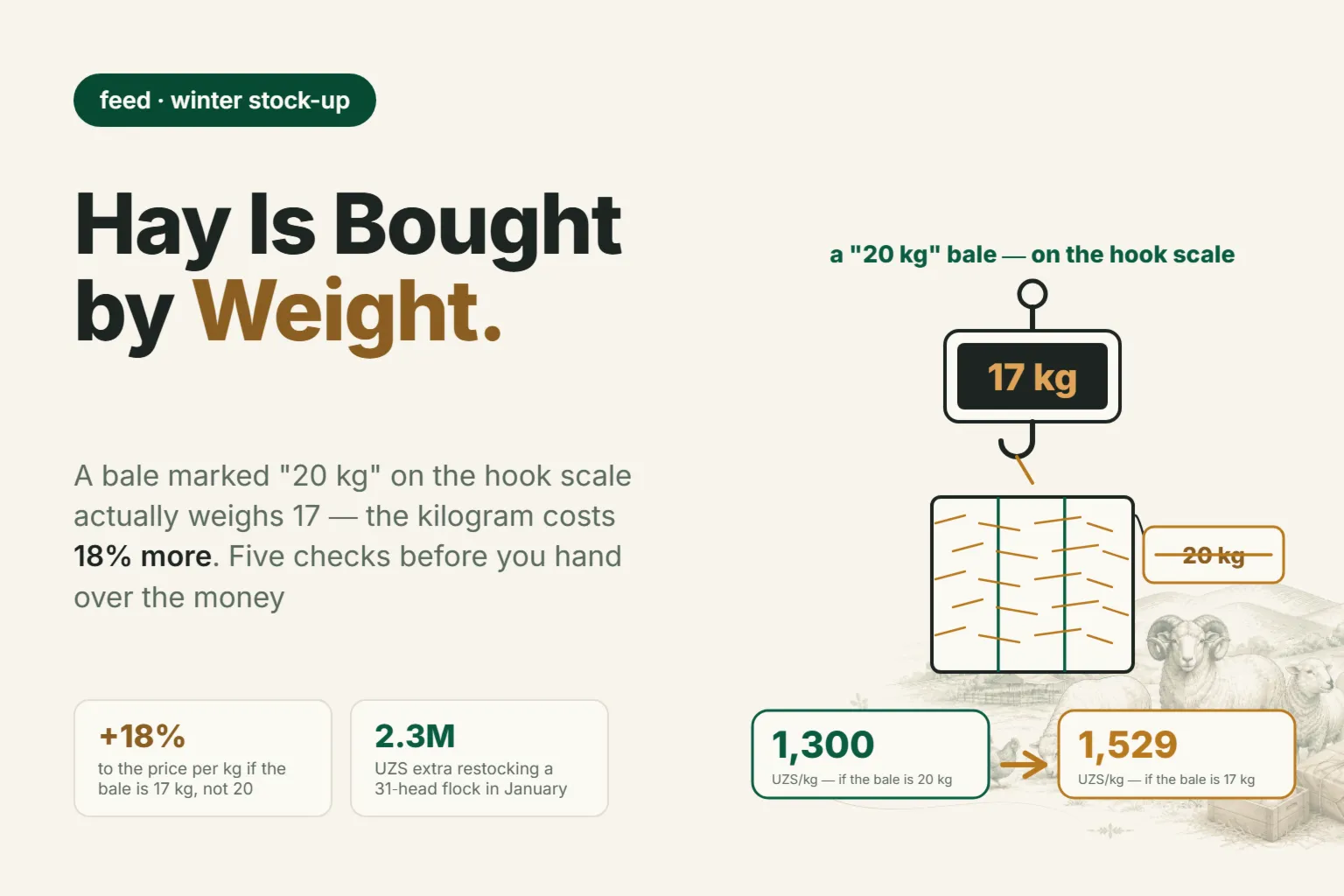
Good hay for sheep is green, leafy alfalfa cut before bloom or at its very start, with no mold and no musty smell. It pays to buy it by weight: a bale sold as "20 kg" that comes to 17 on a hook scale makes a kilogram 18% more expensive. Five checks to run on a batch, and a calculation of the losses for a 31-head flock over the 2026/27 winter.
How to choose hay for sheep at purchase: pick green, leafy alfalfa cut in the bud stage or at early bloom, with no mold, dust, or musty smell, and buy it by weight, not by the piece. A bale sold as "20 kg" that weighs in at 17 on a hook scale makes a kilogram of hay 18% more expensive, and overgrown alfalfa with a coarse stem comes up short on protein — protein you then have to buy back as meal.
Below: five checks on a batch that take half an hour at the seller's stack, and a calculation of what a bad hay purchase costs a 31-head flock over the 2026/27 winter. Prices are as of September 2026; the Central Bank of Uzbekistan's rate for September 11, 2026 is 11,783 UZS per dollar.
What Hay Is Best for Sheep?
Alfalfa hay is the backbone of the winter hay stock for sheep in Uzbekistan: it has more protein and calcium than straw or grass hay. But "alfalfa" at the bazaar isn't one single feed — it's a whole range. The same crop, cut early versus cut late, can differ in protein by almost one and a half times.
The leaf decides everything. According to the industry publication Hay and Forage Grower, alfalfa leaves hold 25–30% crude protein, while the stems hold only 6–10%, and at the bud stage and early bloom, leaves make up about half the plant's dry weight. That means most of a bale's protein sits in the leaf. Crude protein is the total protein content of a feed, as measured in a lab analysis. As alfalfa blooms and grows past that point, the stem thickens and turns woody, the leaf share drops, and every kilogram of hay carries less protein.
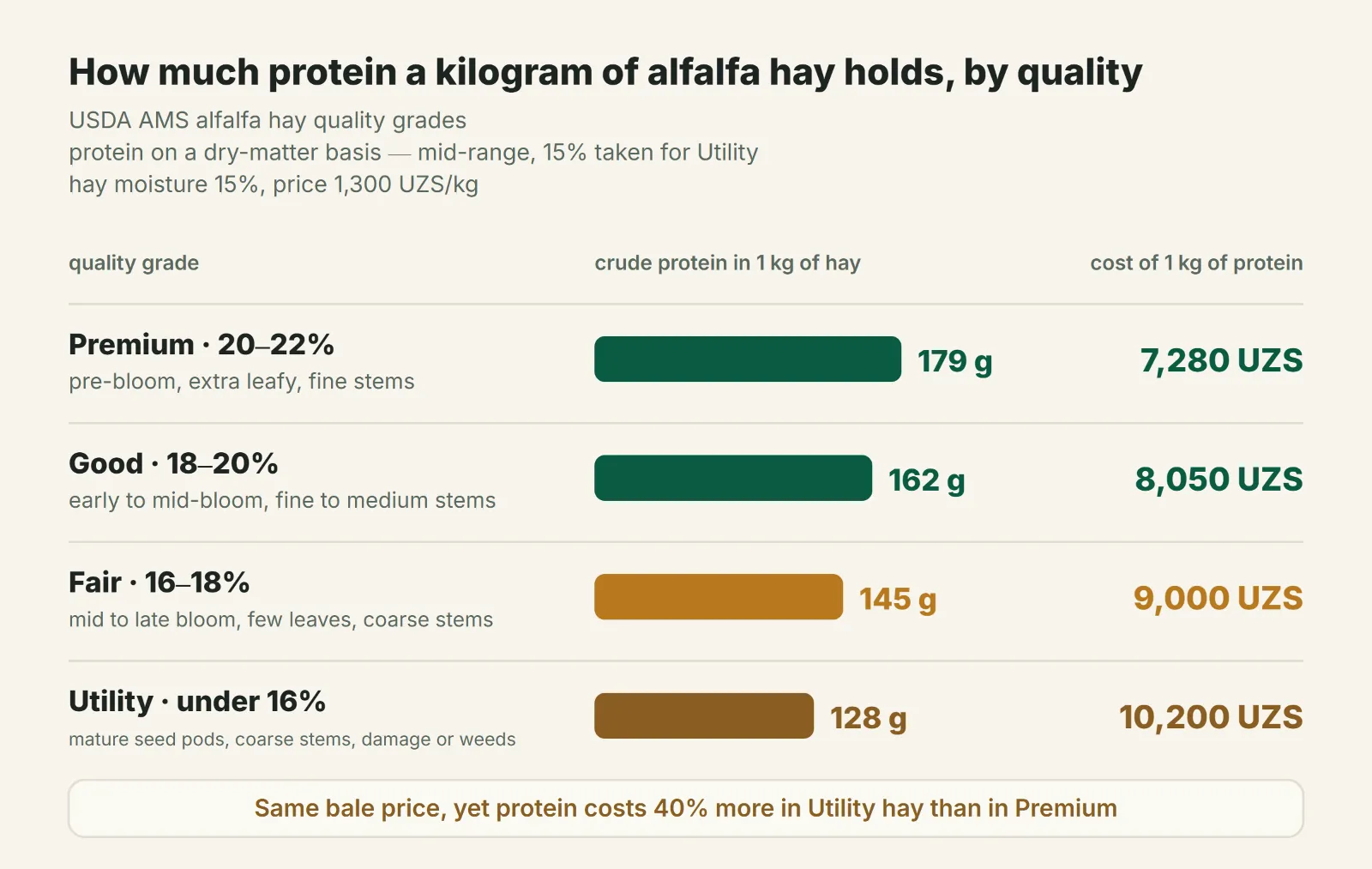
The US Department of Agriculture's Agricultural Marketing Service (USDA AMS) grades alfalfa hay into quality classes based on feed analysis, and publishes this scale in its hay market reports. Protein in it is measured on a dry-matter basis — what's left of the feed once you take out the water. The table shows what that means for a kilogram of hay you're buying:
| Quality class (USDA AMS) | What it looks like | Crude protein, dry-matter basis | Protein per kg of hay* | Price per kg of protein at 1,300 UZS/kg hay |
|---|---|---|---|---|
| Premium | cut before bloom, very leafy, thin stem | 20–22% | 179 g | 7,280 UZS ($0.62) |
| Good | early to mid bloom, leafy, thin to medium stem | 18–20% | 162 g | 8,050 UZS ($0.68) |
| Fair | mid to late bloom, medium to low leaf, coarse stem | 16–18% | 145 g | 9,000 UZS ($0.76) |
| Utility | seed pods present, coarse stem, damage, weeds, or mold | under 16% | 128 g | 10,200 UZS ($0.87) |
* At 15% hay moisture, using the midpoint of each range; for the Utility class, 15% protein was used. Above Premium, the USDA AMS scale also has a Supreme class — over 22% protein.
At the same bale price, a kilogram of protein in Utility-grade alfalfa costs 40% more than in Premium-grade. Without a feed analysis, you judge the class by eye, on three signs: buds versus open flowers and seed pods on the stems, a thin versus woody stem, and whether the leaf stays on when you shake a handful.
How Much Does a Hay Bale Weigh, and Why Buy It by Weight?
A small square bale of alfalfa hay is usually counted as 20 kg, and stock calculations start from that number. But bale weight is set by the baler and how tightly it packs, not by an agreement at the bazaar, and it swings noticeably from batch to batch. The seller quotes a price per bale, but the sheep eats kilograms.
In the fall of 2026, an alfalfa bale costs roughly 24–28 thousand UZS (≈ $2.0–2.4), rising to 30–45 thousand UZS by January; the exact price depends on the region and the harvest. Let's take the middle of the fall price — 26,000 UZS per bale — and work out the price per kilogram of hay at different actual weights:
| Actual bale weight | Price per kg of hay | Vs. the "20 kg" price |
|---|---|---|
| 22 kg | 1,182 UZS ($0.10) | −9% |
| 20 kg | 1,300 UZS ($0.11) | — |
| 18 kg | 1,444 UZS ($0.12) | +11% |
| 17 kg | 1,529 UZS ($0.13) | +18% |
| 16 kg | 1,625 UZS ($0.14) | +25% |
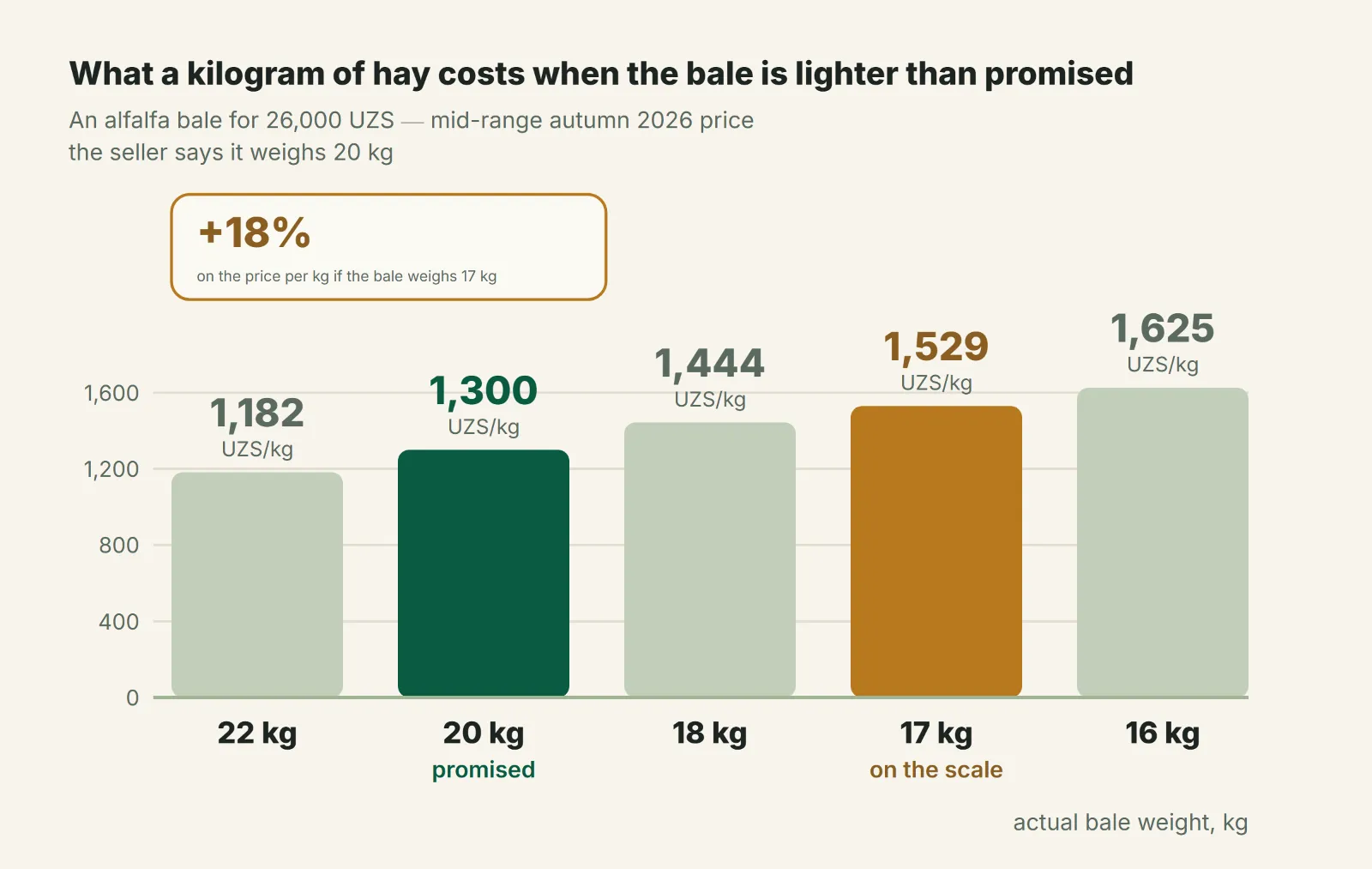
Underweight bales hit you twice: first on the price per kilogram, then on the stock itself. A flock of 31 head — 20 ewes, 10 young animals, and a breeding ram — needs about 8.4 t of hay for the winter; we worked out that number in "How Much Hay Does a Sheep Need for Winter: Calculating Your Stock and Why Buying in Summer Pays Off". The farm buys 420 bales at a nominal 20 kg for 10.9 million UZS (≈ $927). If the bales actually weigh 17 kg, the shed holds 7.1 t of hay: 1.26 t short, and in January you'll have to buy the difference at the winter price of about 1,800 UZS per kilogram — another 2.27 million UZS (≈ $192).
How not to overpay for underweight bales:
- Weigh 3–5 bales with a hook scale. A hook scale is a hand-held spring scale with a hook; for hay you need one rated for 50 kg. Take bales from different spots in the stack: the top, the middle, and the bottom row.
- Calculate the batch's average weight — total weight divided by the number of bales.
- Negotiate by the ton, not by the bale. Price per ton = bale price × 1,000 ÷ average weight. A 26,000 UZS bale that actually weighs 17 kg works out to 1.53 million UZS per ton, not 1.3 million as the nominal 20 kg would suggest.
A heavy bale still isn't automatically a good one. Wet hay weighs more than dry hay: a 20 kg bale at 25% moisture holds 15 kg of dry matter, while at 15% moisture it holds 17 kg. That's why you always check weight together with moisture.
A batch bought by weight is easier to manage afterward in kilograms too. QoyHunter, a CRM for sheep records and the bazar.qoyhunter.com marketplace, gives you hay and feed stock tracking for a farm in kilograms, sacks, or bales: a purchase lands in your stock and flows straight into farm expenses, and when stock drops below a threshold, you get a reminder to restock.
How Much Money Do You Lose on Overgrown Alfalfa?
Protein that's missing from the hay has to come from concentrate feed. The cheapest local protein source is cottonseed meal: about 3,500 UZS per kilogram at 35–41% crude protein. We worked out why it beats bran and barley on value in "What to Replace Expensive Ram Feed With: Cost per Kilogram of Protein in Meal, Bran and Barley".
The calculation is for the same 31-head flock and the same 8.4 t of hay. We take the meal's protein at the midpoint of its range — 38%:
| Good hay (18–20%) | Fair hay (16–18%) | |
|---|---|---|
| Crude protein per kg of hay | 162 g | 145 g |
| Protein in the full 8.4 t stock | 1,357 kg | 1,214 kg |
| Protein shortfall | — | 143 kg |
| Cottonseed meal to close the gap | — | 376 kg |
| Cost of meal at 3,500 UZS/kg | — | 1.32 million UZS (≈ $112) |
With Utility-grade alfalfa (15% protein), the gap roughly doubles: about 750 kg of meal, or 2.63 million UZS (≈ $223) for the winter.
An honest caveat: this money only matters where protein actually matters — for pregnant ewes in the second half of pregnancy, nursing ewes, and growing young stock. A dry ewe on maintenance does fine on plainer hay. So set the best part of the batch aside for ewes approaching lambing and for lambs, and feed the coarser hay to dry ewes and mature animals. Closing a protein gap with meal is cheaper than pushing more barley: you can buy oilseed meal, barley and compound feed in Tashkent directly from sellers, comparing prices.
Total for the 31-head flock: underweight bales (2.27 million UZS) plus Fair-grade alfalfa instead of Good (1.32 million UZS) — about 3.6 million UZS (≈ $304) for one winter. That's almost two spring-born lambs: in October 2026, a 35 kg lamb sells for about 1.93 million UZS.
How Do You Check Hay Moisture Without a Meter?
Hay should be baled at 12–18% moisture — that's the recommendation from Mississippi State University's farmer extension service (MSU Extension). Wetter hay heats up and molds inside the bale; over-dried hay loses its leaf already at baling. Without a moisture meter, you check it by hand:
- Hand in the bale. Break open a bale from the middle of the batch and put your hand inside. A warm or damp core means the bale is heating up — don't buy that batch.
- Twist test. Twist a handful of hay into a rope. Dry hay crackles and snaps; damp hay just bends and won't break.
- Smell. Good hay smells like hay. A musty, moldy smell means mold; a sweet, caramel-like or "tobacco" smell means the bales overheated.
- Color inside. The inside of the bale should be green. A golden top layer, bleached by the sun, isn't overheating. A dark brown core means overheating; a white coating and a cloud of dust when you shake it means mold.
According to the University of Nebraska, overheated brown hay is usually still safe to feed, but heat damage already makes part of its protein indigestible. It's not worth paying for that batch as if it were green.
Also look at how the batch is stored at the seller's. A stack under cover and on pallets keeps hay in good shape, while the bottom row of bales sitting on bare ground draws up damp — check those separately.
Why Is Moldy Hay Dangerous for Sheep?
Ruminants handle moldy hay better than many other animals: the rumen breaks down some of the mycotoxins — poisons produced by mold — before they do harm. The exception is pregnant ewes. According to MSU Extension, moldy hay causes mycotic abortions and aspergillosis in them. The second risk is listeriosis: according to the small ruminant team at Ohio State University (OSU), it's most often seen after feeding moldy or spoiled hay and silage. Listeriosis in sheep usually attacks the brain, and in pregnant ewes it can end in abortion.
Which gives a rule: don't feed moldy bales to ewes, and don't buy a batch where mold sits inside several bales, even at a discount. A 20% discount on 80 bales at 26,000 UZS is 416 thousand UZS, and one lost lamb at October prices is about 1.93 million UZS. If ewes abort after a feed change, or a sheep circles and tilts its head, call a vet right away: diagnosis and treatment are the vet's job.
Five Checks to Run on a Hay Batch Before You Buy
| What to check | How | When to walk away |
|---|---|---|
| Weight | hook scale, 3–5 bales from the top, middle, and bottom row | average weight below what was quoted, but the price per bale stays the same |
| Moisture | hand inside the bale, twist test on a handful | core is warm or damp, handful bends and won't break |
| Color and smell | break open 1–2 bales | white coating, dust, musty smell; don't pay for a dark brown core as if it were green |
| Leaf and stem | shake a handful | leaf crumbles to dust, stem is thick and woody, lots of seed pods |
| Weeds and debris | inspect the broken face of the bale | dirt, stones, wire, poisonous plants like datura (jimsonweed) |
Check every stack you're buying from separately: one seller may have hay from different cuttings and different fields stacked together, and the quality between them can differ.
FAQ
How Much Does a Bale of Alfalfa Hay Weigh?
A small square bale of alfalfa hay is usually counted as 20 kg, but the actual weight depends on the baler and how tightly it's packed, and it varies noticeably from batch to batch. Before buying, weigh 3–5 bales from different spots in the stack with a hook scale and work out the price per kilogram: a 26,000 UZS bale that actually weighs 17 kg costs 1,529 UZS per kilogram of hay — 18% more than a 20 kg bale.
How Can You Tell If Hay Is Too Wet?
Break open a bale and put your hand inside: a warm or damp core means the hay is heating up. Twist a handful into a rope — dry hay crackles and snaps, damp hay just bends. Hay should be baled at 12–18% moisture (MSU Extension's recommendation), and wetter bales mold from the inside, so it's better to skip that batch.
Can You Feed Moldy Hay to Sheep?
No, especially not to pregnant ewes. According to MSU Extension, moldy hay causes mycotic abortions and aspergillosis in pregnant ewes, and according to Ohio State University, listeriosis is most often linked to feeding moldy hay and silage. Cull moldy bales, don't buy a batch with mold inside the bales even at a discount, and call a vet right away if you see an abortion or signs of listeriosis.
How Much Does a Farm Lose on Bad Hay Over a Winter?
For a 31-head flock with an 8.4 t hay stock for the 2026/27 winter: bales that actually weigh 17 kg instead of the promised 20 leave a 1.26 t gap and 2.27 million UZS of buying in January, and Fair-grade alfalfa instead of Good costs another 1.32 million UZS in cottonseed meal to close the protein gap. Together that's about 3.6 million UZS (≈ $304) — almost two spring-born lambs at October prices.
Manage your flock in QoyHunterCRM for sheep farmers: livestock, health, weighing, finance and analytics — in the app and a Telegram bot.All features →