How Much Hay Does a Sheep Need for Winter: Calculating Your Stock and Why Buying in Summer Pays Off
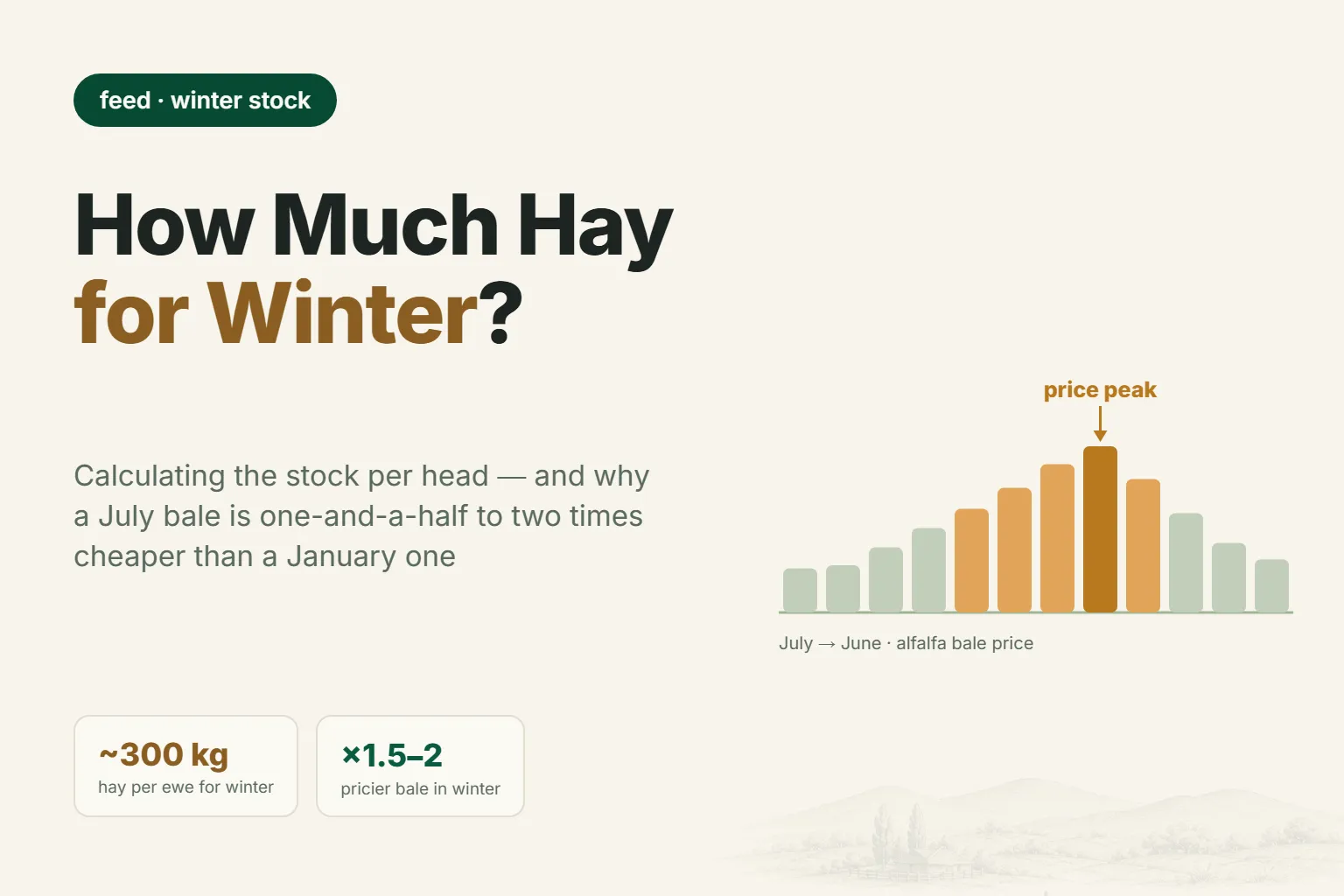
Calculating the winter feed stock: how much hay, straw, and barley an ewe, a lamb, and a ram need for the stall-feeding period — and how much money buying hay in July saves, before the bale price climbs one-and-a-half to two times.
July and August are the peak of hay-making season. Hay is at its cheapest all year during these weeks, and it's right now that the cost of your winter gets decided. Whoever counts the stock in summer buys bales at the summer price and sleeps easy. Whoever puts it off "for later" ends up buying the same hay in December at one-and-a-half to two times the price, and by February, when everyone's supply runs low, at an even higher price and worse quality. Let's break it down in numbers: how much hay, straw, and grain each group of animals needs to get through to spring, how to calculate the stock for your own flock, and how much money a summer purchase saves.
How Long Does Wintering Last
You shouldn't calculate the stock for "winter" as a vague season, but for the entire stall-feeding period — the time when pasture no longer feeds the flock. In the plains and steppe regions of Uzbekistan this is usually 120–150 days: from late November–December to the end of March, until spring grass comes up. In foothill and colder regions it's longer — up to five months.
For the calculations below we use 135 days — the middle of the range. If your winter runs longer, or pasture is already thin by November, calculate using the upper limit: one extra month of feeding adds another 20–25% to the stock.
Hay Norm Per Head: Calculating by Group
We covered the daily norms for winter feeding in detail in the article Feeding Sheep in Winter — here we convert them into a stock for the whole stall-feeding period. We add a 15–20% buffer to the net requirement right away: some hay is lost in storage and feeding out, some gets trampled by the sheep, and spring may arrive a couple of weeks late.
| Group | Hay, kg/day | Over 135 days, kg | Winter stock (+20%), kg |
|---|---|---|---|
| Ewe | 1.5–2.0 | ~240 | ~300 |
| Lambs 6–12 months | 1.0–1.5 | ~170 | ~200 |
| Breeding ram | 2.0–2.5 | ~300 | ~360 |
These are norms for average-sized animals: large Hissar and Edilbay sheep need the upper end of the range, small Jaidara sheep the lower end. Easy to remember: an adult sheep needs about 300 kg of hay for the winter, lambs about 200 kg.
The base of the stock should be alfalfa hay — a local legume feed rich in protein and carotene that keeps ewes in good condition and supports lamb growth. In addition to hay (not instead of it!), you should also stock up on:
- straw (wheat, barley) — used to replace part of the hay for adult animals, plus bedding. Target: 50–70 kg per head;
- concentrates (barley, corn, bran) — an ewe needs ~40–50 kg over the winter, a lamb ~40 kg, a ram ~70 kg;
- salt — 8–10 g per day per head, i.e. about 1.5 kg per sheep for the winter, plus a salt-lick block in the feeder.
Example: Stock for a Flock of 31 Head
Let's calculate for a farm with 20 ewes, 10 lambs, and one breeding ram:
| Feed | Calculation | Total for winter |
|---|---|---|
| Hay | 20 × 300 kg + 10 × 200 kg + 360 kg | ~8.4 t |
| Straw | 31 × ~60 kg | ~1.9 t |
| Concentrates | 20 × 45 kg + 10 × 40 kg + 70 kg | ~1.4 t |
In total, this flock needs about 8–8.5 tonnes of hay. In bales: a standard pressed alfalfa bale weighs about 20 kg, so the stock comes to roughly 400 bales. That's the number that should be in front of you in July — not something that surprises you in December.
How Much a Summer Purchase Saves
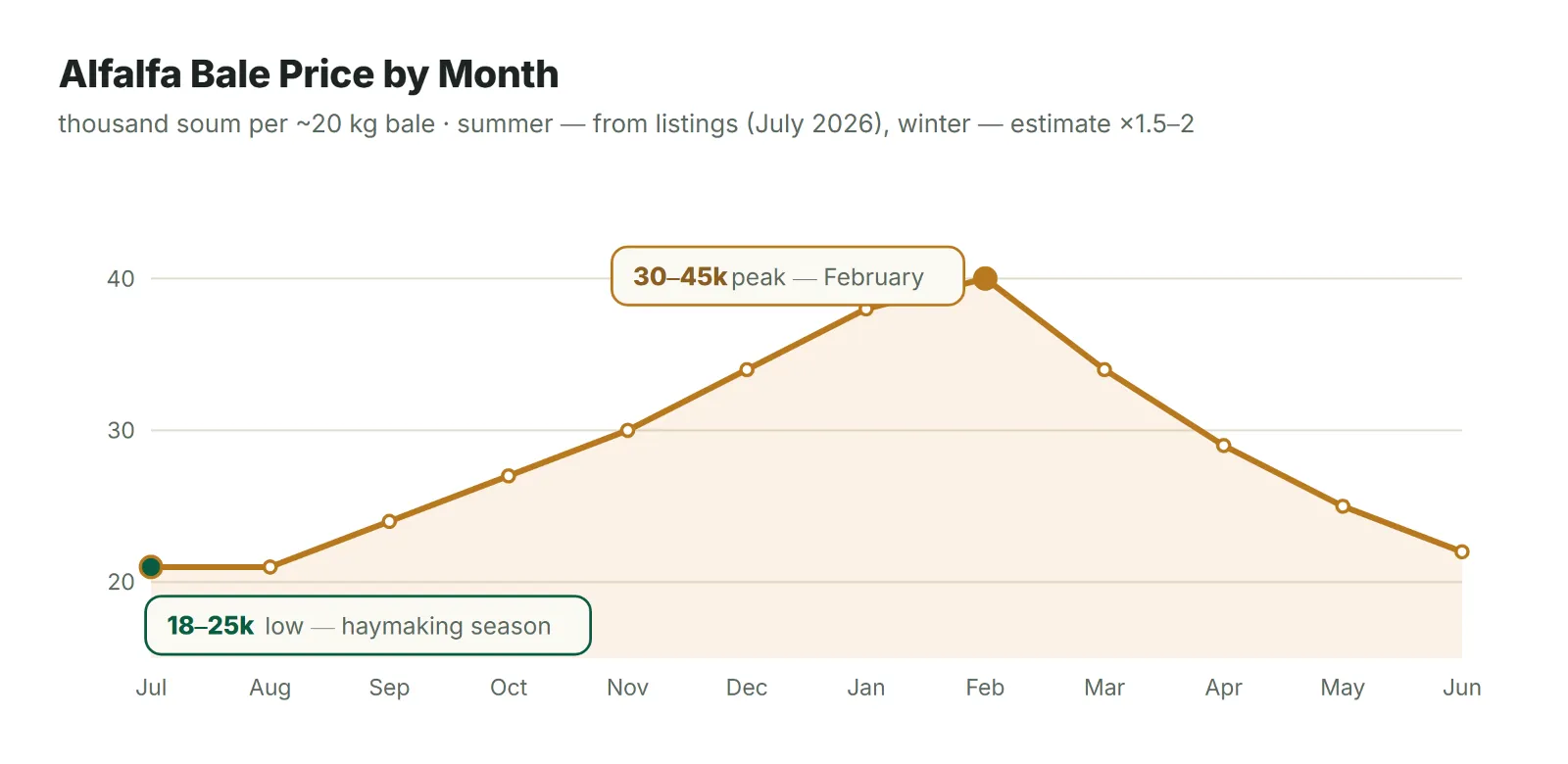
Now for the important part — money. Hay prices in Uzbekistan follow the same yearly cycle: the low point is during haymaking season (June–August), when supply is at its peak, followed by a gradual rise in autumn and a peak in mid-winter, when sellers' stocks are running out and demand is desperate.
Rough figures for July 2026 (exchange rate — about 12,000 soum per dollar): during haymaking season, an alfalfa bale listed for sale costs 18–25 thousand soum (≈ $1.5–2) — cheaper in the regions, more expensive in Tashkent. By mid-winter, based on past years, the same bale gets one-and-a-half to two times more expensive — up to 30–45 thousand soum (≈ $2.5–4). Per tonne: about 1.0–1.2 million soum (≈ $85–100) in summer, 1.6–2.2 million soum (≈ $130–185) in winter. The spread depends on region and harvest (even wider in a drought year), but the seasonal pattern repeats every year.
What this means for our flock of 31:
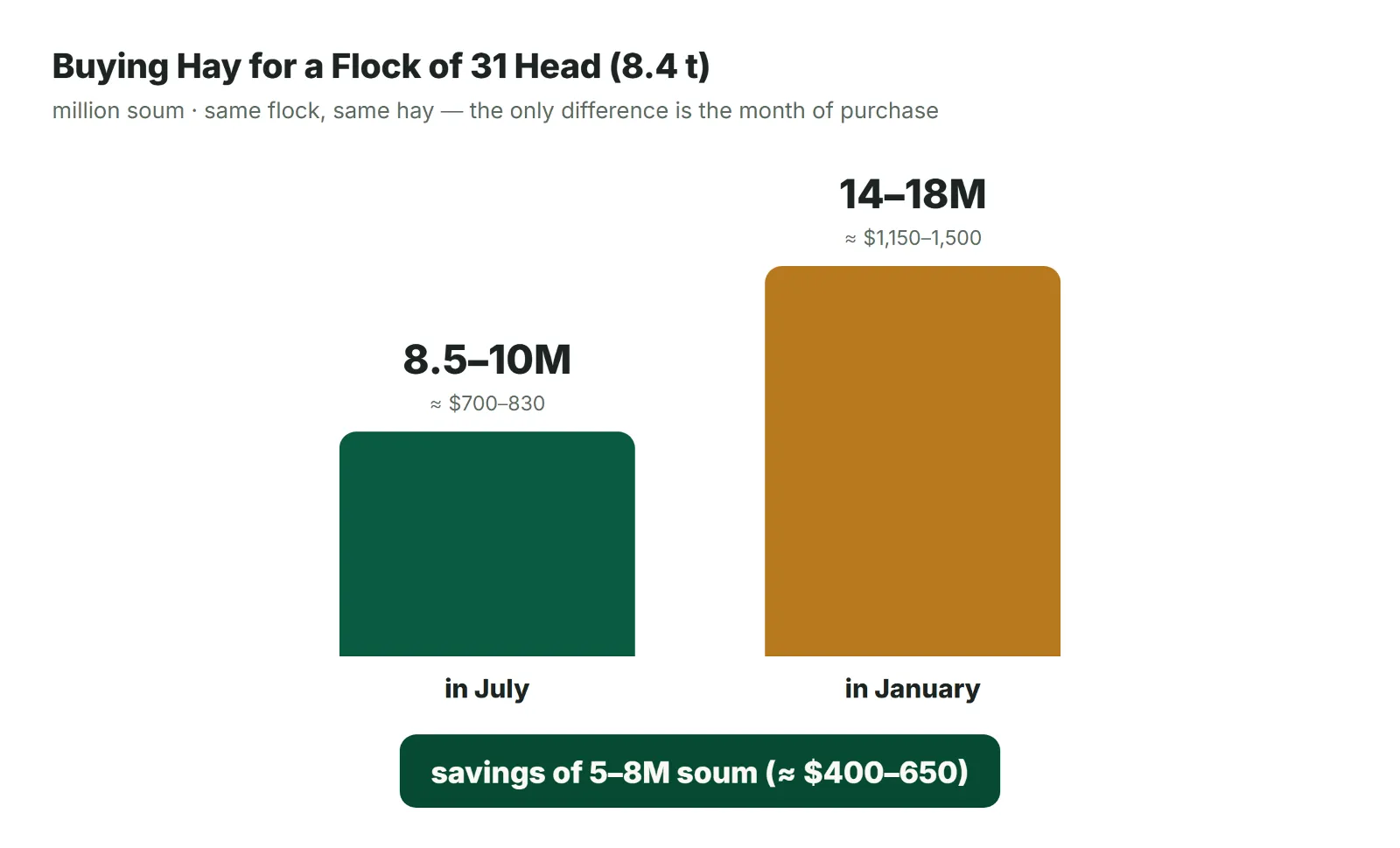
- buying 8.4 t of hay in July — around 8.5–10 million soum (≈ $700–830);
- the same purchase in January — around 14–18 million soum (≈ $1,150–1,500);
- the difference — 5–8 million soum (≈ $400–650) — on a single flock of 31 head alone.
That's not "small change saved" — it's the price of two or three good lambs, just for buying feed six months earlier. And this is without counting winter surprises: by February, good hay may simply not be available, and you'll have to take musty, dusty hay instead — the very kind that makes ewes lose condition before lambing.
There's a second benefit to buying in summer too: choice. In summer you choose the seller, negotiate, and check the quality of each batch. In winter, whoever still has hay left does the choosing.
Choice also means choosing between several offers at once: it is easier to buy hay in bulk in summer when you can see the price per tonne, the moisture and the batch size from different sellers.
Your feed reserve and the decision to sell are directly linked: selling your ram in autumn or holding him until spring is essentially a choice about whether to buy hay for him now.
Choosing in summer only pays if you can check the lot: how to choose hay for sheep when buying — bale weight, moisture and mold, with the overpayment worked out for the same 31-head flock.
Growing Your Own Alfalfa: How Much Land Covers a Flock
If you have irrigated land, the stock question gets solved even more cheaply. Irrigated alfalfa gives 4–5 cuttings per season; hay yield ranges from 40–60 quintals per hectare with average care up to 100–120 quintals per hectare with good irrigation and agronomy. That means one hectare of alfalfa is 4–12 tonnes of hay: on average, one to two hectares covers the winter for our flock of 31.
The cost of your own hay (irrigation, fertilizer, cutting, baling) is usually noticeably lower than the market price, and you control the quality yourself — the cutting stage determines how much protein and carotene reaches the feeder. The best feed comes from cutting alfalfa at the budding stage — early flowering — not overgrown.
Not all of the stock has to be hay. Maize silage covers part of the roughage: how much silage a ewe needs a day and when it beats hay on price — costed for a flock of 100 ewes.
Storage: Keeping Hay Good Until Spring
Buying cheap is only half the job. Hay still needs to survive until spring, and poor storage can waste a significant part of the stock:
- Under a shelter. Hay left in the open gets wet from above and draws moisture from below — the top and bottom layers end up wasted. A shelter or barn cuts losses many times over.
- Not on the ground. Place the bottom row of bales on pallets, poles, or a layer of straw — 20–30 cm off the ground, so moisture isn't drawn up.
- Only dry hay. Bales with moisture above ~18% heat up inside the stack, grow mold, and in the worst case can spontaneously combust. If a bale seems questionably dry, put your hand inside: hot and damp means it needs drying, not stacking.
- Check the stack during the first few weeks: a musty smell or heat inside means you need to restack it before you lose the whole batch.
- Never feed moldy or musty hay to sheep: it risks digestive problems and abortions in ewes.
A stock worked out in July almost always drifts from reality by February: hay goes faster than the norm and nobody recounts what is left in the barn. The restock threshold formula and the six reasons actual use runs 10–20% ahead of plan are covered in feed records on the farm.
In Short: Your July Plan
- Recount the animals that will go into winter. It's more profitable to fatten and sell weak or surplus animals in autumn than to feed them all winter.
- Calculate the stock: ~300 kg of hay per adult sheep, ~200 kg per lamb, plus a 20% buffer, with straw and barley counted separately.
- Buy hay now, during haymaking season — at summer prices and with a choice of quality. The difference from winter prices on an average flock runs into millions of soum.
- Stack it under a shelter, off the ground, only when dry.
- Feed by the norms in winter — you'll find them in the article Feeding Sheep in Winter.
To calculate the stock accurately, you need to know your actual flock numbers, not "about thirty head." In winter feed planning for a flock, flock records are kept for free right from your phone: how many ewes, how many lambs, who's headed for sale in autumn — and calculating winter feed becomes multiplying two numbers.
Prices and norms in this article are guidelines based on market data and zootechnical references as of mid-2026. Hay prices vary significantly by region and harvest — check your local market before making a large purchase.
Manage your flock in QoyHunterCRM for sheep farmers: livestock, health, weighing, finance and analytics — in the app and a Telegram bot.All features →