
How Much to Pay a Shepherd in 2026: Workload Per Person, Pay Schemes, and a Survival Bonus
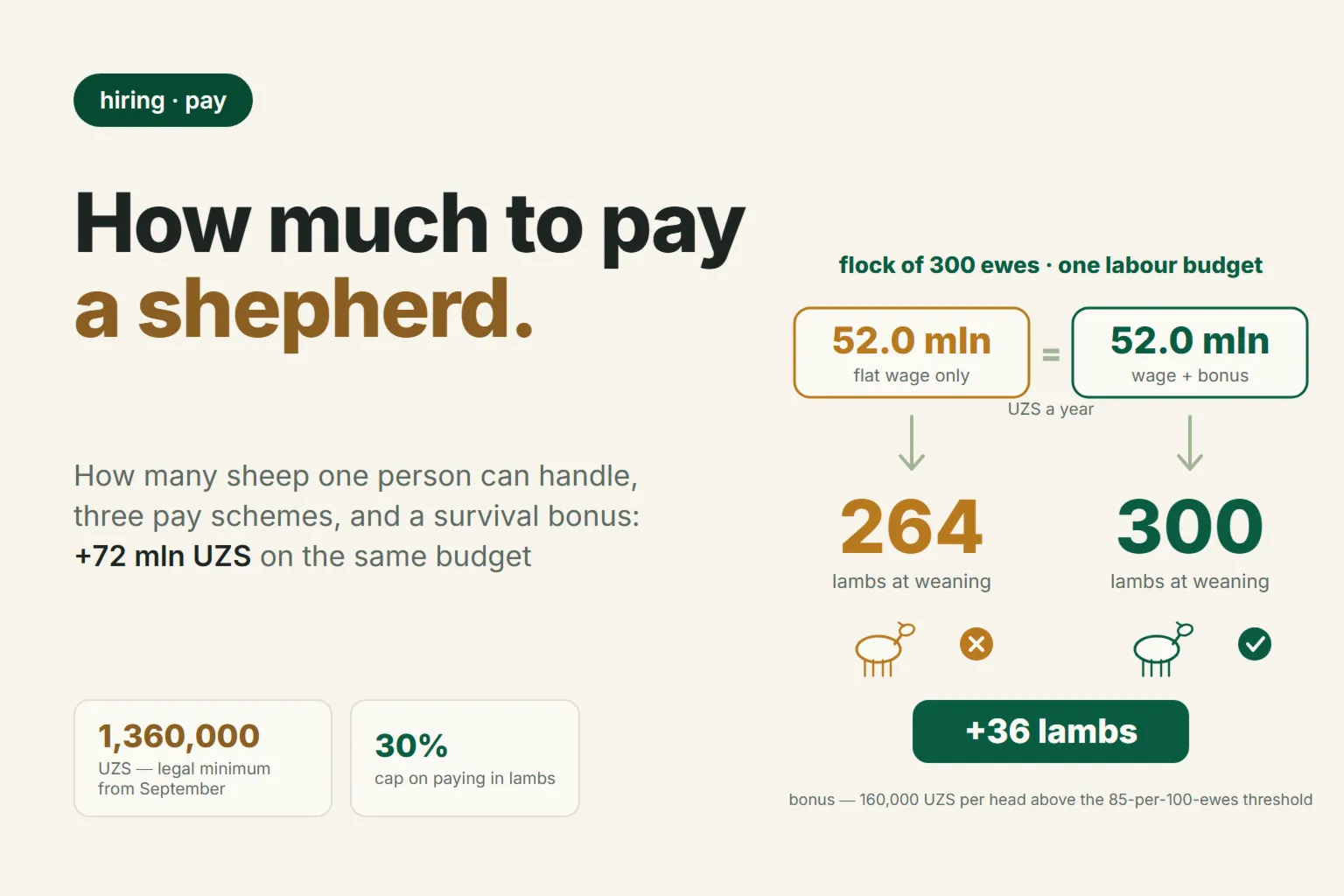
By law, a shepherd's minimum wage is 1,360,000 UZS a month from 1 September 2026, and in-kind pay is capped at 30%. On a flock of 300 ewes, a bonus-based pay scheme beats a flat wage by 72 million UZS in lamb-crop revenue on exactly the same labour budget.
How much to pay a shepherd in Uzbekistan in 2026: by law, no less than the minimum wage, which is 1,360,000 UZS a month (≈$115) from 1 September 2026; before September the rate was 1,271,000 UZS, and Presidential Decree No. UP-115 of 23 June 2026 raised it by 7%. You can pay part of the wage in lambs instead of cash, but no more than 30% of pay, and only with the worker's written consent. And the costliest part of this question isn't the wage amount — it's the form: a farm that pays a shepherd a flat wage loses more on the lamb crop than his entire annual pay.
Below: how many sheep one person can handle, what a shepherd's job costs on a flock of 300 ewes, and a calculation comparing two pay schemes on the same budget.
How Many Sheep Can One Shepherd Handle?
By zootechnical norms, a breeding flock is formed at 600–800 head — for coarse-wool and fat-tailed breeds, meaning ours, closer to the upper end — and a team of 3–4 shepherds is assigned to it. In other words, one person doesn't hold a flock that size alone: he holds it together with a helper and a second shepherd.
Practical benchmarks for lowland and foothill grazing:
| Group | Head per person | What limits it |
|---|---|---|
| Breeding flock outside lambing, on pasture | 350–500 | grazing distance, watering, the trek back to the shed |
| Breeding flock during lambing | 150–250 | round-the-clock checks, help with births, warming lambs |
| Finishing in a pen, barn-fed | 200–300 | feeding 2–3 times a day, cleaning, monitoring |
| Young stock after weaning, on pasture | 400–600 | less individual handling per animal |
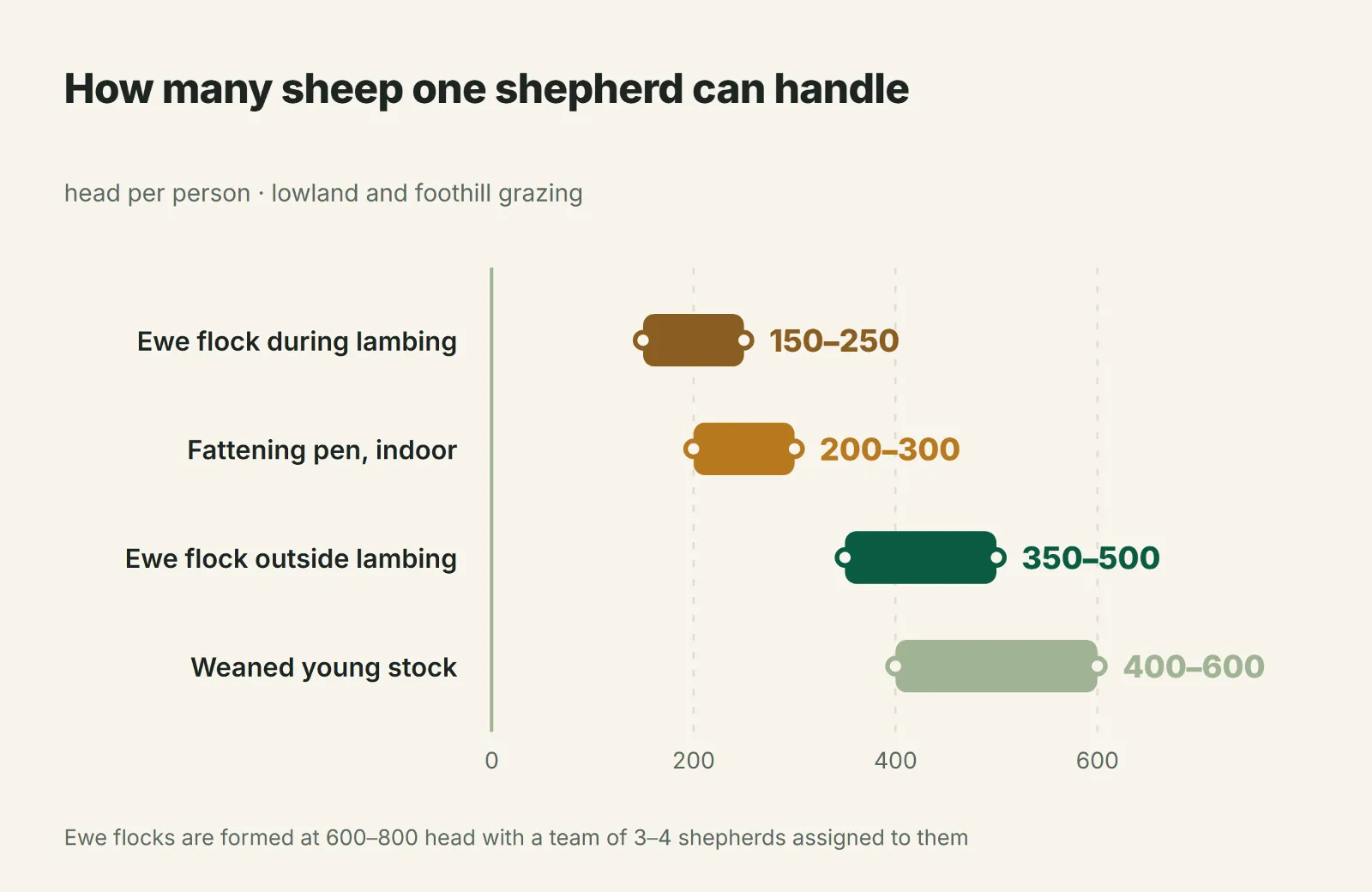
The main hiring mistake is sizing the workload by the quiet season. A flock of 300 ewes grazes under one shepherd without trouble in summer, but in February, during lambing, the same person physically can't get around to check on all of them at night. That's the month when lambs are lost, and afterwards nobody is held responsible for it. Lambing needs a second person — seasonally, for 25–30 days.
What Does a Shepherd Cost the Farm Per Year?
The wage is only part of the cost. Here's the full cost of a shepherd's position for a flock of 300 ewes with their lambs (a model calculation — plug in your own numbers):
| Item | Per year, UZS | In dollars |
|---|---|---|
| Shepherd's wage, 3.0 million a month | 36,000,000 | ≈$3,050 |
| Food at the flock (flour, oil, tea, meat) | 8,400,000 | ≈$712 |
| Housing at the sheep shed, electricity, firewood or gas | 3,000,000 | ≈$254 |
| Phone, transport, hauling water and supplies to the grazing ground | 2,400,000 | ≈$203 |
| Three guard dogs: feed and treatments | 2,200,000 | ≈$186 |
| Total | 52,000,000 | ≈$4,405 |
That's 173,000 UZS per ewe per year (≈$15) — with the wage itself making up just under 70% of that sum. For comparison: the average nominal wage across Uzbekistan for January–June 2026 was 7,091,000 UZS (≈$601), according to the National Statistics Committee, but that figure excludes small enterprises, micro-firms, and agricultural organisations — that is, nearly all rural hiring — so the real benchmark for a village is lower. The exchange rate used here and throughout is 11,801 UZS per dollar (Central Bank of Uzbekistan, 28 August 2026).
Three Ways to Pay a Shepherd: What Each One Does to the Flock
| Scheme | What the shepherd optimises for | Main risk |
|---|---|---|
| Flat wage | an uneventful day: take them out, bring them back, count them | lamb deaths are nobody's personal problem |
| Payment in lambs instead of money | the lamb crop and young-stock survival | breaks the law: in-kind pay is capped at 30% |
| Flat wage + bonus for survival and lambing rate | exactly what the owner does | requires honest records of lambing and losses |
The difference between the schemes isn't about the money — it's about what the person counts as his job. On a flat wage, a lamb that dies overnight is, for the shepherd, an event with no consequences. With a survival bonus, that same lamb is his personal 160,000 UZS, worth getting up at three in the morning for.
Same Money, Different Result: Flat Wage vs. Bonus on 300 Ewes
Take the same flock, the same labour budget, and two schemes.
Scheme A. Wage of 3.0 million UZS a month, no bonus. By weaning, the farm gets 88 lambs per 100 ewes — that's 264 head.
Scheme B. Wage of 2.4 million UZS a month (≈$203) plus a bonus: 160,000 UZS (≈$14) for every lamb that survives to weaning above a threshold of 85 head per 100 ewes. By weaning: 100 lambs per 100 ewes, i.e. 300 head.
| Metric | Scheme A: flat wage | Scheme B: wage + bonus |
|---|---|---|
| Annual wage | 36,000,000 UZS | 28,800,000 UZS |
| Other costs of the position | 16,000,000 UZS | 16,000,000 UZS |
| Bonus for 45 lambs above the threshold | — | 7,200,000 UZS |
| Total labour cost per year | 52,000,000 UZS | 52,000,000 UZS |
| Lambs at weaning | 264 | 300 |
| Revenue from the lamb crop, sold at 4–5 months at 2.0 million UZS | 528,000,000 UZS | 600,000,000 UZS |
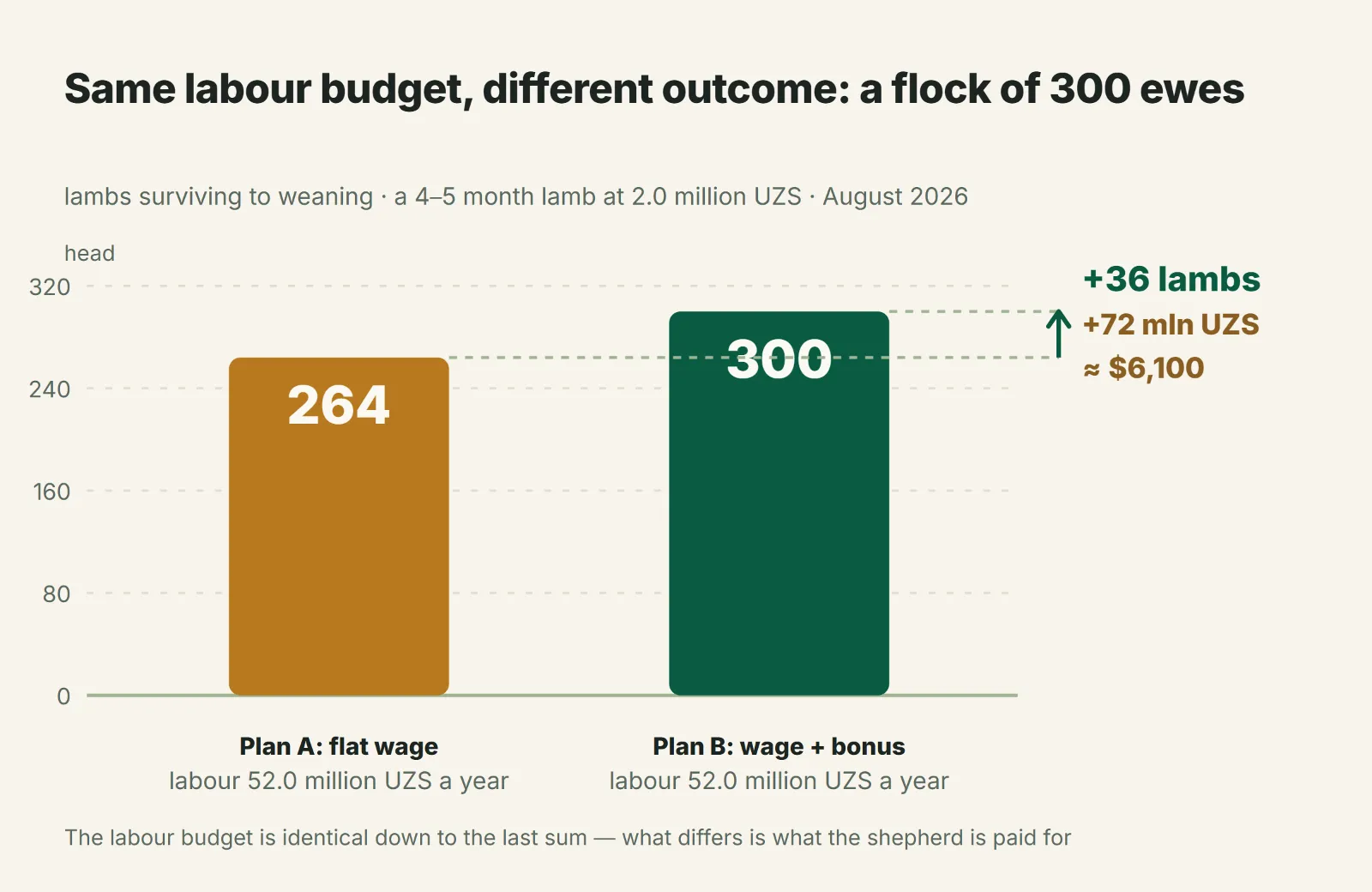
The labour budget matches to the sum. At the planned result, the shepherd ends up with the same 36 million UZS as on a flat wage — only he earns it for 300 lambs instead of 264: perform worse, earn less; perform better, earn more. For the farm, the difference is 36 lambs, or 72 million UZS (≈$6,100), for the same labour spend. The lamb price used here is 2.0 million UZS — a 4–5-month-old lamb, around 35 kg live weight at 55,000–58,000 UZS per kilogram, as in summer 2026; current prices are always visible in the sheep and rams for sale listings.
The 12-lamb gap per 100 ewes is an assumption, not a guarantee: 88 head at weaning is what you get from a flock with no night checks during lambing, while careful operations reach 105–115. Take your own last two lambing campaigns and plug in the real numbers. Even if the gap turns out half as large — six lambs per 100 ewes — that's 18 head and 36 million UZS on a flock of 300 ewes, five times the entire Scheme B bonus. What actually raises the lambing rate ahead of mating is covered separately: how to prepare a flock for mating.
How to Calculate a Shepherd's Bonus So It Can't Be Disputed
A bonus works when both sides can state its current size on any day of the year. That takes three things.
One clear metric. The best one is the number of lambs that survive to weaning per 100 ewes put to the ram. It covers conception, lambing, and young-stock survival all at once, and it can't be faked: lambs are counted at weaning, with both parties present.
A threshold below which there's no bonus. Set the threshold at the farm's usual result from past years — say, 85 head per 100 ewes. Everything above it gets a fixed rate: so many UZS per head. Don't pay from the first head — otherwise the bonus turns into a second wage and stops changing anything.
Settlement date. Weaning is the natural point: lambs are recounted, weighed, and sorted into groups. When to wean without losing weight gain or the bonus is covered in the article on weaning lambs from the ewe.
The second half of the bonus is adult-flock survival: so many UZS for every ewe above, say, 96% remaining by year's end. Here it's important to record the reason for every loss, or a dispute is inevitable.
Can You Pay a Shepherd in Lambs? What the Law Says
In-kind pay is allowed in Uzbekistan, but under rules approved by Cabinet of Ministers Resolution No. 286 of 13 July 2023:
- in-kind payment is possible only with the worker's written consent, and must be spelled out in the employment contract;
- the in-kind share is no more than 30% of wages;
- if deductions from the wage run up to 50%, no more than 10% can be paid in kind, and if deductions exceed 50%, in-kind payment is banned outright;
- agricultural produce is handed over to the worker at a price no higher than cost, not the market price;
- the monthly wage, in any case, cannot fall below the established minimum.
There's a practical conclusion here. The familiar deal — "you herd for a year, you take ten lambs instead of money" — doesn't meet the law: the lambs there replace the entire wage, not 30% of it. But paying a lambing-season bonus in lambs is legal — if consent is documented, the share stays within 30%, and the animals are valued at your cost. For the shepherd, it's actually more favourable than cash: a lamb's cost price is lower than the price at which he'd sell it himself.
What You Can't Hold a Shepherd Responsible For
A bonus stops working the moment its size depends on something the person doesn't control. On the shepherd: grazing, watering, checks during lambing, cleanliness in the sheep shed, raising the alarm in time about a sick animal. Not on him: buying feed and its quality, having vaccines on hand, choosing the breeding ram, the market price, and the weather. If hay ran short in winter and the bonus gets docked for scrawny lambs, next season you'll be without a shepherd. To keep these duties from dissolving into spoken agreements, they are kept as a plan with a due date and one person responsible — how that works is covered in the article on the farm work plan.
What to Record Throughout the Year
A bonus dispute almost always comes down to nobody remembering how many there were and where they went. The minimum that settles the question: the animal's ear tag, the date and reason for each loss, the lambing date and lamb count (live and dead recorded separately), weight at weaning, treatments given. A notebook is enough for 50 head; at 300 ewes it stops adding up by spring, because the records live in two places — with the owner and in the shepherd's head. It's easier to keep that register somewhere the reconciliation runs on ear tags, not on memory — which is what ear-tag based livestock records in QoyHunter, a CRM for sheep record-keeping, and the bazar.qoyhunter.com marketplace, are built for.
Once two or more people keep the records, the entries have to stay with the farm, not in a worker's notebook. Who records what, who gets to see what, and what to do on the day a shepherd leaves is covered in how to keep farm records together with your workers.
A flock of 300 ewes brings in 528 to 600 million UZS in lamb-crop revenue, and the 72-million gap isn't decided by breed or feed — it's decided by how many lambs survive to sale. A pay scheme that costs you exactly the same but adds 36 head is the cheapest decision you'll make all season.
FAQ
How many sheep can one shepherd handle?
Outside lambing, one person on pasture holds 350–500 ewes; during lambing, 150–250; on barn-fed finishing, 200–300 head. By zootechnical norms, a breeding flock is formed at 600–800 head with a team of 3–4 shepherds assigned to it. Plan separately for a helper during the 25–30 days of lambing — that's when the lamb crop is lost.
How much should you pay a shepherd per month in 2026?
By law, no less than the minimum wage: from 1 September 2026 that's 1,360,000 UZS a month (≈$115); before September it was 1,271,000 UZS. The model calculation above uses a wage of 2.4–3.0 million UZS, but with food, housing, firewood, transport, and dogs, the full cost of a shepherd's position for a flock of 300 ewes runs to about 52 million UZS a year (≈$4,405) — that's 173,000 UZS per ewe.
Can you pay a shepherd in lambs instead of money?
Only partially. Under Cabinet of Ministers Resolution No. 286 of 13 July 2023, in-kind pay is allowed with the worker's written consent, must be spelled out in the employment contract, and cannot exceed 30% of wages. Agricultural produce is handed over at a price no higher than cost. A deal like "herd all year for ten lambs" doesn't meet these rules.
How do you calculate a lamb-survival bonus?
Take one metric — the number of lambs surviving to weaning per 100 ewes put to the ram. Set a threshold at your usual result (say, 85 head) and pay a fixed amount for every head above it: 160,000 UZS per lamb on a flock of 300 ewes works out to a bonus of around 7.2 million UZS a year at a rate of 100 head per 100 ewes. Settle it on weaning day, with both parties present.
Do you need an employment contract with a shepherd?
Yes. Without a contract, you can't legally arrange in-kind pay, prove the bonus terms, or confirm that the wage isn't below the minimum. It's worth spelling out in the contract: the wage amount, the bonus metric and threshold, the settlement date, and what the shepherd isn't responsible for — feed quality, having vaccines on hand, choosing the breeding ram, and the market price.
Manage your flock in QoyHunterCRM for sheep farmers: livestock, health, weighing, finance and analytics — in the app and a Telegram bot.All features →