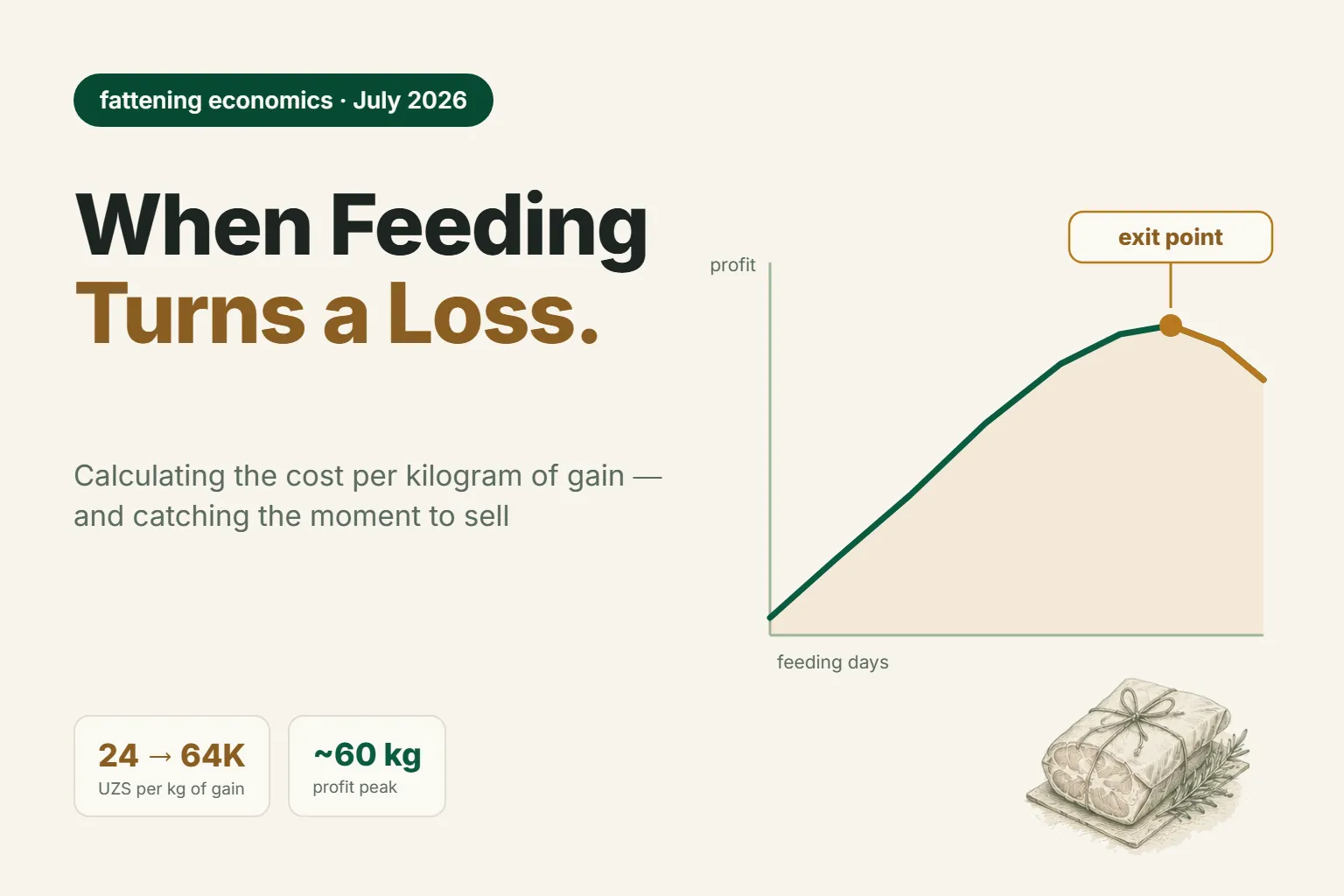
How Much Does a Kilogram of Weight Gain Cost: The True Cost of Fattening a Ram and When to Sell
Calculated on July 2026 prices: what a day of fattening costs, how much a kilogram of weight gain costs at the start versus the finish, and the exact point where feed starts eating your profit.
A farmer usually measures success in weight gain: "put on twenty kilograms — good." But the number that actually decides your money is a different one — how much each of those kilograms cost you. The same ram can turn a profit for you, or quietly get eaten back by feed costs, and the difference isn't the breed — it's the moment you stopped.
Let's work it out using July 2026 prices: what a day of fattening costs, how much a kilogram of weight gain costs at the start of fattening versus the end, and where the point is after which every extra day works against you. The exchange rate used for conversion is about 12,100 UZS (soʻm) per dollar.
The Formula That Decides Everything
The cost of a kilogram of weight gain is simple to work out:
Feed cost for the period ÷ weight gain for the same period = the price of one kilogram of weight gain.
You then compare that number to the price of a kilogram of live weight — what a buyer will actually pay for your ram. In summer 2026, a meat ram sells live-weight for roughly 55,000–65,000 UZS/kg (≈ $4.5–5.4), with sales to a middleman running closer to the lower end and the market climbing higher before Qurban Hayit. For the calculations below we use a conservative 55,000 UZS/kg (≈ $4.5). For more on pricing, see How Much a Ram Costs in Uzbekistan.
The rule is simple: as long as a kilogram of weight gain costs less than a kilogram of live weight, feeding pays off. The moment it costs more, you're feeding the ram out of your own pocket.
The market isn't holding still either: from April to June 2026 meat prices in the country rose another 6–8%, and the government is responding with imports — plans call for bringing in 150,000 head of sheep and goats by year-end, plus subsidized loans at 10% a year for livestock projects. For a farmer, that means selling prices will stay high, but competition will grow too — and the winner will be whoever knows the true cost of their own kilogram.
What a Day's Ration Costs
Feed prices from classified listings by region, July 2026:
| Feed | Price, UZS/kg | ≈ $ |
|---|---|---|
| Alfalfa hay (~20 kg bale for 18,000–25,000) | 900–1,250 | 0.07–0.10 |
| Barley | 3,200–4,200 | 0.26–0.35 |
| Corn (grain) | 4,000–5,000 | 0.33–0.41 |
| Wheat bran (25 kg sack for 61,000–88,000) | 2,400–3,500 | 0.20–0.29 |
| Cottonseed cake | 4,000–5,000 | 0.33–0.41 |
For the calculations we use the midpoint: hay 1,100, barley 3,800, corn 4,500, bran 2,800 UZS/kg. Plus salt and minerals — about 100 UZS a day per head.
We covered the ration in detail in What to Feed Rams for Weight Gain — here we're simply putting a price tag on it.
A Kilogram of Weight Gain Gets Pricier Along with the Ram
The main trap of fattening: the heavier the animal gets, the more it eats and the less it gains. The ration grows, the gain slows — and the cost per kilogram of gain climbs several times over.
| Fattening Phase | Ration (hay / barley / corn / bran), kg | Daily Cost | Weight Gain, g/day | Cost per 1 kg of Gain |
|---|---|---|---|---|
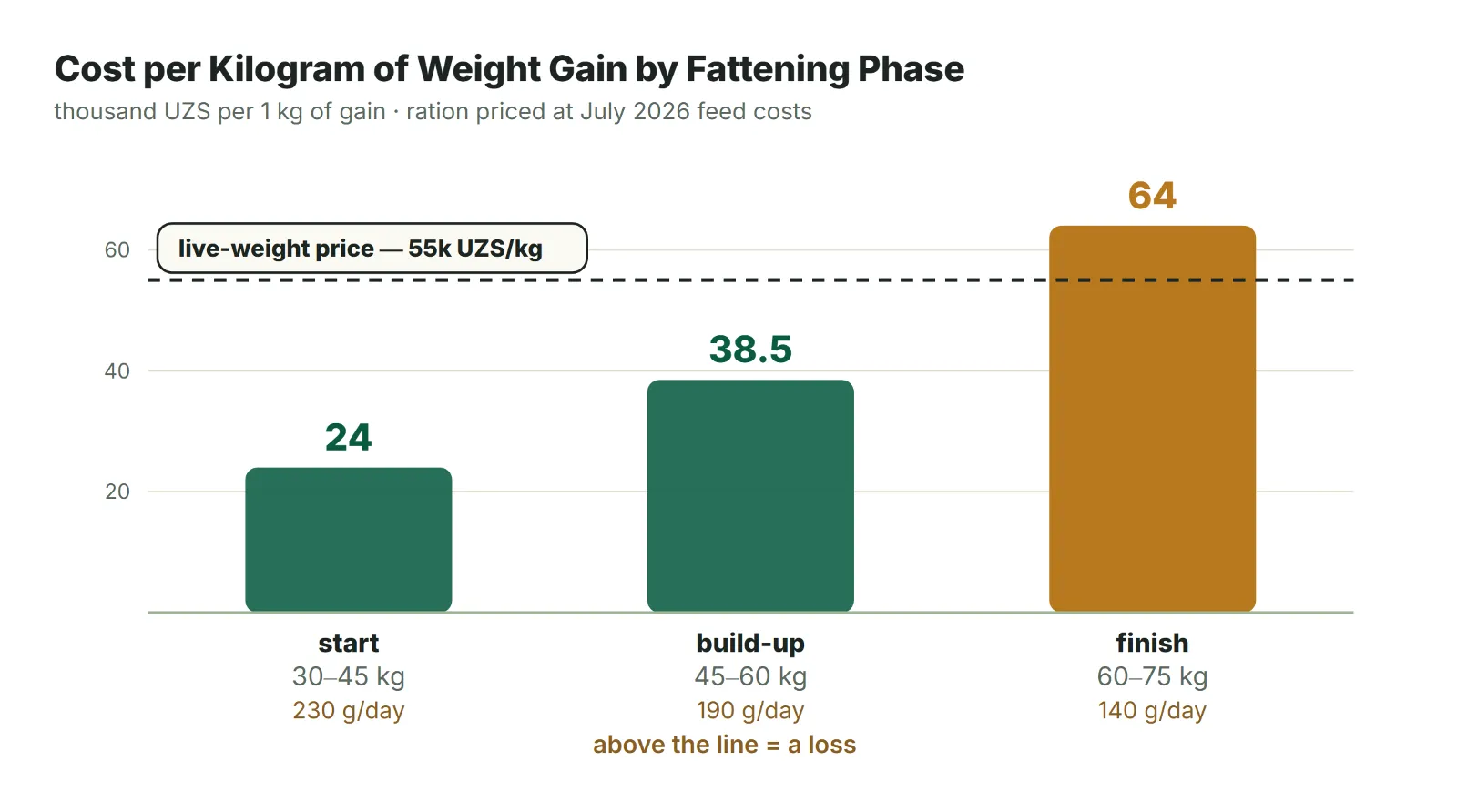
| Start, 30–45 kg | 1.2 / 0.5 / 0.3 / 0.3 | 5,500 UZS ($0.45) | 230 | ~24,000 UZS ($2.0) |
| Build-up, 45–60 kg | 1.5 / 0.7 / 0.4 / 0.4 | 7,300 UZS ($0.60) | 190 | ~38,500 UZS ($3.2) |
| Finish, 60–75 kg | 1.6 / 0.9 / 0.5 / 0.5 | 8,900 UZS ($0.74) | 140 | ~64,000 UZS ($5.3) |
Look at the last column. At the start, a kilogram of gain costs you 24,000, and you sell it as part of the live weight at 55,000 — pure profit. By the finish, that same kilogram costs 64,000, meaning it costs more than you'll get for it. The ram is still doing fine. You aren't.
The gain figures here are honest ones, at the lower-to-mid end for stall-fed fat-tailed breeds (150–250 g a day). If your animals gain faster, the cost per kilogram drops proportionally, but the underlying rule doesn't change: a heavy ram gains slower than a light one.
The Exit Point: When to Sell
Take a typical case: you buy a young sheep weighing 35 kg and put it on feed.
| Day of Fattening | Live Weight | Spent on Feed | Gain × 55,000 UZS | Result |
|---|---|---|---|---|
| 35 | 43 kg | 193 thousand UZS ($16) | 443 thousand UZS | +250 thousand UZS ($21) |
| 100 | 56 kg | 653 thousand UZS ($54) | 1,142 thousand UZS | +489 thousand UZS ($40) |
| 130 | 61 kg | 884 thousand UZS ($73) | 1,436 thousand UZS | +552 thousand UZS ($46) |
| 160 | 65 kg | 1,152 thousand UZS ($95) | 1,667 thousand UZS | +515 thousand UZS ($43) |
Profit climbs, and climbs — then turns around on day 130. After that, the ram keeps gaining weight while your pocket keeps losing it: over the last 30 days the animal gained 4 kg, while feed cost you 268 thousand UZS. Every extra month past 60 kg costs about 35,000–40,000 UZS per head (≈ $3), and for a group of 20 head that's close to 750 thousand UZS (≈ $61) thrown straight into the feeder.
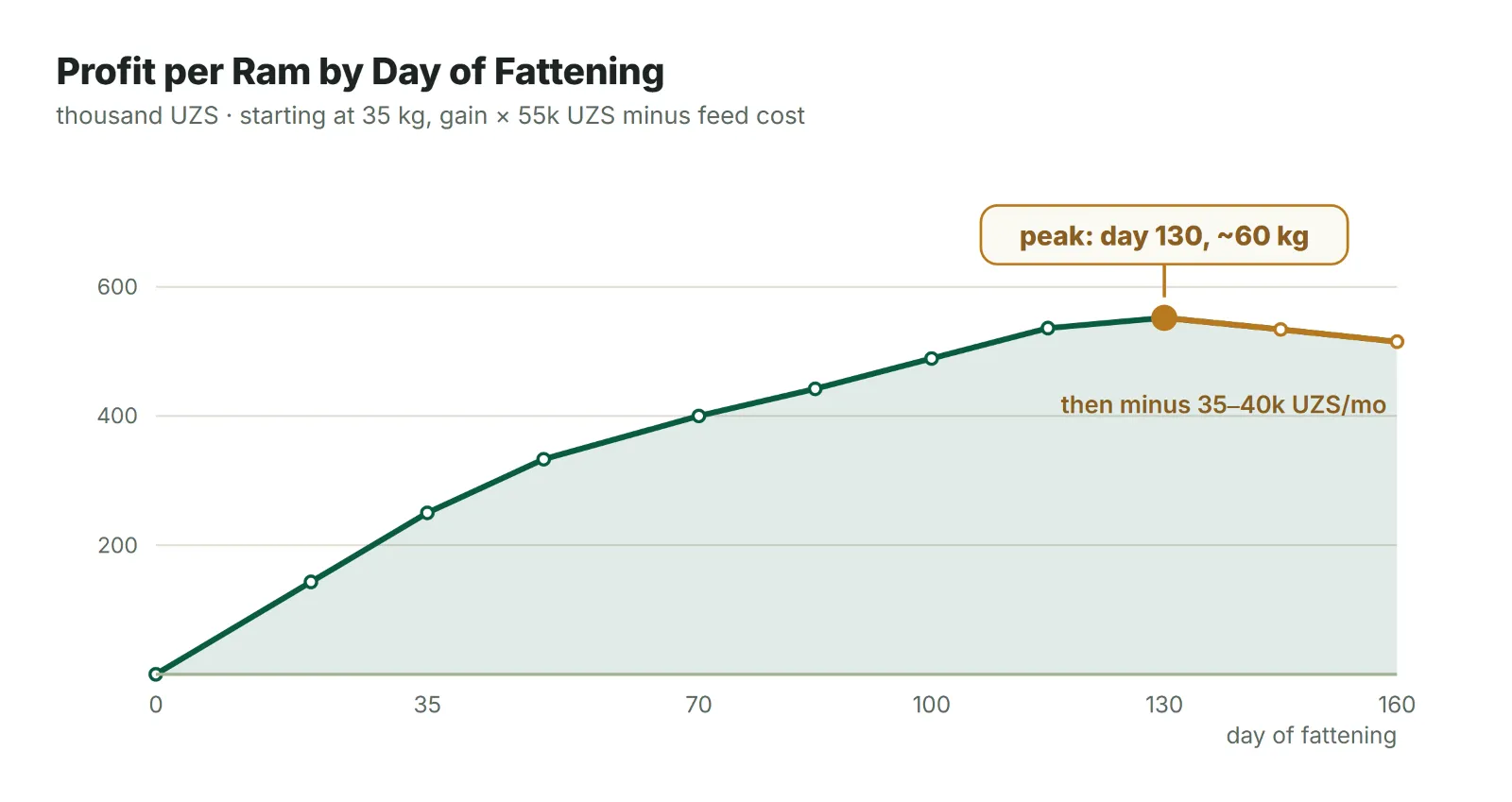
Practical rule: keep a ram on feed as long as a kilogram of gain costs less than 70% of the live-weight price. With our numbers, that's around 60 kg and roughly four months of fattening. Past that, it's more profitable to sell and replace the animal with new, light young stock — it will grow again at 230 grams a day on a cheap kilogram of gain.
You can only catch that point by weighing: how to work out average daily gain, how often to weigh and what to do when the figure drops is covered in average daily gain in rams.
The season is part of that decision too: in autumn a dealer at the gate pays at the bottom of the corridor, while by Qurban Hayit the price moves to the top. Which pays better — selling your ram in autumn or holding him until spring — we worked out separately for the 2026/27 winter.
An Example with 20 Head
A farm bought 20 head of young sheep at 35 kg and fattened them for 100 days:
- feed: 13.1 million UZS (≈ $1,080);
- weight gain: 21 kg per head, 420 kg for the group;
- added value: 9.8 million UZS (≈ $810) on top of the cost of the animals themselves.
That's from weight alone. On top of that, a well-conditioned ram sells for more per kilogram than a lean one of the same mass: a difference of 5,000 UZS per kilogram on a 56-kilogram ram adds another 280,000 UZS per head — more than 5 million UZS (≈ $460) across the group. Body condition sells just as well as weight does.
The cost per kilogram comes out of an expense ledger: feed, vet care and labour have to be logged by category and tied to the fattening group, or there is nothing to divide. Our article on tracking farm income and expenses explains how to keep that ledger.
How to Bring Down the Cost per Kilogram
Pasture plus supplemental feed gives you the cheapest kilogram. As long as grass holds up, daily grazing covers volume and part of the nutrition, with concentrates added on top. A ration of "pasture + 0.5 kg barley + 0.2 kg bran" costs about 2,600 UZS a day ($0.21) and delivers about 180 g of gain — that's ~14,000 UZS/kg ($1.2), more than four times cheaper than a stall-fed finish. It makes sense to save intensive stall feeding for the last 4–6 weeks before sale, once pasture has burned out.
The final 4–6 weeks are budgeted separately and the feed bought ahead: in autumn buy barley and bran for the finish is cheaper, and the ration at this stage decides half the cost price.
Buy feed during haymaking season. Hay costs 1.0–1.2 million UZS per tonne in summer, rising to 1.6–2.2 million by mid-winter. The same ration costs a third more in winter — and so does the kilogram of gain. For how to calculate your stock, see How Much Hay a Sheep Needs for Winter.
Don't chase gain with grain alone. When an animal doesn't get enough protein, extra barley doesn't turn into meat — it turns into a feed bill. It's cheaper to add local protein — cottonseed cake — but strictly within limits: up to 200 g a day for adults, and none at all for lambs under 4 months, because gossypol builds up in the cake. Check the dose for your batch of raw material with a veterinarian.
Water and shade are free weight gain. In Uzbekistan's summer heat, a ram drinks up to 6 liters a day or more. An empty trough in July stops weight gain for a whole day — and you've already paid for that day's feed regardless.
Worms and disease eat your margin quietly. Deworming costs pennies next to the weight gain lost on an infested flock, and losing a single ram from a group wipes out the profit from several of its neighbors at once. For a treatment schedule, see Sheep Vaccination Calendar.
Switch to grain gradually. A sharp jump in concentrates causes rumen acidosis: the animal stops eating and loses weight for weeks. Increase the grain share by 5–10% every 3–5 days.
In Short
- Track not the weight gain, but the price of a kilogram of gain: feed for the period ÷ gain for the period.
- Compare it to the price of a kilogram of live weight (summer 2026 — around 55,000–65,000 UZS).
- The cost per kilogram of gain rises with the animal's weight: 24,000 UZS at the start, 38,500 at the build-up, 64,000 at the finish.
- The exit point on our ration is around 60 kg and 4 months of fattening; past that, every extra month costs 35,000–40,000 UZS per head.
- Pasture with supplemental feed gives the cheapest kilogram (~14,000 UZS); a long stall-fed finish gives the priciest.
- Buy feed in summer, balance protein with cottonseed cake, and don't skip water or treatments.
Catching the exit point takes two numbers: the animal's weight and the date it was weighed. In weight-gain tracking for fattening, weighings and weight gain for every ram are tracked for free from your phone — you can see who's growing and who's just eating by now. You can sell fattened animals or buy young stock for fattening on the ram buying and selling listings.
Feed and live-weight prices are guidelines based on open listings and market reviews as of July 2026; feeding norms follow zootechnical references. Check your own market's prices before a large purchase, and confirm the ration and the cottonseed cake dose with a veterinarian or livestock specialist.
Manage your flock in QoyHunterCRM for sheep farmers: livestock, health, weighing, finance and analytics — in the app and a Telegram bot.All features →