Listeriosis in sheep: signs, treatment and why a sheep walks in circles after silage
Listeriosis in sheep: spot it by a drooping ear and circling, what to do in the first hours, what an outbreak costs on 100 ewes and how silage brings it in.
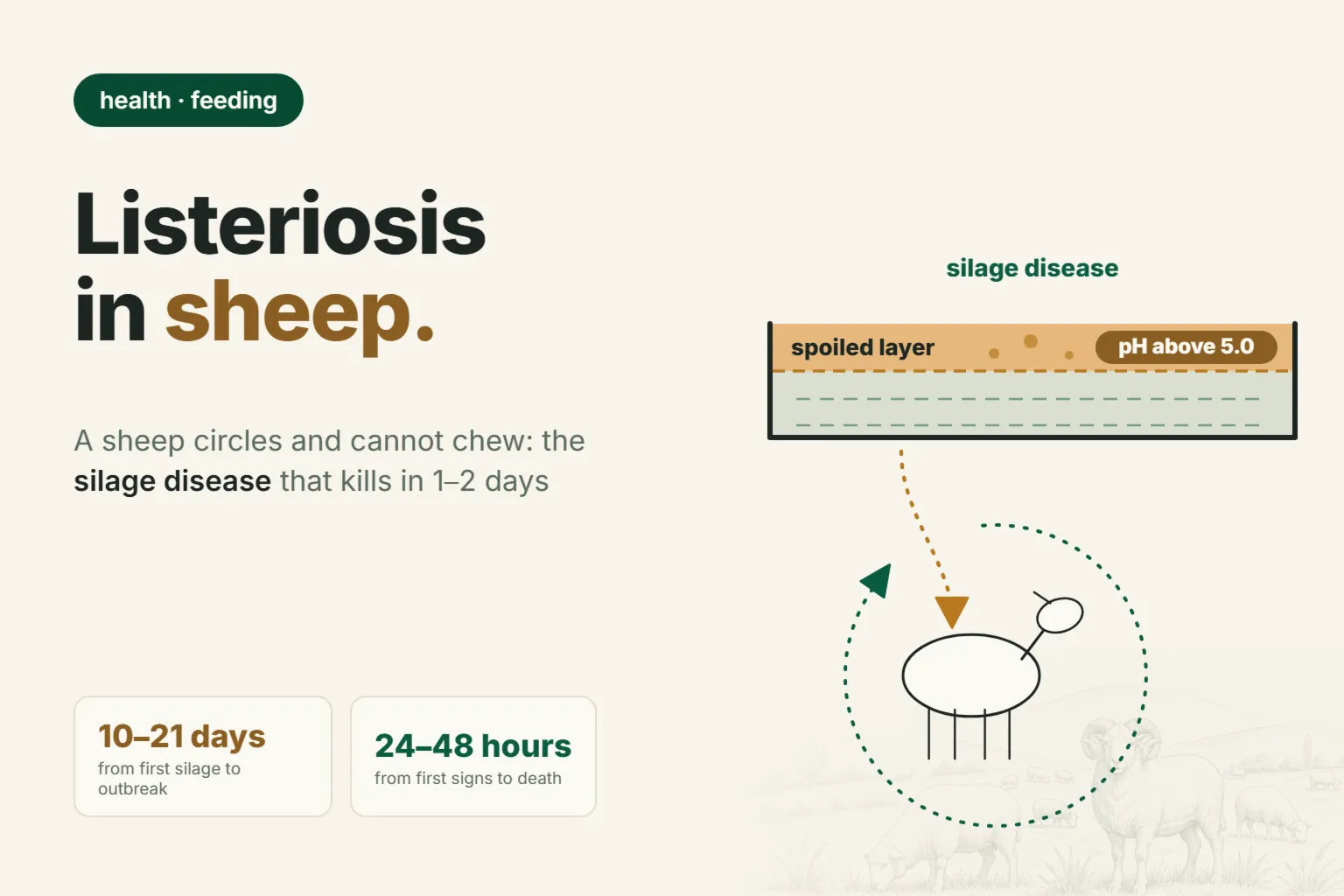
Listeriosis in sheep is a bacterial disease that a flock most often picks up from spoiled silage: 10–21 days after a bad batch is fed out, the ear and lip droop, feed gets stuck in the cheek, the animal walks in circles and goes down within 1–2 days. Treatment only helps if it starts right away, at the first signs; without it a sick sheep almost always dies. So the main protection against listeriosis in sheep is not a drug but clean silage with no rotten top layer.
Below: how to tell listeriosis from gid and ketosis, what to do in the first hours, what an outbreak costs a flock of 100 ewes in November 2026, and why the disease is dangerous to people. The exchange rate used is 11,994 sum per dollar (Central Bank of Uzbekistan, 10 November 2026).
What is listeriosis and how does it get into a flock?
Listeriosis is an infection caused by the bacterium Listeria monocytogenes. It lives in soil, manure, rotting plants and in the gut of healthy animals, tolerates cold and multiplies even at refrigerator temperature. That is why listeriosis in sheep is a disease of winter and early spring, when the flock is housed on stored feed.
The main source is bad silage. In well-fermented silage acidity is high, pH 4.0–4.5, and listeria does not grow. Where fermentation fell short, with pH above 5.0, it multiplies: in the top layer touched by air, in silage mixed with soil, in poorly packed corners of the pit. Haylage in torn wrap, rotting leftovers in the feeder and wet, dirty bedding carry the same danger.
Sheep pick it up by mouth: the bacterium enters through tiny wounds in the mucous membrane, for example when young sheep are changing teeth, and travels up a nerve to the brainstem. That explains the typical picture: only one side of the head is affected.
What are the signs of listeriosis in a sheep?
Listeriosis in sheep shows up in three forms, and they make it easy to recognize.
The nervous form is the most common in adult sheep and young ewes. Signs, usually on one side of the head:
- the ear droops, the eyelid sags, the lip hangs;
- drool runs from the corner of the mouth, cud drops out of the mouth, feed gets stuck in the cheek;
- the head tilts to one side, the sheep presses its head against the wall or walks in circles in one direction;
- early in the disease there may be a fever, then the temperature drops to normal;
- the sheep lags behind the flock, then lies down on its side and does not get up.
Without treatment, only 24–48 hours often pass from the first signs to death. According to the British veterinary service NADIS, usually fewer than 2% of the flock fall ill, in severe outbreaks up to 10%. Even with early treatment only up to 30% of sick animals recover.
Abortions. Listeriosis makes ewes abort in the last third of pregnancy, often shortly before lambing. The ewe herself often looks healthy but can develop metritis if the afterbirth is retained. Abortions come in clusters, more often in winter.
Sepsis in newborn lambs. Lambs from infected ewes are born weak or die in the first days of life.
There is also an eye form, "silage eye": watery eyes and clouding of the cornea in sheep that eat silage from a high feeder and push their muzzles into it. It is not life-threatening but says the same thing: the silage batch is contaminated.
How do you tell listeriosis from gid, ketosis and other diseases?
A sheep walking in circles is not always listeriosis. Three other diseases look similar, and each has its own clue.
| Disease | Who gets it | How it develops | Main clue |
|---|---|---|---|
| Listeriosis | adult sheep and young ewes, a group fed from one pit | 1–2 days | paralysis of one side of the face: ear, eyelid, lip; feed in the cheek |
| Gid (coenurosis) | young stock under two years | weeks and months | face not paralyzed, skull bone may soften |
| Pregnancy toxemia (ketosis) | ewes with twins 2–6 weeks before lambing | 2–10 days | thin or overfat ewe, acetone smell, blindness |
| Vitamin B1 deficiency (polioencephalomalacia) | young stock finished on grain | hours and days | blindness, head thrown back, responds to vitamin B1 within a day |
For more on the bladder worm in the brain and the deworming schedule for dogs, see the article on gid in sheep. You cannot make a firm diagnosis just by looking at the sheep: a lab confirms it from the brain of a dead sheep or from an aborted fetus. Without a diagnosis the owner risks treating the wrong thing, and with listeriosis every hour counts.
What should you do if a sheep gets listeriosis?
The first hours decide whether the sheep survives and how many more animals fall ill.
- Separate the sick sheep into a dry pen with water and soft feed. It rarely passes the disease directly from sheep to sheep, but discharges and aborted fetuses contaminate the bedding.
- Call a veterinarian the same day. Treatment is high-dose antibiotics: reference books list penicillin or oxytetracycline given over a course of several days. The vet sets the regimen and dose. A sheep that is still standing and swallowing has a chance; one that is down almost always dies.
- Give the sick sheep fluids and feed. A sheep with a paralyzed throat cannot drink on its own and quickly dehydrates, so the vet gives fluids by stomach tube or drip.
- Stop feeding the flock this silage batch immediately. Remove leftovers from the feeders and switch to hay until the pit has been checked.
- Aborted fetuses and afterbirths should be collected wearing gloves and sent for testing to the district veterinary lab; burn the rest or bury it with lime.
- Write down every sick sheep: the date, tag number, signs and what treatment was given. From that list you can see whether the outbreak is growing or fading.
Surviving sheep often stay with a crooked face or an ear that never lifts again. If such a sheep eats poorly and falls behind in weight, it is wiser to cull it than to keep it for breeding.
What does a listeriosis outbreak cost on 100 ewes?
Let's run the numbers for a flock of 100 ewes fed silage in winter. Prices are for November 2026: a young ewe sells for 3–6.5 mln sum in listings, and we take a cautious 4 mln sum (≈ $333). A lost lamb is 1.3 mln sum (≈ $108), as in our breakdown of silage for sheep.
| Scenario | What happened | Loss, sum | In dollars |
|---|---|---|---|
| Prevention | throw away 10 cm of spoiled layer, about 2 t in a pit of 30 t of silage, at 440 sum/kg | 0.9 mln | ≈ $73 |
| Ordinary outbreak | 2 in-lamb ewes fell ill, one died, the other aborted | 6.6 mln | ≈ $550 |
| Severe outbreak | 10 in-lamb ewes fell ill, 5 died, the other five aborted | 33 mln | ≈ $2,750 |
The math: a dead ewe is 4 mln sum for her and 1.3 mln for the lamb she carried. In an ordinary outbreak 4 + 1.3 + 1.3 = 6.6 mln sum. In a severe one 5 × 5.3 + 5 × 1.3 = 33 mln sum. We assume treatment saved half the sick ewes, although according to NADIS only up to 30% recover, so real losses may be higher. Treatment, the vet's visit and lab tests come on top; price them from your veterinary service's list.
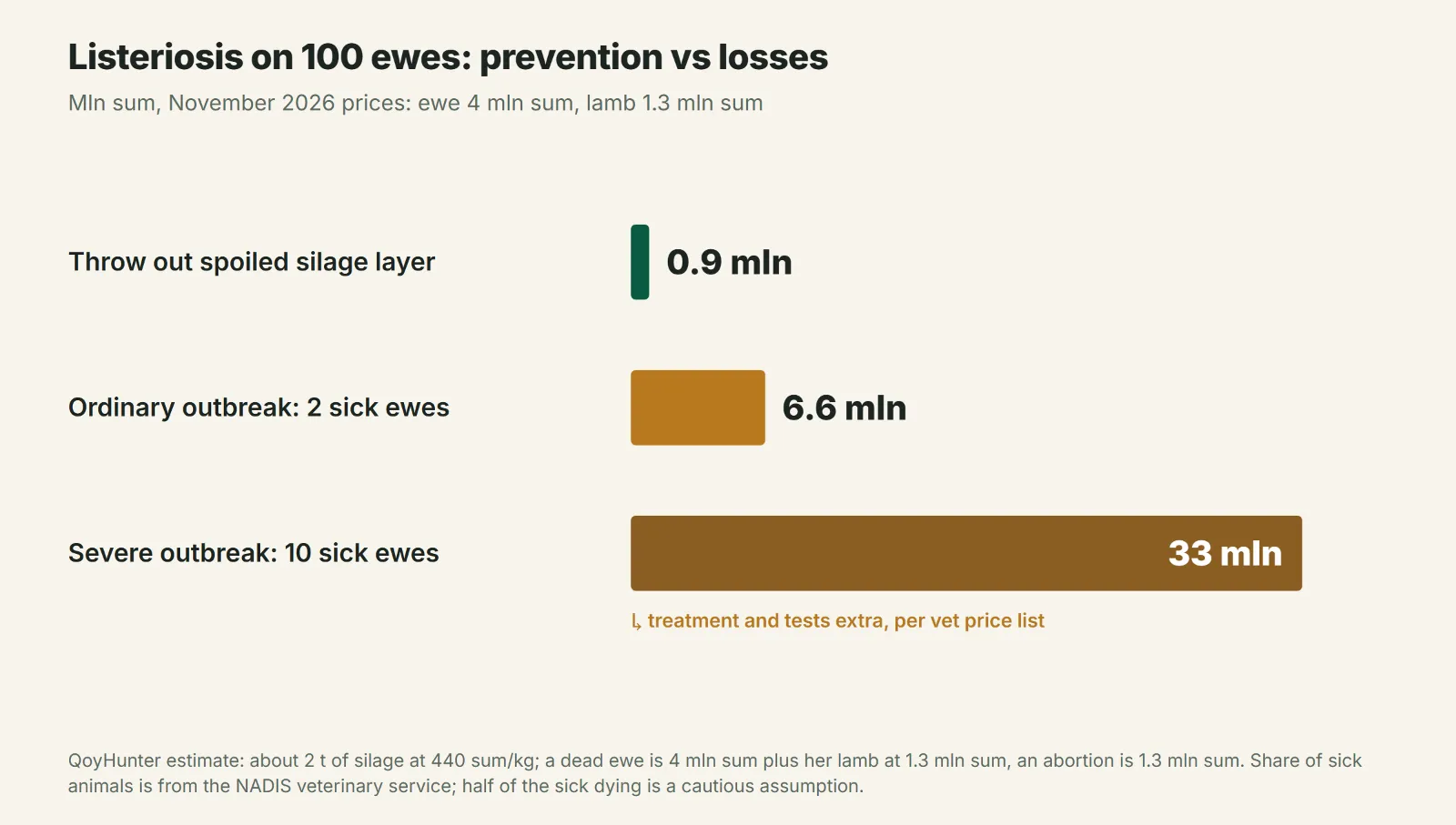
Throwing away the spoiled layer of silage is more than seven times cheaper than even an ordinary outbreak and almost 40 times cheaper than a severe one. Don't hold on to it: feed that seems "too good to throw out" ends up the most expensive feed of the winter. Hay to replace spoiled silage is cheaper to buy in advance; check current prices in the listings of hay and compound feed for sale.
How do you prevent listeriosis in the flock in winter?
Preventing listeriosis in sheep comes down almost entirely to feed.
- Remove the top layer of silage: at least 10 cm, and more if it is dark, slimy or moldy. Spoiled silage is not fed "just a little" and not to adult animals either.
- Take silage from the whole face of the pit: at least 15–20 cm a day in winter. An open face that sits for a week heats up and rots.
- Keep soil out of the silage. Cut silage corn no lower than 10–15 cm, do not pick up material from the ground, keep the pit entrance clean.
- Clear leftovers from feeders every day. Silage in open air heats and spoils within a day.
- Check a doubtful batch. The sour smell of bread or sauerkraut is normal. The smell of manure, rot or ammonia, gray slime, warm silage: do not feed that.
- Keep bedding dry in the lambing area: that is where listeria passes from an aborted fetus to the lambs.
- Keep a disease log. When you can see that three sheep with a crooked face fell ill within a week and all ate from one pit, the cause is found in a day, not after the fifth death. Such a log with dates, tags and treatment is easy to keep in vaccination and disease records for sheep; it is part of QoyHunter, a CRM for sheep records and the bazar.qoyhunter.com marketplace.
Vaccines against listeriosis exist (Russia, for example, uses a live vaccine from the AUF strain), but in Uzbekistan they are rarely prescribed for an ordinary flock. The district vet decides whether a vaccine is available in your district and whether a farm with repeated outbreaks needs it.
Is listeriosis dangerous to humans?
Yes. Listeriosis passes to people and is especially dangerous for pregnant women: the infection may go almost unnoticed in the mother but cause a miscarriage or the death of the baby. It is also dangerous for newborns, the elderly and people with weakened immunity.
The rules on the farm are simple:
- pregnant women do not attend lambing and do not handle aborted fetuses and afterbirths;
- fetuses and afterbirths are handled only with gloves, then hands are washed with soap;
- milk from sheep in an affected flock is drunk only boiled, and no brynza or qurt is made from the raw milk of such ewes;
- meat from sick and dead sheep is not eaten.
FAQ
Why is a sheep walking in circles and unable to chew?
Most often it is listeriosis, the "silage disease". The bacterium damages the brainstem on one side: the sheep's ear and lip droop, feed gets stuck in the cheek, drool runs, and it walks in circles in one direction. If the whole group eats silage, especially spoiled silage, listeriosis is the first suspect. Separate the sheep, stop feeding that silage batch and call a veterinarian the same day.
Can listeriosis in a sheep be cured?
Yes, but only if treatment starts early, while the sheep is still standing and swallowing. The veterinarian prescribes high-dose antibiotics, usually penicillin or oxytetracycline, and gives the sick animal fluids. A sheep that is down with listeriosis almost always dies, and survivors often keep a crooked face.
How many days after silage feeding starts does listeriosis appear in sheep?
According to the British veterinary service NADIS, the first sick sheep appear 10–21 days after the flock starts getting contaminated silage. That is why a new pit is checked as soon as it is opened, not after the first death.
Can you eat the meat and drink the milk of a sheep with listeriosis?
No. Meat from sick and dead sheep is not eaten, and milk from an affected flock is drunk only boiled. Listeriosis passes to humans and is especially dangerous for pregnant women: it can cause a miscarriage.
What silage can you feed sheep without the risk of listeriosis?
Well-fermented silage: with a sour bread smell, no mold, slime or soil, pH 4.0–4.5. The spoiled top layer of at least 10 cm is thrown away, feeder leftovers are cleared every day, and the pit face is taken down 15–20 cm a day so the silage does not heat up.
Manage your flock in QoyHunterCRM for sheep farmers: livestock, health, weighing, finance and analytics — in the app and a Telegram bot.All features →