Silage for sheep: how much to feed per day, what makes it dangerous and when it comes cheaper than hay
Silage rates for sheep by group, the “2.5 kg of silage per kilogram of hay” conversion, the 440 UZS per kilogram price threshold and the winter costing for a 100-ewe flock at September 2026 prices.
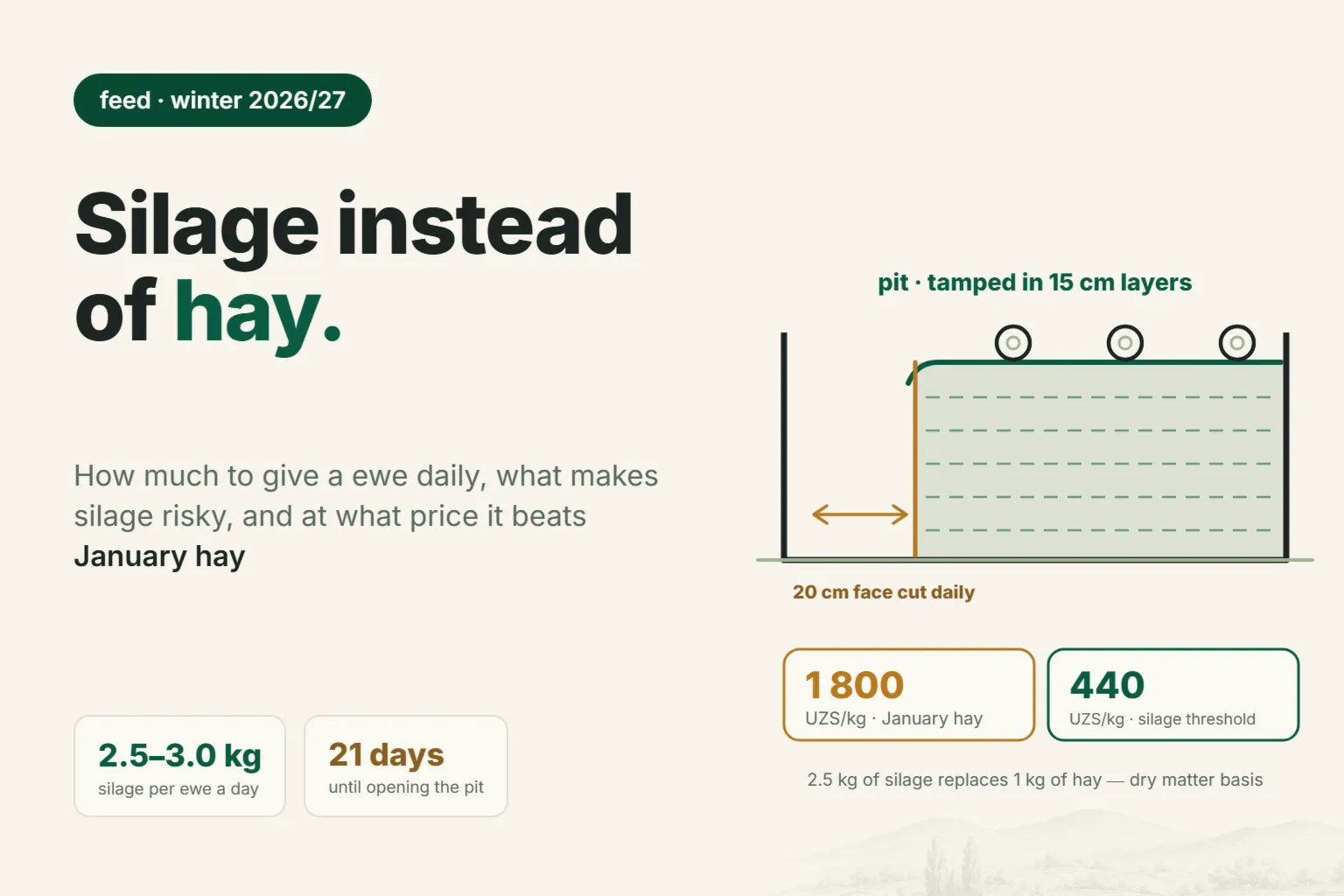
Yes, you can feed silage to sheep. During the housed period an adult ewe gets 2.5–3.0 kg of maize silage per day, weaned young stock 1.5–2.5 kg, and a breeding ram 2.0–2.5 kg. Silage alone will not carry a flock through: dry matter makes up only a third of it, and a kilogram of silage holds seven times less digestible protein than a kilogram of alfalfa hay (three times less on a dry matter basis), so silage replaces part of the hay, not the whole of the roughage.
September 2026 is the month to decide: Uzbekistan is harvesting the second maize crop sown after wheat, and these are the only weeks in which a silage pit can be filled. Below are the daily rates by group, the conversion of how much silage stands behind a kilogram of hay, the price threshold above which silage stops paying off, and the reason silage kills sheep more often than hay does.
How much silage can you feed a sheep per day?
Silage is chopped green mass, most often maize, preserved without air: lactic acid bacteria ferment it down to an acid reaction, and the feed keeps for a year or longer. Sheep get it during the housed period as the succulent part of the ration.
| Sheep group | Maize silage, kg per head per day | What must go alongside |
|---|---|---|
| Dry ewe and first half of pregnancy | 2.5–3.0 | hay or straw, salt lick |
| Ewe in the second half of pregnancy | 2.5–3.0 | + 0.3–0.5 kg of concentrates |
| Lactating ewe | 3.0–4.0 | + concentrates and a protein supplement |
| Weaned young stock, replacement ewe lambs | 1.5–2.5 | hay ad lib |
| Breeding ram, housed period | 2.0–2.5 | concentrates to match the workload |
| Lambs up to 6 months | 0.5–0.6 together with root crops | starter compound feed |
The rates by group come from livestock feeding standard handbooks. The general principle — silage supplies about half of the roughage and needs a protein supplement alongside it — is confirmed by the agricultural extension service of South Dakota State University (SDSU Extension). The British service AHDB adds two corrections: finishing lambs get maize silage ad lib, and an animal of 30–40 kg eats 3–3.5 kg a day; while ewes in early pregnancy should not have silage ad lib — they run to fat on it and lambing goes harder.
The ceiling is simple: silage covers about half of the roughage requirement on a dry matter basis — 2.2 kg of silage instead of 0.9 kg of hay. Hay cannot be taken out of the flock's winter ration entirely. Dry roughage keeps the rumen chewing its cud, and in winter it also warms the animal: the heat comes from fermentation in the rumen, not from the bedding.
How much silage replaces one kilogram of hay?
One kilogram of alfalfa hay is replaced by about 2.5 kg of maize silage — that is the conversion by dry matter. By energy, 2.0–2.3 kg would be enough. By protein, though, the swap is not equal: 2.5 kg of silage gives around 35 g of digestible protein against 100 g in a kilogram of alfalfa hay.
| Feed | Dry matter, % | Feed units per 1 kg | Digestible protein, g/kg |
|---|---|---|---|
| Maize silage | 32–36 | 0.20 | 14 |
| Alfalfa haylage | 50–55 | 0.35 | 70 |
| Alfalfa hay | 83–85 | 0.45 | 100 |
| Wheat straw | 83–85 | 0.20 | 12 |
The figures for hay and straw are the same as in our cost per kilogram of protein in feeds breakdown; the silage and haylage figures come from feed nutrition handbooks.
Hence the swap rule for the 2026/27 winter: for every kilogram of hay you take out of the ration and replace with silage, put back about 200 g of cottonseed meal or cake. Otherwise the ewe gets the energy but falls short on protein — and instead of saving money you come to lambing with thin ewes and weak lambs.
What is cheaper in winter: hay or silage?
It all comes down to the price you pay for hay. Let us count on a flock of 100 ewes and a housed period of 135 days — the same planning horizon as in the breakdown of how much hay a sheep needs for winter. A ewe needs 1.75 kg of hay a day; we replace half of that rate with silage.
| What we count | Per head per day | For 100 ewes over 135 days |
|---|---|---|
| Hay we no longer buy | 0.875 kg | 11.8 t |
| Silage in its place | 2.2 kg | 29.7 t |
| Cottonseed meal to make up the protein | 0.175 kg | 2.36 t |
Now in money, at August–September 2026 prices. Alfalfa hay costs about 1,100 UZS per kilogram ($0.09) in summer and one and a half to two times more in winter, roughly 1,800 UZS ($0.15). Cottonseed meal runs about 3,500 UZS per kilogram ($0.30). The Central Bank of Uzbekistan rate on 31 August 2026 is 11,801 UZS to the dollar.
- Hay not bought in winter: 11.8 t × 1,800 = 21.3 million UZS ($1,800).
- Meal you will have to buy on top: 2.36 t × 3,500 = 8.3 million UZS ($700).
- What is left for all the silage: 13.0 million UZS ($1,100) for 29.7 tonnes.
Divide it out: 440 UZS per kilogram of silage is the threshold. Cheaper than that and you are ahead; dearer and it is simpler to buy hay. Translated to the field: a hectare of silage maize has to cost you less than 18.5 million UZS ($1,570) all in — seed, irrigation, harvesting, film, compaction.
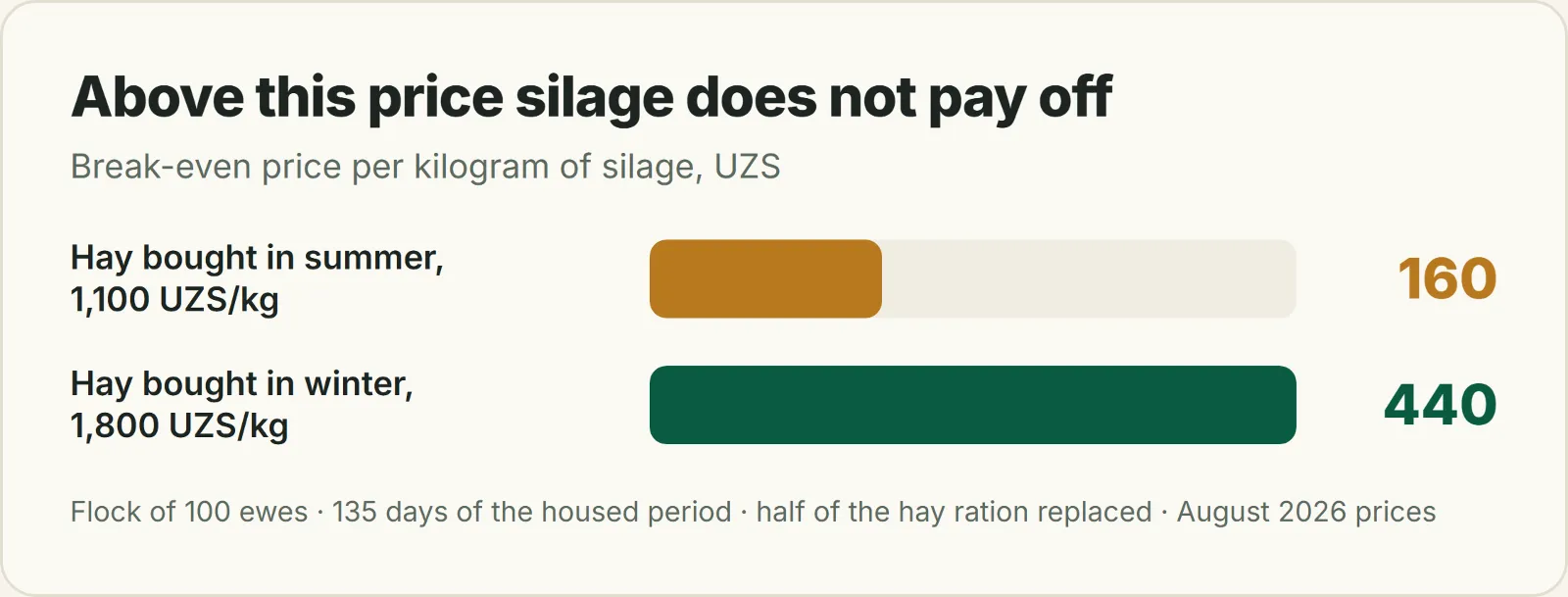
And now the honest part. If you manage to buy hay in summer at 1,100 UZS, the whole calculation changes: only 4.7 million UZS is left for silage, and the threshold drops to 160 UZS per kilogram. Silage costs that little only when it is your own, off your own field with your own machinery. Silage does not beat hay in general — it beats hay bought in January.
The other half of the roughage alongside silage comes from hay or straw, but straw is not always cheaper than hay: when straw beats hay on cost and how urea treatment raises its feeding value.
How much silage does a hectare of second-crop maize give?
A second maize sowing after wheat under irrigation gives 35–60 tonnes of green mass per hectare: 50–60 tonnes are taken by leading farms with good agronomy, the average is lower — a second crop has a shorter growing season. With normal losses at filling and storage (about 15%), that works out at 30–51 tonnes of finished silage.
A flock of 100 ewes needs 29.7 tonnes of silage for a 135-day housed period. One hectare of second-crop maize covers the silage half of the winter ration for a hundred ewes: at a high yield 0.7 hectares is enough, at an average yield you need the whole hectare. The other half of the roughage still comes from hay — a hectare of alfalfa feeds about 30 sheep through the winter, and one does not replace the other.
This is no side issue for the country. Following the livestock meeting of 13 February 2026 (reported by Spot.uz and Gazeta.uz the same day), an extra 60,000 hectares are being set aside for fodder crops in 2026. And presidential decree PP-179 of 12 May 2026 rules that from the 2027 harvest specialised livestock districts may put fodder crops on up to half of their cotton and grain fields. There will be more green mass for silage in the coming seasons, not less.
Who does silage not pay off for?
The small farm. The issue is not the money to fill the pit but the speed of removal: in winter the open face of the clamp has to be cut back by at least 15–20 cm a day, otherwise the mass at the face heats up, goes mouldy and turns into exactly the spoiled feed that starts the losses.
That is where the allowable pit size comes from. Finished silage weighs about 667 kg per cubic metre, so at a 20 cm cut every square metre of face gives up roughly 133 kg of feed a day:
Face area (m²) = flock's daily silage requirement (kg) ÷ 133
| Flock | Silage per day | Allowable pit cross-section |
|---|---|---|
| 30 ewes | 66 kg | 0.5 m² — that is no longer a pit but a bag or a barrel |
| 100 ewes | 220 kg | 1.65 m² — for example 1.4 m high × 1.2 m wide |
| 300 ewes | 660 kg | 5 m² — 2 m high × 2.5 m wide |
For a farm with 20–40 head a silage pit is simply the wrong size: build it "the way everyone does", two metres wide, and you will be taking off five centimetres a day while the top has time to rot. Two other routes are more honest for such a farm: either bought hay purchased in summer, or haylage in plastic-wrapped bales: a 500–800 kg bale is eaten by a flock of 20–40 head in a week to ten days, and it is opened on its own, without an open pit face.
Silage or haylage: which is easier to make?
Haylage is the same grass, but wilted before ensiling down to 45–55% moisture — that is, twice as dry as silage. For a sheep farmer in Uzbekistan the difference is fundamental: alfalfa haylage holds about 20% crude protein in dry matter, three times more than maize silage (about 7%).
| What we compare | Maize silage | Alfalfa haylage |
|---|---|---|
| What it gives the ration | energy, starch from the cobs | energy and protein |
| Dry matter | 32–36% | 50–55% |
| Raw material | second-crop maize | second and third alfalfa cut |
| Main risk | spoiled top layer, listeriosis | poor sealing, mould where compaction falls short |
| Who has it easier | those with a forage harvester or hired harvesting | those with their own alfalfa and a baler |
If you already have irrigated alfalfa, haylage is the more honest choice: it covers energy and protein alike, and it does not force you to buy meal for every kilogram of hay you replace.
What makes silage dangerous for sheep?
Silage does not kill sheep by itself — spoiled mass does. Three things to know before you open the pit.
Listeriosis, the "silage disease". Listeria monocytogenes multiplies wherever the acidity fell short: pH above 5.0, soil got into the mass, the top layer caught air and mould. In silage listeria survives for months — the same batch fed later sets off another outbreak. According to the British veterinary service NADIS, an outbreak in sheep starts 10–21 days after feeding of an infected batch begins. Usually less than 1–2% of the flock falls ill, up to 10% in severe outbreaks. But in those that do fall ill the nervous form — the sheep walks in circles, the lip and ear droop, the animal cannot swallow — kills about half of them: up to 30% recover, and only if treatment starts at once. In severe cases the animal dies 24–48 hours after the first signs. Listeriosis is dangerous to people too, especially to pregnant women.
A sheep walking in circles is not always listeriosis: gid gives a similar picture, covered in the article on coenurosis in sheep. The difference is that gid unfolds over months and usually in young stock, while listeriosis strikes suddenly and takes a whole group fed from one pit.
Botulism. It develops in wet, musty silage where the carcass of a rodent or a bird has been preserved along with the mass. The incubation period runs from a few hours to two weeks, up to 18 days in some silage outbreaks. The prognosis for affected animals is poor and there is usually nothing left to treat: in documented outbreaks losses reached 65–90% of the affected group.
Abortions in pregnant ewes. Mouldy feed hits a pregnant ewe directly, with no infection involved: mycotoxins — zearalenone among them — act on the uterus and end the pregnancy. Rotting silage contaminated with soil is dangerous in a different way: it brings listeriosis into the flock, and listeriosis causes not only the nervous form but also abortions, usually in the last third of pregnancy. Every lamb lost this way is about 1.3 million UZS ($110) out of the till.
The rules that follow are short:
- take off the spoiled top layer, at least 10 cm, and throw it away instead of "feeding it so nothing goes to waste";
- never give mouldy, frozen or foul-smelling silage to pregnant ewes;
- clear yesterday's leftovers out of the trough: in the open air silage heats and moulds within a day;
- keep soil out of the mass — cut no lower than 10–15 cm, and higher is better: cleaner mass.
How do you fill a silage pit in September so it does not rot?
| What we do | Standard |
|---|---|
| Harvest stage | milk-wax and wax ripeness of the cobs |
| Moisture of the mass at filling | 60–70%, 65% is optimal |
| Chop length | 10–20 mm at wax ripeness, 30–35 mm at milk-wax |
| Compaction density | at least 220 kg of dry matter per cubic metre |
| Layer per pass | no thicker than 15 cm |
| Filling one pit | 2–3 days, the faster the better; cover on the day you finish |
| Opening | no earlier than 21 days after covering |
| Removal rate | at least 15–20 cm a day in winter and 30–40 cm in summer, across the whole face |
The standards come from regional agricultural agency guidance on silage making and from Syngenta materials on removal technique. Harvesting at wax ripeness instead of milk ripeness gives 10–12% more finished silage and 7–11% more digestible protein off the same field — in other words, the choice of harvest day is worth about a tenth of a hectare.
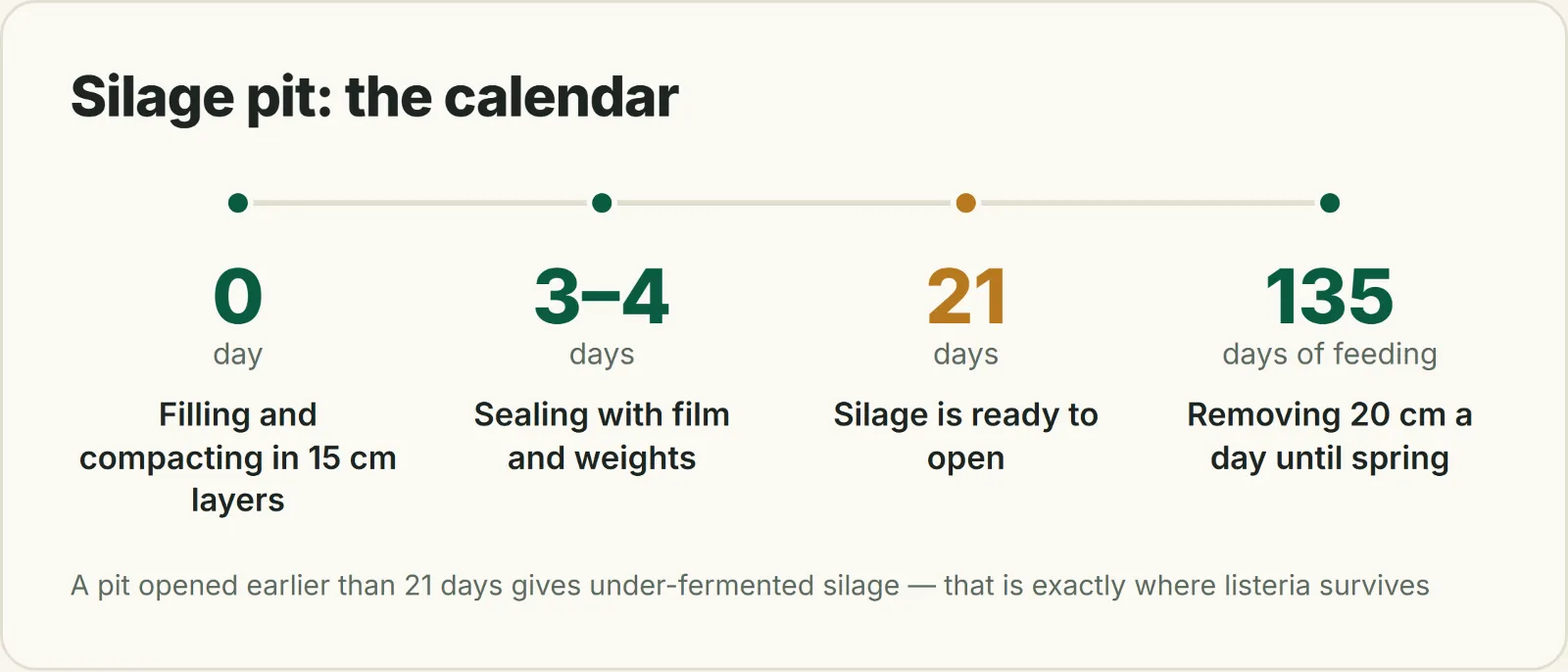
Two numbers decide the fate of a pit. The first is density: an under-compacted mass heats up, and instead of silage you get brown, musty feed. The second is the removal rate: at least 15–20 cm off the whole face a day in winter and 30–40 cm in summer. Losses under normal fermentation are about 5% of the mass, and up to 15% together with the spoiled top layer — and those 15% have to go into your stock calculation in advance.
Feed stock in general is worth counting not "by eye, until spring" but from daily consumption and what is left in store: that is the whole point of farm feed stock records — the app keeps the stock on hand, writes it down at every feeding and warns you when the balance drops below your own threshold — before the feed runs out. It is part of QoyHunter, a CRM for sheep records and the bazar.qoyhunter.com marketplace where farmers in Uzbekistan sell animals and feed.
How do you get a flock used to silage?
Gradually, over 10–14 days: for the first two days give about 0.5 kg per head, then add 0.5 kg every two days until you reach the full rate — up to 2.5–3.0 kg for an adult ewe. Better not to start on an empty stomach — hay first, silage after.
An honest caveat: the official guides contain no step-by-step schedule for introducing sheep to silage specifically; the figures above are common practice for moving animals onto any new succulent feed. A strict day-by-day schedule exists only for grain: the Australian service NSW DPI sets out the switch to grain finishing over 22 days, starting at 50 g per head.
For the first week watch the droppings and the group's appetite. Loose droppings and several head going off feed at once are a reason to cut the dose and check the mass you are taking from. Concentrates and the protein supplement that go with silage — barley, maize, meal — are easiest to buy in the same place where you check grain prices: feed and grain listings for the Tashkent region are updated every week.
FAQ
Can you feed silage to pregnant ewes?
Good silage can be fed to pregnant ewes — 2.5–3.0 kg per head per day — but only up to the last six weeks. What you cannot feed is mouldy, frozen or rotting feed: it both ends pregnancies and brings in listeriosis. A month and a half before lambing the silage share is cut back and concentrates are added: the lamb is growing, the rumen runs out of room, and bulky feed no longer fills the ewe.
How much silage replaces one bale of hay?
A 20 kg bale of alfalfa hay is replaced by about 50 kg of maize silage — the conversion by dry matter. Along with the silage you will have to give another 4 kg or so of cottonseed meal or cake: a kilogram of maize silage holds seven times less digestible protein than a kilogram of alfalfa hay.
Why does a sheep walk in circles after eating silage?
That is what listeriosis, the "silage disease", looks like. The bacterium multiplies in poorly compacted or spoiled silage and attacks the nervous system: the sheep walks in circles, the lip and ear droop, the animal cannot swallow. Isolate the sick animals, stop feeding that batch and call a vet. Gid causes similar circling, but it unfolds over months and usually in young stock, while listeriosis takes a whole group fed from one pit.
Can you feed sheep on silage alone, without hay?
No. Silage covers about half of the roughage on a dry matter basis; the rest is hay or straw. Dry roughage keeps the rumen chewing its cud, and in winter the fermentation in the rumen also warms the animal. A flock kept on silage alone all winter loses condition and brings weak lambs.
When can you open the pit after filling it?
No earlier than 21 days after the pit was covered. In that time lactic acid fermentation reaches its stable phase and the mass becomes feed. A pit opened sooner gives under-fermented silage with a high pH — and that is exactly where listeria survives.
Manage your flock in QoyHunterCRM for sheep farmers: livestock, health, weighing, finance and analytics — in the app and a Telegram bot.All features →