Maize for sheep: how much to feed per day, whether to grind it, and at what price it beats barley
Maize has 9% more energy than barley but a fifth less protein. How much maize to feed rams, ewes and lambs, whether to grind it, at what price it beats barley in October 2026, and how to avoid urinary stones in rams.
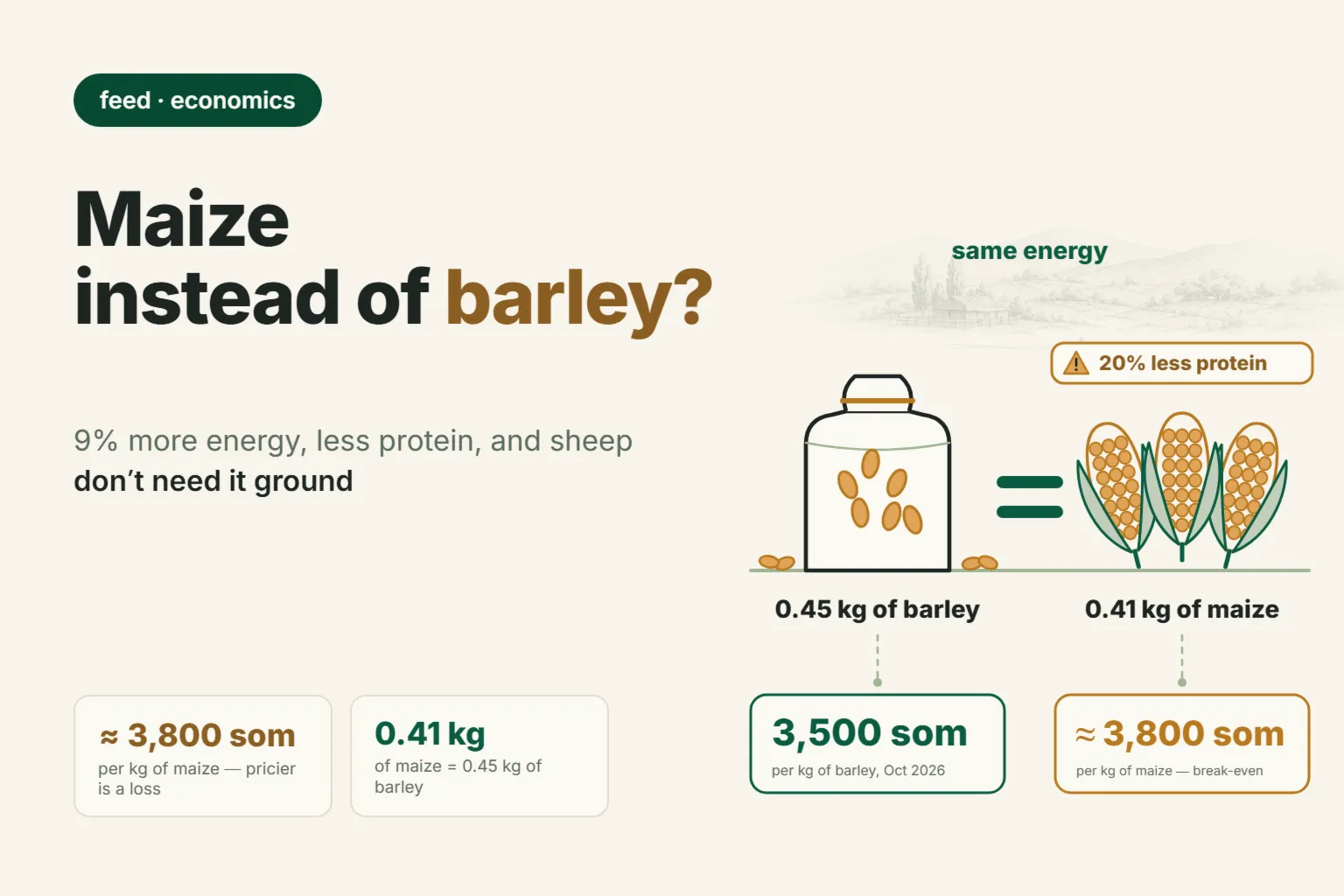
You can feed maize to sheep, and it pays: a kilogram of maize grain has about 9% more energy than a kilogram of barley, so 0.41 kg of maize replaces 0.45 kg of barley. Maize's weak spot is protein: it has a fifth less, and almost no calcium. With barley at 3,500 som per kilogram, maize is the better buy as long as it costs less than ≈ 3,800 som/kg (≈ $0.32). Adult sheep do not need it ground.
Below: how much maize to feed sheep by group, at what price it beats barley in October 2026, how much that saves on 100 rams over a fattening period, and how to avoid urinary stones in rams. The Central Bank of Uzbekistan rate on 17 October 2026 is 12,055.90 som per dollar.
Can you feed sheep maize?
Yes. Maize grain is an ordinary concentrate for sheep, just like barley: it is mostly starch, that is, energy for weight gain and milk. In Uzbekistan grain maize is harvested from September to November: the main crop earlier, the second crop after wheat later. That is why there is plenty of it in the listings in autumn.
The limits are the same as for any grain. Too much starch at once means rumen acidosis: acid, diarrhea, refusing feed, and death in heavy rams. Maize starch ferments in the rumen more slowly than barley or wheat starch, as the Feedipedia feed database (INRAE, CIRAD, AFZ and FAO) notes, so the acidosis risk is lower, but not zero. Introduce maize gradually and only together with hay.
How much energy and protein does maize have compared with barley?
According to Feedipedia (European table), maize grain has 86.3% dry matter, 13.6 MJ of metabolizable energy and 9.4% crude protein per kilogram of dry matter, with 73.4% starch. Barley has 87.1% dry matter, 12.4 MJ and 11.8% protein. Metabolizable energy is the part of a feed's energy that the sheep actually uses for living, growing and making milk.
| Per 1 kg of feed as fed | Maize | Barley |
|---|---|---|
| Dry matter | 863 g | 871 g |
| Metabolizable energy | 11.7 MJ | 10.8 MJ |
| Crude protein | 81 g | 103 g |
| Starch | about 73% of dry matter | about 60% of dry matter |
| Fiber | 2.5% of dry matter | about 5% |
From this comes the main ratio: 0.41 kg of maize gives the same energy as 0.45 kg of barley. With this swap you get 13 g less protein per head per day. If the base of the ration is alfalfa hay, its protein is more than enough and you can ignore that. If the base is straw, cover the shortfall with cottonseed meal: about 35 g of meal per head per day.
At what price is maize cheaper than barley?
Compare the price of energy, not the price of a kilogram. In October 2026 barley in olx.uz listings costs 3,100–4,000 som per kg; we use 3,500 som (≈ $0.29) in the calculation. That is 324 som per megajoule of energy. So maize beats barley as long as a kilogram costs less than ≈ 3,800 som (≈ $0.32). In other words, maize can even be slightly more expensive per kilogram than barley and still come out ahead.
| Maize, autumn 2026 | Price, som/kg | Price of 1 MJ | Versus barley |
|---|---|---|---|
| Jomboy district, Samarkand region | 3,200 ($0.27) | 273 som | 16% cheaper |
| Dustabad district, new harvest | 3,500 ($0.29) | 298 som | 8% cheaper |
| Tashkent | 3,700 ($0.31) | 315 som | 3% cheaper |
| Samarkand | 3,900 ($0.32) | 332 som | 3% more expensive |
| Akkurgan district, Tashkent region | 4,100 ($0.34) | 349 som | 8% more expensive |
| Barley for comparison | 3,500 ($0.29) | 324 som | — |
Prices are olx.uz listings from August to October 2026. The gap between the cheapest and the most expensive listing is almost a third, so compare the prices of two or three sellers. If the ration is straw-based and the maize needs meal alongside it, the threshold drops to ≈ 3,500 som/kg: paying extra for 35 g of meal eats part of the gain.
How much maize should you feed a sheep per day?
Maize replaces barley by energy, so it is easiest to work out the amount from your usual barley amount: 0.9 kg of maize for every kilogram of barley. Our recommendation for Uzbek rations is to cover up to half of the concentrate with maize, with barley and meal making up the other half:
| Group | Maize per day | Rest of the concentrate | Condition |
|---|---|---|---|
| Fattening rams and lambs | 0.35–0.45 kg | 0.4–0.45 kg barley | alfalfa hay ad libitum or at least 1 kg |
| Weaned lambs, 3–5 months | 0.15–0.25 kg | barley + 50–80 g meal | at least 14% protein in the ration |
| Pregnant ewes, last 6 weeks | 0.15–0.2 kg | 0.15–0.25 kg barley | introduce 2–3 weeks before reaching the full amount |
| Breeding rams before mating | 0.2–0.25 kg | 0.2–0.25 kg barley | do not overfeed: excess fat lowers activity |
Only adult sheep on good alfalfa can be fed pure maize, without barley and meal. Maize alone is not enough for lambs and weaned lambs: they need more protein than it has.
Do you need to grind maize for sheep?
For adult sheep, no. A sheep chews grain well and grinds it once more when ruminating, so it digests whole maize almost as well as ground. University guides also recommend whole grain for sheep, for example the sheep specialists at Ohio State University: processing is needed mostly for cattle and for lambs under 25 kg.
Fine grinding is also harmful: the fine fraction ferments faster in the rumen and raises the acidosis risk, and sheep eat dust less willingly. Grinding is justified in two cases: for old ewes with worn teeth, and in creep feed for small lambs that are just learning to eat grain. Then grind coarsely, into 2–4 pieces per kernel. On 100 head, skipping the grinder saves electricity and an hour or two of work a day.
How do you get sheep used to maize without acidosis?
Introduce maize over 2–3 weeks: start with 100 g per head per day and add more every 3–4 days, taking off the same amount of barley by energy. If the sheep were on barley before, the swap goes easier: the rumen is already used to grain.
Three rules that work for any grain:
- Hay first, grain after. A hungry ram given maize first eats it too fast.
- A feeder long enough for the whole group. Otherwise the strongest rams eat someone else's share and overeat.
- Unlimited water, especially in winter: too little drinking raises the risk of urinary stones.
If a ram stops eating after grain, lies down, its rumen is not working or diarrhea starts, take away the maize and barley and call a vet. What happens in the rumen when you overfeed grain and what to do in the first hours is covered in detail in the article why rams die on grain fattening.
Why do rams get stones on maize and other grain, and how do you prevent it?
Grain, both maize and barley, is low in calcium and high in phosphorus, and maize also pushes alfalfa out of the ration. If fattening rams and wethers eat a lot of grain and little alfalfa, the calcium-to-phosphorus ratio in the ration drops below the norm, and stones form in the urinary tract. Castrated rams suffer most often: their urethra is narrow. The signs: the ram strains, urinates in drops or does not urinate at all. Without a vet such a ram dies.
Prevention costs pennies:
- There should be at least twice as much calcium in the ration as phosphorus. Alfalfa hay is rich in calcium and usually evens out the balance on its own. On straw, add feed chalk to the maize, about 1.5% of the concentrate weight, that is, 15 g per kilogram of grain. The New South Wales agriculture service (NSW Local Land Services) recommends this dose for fattening lambs.
- Salt ad libitum and warm water in winter: the more a sheep drinks, the lower the risk of stones.
How much does this save on fattening 100 rams?
Take a fattening ram on a ration of 1.0 kg of alfalfa hay and 0.9 kg of barley per day. We swap half of the barley, 0.45 kg, for 0.41 kg of maize (more precisely 0.414 kg): the same energy, with alfalfa covering the protein. That is 1,575 som less barley per head per day. The saving on 100 rams over 90 days of fattening depends on the price of maize:
- maize at 3,200 som/kg: saving ≈ 2.25 million som (≈ $187);
- maize at 3,600 som/kg: saving ≈ 0.76 million som (≈ $63);
- maize at 4,100 som/kg: overspend of ≈ 1.10 million som (≈ $92) versus pure barley.
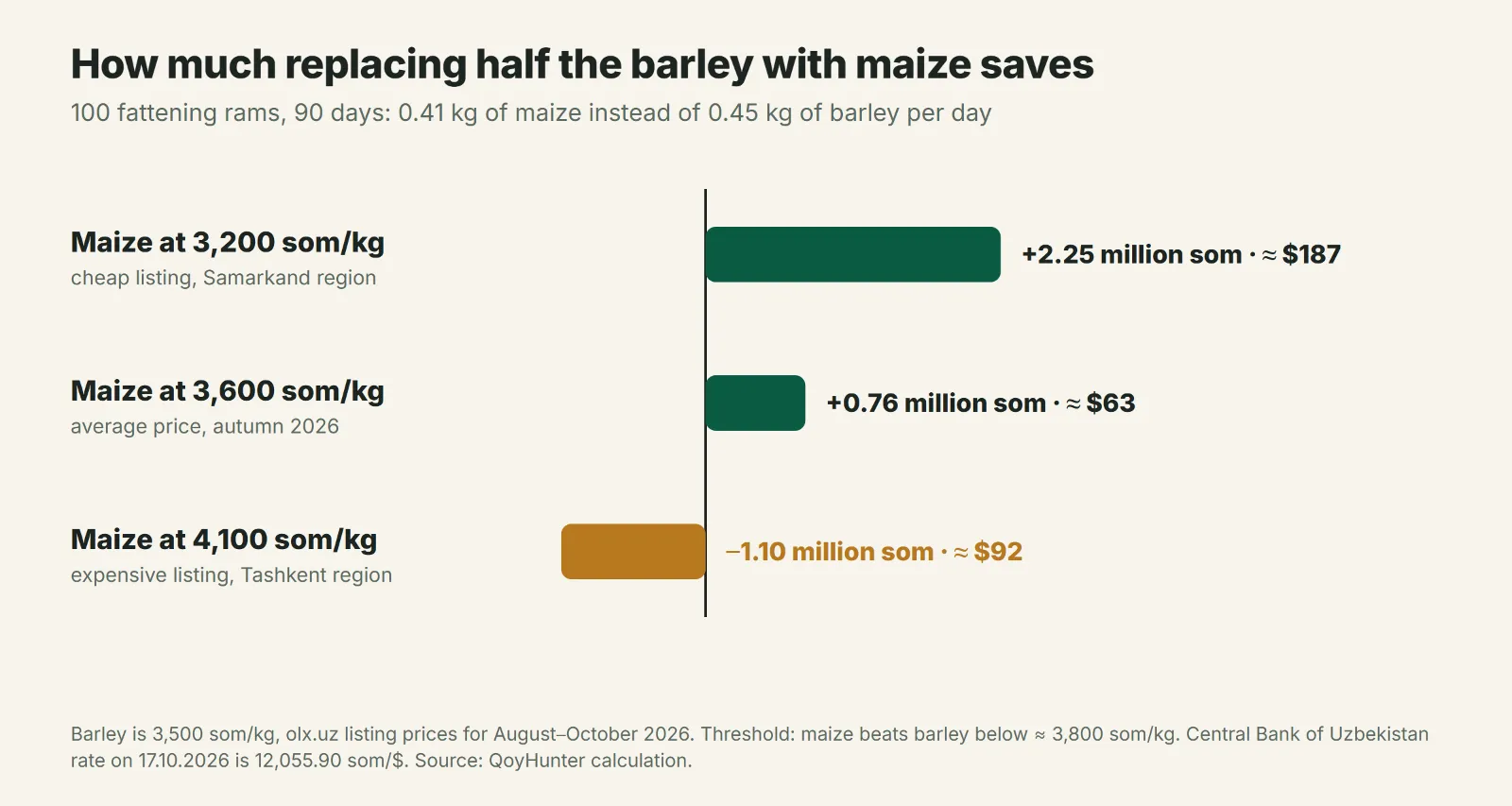
The calculation is hypothetical: it ignores delivery and storage losses, and weight gain is assumed to be the same because the energy in the ration is the same. The conclusion is simple: maize is not a magic feed, it is a way to save when it is cheaper than barley by the price of energy. It is worth comparing grain prices from different sellers before buying, for example in listings where you can buy maize, barley and compound feed for rams. We covered how to compare meal, bran and other feeds by price of protein in the article what to feed rams instead of expensive feed.
What maize must you not feed sheep?
- Moldy and musty. Maize that has lain damp grows fungi that produce aflatoxins and other mycotoxins. You cannot see them or dry them out: they reduce weight gain and hit the liver and reproduction. A bag with mold, clumps or a musty smell is thrown out whole.
- Wet, not dried. New-crop grain with moisture above 14% heats up and molds in the bag. Dry it in the sun or under a shed until it flows freely, and only then put it into storage.
- Treated seed maize. Planting maize may be treated with pesticides and is usually dyed. Never give it to livestock.
Maize silage is a different feed with different norms: it contains the whole green plant, not just the grain.
How do you keep records if maize is a permanent part of the ration?
The gain from maize is a 5–15% difference in the price of energy. It is easy to lose if you do not know what each batch cost and how much of it has gone. If you buy grain once a season in one batch, a notebook is enough.
If there are many batches and the prices differ, it is easier to keep them in feed and warehouse records. This is a section of QoyHunter (a CRM for sheep records and the bazar.qoyhunter.com marketplace): a purchase goes straight into the farm's expenses, feeding deducts the stock from the warehouse, and when stock runs low you get a reminder to buy.
FAQ
What is better for sheep, maize or barley?
By energy maize is stronger: 11.7 MJ per kilogram against 10.8 MJ for barley. By protein barley is stronger: 103 g against 81 g. On alfalfa hay they are nearly equal in value, and the choice comes down to price: with barley at 3,500 som per kilogram, maize pays as long as it costs less than about 3,800 som (≈ $0.32) as of October 2026.
How much maize can a ram get per day?
A fattening ram gets 0.35–0.45 kg of maize per day, together with the same amount of barley and alfalfa hay. That is half of the concentrate. Start at 100 g per head and increase over 2–3 weeks, otherwise rumen acidosis is possible.
Do you need to grind maize for sheep?
Not for adult sheep: they chew whole grain well, and fine grinding raises the acidosis risk. Maize is ground coarsely only for old ewes with worn teeth and for small lambs in creep feed.
Can lambs be fed maize?
Weaned lambs of 3–5 months can have it, 0.15–0.25 kg per day, but only together with barley and 50–80 g of cottonseed meal: maize alone does not give them enough protein. Small lambs get coarsely ground maize in creep feed, a few tens of grams.
Why did a ram on maize stop urinating?
Most likely it is urinary stone disease: grain is low in calcium and high in phosphorus, and on a ration without alfalfa stones form in the urinary tract. Show such a ram to a vet right away. To prevent it, add feed chalk, about 15 g per kilogram of grain, and give unlimited water.
Manage your flock in QoyHunterCRM for sheep farmers: livestock, health, weighing, finance and analytics — in the app and a Telegram bot.All features →