
Why Sheep Die on Grain Finishing: Rumen Acidosis and Urolithiasis
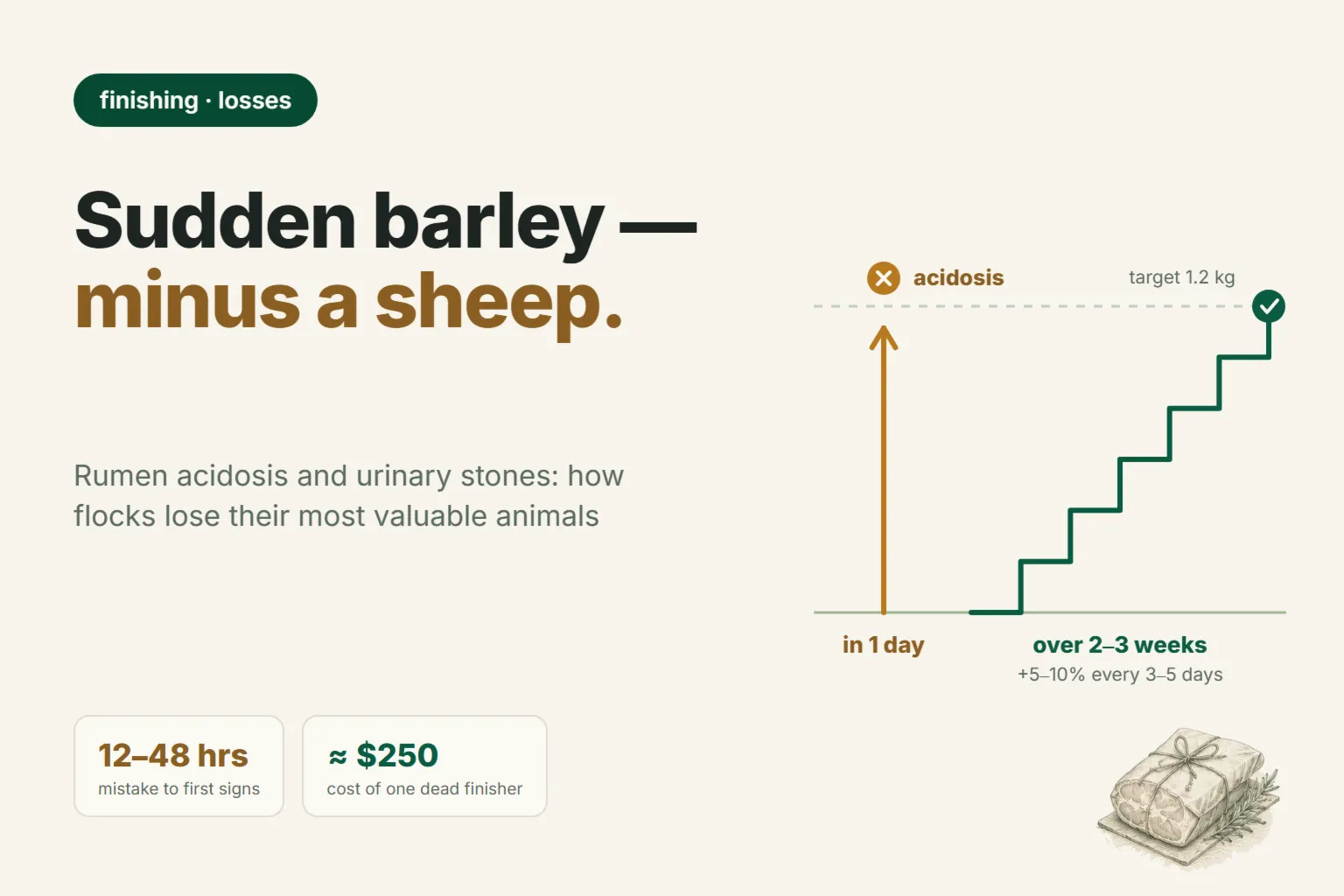
A sudden jump in barley can kill a sheep within a day, and urinary stones within two. Signs, first aid, a safe grain-introduction schedule, and the math on what one dead finisher actually costs you.
Right before a sale you want to "push" the finish: pile on more barley so the sheep shows up round at the bazaar. Two days later, one is down and won't get up, another is pacing by the wall, straining as if it can't urinate. This isn't an epidemic or bad luck — it's two feeding diseases of grain finishing: rumen acidosis and urolithiasis (urinary stones). Both hit the most expensive animals in the flock — the ones you've almost finished fattening.
Here's the breakdown, in order: what a case like this costs you, how to spot it within hours, what to do right now, and how to structure the finishing period so it never happens. Exchange rate used for conversions — about 12,000 soum to the dollar (the official rate in early August 2026 was 11,960 soum).
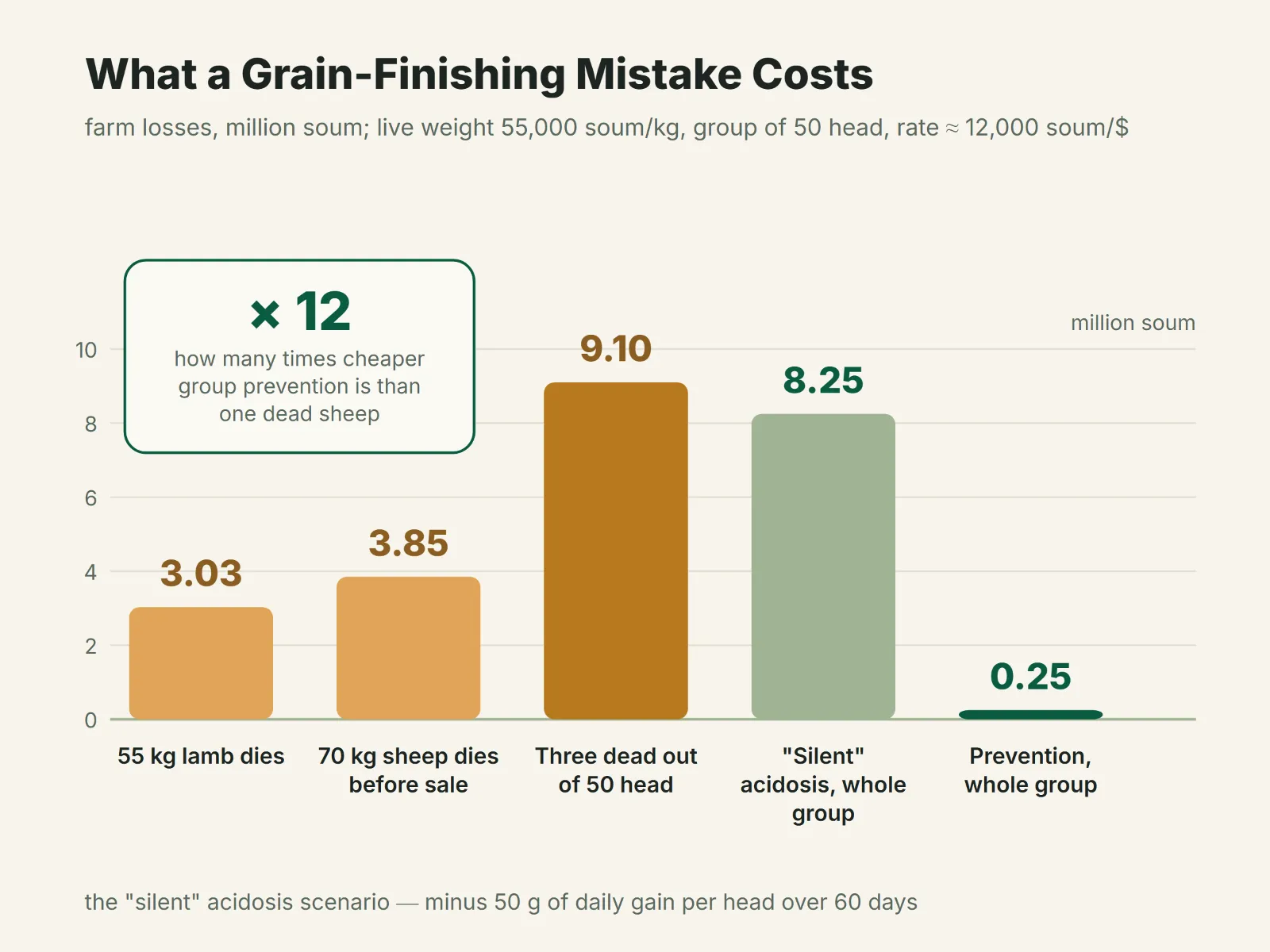
What One Mistake Costs
We're calculating at a live-weight price of 55,000 soum/kg (≈ $4.6) — a cautious lower bound for summer 2026; more detail in the article «How Much a Sheep Costs in Uzbekistan».
| What Happened | Loss to the Farm |
|---|---|
| A 55 kg ram lamb dies mid-finishing | 3.03 million soum (≈ $250) |
| A finished 70 kg sheep dies a week before sale | 3.85 million soum (≈ $320) |
| Three animals die out of a group of 50 | 9.1 million soum (≈ $760) |
| "Silent" acidosis: say, −50 g of daily gain per head, 60 days, 50 head | 8.25 million soum (≈ $690) |
The last line stings the most. Nobody died, no vet was called, and 150 kilograms of live weight simply never grew. That's usually exactly how finishing profit disappears.
Acidosis: When Barley Works Against You
The rumen is a fermentation vat where microbes break down fiber. They ferment grain starch far faster than hay, and when concentrates spike suddenly, lactic acid builds up in the rumen.
Acidity drops step by step:
- 6–7 — normal on a hay/pasture ration;
- 5.5–6 — the working level during finishing, once the animal is adjusted to it;
- 5.2–5.6, day after day, in episodes — subclinical (hidden) acidosis;
- below 5.5, all at once and for a long stretch — acute acidosis;
- 4–4.5 — the level animals usually don't come back from.
Signs appear 12–48 hours after the feeding mistake — a sudden jump in grain, a new batch of barley, or the classic case: a sheep got into an open sack in the storeroom.
What acute acidosis looks like. The animal refuses feed, stands hunched or lies down, staggers when it tries to walk, breathes fast. Profuse, watery, sour-smelling diarrhea appears, often with undigested grain in it; the left flank is bloated. Mortality is high.
What to do before the vet arrives: remove all concentrates immediately, leave only long-stem hay and clean water. After that it's the vet's job — oral alkaline solutions, IV fluids, and in severe cases, rumen lavage. Guessing at "folk remedy" doses of baking soda doesn't help here — you're working against the clock.
The Quiet Form That Just Eats Your Weight Gain
Subclinical acidosis is far more common: the animal doesn't die, but it eats in fits and starts — lunging at the feed, then backing off. Manure softens, and the group loses its evenness: some sheep fall noticeably behind on weight. A constantly acidic environment eats away at the rumen wall, and infection travels from there into the liver — a liver like that gets condemned at slaughter. Lameness shows up last of all: changes to the hoof horn after acidosis only become visible 1–2 months later, by which point nobody connects it back to the feed.
Flocks with this kind of acidosis look healthy from the outside. It's just that every kilogram of gain costs more, and the finishing period stretches out — we walked through how to calculate that in the article «How Much a Kilogram of Weight Gain Costs».
Urolithiasis: The Sheep That Can't Urinate
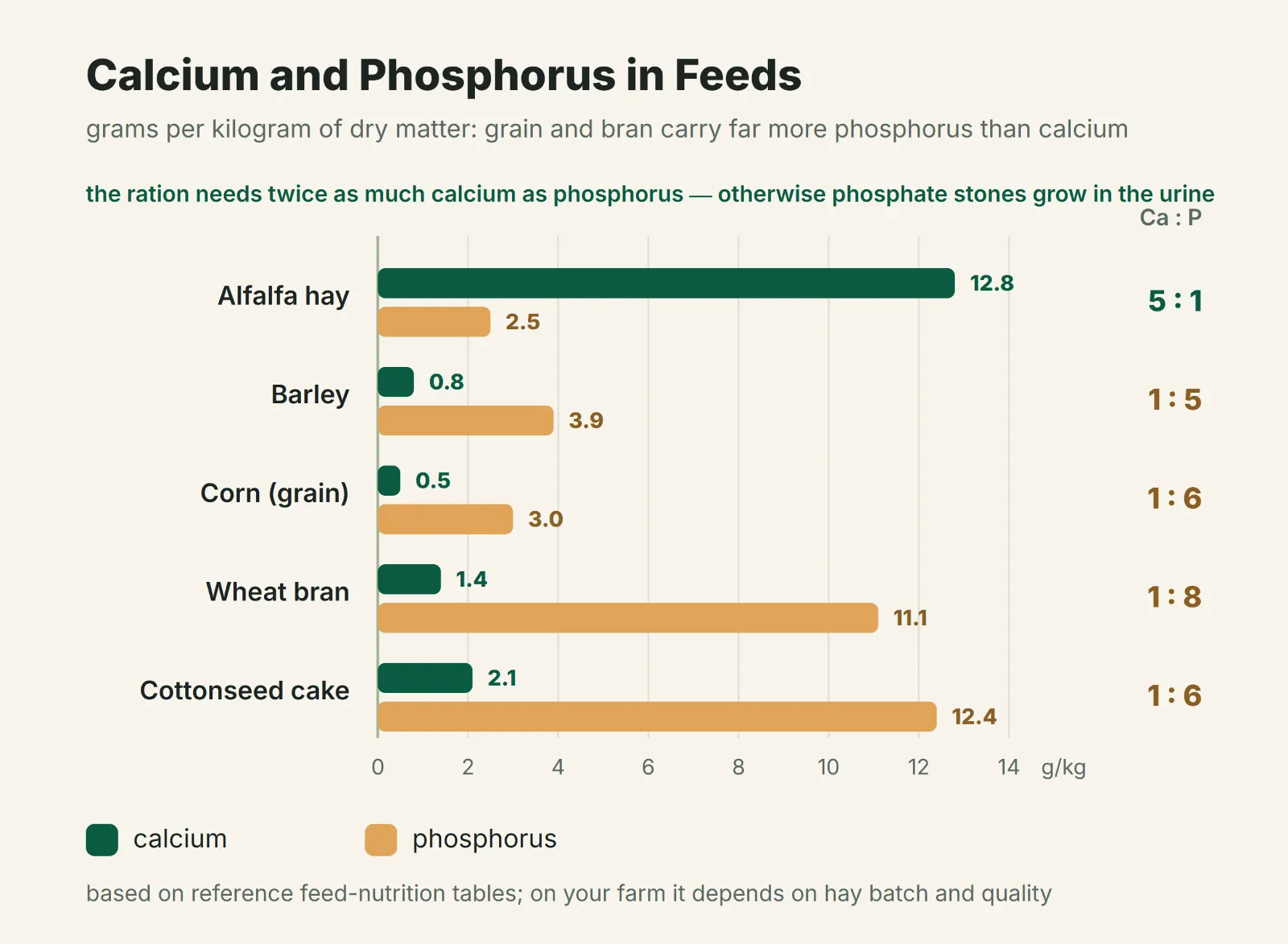
The second scourge of grain finishing is stones in the urinary tract. The cause is a mineral imbalance: grain is rich in phosphorus and poor in calcium.
| Feed | Approximate Calcium : Phosphorus Ratio |
|---|---|
| Alfalfa hay | ~5 : 1 |
| Barley | ~1 : 5 |
| Corn (grain) | ~1 : 6 |
| Wheat bran | ~1 : 8 |
| Cottonseed cake | ~1 : 6 |
| Needed in the ration | no lower than 2 : 1 |
When phosphorus is high and calcium is low, phosphate crystals precipitate out in the urine. They form into sand and stones and get stuck at the narrowest point — the vermiform (urethral) process at the tip of the penis; this is the most common blockage site in small ruminants.
Who's at risk: ram lambs on concentrate finishing, especially wethers — their urethra stays narrow, and the earlier the castration (within the first month of life), the higher the risk. Winter is more dangerous than summer: animals drink less, and urine becomes concentrated.
Signs. The sheep is restless, keeps assuming the urination stance and straining without result; urine comes out in drips, sometimes bloody; crystals show up on the hairs around the prepuce. The animal grinds its teeth, kicks at its own belly with a hind leg, refuses feed. Later the belly swells and turns "watery," and the animal's behavior deceptively calms down — which usually means the urethra or bladder has already ruptured. With a complete blockage, rupture happens within 24–48 hours; after that the animal lives a few more days and dies from metabolic waste poisoning. Saving it at this stage rarely works.
What to do. Get it to a vet the same day, not the next morning. The simplest intervention is amputating the vermiform process, which clears some blockages. Beyond that it's surgery: a catheter usually won't pass in small ruminants, and a bladder-exteriorization procedure gives good results but costs money and needs a clinic. If treatment isn't economically justified, the vet can advise emergency slaughter — while the animal is still alive and the meat is still fit to eat, you save at least part of its value. Don't try to clear the blockage yourself.
Sign → What It Is → What to Do Now
| What You See | Most Likely | Action |
|---|---|---|
| Refusing feed, staggering, watery diarrhea 1–2 days after a grain increase | Acute acidosis | Remove concentrates, hay and water only, call the vet urgently |
| Eating in fits and starts, soft manure, group spreading apart in weight | Subclinical acidosis | Cut the grain share, add roughage, feed 2–3 times a day |
| Lameness in several animals a month or two after ramping up grain | Laminitis from acidosis | Review the ration, call the vet |
| Straining, urine in drips or bloody, grinding teeth | Urinary tract blockage | Get to the vet immediately — you're on the clock |
| Swollen, soft belly, animal "calms down" | Ruptured urethra or bladder | Urgent vet visit, discuss emergency slaughter |
If the best-conditioned lamb on the feedlot dies suddenly, without scours or staggering, it is more often enterotoxemia than acidosis: why the best lambs die on grain and how to vaccinate the group before concentrates.
Safe Grain Introduction: Three Weeks, Not Three Days
The main rule of finishing: the rumen adjusts to grain over 2–3 weeks, and you can't rush it. Here's a practical schedule for a 45–55 kg sheep working up to 1.2 kg of concentrates a day:
| Days | Concentrates, kg/day | Roughage |
|---|---|---|
| 1–3 | 0.2 | hay free-choice |
| 4–6 | 0.35 | hay free-choice |
| 7–9 | 0.5 | hay free-choice |
| 10–12 | 0.65 | hay free-choice |
| 13–15 | 0.8 | at least 1 kg |
| 16–18 | 0.95 | at least 1 kg |
| 19–21 | 1.1–1.2 | at least 1 kg |
The step-up is roughly 5–10% of the ration every 3–5 days. Alongside that, four rules that don't cost you a thing:
- Never take away roughage — long-stem hay keeps rumination going, and saliva works as a natural buffer against acid.
- Split the daily concentrate ration into 2–3 feedings — no more than half the total in one go, or even an adjusted rumen takes a starch hit all at once.
- Feed grain to sheep whole, not ground into flour: fine grinding speeds up starch breakdown and raises the risk of acidosis.
- Lock the storeroom. An animal that gets into the sacks eats a fatal dose in one sitting.
Switching to a new batch of barley or changing from corn to wheat is also a change for the rumen: step back a couple of stages and work your way up again.
Calcium, Salt, and Water — Three Cheap Levers
- Calcium. Alfalfa hay in the ration is itself a counterweight to grain. If concentrates make up a large share, add feed-grade chalk or limestone flour, about 1% of the concentrate weight, to bring the ratio back up to 2:1 or higher.
- Salt. 0.5–1% of the ration, and on farms that have already had stone cases, zootechnicians push it up to 3–4%: salt makes animals drink more and dilutes the urine. A salt lick should be available at all times. Don't salt the water itself — sheep start drinking less of it, which gives you the opposite effect.
- Water. On a dry ration, a sheep drinks 2–3 liters for every kilogram of dry feed, so 4–8 liters a day on average. Water needs to be clean and available round the clock, and not ice-cold in winter. A frozen or dirty trough in winter is the single most common cause of stones. How much water each group of animals actually needs, and which water is dangerous for sheep, is covered in "How much water a sheep needs per day".
- Urine acidification. If your farm has already had cases, ammonium chloride is added to the ration — about 0.5% of the ration (1% maximum), with the goal of bringing urine pH below 6.5. Agree the dose and monitoring with your vet: this is a treatment measure, not a standing "just in case" additive.
All of this is the cheapest part of prevention: to buy feed chalk and mineral premix for a group of 50 head costs less than a single lost feeder ram.
Prevention vs. One Sheep
Let's run the numbers for a group of 50 head over 100 days of finishing. Chalk and salt work out to roughly 1.5–2 kg per head for the whole period. Even at 3,000 soum a kilogram, that's about 5,000 soum per head (≈ $0.4), or 250,000 soum for the whole group (≈ $21).
One dead sheep costs 3 million soum. Preventing losses across the whole group costs 250,000 — twelve times cheaper than a single loss.
And here's one more piece of math people forget: at this summer's prices, a kilogram of alfalfa hay costs around 1,100 soum, a kilogram of barley around 3,800 soum. Roughage is three times cheaper than grain. Trying to "push it with grain" is both riskier and more expensive than a properly balanced ration — a detailed breakdown of feeds is in the article «What to Feed Sheep for Weight Gain».
What's Worth Tracking
Both diseases are caught in the small details that memory doesn't hold onto: exactly when you raised the grain ration, which day a sheep started falling behind, who in the group has already been sick. Log the start date of finishing and every step-up in concentrates, weigh a control group every two weeks, and record every animal that gets sick. In QoyHunter this is tracked per animal, so a sheep falling behind on weight gain shows up before the whole group starts limping. General flock prevention rules are gathered in the article «Sheep Diseases: Symptoms and Prevention».
There is no need to invent anything for this: logging concentrate step-ups by date and the control group’s weighing schedule live in one place, so the step where trouble started is immediately visible.
The Short Version
- The rumen adjusts to grain over 2–3 weeks: step up 5–10% of the ration every 3–5 days, no more.
- Roughage stays in the feeder at all times; split the daily concentrate ration into 2–3 feedings.
- Refusing feed, staggering, and watery diarrhea 12–48 hours after a grain increase — that's acidosis: pull the concentrates and call the vet.
- A ram lamb straining and unable to urinate — that's stones: rupture within a day or two, get it to the vet the same day.
- Keep the calcium-to-phosphorus ratio no lower than 2:1: alfalfa, chalk, salt, and water round the clock.
- One dead finisher costs about 3 million soum (≈ $250); preventing losses across a group of 50 costs 250,000.
Agree mineral supplement doses and any treatment protocols with your own vet: rations, water, and breeds differ from farm to farm, and what works for your neighbor might overshoot for you.
Manage your flock in QoyHunterCRM for sheep farmers: livestock, health, weighing, finance and analytics — in the app and a Telegram bot.All features →