What to Replace Expensive Ram Feed With: Cost per Kilogram of Protein in Meal, Bran and Barley
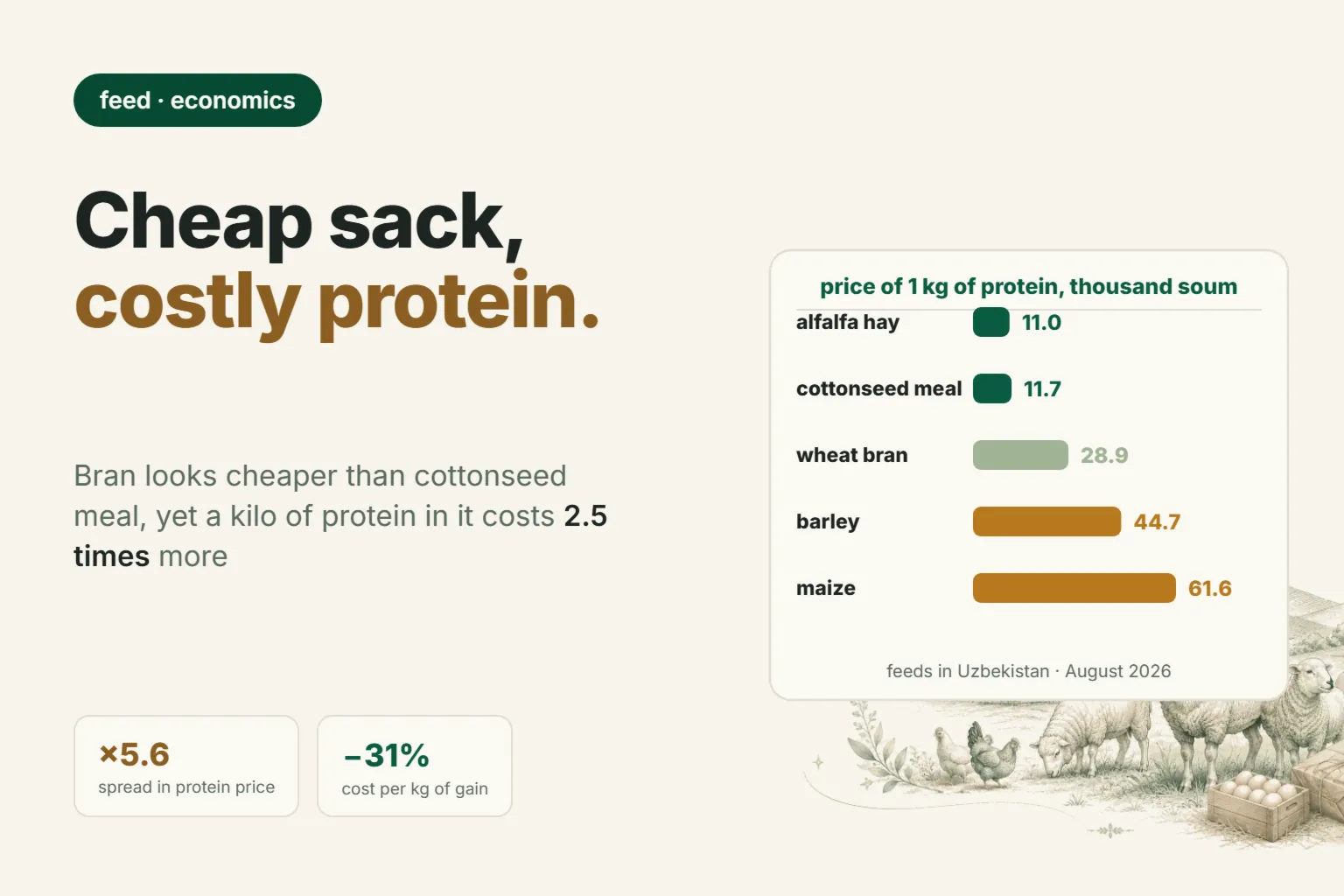
A bag of wheat bran is cheaper than a bag of cottonseed meal, yet a kilogram of protein in it costs almost 2.5 times more. We work out the cost of protein and of a feed unit in local feeds — alfalfa, barley, maize, bran, meal, cake — and recalculate a fattening ration so the cost per kilogram of gain drops from 29.8 to 20.4 thousand soum.
A bag of wheat bran costs less than a bag of cottonseed meal, so farmers buy bran. The logic seems sound: cheaper bag, cheaper feed. But a ram doesn't eat bags — it eats protein and energy, and once you recalculate the purchase on that basis, the picture flips: a kilogram of protein in bran ends up costing almost 2.5 times more than in cottonseed meal.
Below is a table of local feeds converted to nutritional value, a breakdown of what's worth buying and what isn't, and a recalculated fattening ration that brings the cost of a kilogram of gain down from 29.8 to 20.4 thousand soum. Prices are reference points for August 2026, the exchange rate is around 11,960 soum per dollar, and live weight is priced at 55,000 soum/kg (≈ $4.6).
Feed is bought not by the kilogram, but by protein and energy
Every feed has two numbers that matter more than the price tag.
Feed unit — this is energy. One feed unit equals the nutritional value of a kilogram of oats; it's used to work out whether the animal has enough energy for maintenance and weight gain.
Digestible protein — this is the protein a sheep actually absorbs, not the number written down as "crude" protein. It's what builds meat, milk and wool.
A ram on fattening needs roughly 1.4–1.7 feed units a day and 100–110 g of digestible protein per feed unit. Not enough energy — the animal stalls on weight. Not enough protein — it also stalls, even with a full feed trough.
From there the math is simple. Divide the price of a kilogram of feed by how much protein it contains, and you get the price of a kilogram of protein. Divide by feed units, and you get the price of energy. These are the two numbers to compare when buying.
| Feed | Price, soum/kg | Feed units per kg | Digestible protein, g/kg | 1 kg protein | 1 feed unit |
|---|---|---|---|---|---|
| Alfalfa hay (summer) | 1,100 | 0.45 | 100 | 11,000 soum ($0.92) | 2,440 soum |
| Cottonseed meal | 3,500 | 1.05 | 300 | 11,700 soum ($0.98) | 3,330 soum |
| Cottonseed cake (kunjara) | 3,300 | 1.15 | 270 | 12,200 soum ($1.02) | 2,870 soum |
| Wheat bran | 2,800 | 0.75 | 97 | 28,900 soum ($2.41) | 3,730 soum |
| Wheat straw | 400 | 0.20 | 12 | 33,300 soum ($2.79) | 2,000 soum |
| Barley | 3,800 | 1.15 | 85 | 44,700 soum ($3.74) | 3,300 soum |
| Maize (grain) | 4,500 | 1.33 | 73 | 61,600 soum ($5.15) | 3,380 soum |
The nutritional values here are reference averages. An actual batch can differ from the table by 10–20%: first-cut hay and hay caught by rain are different feeds in terms of protein, and that's worth keeping in mind too.
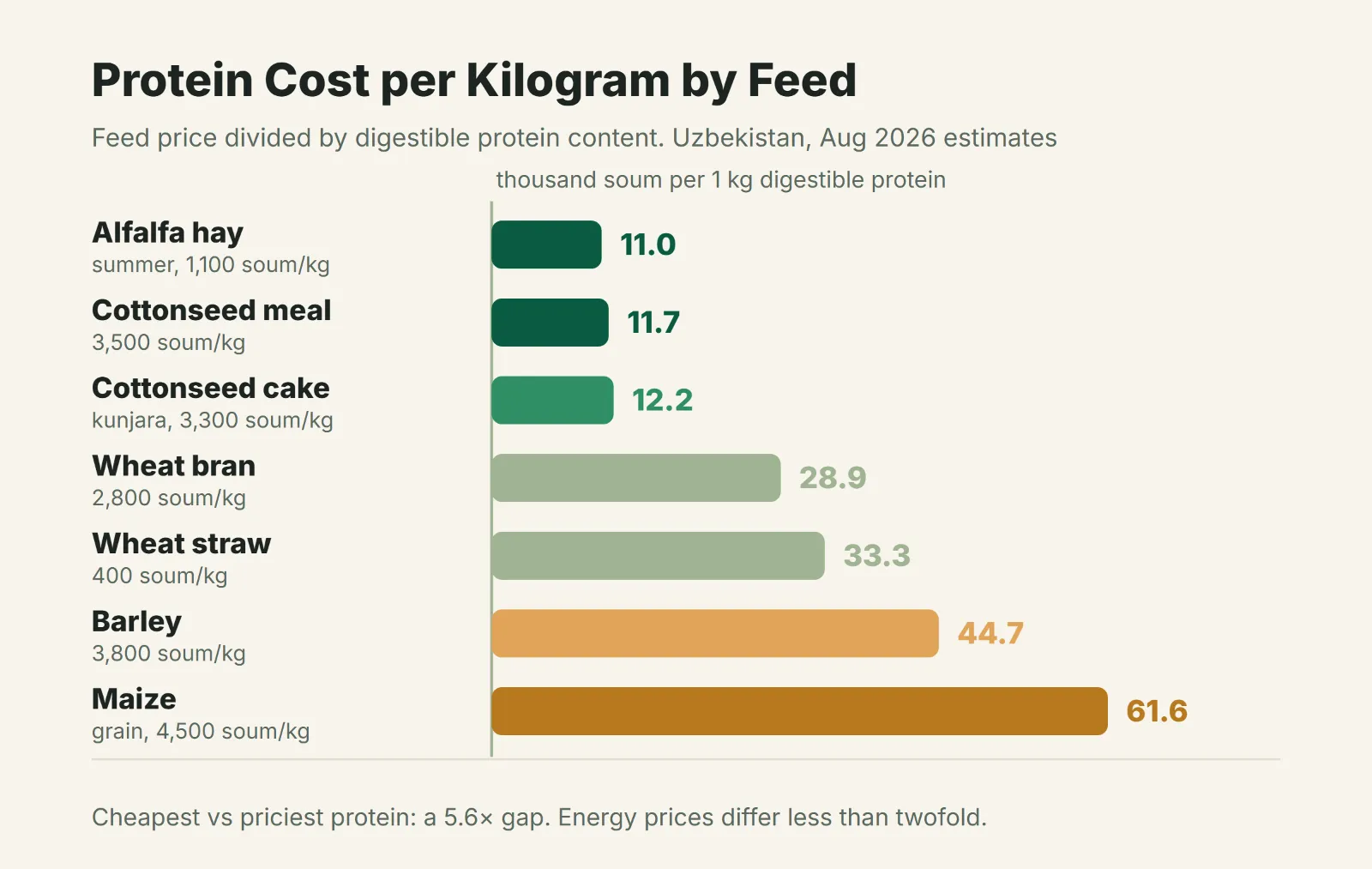
Protein prices vary 5.6-fold, energy prices less than twofold
Look at the last two columns. Energy is priced comparably across feeds: from 2,000 soum per feed unit in straw to 3,730 in bran, and if you look only at concentrates, the whole spread fits within a third.
But for protein the gap is 5.6 times: from 11,000 soum per kilogram of protein in summer alfalfa hay to 61,600 in maize. This is exactly where money quietly leaks out: a farm covers its protein shortfall with maize and bran for years, effectively buying the most expensive protein in the country while convinced it's saving money.
That gives three takeaways worth pinning above the feed trough.
Barley and maize are energy, not protein. Their job is to fuel weight gain. Making up a protein shortfall with them makes no sense: to get an extra 50 g of protein from maize, you'd have to feed nearly 700 g of grain and pay five times over.
Bran is the most overrated feed. It's expensive both for protein (28,900 soum per kilogram) and for energy — the most expensive in the whole list (3,730 soum per feed unit). Bran works well as a gentle, laxative-type supplement for pregnant ewes, but as the base of a ration it's simply expensive.
Alfalfa hay is the cheapest protein in the country — as long as it's bought at haymaking time. By mid-winter a bale costs one-and-a-half to two times more, and its protein price climbs from 11,000 to 16,000–22,000 soum per kilogram — at which point cottonseed meal takes the lead. We covered how to calculate your hay stock and why you should buy it in summer in "How much hay a sheep needs for winter".
Recalculating the ration: same feeds, different weight gain
The most expensive mistake looks like saving money. Take a typical "cheap" ration for a 45 kg animal on fattening: straw, a bit of hay, and barley.
| Ration | Composition, kg | Cost per day | Feed units | Protein | Gain |
|---|---|---|---|---|---|
| "Cheap" | straw 1.0 / hay 0.3 / barley 0.8 | 3,870 soum ($0.32) | 1.25 | 110 g (88 g per feed unit) | ~130 g/day |
| Recalculated | straw 0.8 / hay 0.4 / barley 0.9 / meal 0.12 | 4,700 soum ($0.39) | 1.50 | 162 g (108 g per feed unit) | ~230 g/day |
In the first ration, protein falls short of the norm by almost a quarter. Energy is there, the fuel burns, but there's nothing to build meat from — the animal eats its feed and gains 130 grams instead of 230. Adding 120 grams of cottonseed meal for 420 soum closes the protein gap and restores the gain.
A hundred and twenty grams of meal is a sack per head over the season, and the price of that sack decides everything: it is worth comparing where to buy meal and mixed feed across several sellers — the spread between regions runs up to a third.
You can also check yourself with another indicator: under normal feeding, a kilogram of gain takes 5–6 feed units. In a deficient ration it's higher — almost 10: a lot of feed eaten, little gain to show for it. If your feed cost per kilogram of gain has drifted well past six, it's almost always a protein problem.
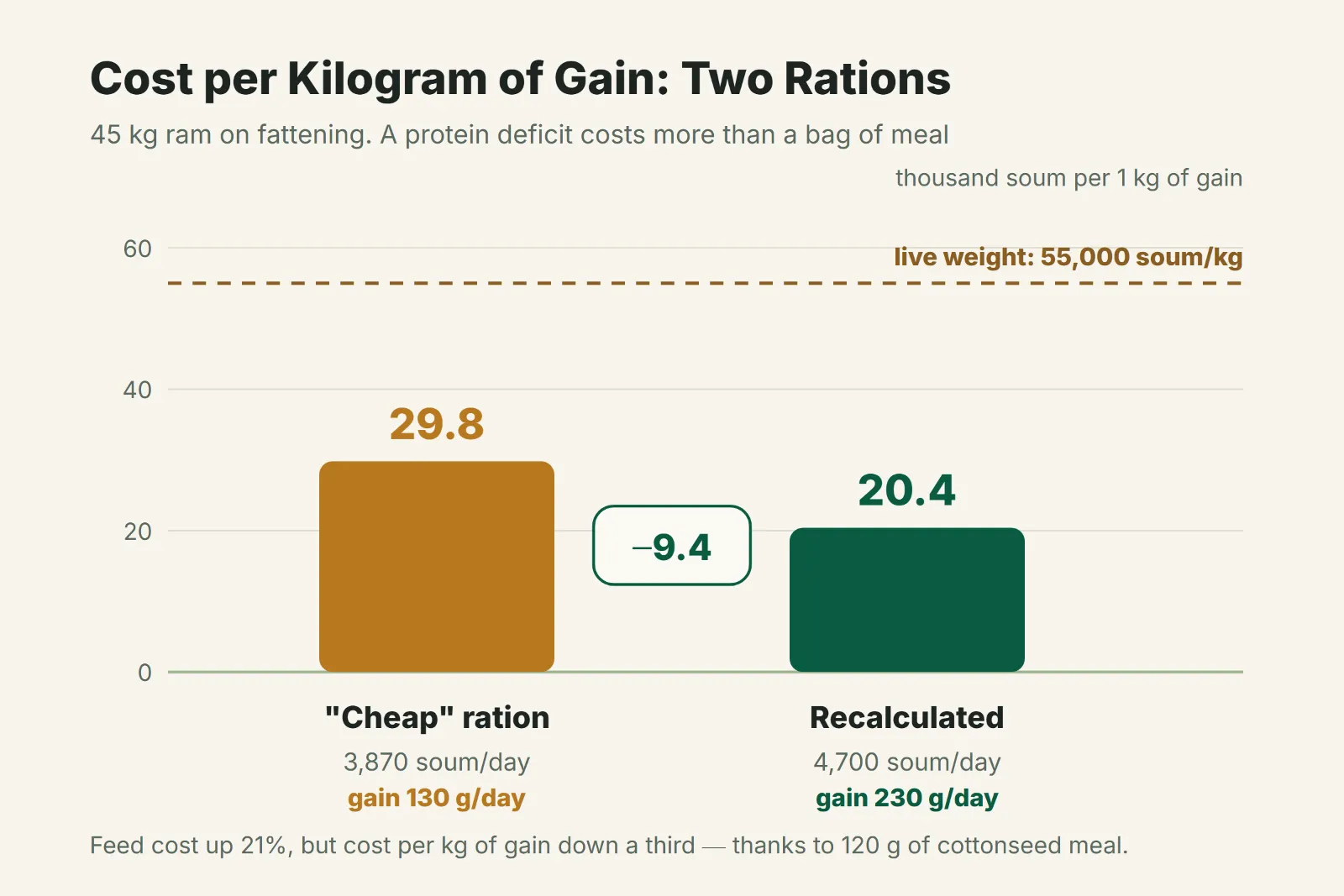
Now the key figure — cost per kilogram of gain:
- "cheap" ration: 3,870 ÷ 0.13 kg = 29.8 thousand soum per kg of gain ($2.5);
- recalculated: 4,700 ÷ 0.23 kg = 20.4 thousand soum per kg of gain ($1.7).
Feed cost went up 21%, while the cost of a kilogram of gain dropped by a third. What you sell is kilograms, not days of feeding.
For a group of 100 head over a 90-day fattening period, the difference looks like this:
| "Cheap" | Recalculated | |
|---|---|---|
| Spent on feed | 34.8 million soum ($2,910) | 42.3 million soum ($3,540) |
| Gain obtained | 1,170 kg | 2,070 kg |
| Gain in money (55,000 soum/kg) | 64.3 million soum | 113.8 million soum |
| Left after feed costs | 29.5 million soum ($2,470) | 71.5 million soum ($5,980) |
The difference is 42 million soum (about $3,500) over three months on a hundred head. That's exactly what the habit of pricing by the bag instead of by protein costs you. For how the cost of gain rises along with the animal's weight, and when it's time to stop fattening, see "How much a kilogram of gain costs".
Cottonseed meal: how much is safe, and who shouldn't get it
Cottonseed meal and cottonseed cake (kunjara) are the most accessible protein in Uzbekistan — a by-product of the country's own oil-pressing industry, traded on the exchange and sold by processors for 2,900–4,000 soum per kilogram, containing 35–41% crude protein. But it has a limit, and that limit gets broken more often than any other rule.
Cottonseed contains gossypol — a natural toxin that builds up in the body and damages the liver, heart and reproduction. An adult sheep neutralizes it in the rumen, so gossypol is far less dangerous to ruminants than to poultry or pigs — but that doesn't mean you can feed cottonseed meal without limit.
Working guidelines:
- adult sheep — up to 20% of the ration by nutritional value, roughly 250–300 g of meal per day;
- young stock over 4 months — half that, up to 10% of the ration, around 120–150 g;
- lambs under 4 months should not get cottonseed meal or cake at all: their rumen doesn't yet function like an adult's, so there's nothing to neutralize the gossypol;
- cottonseed cake (kunjara) contains more free gossypol than meal, so its allowance is kept lower — a guideline of up to 200 g per day for an adult animal;
- with continuous feeding of cake or meal, take a 3–4 week break once every 1–2 months — a standard precaution against gossypol buildup;
- pregnant ewes and breeding rams are best kept off large doses altogether: gossypol worsens semen quality and raises the risk of losing offspring. A breeding ram for the mating season is worth more than the bag you'd save — we covered how to choose one and what it costs here.
When buying, ask whether the meal is low-gossypol, check the production date and the smell — don't take rancid, caked or damp-spoiled meal at any price. Introduce it gradually, over 10–14 days: a sharp jump in concentrates ends in rumen acidosis, which we covered in "Why rams die on grain fattening". And if animals lose their appetite, breathe heavily or stagger after a feed change, pull the feed and call a vet — don't wait until morning.
What not to cut corners on
Recalculating a ration is about swapping expensive protein for cheap protein, not about cutting back.
Salt and minerals. The cheapest line item in the budget and the costliest one to skip: a mineral lick block per head costs pennies, and going without it costs the flock both weight gain and lambs (more here).
Water. A sheep on a dry ration drinks 5–8 liters a day, more in heat. An empty trough wipes out the most carefully calculated ration.
Roughage. The temptation to swap hay for grain is strong, but the rumen needs fiber. Roughage below a third of the ration by nutritional value is a direct road to acidosis and urolithiasis.
Quality over quantity. Dust, moldy straw, musty hay — that's not cheap feed, it's spoiled feed: the animal will simply leave half of that trough untouched.
When to buy cheaper
Feed price is a question not just of choice, but of timing.
- Alfalfa and hay — cheapest at haymaking time, June–July. The difference from the winter price is one-and-a-half to two times.
- Cottonseed meal and cake — cheaper during the cotton-processing season, October through January, when oil mills are producing them in bulk.
- Grain — after harvest, July through September.
If you have an irrigated hectare, the cheapest protein is the one your farm grows itself: irrigated alfalfa gives 4–5 cuttings and 4–12 tons of hay per hectare — enough to cover a small flock through winter without buying protein elsewhere.
The bulky part of the ration is costed separately, on a dry matter basis: silage versus hay and the break-even price of silage — it also works out how much meal such a swap needs.
In short
- Compare not the price of the bag, but the price per kilogram of protein and per feed unit.
- Protein prices vary 5.6-fold between feeds; energy prices vary less than twofold.
- The cheapest protein is summer alfalfa hay (11,000 soum/kg) and cottonseed meal (11,700). The most expensive is maize (61,600) and bran (28,900).
- Barley and maize are bought for energy; making up protein with them means paying several times over.
- A quarter protein shortfall cuts weight gain almost in half and pushes the cost per kilogram of gain from 20 up to 30 thousand soum.
- Cottonseed meal is safe within limits: up to 250–300 g for adults, 120–150 g for young stock over 4 months, and none at all for lambs under 4 months.
So these calculations don't just live in a notebook, QoyHunter has flock record-keeping built in: scheduled weigh-ins, history and average daily gain for every animal — so you can see which ration actually works, instead of which one just looks cheaper.
The price per kilogram of protein is only half the job; the other half is where you buy that kilogram. We covered five feed buying channels and August 2026 prices separately.
The only way to check this is with numbers: comparing rations by weight gain over a month shows which of the two rations is genuinely cheaper per kilogram of meat.
Manage your flock in QoyHunterCRM for sheep farmers: livestock, health, weighing, finance and analytics — in the app and a Telegram bot.All features →