Mastitis in Sheep: Signs, Treatment, and Which Ewes to Cull Before Breeding
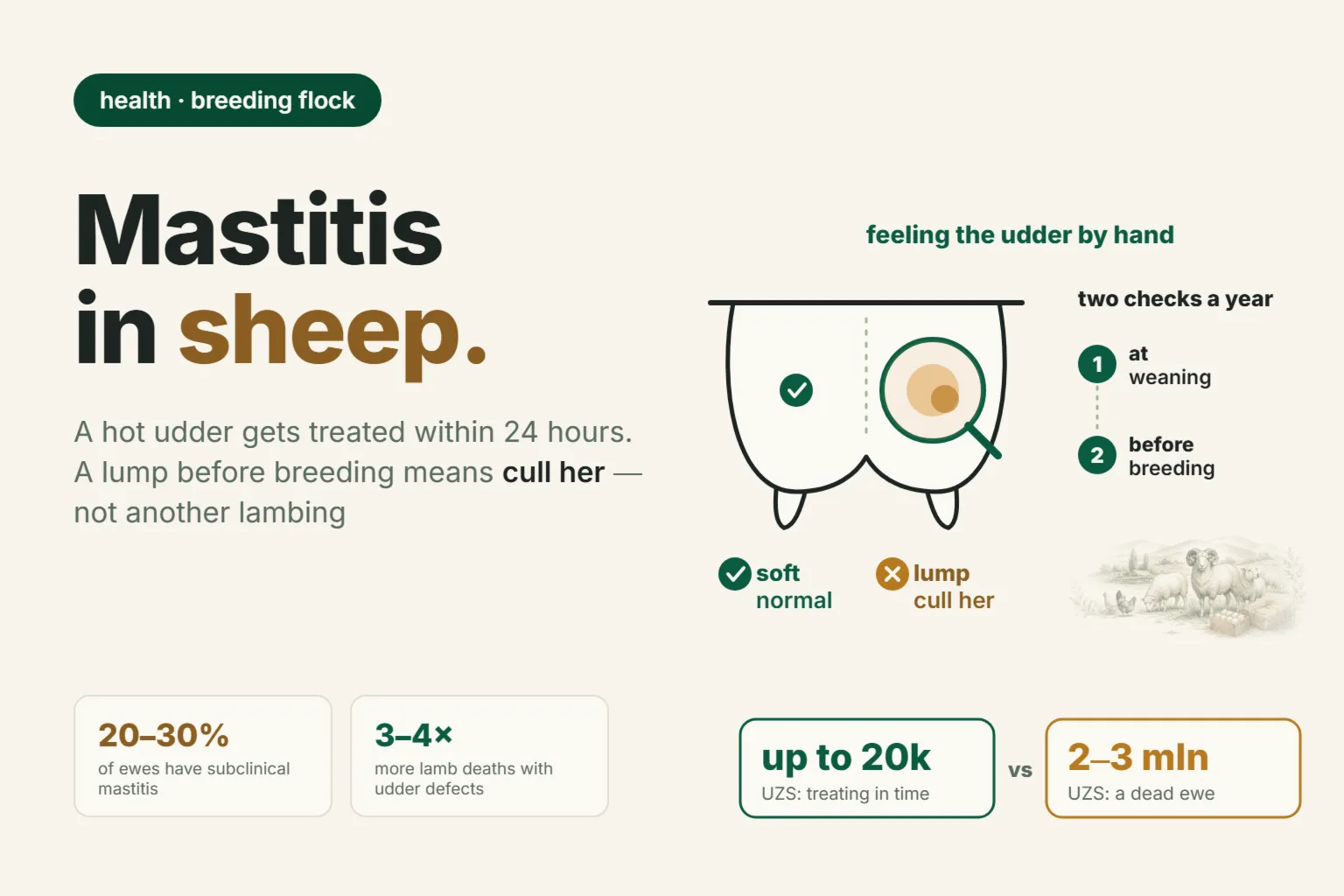
Mastitis in sheep is inflammation of the udder: a hot, swollen half, limping, a ewe that won't let lambs nurse. Acute mastitis is treated within 24 hours; chronic mastitis doesn't respond to treatment — those ewes get culled before breeding. Signs of every form, first aid, a loss calculation for a 100-ewe flock, and an udder check, September 2026.
Mastitis in sheep is inflammation of the udder, most often bacterial. Acute mastitis is easy to spot: one udder half turns hot, swollen, and painful, the ewe limps and won't let lambs nurse. A vet treats it in the first 24 hours with an antibiotic and an anti-inflammatory, on the vet's own call. Chronic mastitis — hard lumps in the udder — doesn't respond to treatment, and it pays better to cull that ewe for meat in autumn, before breeding, than to keep her for another lambing.
Meat-breed ewes in Uzbekistan aren't milked, so mastitis in a Hissar, Edilbay, or Jaydara ewe often gets noticed late — once the lamb has already fallen behind on weight. Below: the signs of mastitis in a ewe, what to do in the first 24 hours, a loss calculation for a 100-ewe flock, and an udder check you can still fit in before the 2026 autumn breeding season. Prices are as of September 2026; the Central Bank of Uzbekistan's rate for September 17, 2026 is 11,797 UZS per dollar.
What Is Mastitis in Sheep, and How Common Is It?
Mastitis is inflammation of the mammary gland (the udder). In sheep it's caused mainly by bacteria: Staphylococcus aureus and Mannheimia haemolytica. In a study of 30 meat-breed flocks in Quebec, Canada, the bacterium most often isolated from ewes with clinical mastitis was Mannheimia — 26% of cases, followed by Staphylococcus aureus at 23% and other staphylococci at 17%.
Mastitis comes in two forms, and they need to be counted separately:
- Clinical — you can see and feel it. Studies of meat-breed flocks put it at 1% to 6% of ewes per lactation: 0% to 6.6% in the Quebec flocks (median 1.2%), an average of 3.8% in the Farming Connect study in Wales, and around 5% per the UK's AHDB farming agency.
- Subclinical (hidden) — the udder feels normal, but there are bacteria in the milk and less of it. AHDB estimates this at 20–30% of ewes per lactation.
There's no open mastitis statistics for Uzbekistan, so the figures above are a reference point from UK and Canadian flocks, not a local benchmark.
What Are the Signs of Mastitis in a Ewe?
The main question when you examine a ewe is which form you're looking at. That decides whether you treat her or prepare her for culling.
| Form of mastitis | What you see | What to do |
|---|---|---|
| Acute (clinical) | One udder half is hot, swollen, and painful. The ewe limps on the hind leg on the affected side, won't let lambs nurse, and drifts away from the flock. Milk is watery, with flakes or blood | Call a vet and treat within the first 24 hours |
| Gangrenous ("blue udder") | The affected half is first hard, then cold, with blue-black skin. The ewe is depressed and loses weight fast | Call a vet urgently; put lambs on supplemental feeding |
| Chronic | Hard lumps in the udder tissue, the two halves differ in size, one half is "blind" — gives no milk, teat is thickened | Doesn't respond to treatment — cull |
| Subclinical | The udder feels normal, but lambs fall behind, cry, and try to nurse from other ewes | Watch the lambs, check the udder |
Temperature is another clue: normal for an adult ewe is 38.3–39.9°C; above 40.5°C is a fever. It often rises with acute mastitis, and is usually normal with chronic mastitis.
One separate case: both udder halves are hard on a ewe, but neither is hot nor painful. That can be the maedi-visna virus, which causes a painless hardening of the udder. There's no data on how widespread maedi-visna is in Uzbekistan, so if "hard udder" shows up in several ewes at once, that's a reason to run tests through a vet — not to treat each one with an antibiotic.
What Causes Mastitis in Sheep?
Bacteria get into the udder through the teat. Five things most often open the way:
- Teat injuries. A lamb nicks the teat with its incisors, especially when nursing hungry. Per the WikiVet veterinary reference, gangrenous mastitis is often preceded by teeth damage to the teats from lambs.
- Twins and triplets. Per AHDB, the risk of acute mastitis is higher in ewes raising two or more lambs; in the Quebec study, it was higher for ewes with three or more.
- Contagious ecthyma (orf) — a viral disease with sores on lambs' lips. A lamb carries it onto the teats, nursing becomes painful for the ewe, she won't let the lamb suck, milk backs up — and per the MSD Veterinary Manual, mastitis can follow orf, sometimes the gangrenous form.
- Crowding and dirty bedding. Per AHDB, the longer ewes and lambs stay in the sheep barn, the higher the risk; crowding and damp bedding only raise it further, especially in the first six weeks of lactation.
- Abrupt weaning. If ewes get concentrate feed right up to the last day, the udder overfills. That's why concentrates are pulled 5–7 days before weaning — the full schedule is covered in the article on when to wean lambs from the ewe.
What Do You Do If a Ewe Has Mastitis?
Acute mastitis is urgent — you're counting hours, not days. Here's the order of steps.
- Separate the ewe from the flock along with her lambs and feel both udder halves. Take her temperature.
- Call a vet. The vet picks the protocol — usually an injectable antibiotic and an anti-inflammatory (flunixin or meloxicam, for example), and stripping out the affected half if needed. The dose is calculated by the ewe's weight.
- Check the lambs. If the ewe won't let them nurse, or one udder half isn't working, the lambs need supplemental feeding — milk replacer or fostering onto another ewe.
- Observe the withdrawal period. Until the time set on the antibiotic's label has passed, the ewe can't be sold for meat.
- Write down the ewe's tag number, the date, which half, and what you treated with. Per AHDB, 9 out of 10 ewes lose the affected half after acute mastitis — a candidate for culling even after she recovers.
The materials for a course — antibiotic and anti-inflammatory — for an adult ewe run about 10,000–20,000 UZS (≈ $0.8–1.7) if the owner gives the injection. That's an estimate scaled up from our figure for 35 kg weaned lambs (6,000–10,000 UZS a head), adjusted for a ewe's weight of 55–65 kg; count the vet's call-out fee separately.
Gangrenous mastitis is treated with the same drugs, but the outlook is poor. Per New Mexico State University (NMSU), around a quarter of these ewes die. In survivors, the dead udder tissue sloughs off and that half stops working for good — a ewe like that isn't kept for breeding.
What Does Mastitis Cost: A Calculation for a 100-Ewe Flock
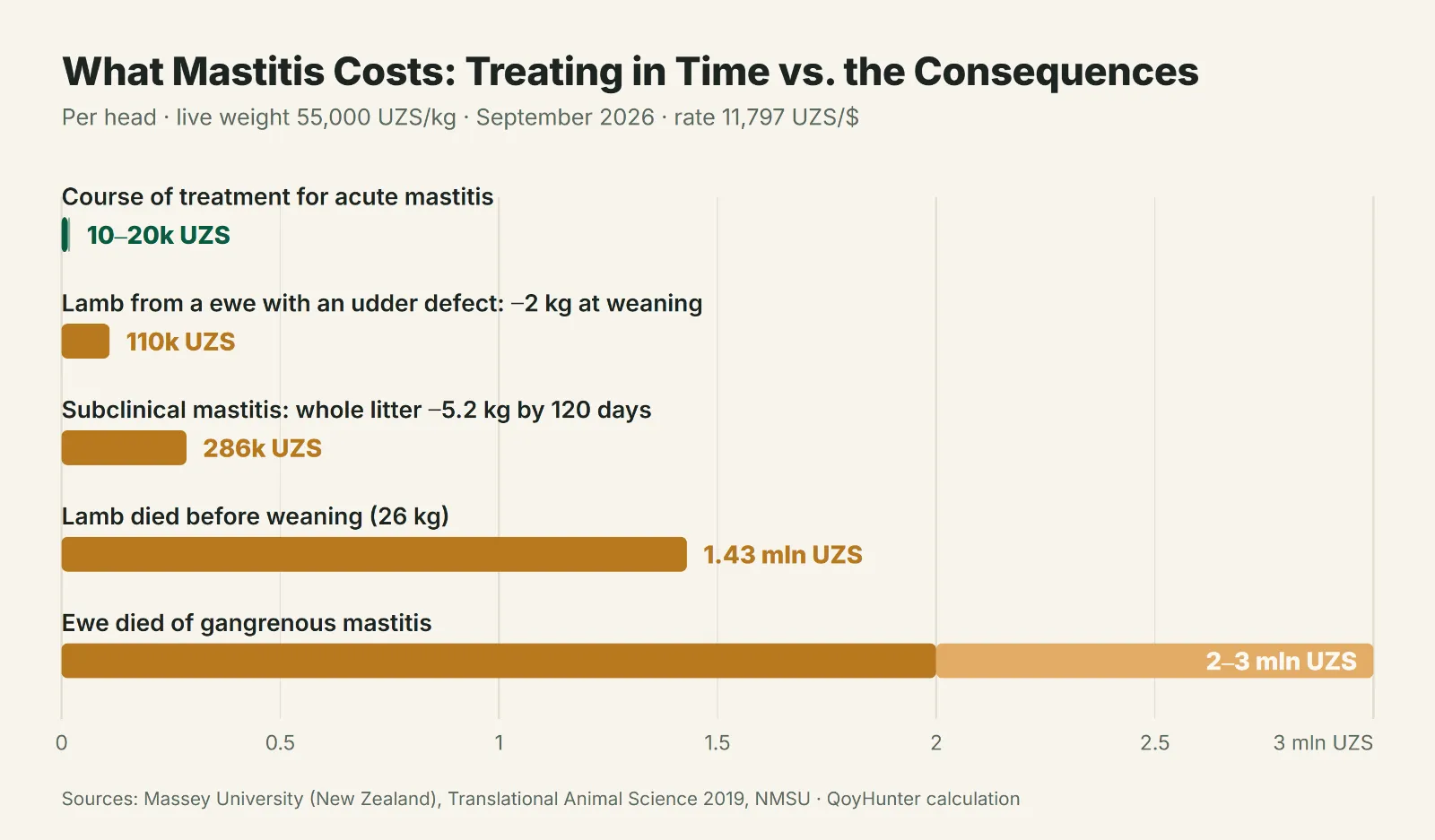
The money mastitis costs you doesn't come from treatment — it comes from the lambs. We use the same prices as in our other calculations: a lamb weighs about 26 kg at weaning, live weight sells at 55,000 UZS/kg (the low end of the autumn range of 55,000–65,000 UZS), and a dead adult ewe is worth 2–3 mln UZS.
| What happened | Per head | UZS | $ |
|---|---|---|---|
| Course of treatment for acute mastitis, owner gives the injection | antibiotic and anti-inflammatory | 10,000–20,000 | 0.8–1.7 |
| Lamb from a ewe with an udder defect | 2 kg lighter at weaning | 110,000 | 9 |
| Ewe with subclinical mastitis early in lactation | whole litter 5.2 kg lighter by 120 days | 286,000 | 24 |
| Lamb died before weaning | 26 kg at weaning | 1,430,000 | 121 |
| Ewe died of gangrenous mastitis | ewe | 2–3 mln | 170–254 |
Where the lamb numbers come from. In a Massey University study (New Zealand), lambs from ewes with udder defects died 3–4 times more often, grew 25 g a day slower, and weighed 2 kg less at weaning. In a study of three US flocks (Translational Animal Science, 2019), ewes with bacteria culturing positive from their milk early in lactation raised litters that were 2.9 kg lighter by 45 days and 5.2 kg lighter by 120 days than ewes with no bacteria in their milk.
Now for a 100-ewe flock. The same New Zealand study found udder defects in an average of 5% of adult ewes — that's 5 head. If you keep them for breeding:
- five lambs 2 kg lighter at weaning: 5 × 110,000 = 550,000 UZS;
- at a death rate 3–4 times higher, let's conservatively assume one of those five lambs dies: 1,430,000 UZS.
That's about 1.98 mln UZS (≈ $168) in a season from just five ewes — a hundred times or more what a single ewe's treatment costs (10,000–20,000 UZS). On top of that comes subclinical mastitis: if 20 ewes out of a hundred have it and each one's litter comes up 5.2 kg short, that's another 5.72 mln UZS (≈ $485).
An important caveat: in an earlier study (Journal of Animal Science, 1992), the effect of subclinical mastitis on lambs turned out to be minimal where lambs got creep feed. Creep feed from two weeks old partly makes up for the milk shortfall, so on a farm that feeds creep, losses will run lower than this calculation.
How Do You Check the Udder, and Which Ewes Should You Cull Before Breeding?
Chronic mastitis doesn't respond to treatment, and the MSD Veterinary Manual advises checking udders before breeding specifically to pull ewes with chronic mastitis out of the flock. The check takes under a minute a head.
When to check. First, in the first five days after weaning lambs — that catches acute mastitis. Second, 4–6 weeks after weaning, closer to breeding: in the New Zealand study, many ewes had a normal udder at weaning, and defects only showed up 4–6 weeks later. In Uzbekistan, breeding usually runs September–October, so if you haven't done that second check yet, now is the time — before the rams go in.
How to check. Pin the ewe against a wall or in a chute and feel each half with both hands — from the base down to the teat, then the teats themselves. A healthy udder after weaning is soft, both halves match, and there are no lumps.
| What you find | Decision |
|---|---|
| Both halves soft, matching, teats intact | Keep |
| One whole half or both are hard | Cull |
| Lumps inside the udder tissue | Cull |
| A "blind" half — no milk after mastitis | Cull |
| Teat missing its tip, badly damaged, or with a thickened canal | Cull |
| A past case of gangrenous mastitis | Cull |
| Firm spots in front of or behind the udder, outside its tissue | Not a reason to cull |
It pays better to sell culled ewes in autumn, after they've grazed up: per our calculation in the article how to tell a sheep's age by its teeth, a 55 kg ewe at 45,000 UZS per kg of live weight is worth about 2.48 mln UZS, and she loses 5–8 kg over winter. Their places get filled by your own ewe lambs or ones bought from listings of ewes and ewe lambs for sale, where the seller lists breed, age, and weight. Feel the udder yourself on any ewe you buy, before you hand over the money.
How Do You Cut Down Mastitis in the Flock?
You can't eliminate mastitis entirely, but simple things cut down how often it happens:
- Wean with a proper udder dry-off: pull concentrates 5–7 days ahead, and check udders for the first five days after weaning.
- Dry bedding and space in the sheep barn after lambing, especially the first six weeks of lactation.
- Separate lambs with lip sores (orf) and treat them with a vet, and check their mothers more often.
- Extra attention for ewes with twins and ewes in poor condition — their risk is higher.
- Log every case. Ewe's tag number, date, which half, what you treated with — by autumn you have a ready-made cull list, not a shepherd's memory.
QoyHunter, a sheep record-keeping CRM with the bazar.qoyhunter.com marketplace, is built for that kind of log: it keeps a treatment log for every sheep with the date of the next treatment and a reminder, and vet and medicine costs flow straight into your farm's finances.
FAQ
Can You Keep a Ewe for Breeding After She's Had Mastitis?
Yes, if after treatment both udder halves are soft, match each other, and give milk. Feel that ewe's udder again, 4–6 weeks before breeding, without fail. If a half has gone "blind," lumps are left in it, or the mastitis was gangrenous, cull her: chronic mastitis doesn't respond to treatment, and per the New Zealand study, lambs from ewes with udder defects die 3–4 times more often and weigh 2 kg less at weaning.
Why Is a Lamb Crying and Nursing From Other Ewes?
Most often, it's not getting enough milk. One common cause is mastitis in the mother: subclinical, where the udder feels normal, or acute, where the ewe won't let the lamb nurse because it hurts. Feel the mother's udder and take her temperature (normal for a ewe is 38.3–39.9°C). Hungry lambs that nurse from other ewes injure their teats and spread bacteria through the flock.
How Much Does Treating Mastitis in a Sheep Cost?
As of September 2026, the materials for an adult ewe's course — antibiotic and anti-inflammatory — run about 10,000–20,000 UZS (≈ $0.8–1.7) if the owner gives the injections; the vet's call-out fee is separate. For comparison, a 26 kg lamb that dies before weaning is worth about 1.43 mln UZS, and a dead adult ewe is worth 2–3 mln UZS.
Can You Sell a Sheep for Meat After Treating It for Mastitis?
Only after the withdrawal period on the antibiotic's label has passed — before that, drug residue stays in the meat. A ewe with gangrenous mastitis and toxemia isn't sold for meat without a vet's exam — that call is his to make.
Is Mastitis in Sheep Contagious to the Rest of the Flock?
Mastitis itself doesn't spread as an epidemic, but the bacteria pass from ewe to ewe. They're carried by hungry lambs nursing from other ewes, dirty bedding, and hands during milking. Contagious ecthyma in lambs is contagious, and through teat injuries it leads to mastitis in ewes, which is why sick lambs get separated.
Manage your flock in QoyHunterCRM for sheep farmers: livestock, health, weighing, finance and analytics — in the app and a Telegram bot.All features →