Fattening Cull Ewes Before Sale: How Many Days to Keep Them, What to Feed Them, and Which Ewes to Sell Right Away
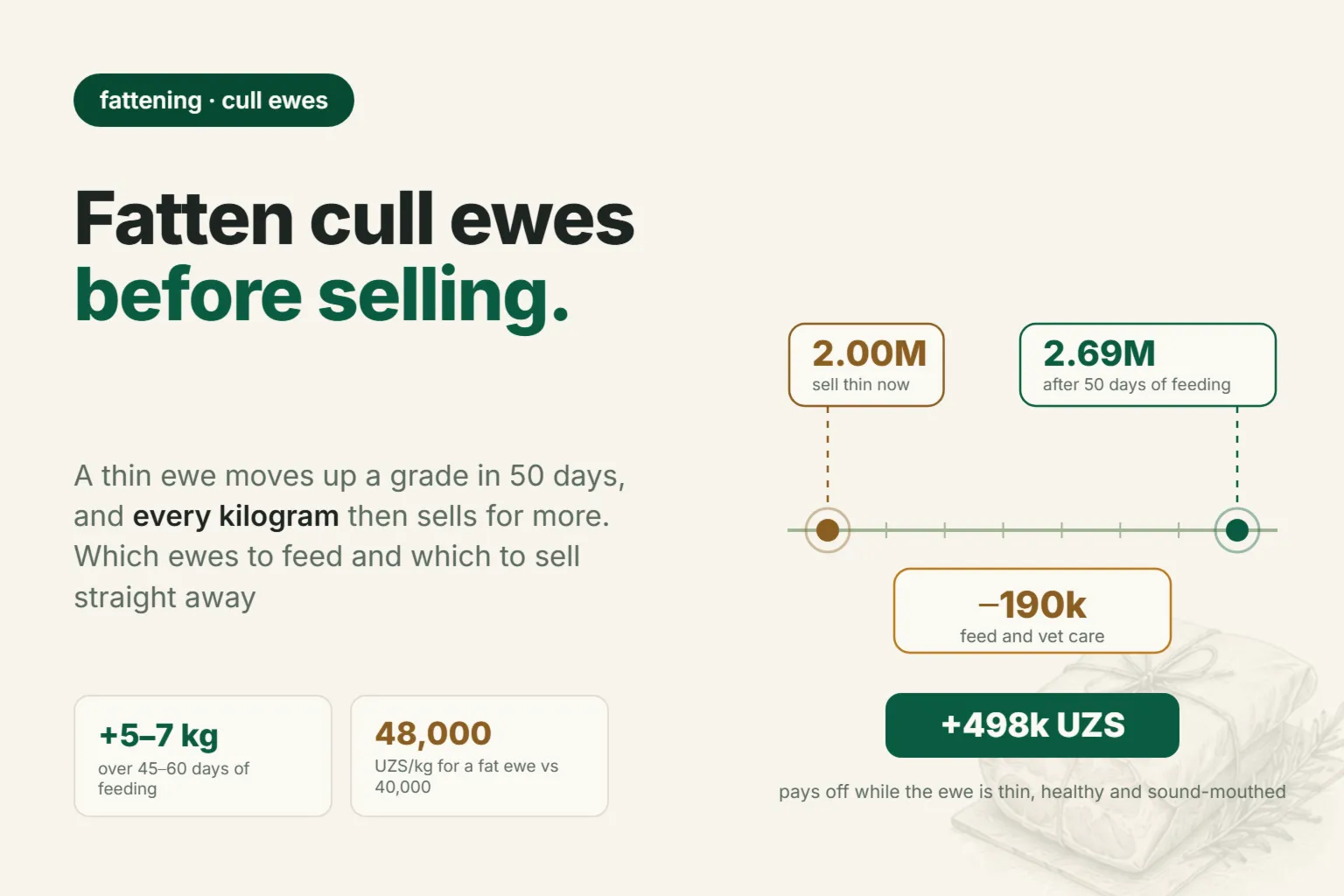
A thin cull ewe on hay and barley gains 5–7 kg in 45–60 days and sells at 48,000 UZS/kg instead of 40,000: about 500,000 UZS (≈ $42) extra per head. Fattening fat, broken-mouthed, or sick ewes doesn't pay off — the math is for September 2026.
Fattening a cull ewe before sale pays off if she's thin but healthy and has sound teeth. Over 45–60 days on hay and barley she gains 5–7 kg and moves from the thin class into the mid class, and buyers pay more per kilogram for a ewe in good condition. For a 50 kg ewe, that's roughly 500,000 UZS (≈ $42) on top, after feed costs. Fattening a fat, broken-mouthed, or chronically sick ewe doesn't pay: sell her right away instead.
The figures below are for September 2026, prices in UZS, converted at 11,840 UZS per dollar (the Central Bank of Uzbekistan's official rate on 19 September 2026).
Which ewes get culled in autumn?
Culling ewes means pulling out of the breeding flock the ewes that won't be kept for the next lambing and selling them for meat. On Uzbek farms this happens after weaning, in August–September, and before mating — so culls don't eat winter feed.
The usual candidates for culling are:
- Old ewes, 7 years and up: teeth worn down or missing, fewer lambs (we covered how to judge age in our piece on sheep age by teeth);
- Barren ewes — empty for a second season in a row;
- Ewes with chronic mastitis: a lump in the udder or a "blind" half;
- Lame ewes with neglected hooves, and chronically sick ewes — they lose weight on any feed.
These four groups are worth different amounts, and the call to fatten or sell right away is made ewe by ewe, not for the whole batch of culls at once.
Why do buyers pay more per kilogram for a ewe in good condition?
A buyer pays for meat, not bone. In a well-fed sheep, dressing percentage — the carcass's share of live weight — reaches 50–55%; in an emaciated one it drops to 35–40% or lower. Bone, hide, and offal weigh about the same either way, so the whole difference sits in meat and fat. This is worked out in detail in our breakdown of ram dressing percentage.
That's why a cull ewe sells within a 40,000–48,000 UZS/kg live-weight corridor: thin ewes at the lower end, ewes in good condition at the higher end. An 8,000 UZS difference on every kilogram matters more than the extra kilograms themselves.
How can you quickly assess a ewe's body condition?
A ewe's body condition is scored by hand on a 1-to-5 scale: you place your palm on the loin behind the last rib and feel for the spine's bony projections.
| Score | What you feel | Decision for a cull ewe |
|---|---|---|
| 1 — emaciated | vertebrae sharp, no flesh between them | see a vet first: look for illness |
| 2 — thin | vertebrae easy to feel, muscle thin | fatten her |
| 3 — average | vertebrae smooth, felt only with pressure | sell now or in 2–3 weeks |
| 4–5 — fat and overweight | vertebrae almost impossible to feel | sell right away |
One body condition point in an adult ewe is roughly 10–13% of live weight (per AHDB and Beef + Lamb New Zealand guidance), which is 5–7 kg for a 50–55 kg ewe. On good feed, a ewe gains one point in 6–8 weeks — that's where the fattening period comes from.
What ration should you feed a cull ewe?
For a 50–55 kg ewe on fattening, a simple ration of local feeds is enough:
| Feed | Per head, per day | Price, UZS/kg | UZS per day |
|---|---|---|---|
| Alfalfa hay | 1.5 kg | 1,300 | 1,950 |
| Crushed barley (average over the period) | 0.35 kg | 3,800 | 1,330 |
| Straw | 0.3 kg | 600 | 180 |
| Total | ≈ 3,500 UZS ($0.30) |
Hay and barley prices are the same ones we used in our annual cost of keeping a sheep calculation for September 2026. Over 50 days, feed costs about 175,000 UZS (≈ $15) per head. Cottonseed meal can replace part of the barley — it's cheaper, but never give more than 200–250 g per head a day: it contains gossypol, and the amount varies a lot from batch to batch.
Three rules that keep fattening from turning into losses:
- Introduce barley gradually. Start at 100 g a day and add 50–100 g every 3–4 days, up to 400–500 g. A sudden switch to grain causes rumen acidosis. More than 500 g a day should be split into two feedings.
- Enterotoxaemia vaccination — on day one. If the ewes aren't vaccinated, give the first dose at the start of fattening and the second 3–4 weeks later; the exact interval is on the vaccine's label. At about 5,000 UZS a dose, the course costs 10,000 UZS per head. Protection only builds up after the second dose, so increase the barley especially carefully before then. Agree the vaccination schedule with a vet.
- Deworm on day one, not the last day. Every dewormer has a withdrawal period before slaughter, stated on the label. Deworming at the start of fattening has time both to add weight and to clear the ewe's system before sale. Choose the drug and dose by weight together with a vet.
It's cheaper to buy the hay and barley for the whole period at once, before winter sets in: by January, hay climbs to 1,800 UZS/kg. For where to buy barley, meal, and hay by the batch, see the feed and compound feed listings.
How much does fattening one ewe earn: the numbers
Take a thin ewe with sound teeth: 50 kg live weight, a body condition score of 2. At a daily gain of 120 g, over 50 days she adds 6 kg, reaching 56 kg and a score of 3.
| Sell now | After 50 days of fattening | |
|---|---|---|
| Live weight | 50 kg | 56 kg |
| Price per kg live weight | 40,000 UZS | 48,000 UZS |
| Revenue | 2.00 million UZS | 2.69 million UZS |
| Feed over 50 days | — | −175,000 UZS |
| Vaccination and deworming (estimate) | — | −15,000 UZS |
| Total | 2.00 million UZS | 2.50 million UZS |
Fattening earned +498,000 UZS (≈ $42) per head. Across ten cull ewes, that's about 5 million UZS (≈ $420) in a month and a half. The deworming cost here is an estimate — plug in your own drug's price; it barely moves the final number.
The key thing in this math is moving to a different price class. The six extra kilograms on their own bring only 264,000 UZS at the corridor's average price of 44,000 UZS/kg. The rest is the premium added to the price of all 56 kg for being in better condition.
When is it not worth fattening a cull ewe?
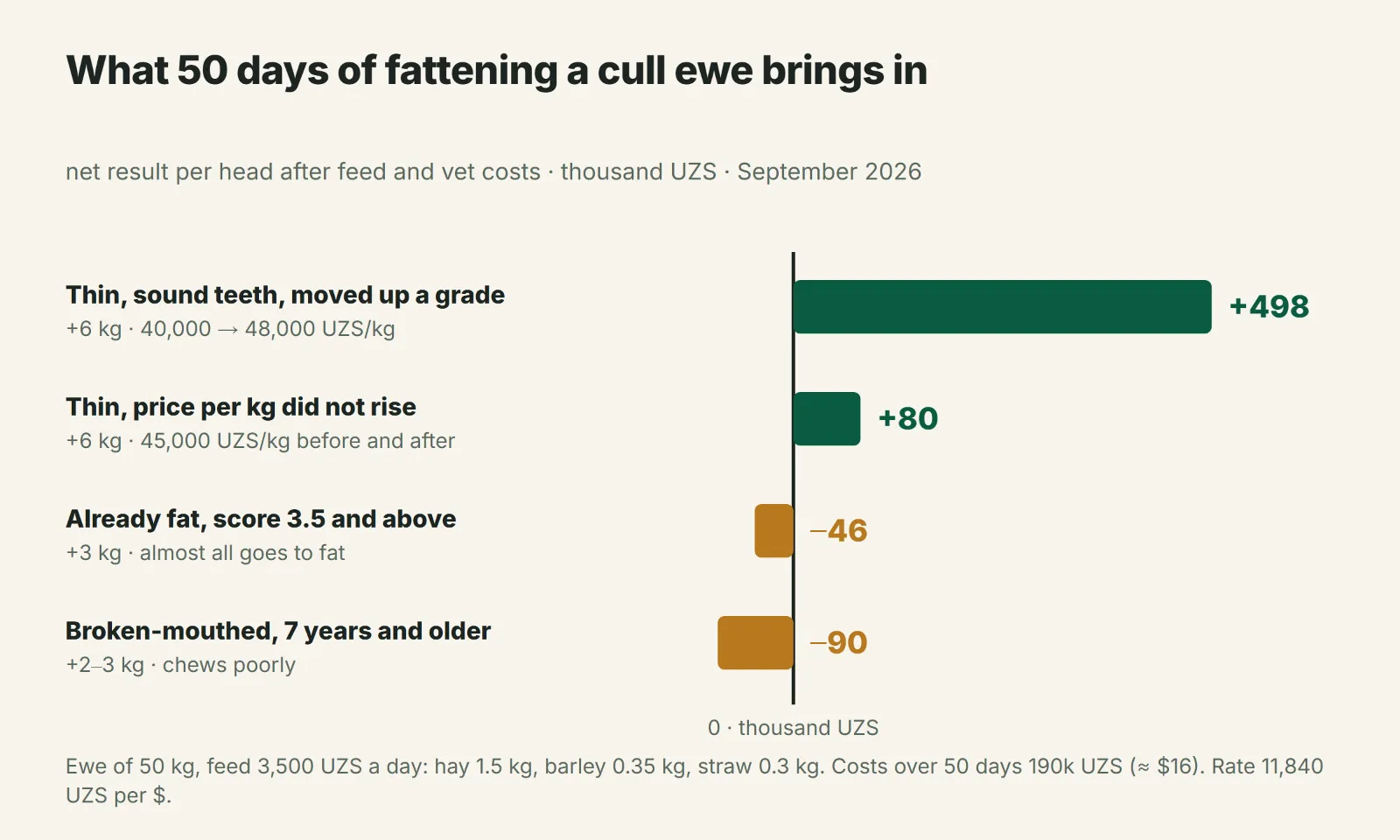
The same math on different ewes gives a different sign:
| Ewe | What happens during fattening | Result per head over 50 days |
|---|---|---|
| Thin, sound teeth, healthy | +6 kg, class moves up: 40,000 → 48,000 UZS/kg | +498,000 UZS |
| Thin, but no premium for condition (45,000 UZS/kg both before and after) | +6 kg, same price | +80,000 UZS |
| Broken-mouthed, 7 years or older | +2–3 kg: chews hay and grain poorly, class doesn't move up | −90,000 UZS |
| Already in good condition, 3.5 points and above | +3 kg, almost all of it turns to fat | −46,000 UZS |
That gives a simple rule for culls:
- Sell right away: fat, broken-mouthed, lame, and chronically sick ewes. Every extra day, they eat feed that never comes back.
- Fatten only thin ewes with sound teeth and no chronic illness. If a weigh-in on day 20 shows a gain of less than 1.5–2 kg, sell the ewe without waiting out the full term.
- Don't keep her longer than 60 days. Once a ewe reaches a score of 3, from then on she's mostly storing fat, and that fat costs more in feed than buyers pay for it.
It's easier to see each ewe's gain on a scale than by eye. Note the weight on day one and again after 20 days: the difference in kilograms divided by the number of days is the average daily gain. The sheep weighing and daily gain records tool works this out automatically for every tag. For ten ewes, a notebook is fine too, as long as you weigh them all on the same day.
When and to whom should you sell fattened ewes?
The profitable window runs from mid-October to the end of November. Ewes get culled in September, and 45–60 days of fattening wrap up before the barn period starts, while hay is still at its autumn price. Holding culls through winter means feeding them at 1,800 UZS/kg hay and handing the weight gain straight back to winter weight loss.
Fattened ewes are sold three ways: to a buyer at the farm gate as a batch, at the mol bozor — the weekend livestock market — or through a listing. A buyer pays less but takes them all in one go. If you're willing to wait a week or two, post the ewes to the sheep for sale in Uzbekistan listings. This is a section of QoyHunter, a CRM for sheep record-keeping, and the bazar.qoyhunter.com marketplace, and listing there is free. State the age and weight honestly: ewes for meat are bought by weight and condition, not breed.
FAQ
How many days should you fatten a cull ewe before selling her?
Cull ewes are fattened for 45–60 days. In that time, a thin ewe gains one body condition point, which is 5–7 kg of live weight for a 50–55 kg ewe. Keeping her longer than 60 days doesn't pay: once she reaches the mid class, she starts storing fat, and the feed no longer earns back its cost.
What should you feed an old ewe destined for meat?
A 50–55 kg ewe on fattening gets about 1.5 kg of alfalfa hay, 0.3 kg of straw, and crushed barley a day: starting at 100 g and working up to 400–500 g over 2–3 weeks. At September 2026 prices, this ration costs about 3,500 UZS (≈ $0.30) per head a day. Broken-mouthed ewes should get their barley only crushed.
Is it worth fattening old ewes, or better to sell them right away?
It only pays for thin ewes with sound teeth and no chronic illness: by the September 2026 math, fattening a 50 kg ewe for 50 days brings in about 500,000 UZS (≈ $42) extra. Broken-mouthed, fat, lame, and chronically sick ewes are better sold right away — fattening them runs at a loss.
How much does a cull ewe cost in Uzbekistan?
As of September 2026, a cull adult ewe sells for 40,000–48,000 UZS per kilogram of live weight: thin ewes at the lower end, ewes in good condition at the higher end. A 50 kg ewe in thin condition is worth about 2 million UZS (≈ $169); the same ewe after fattening, at 56 kg, is worth about 2.7 million UZS (≈ $227).
Can you deworm a sheep right before selling her?
You can, but at the start of fattening, not right before the sale. Every dewormer has a withdrawal period before slaughter, stated on the label, and you can't sell a ewe for meat before that period is up. If you treat the ewes on day one of fattening, the withdrawal period will be long over by the time you sell.
Manage your flock in QoyHunterCRM for sheep farmers: livestock, health, weighing, finance and analytics — in the app and a Telegram bot.All features →