How to Tag Sheep in 2026: Mandatory Identification, Ear Tags, and the QR Code Animal Passport
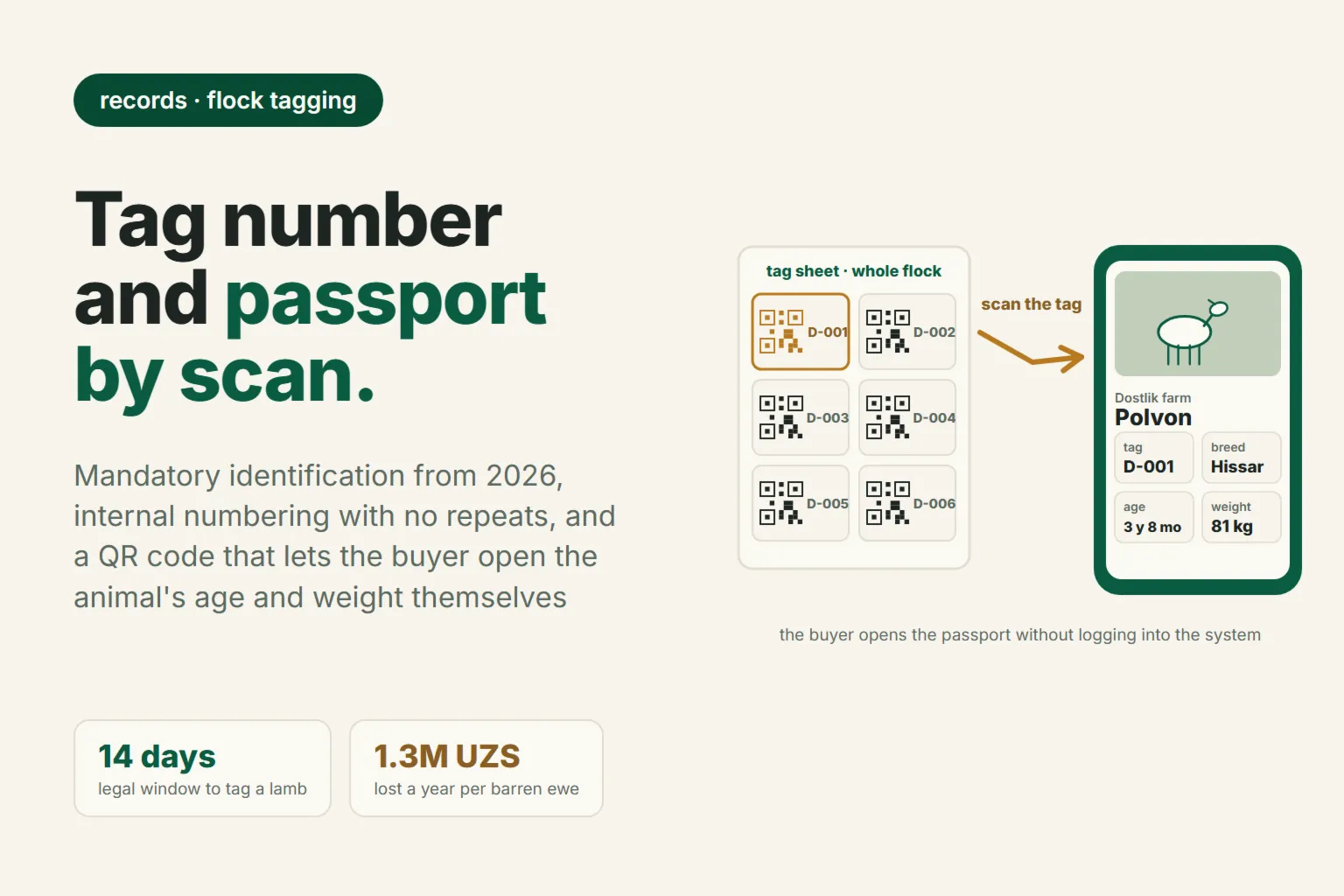
Since August 7, 2026, a lamb must be identified within its first 14 days. How to tag sheep besides the state tag, how to build internal numbering without repeats, and what a QR code on the tag delivers: one scan opens a buyer straight to the ram's passport with its breed, age and weight.
Every sheep in the flock needs an individual ear tag with a unique number, and since August 7, 2026, that's no longer a matter of convenience: Uzbekistan's law "On the Identification, Registration and Traceability of Animals" (Law ZRU-1079) requires a lamb to be identified within 14 days of birth. In practice, farms tag even earlier — in the first 1–3 days, while it's still obvious which ewe a lamb belongs to. Everything else — breed, date of birth, dam, weight gains, vaccinations — lives in records tied to that number: fleece paint and pet names work for twenty head and stop working at a hundred, and ear notches can only be read by whoever knows the code.
Below: what the law requires, how to tag sheep besides the state tag, how to build an internal numbering system without repeats, and what a QR code on the tag changes. The figures in this article come from our breakdown of ewe barrenness and are calculated at July 2026 prices; converted to dollars at the Central Bank of Uzbekistan rate on September 10, 2026 — 11,798 UZS per dollar.
What the animal identification law requires from 2026
Law ZRU-1079 was signed on August 6, 2025 and took effect on August 7, 2026. Under it, cattle, sheep, goats and camels are subject to mandatory identification and registration: each animal gets a unique identification number, the mark is an ear tag (or a microchip), and the data goes into a single electronic database kept by the Center for Identification, Registration and Traceability of Animals under the Committee for Veterinary and Livestock Development.
The key deadlines for a sheep farmer: identify the lamb no later than 14 days after birth, register it no later than a month after that. The tag stays on the animal's ear for life. The law bans keeping or breeding unidentified and unregistered animals; the procedure and funding are set by the Cabinet of Ministers.
The state number and your internal number aren't competitors. The state tag is for counting the animal nationwide and for its movement: transport, sales, veterinary paperwork. A short internal number is for working with the animal every day: calling it out in the pen, writing it in the weighing log, finding it on a list. Most farms keep both — like a passport and a work ID badge for a person.
Why tag sheep if the owner already knows them by sight
Up to about thirty head, an owner usually remembers every sheep. At a hundred ewes of the same color, memory stops being a record-keeping system: "the reddish one with the tan patch" turns out to be four different ewes, and a year later nobody can say which one had twins and which has gone barren for the third season running.
Without an individual number, a flock loses four things, and all four cost money.
You can't cull a barren ewe. An empty ewe eats the same hay, goes through the same treatments, and looks no different from a productive one. According to our breakdown of ewe barrenness and the cost of downtime, the gap between a barren ewe and one that lambs is about 1.3 million UZS (≈ $110) a year per head, and a flock of a hundred ewes at 20% barrenness versus 8% loses about 15.5 million UZS (≈ $1,310) a year. The only way to find these ewes is by name — by number and lambing records.
Inbreeding creeps in. When you keep your own lamb for breeding and nobody records its parentage, within two seasons a young ram is covering his own daughters. Zootechnical research shows close inbreeding causes inbreeding depression: fertility drops, along with young stock live weight and lamb survival. Pedigree is tracked from the number — without it, there's no way to tell whose offspring an animal is.
Treatment loses its address. "One of the white ones was limping" isn't a record. Two weeks later, nobody can say whether the right ewe was treated, whether the course was repeated, or what it was even treated for.
Sales run on your word. A buyer who drove in from another district for rams doesn't know your memory. They won't verify the age and weight you state out loud — they'll just price in the risk and negotiate the price down.
How to tag sheep: marking methods and where each one fails
| Marking method | How long it lasts | What you can read | Where it fails |
|---|---|---|---|
| Paint or marker on the fleece | A regular marker — days; livestock marking paint — 3–7 weeks, until shearing | A group mark, not a number | Carries no number at all; goes with shearing, ordinary paint washes off in the rain |
| Ear notches by code | Lifetime | A number, if you know the code | Only one person can read it; a notching mistake can't be corrected afterward |
| Ear tattoo | Lifetime | A number up close, in hand | Barely visible on a dark ear; the animal has to be caught and restrained |
| Plastic ear tag with a number | Years, usually the animal's whole life | A number from a couple of meters away, if the tag is large | Gets torn out on feeders and fencing — 3–8% a year in field measurements |
| Electronic ear tag (RFID) | Same loss rate as plastic — 3–8% a year | A number via scanner, no manual-reading errors | Needs a scanner; costlier than plastic |
| Rumen bolus (RFID) | Essentially lifelong, retention above 98% | A number via scanner | Given to an older animal, not a newborn; needs a scanner |
The working standard for a farm in Uzbekistan is the state ear tag plus your own records against that number. Special marking paint stays useful as a temporary mark for a few weeks: separating out a group for fattening, flagging ewes under observation. Electronic tags pay off where headcount is high and animals pass through your hands in a steady stream.
A second layer of protection is cheap: duplicate the number in paint on the animal's side on tagging day. If the tag tears out in the first week, the animal won't drop out of your list.
What age to tag a lamb
The statutory deadline is 14 days from birth. Farm practice beats it with room to spare: the tag goes in during the first 1–3 days, while the lamb is still with its dam in the lambing pen.
There's one reason for tagging early, and it has nothing to do with the law. While a lamb is still with its dam, it's obvious whose it is. A month later, in the general pen, the lamb-to-dam link can no longer be reconstructed, and without it there's no pedigree and no way to rate ewes by their offspring. A delayed tagging is a lost season of data. Farms only revisit the animal at weaning, 3–4 months in, to replace a lost tag and check that the number still reads.
Technically, the puncture goes at the border between the first and middle third of the ear, midway between the two longitudinal ear veins and between the cartilage ridges — not at the edge, not into the thick base, and not through a major vessel. The applicator and the puncture site get treated with antiseptic: tagging is a wound, and tetanus has entered flocks through exactly this kind of wound. Right after applying it, spread the tag halves all the way open and check that they turn freely: a tag clamped too tight compresses the tissue and causes ear necrosis. Check the ear again a week later — mild swelling clears up on its own, but pus, a smell, or swelling means it's time to see a vet.
What number to put on a sheep's tag
The state number is assigned at registration, and you don't choose it. Internal numbering, though, is something a farm builds itself, and five rules apply.
- One number for the animal's whole life, never reused. A number freed up by a sale or death doesn't go to a new lamb: a year later your records would show two different animals under one number, and the whole history gets tangled.
- Keep the number short — three to four characters. A long number can't be read from a distance and won't fit on a tag in large print.
- Give the birth year its own character. A letter or digit for the year in the number tells you the animal's age without checking any records — exactly the kind of thing you need to know fast, out in the field.
- Don't put a name, breed, or weight on the tag. You'll run out of space, and the data will change anyway. The tag carries only the identifier.
- Duplicate the tag on the other ear for breeding animals. A herd sire and your best ewes shouldn't lose their number along with a single tag.
An example of a working format: D-001, where the letter marks the year the animal was registered and the three digits are its serial number.
The number's on the ear, but the data lives somewhere else
This is where the real problem starts, and it isn't the tag. A number on the ear is only an address. The question is what opens up at that address, and how fast.
A notebook. Records get kept as long as the owner keeps them. But there's one notebook, and the animals are in three places: some out on pasture with the shepherd, some in the shed, two ewes at a relative's place. Entries get written from memory in the evening, and some events never make it to paper at all — that's exactly how a headcount ends up a few animals short on recount (see reconciling flock turnover by ear tag). A notebook also gets wet, goes missing, and can't be copied.
Excel. Now you can search by number, and totals calculate themselves. But there's no laptop in the pen, and a 300-row spreadsheet doesn't scroll well on a phone. So entries still get made in the evening, still from memory. And most importantly, there's nothing in a spreadsheet you can show a buyer: a file on your computer isn't proof to them.
For a flock of twenty, run by one person, a notebook is genuinely enough. The conversation gets real at around fifty head, and in two situations: when more than just the owner works with the animals, and when stock gets sold to strangers.
What a QR code on the tag changes
A QR code is a square barcode that a phone camera reads on its own, no special scanner needed. On a tag it does the same job as the number, but it opens the data immediately instead of sending you back to a notebook.
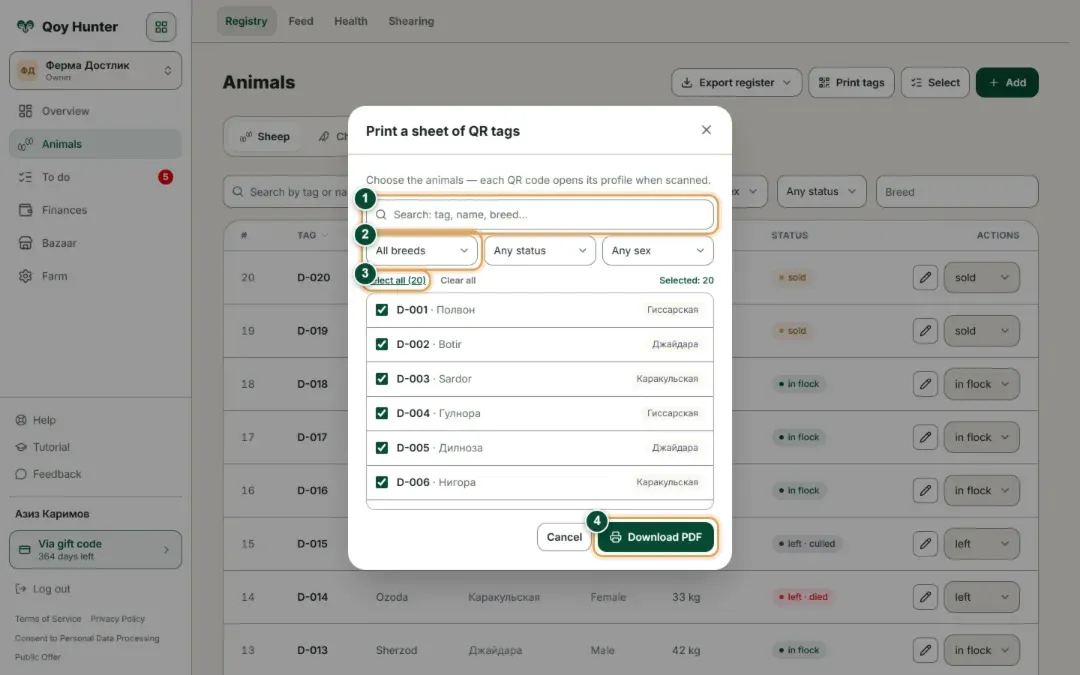
QoyHunter is a CRM for sheep record-keeping and a marketplace at bazar.qoyhunter.com. You print a sheet of QR tags straight from the "Animals" section: in the print dialog, find the animals you need by tag number, name or breed, filter the flock by breed, status and sex, check individual sheep or hit "Select all" — then download a print-ready PDF sheet with its own QR code for every animal.
From there, the code behaves differently depending on who scans it.
Your worker scans it — the animal's card opens in the record-keeping system: weight and growth measurements with charts, veterinary treatments, pedigree, and this ewe's full record.
A buyer scans it — a public passport page opens, no login or password: a large photo of the animal, its name and the farm's name, and below that its tag, breed, sex, age and weight. All from one scan, no calls or explaining needed.
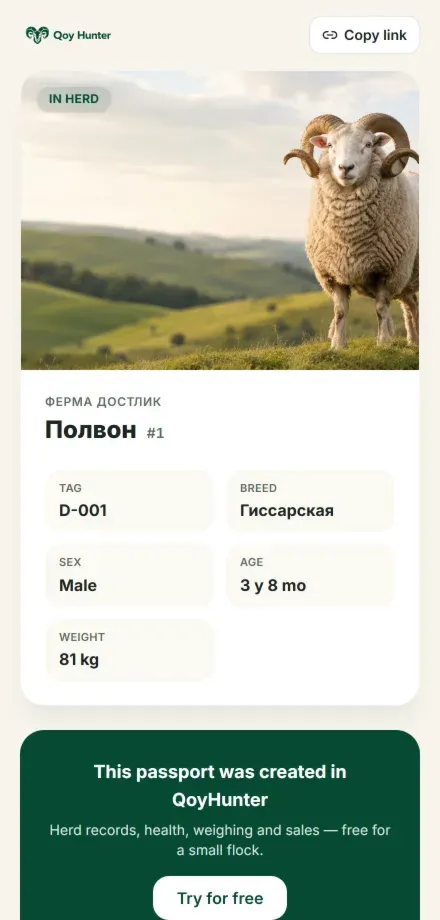
For a seller, that changes the whole conversation about price. Age and weight stop being the owner's word and become a page the buyer opened themselves, on their own phone. You can copy the passport link straight from the page and send it in a messenger, or just let the buyer scan the tag when they come to look at the animals. The full mechanics are laid out step by step on a separate page: printing QR tags and the animal passport.
Buyers use those same data points — breed, age, weight, sex — when they browse rams and sheep for sale in Uzbekistan. A farm that already has these figures recorded against every number puts a listing together in a minute, instead of trying to recall a ram's weight from memory.
What to do this week
If your flock isn't numbered, start with two things at once: find out from your district veterinary service how to register animals for the state count, and settle on a format for internal numbers — a year marker and the "never reuse a number" rule. Then tag the whole flock in one pass, writing every number straight into a master list, and starting with the next lambing, tag each lamb within its first day — along with its dam's number. After one season you'll have something neither memory nor a notebook can give you: the ability to name, one by one, the ewes that aren't earning back their hay.
FAQ
At what flock size should you start tagging sheep?
You tag every animal, from birth: since August 7, 2026, identifying a lamb within its first 14 days is a legal requirement regardless of flock size. The real question of "at what size" isn't about the tag — it's about your system of records by number. Up to about thirty head, an owner can still hold the animals in memory; past fifty, memory starts to slip; and past a hundred, a flock with no records becomes unmanageable — you can't track lambings, cull barren ewes, or prove an animal's age to a buyer.
A lamb tore out its tag — what now?
Fit a new one with the same number, not the next number available. The number is tied to the animal for life; otherwise its history of lambings, treatments, and weigh-ins splits into two. For a state tag, check the replacement procedure with your district veterinary service. And to even work out whose ewe it is after a tag is lost, you need that second mark: a duplicate on the other ear for breeding animals, or paint on the flank for the general flock.
Can you print QR tags on plain paper?
The sheet downloads as a PDF and prints on any printer, but plain paper doesn't last long in a sheep shed. It's more practical to print on heavy paper or self-adhesive stock and protect it from moisture — laminate it or slot it into a plastic tag holder. The code needs to stay clean and unfolded: the camera reads it by contrast.
Do you need a special scanner to read a QR tag?
Almost never. The camera on virtually any modern smartphone reads a QR code by itself: iPhone from iOS 11, Android from Android 9. A buyer doesn't need to install anything — they just point their phone at the tag and land on the animal's passport; only on really old handsets would they need a free scanner app. A dedicated scanner is only for electronic RFID tags — that's a different technology.
What does a stranger see when they scan the QR on a tag?
Only the animal's public passport: its photo, name, farm name, tag number, breed, sex, age, weight, height and status — still in the flock or sold. Finances, veterinary treatments and other records are visible only to that farm's own team; a stranger, even one logged into the system under their own account, sees the same public passport.
Manage your flock in QoyHunterCRM for sheep farmers: livestock, health, weighing, finance and analytics — in the app and a Telegram bot.All features →