
Sheep body condition score: how to check by hand and which ewes to feed extra in winter
Sheep body condition score 1 to 5: how to feel the loin, the score ewes need at mating and lambing, barley cost per point and winter 2026 savings.
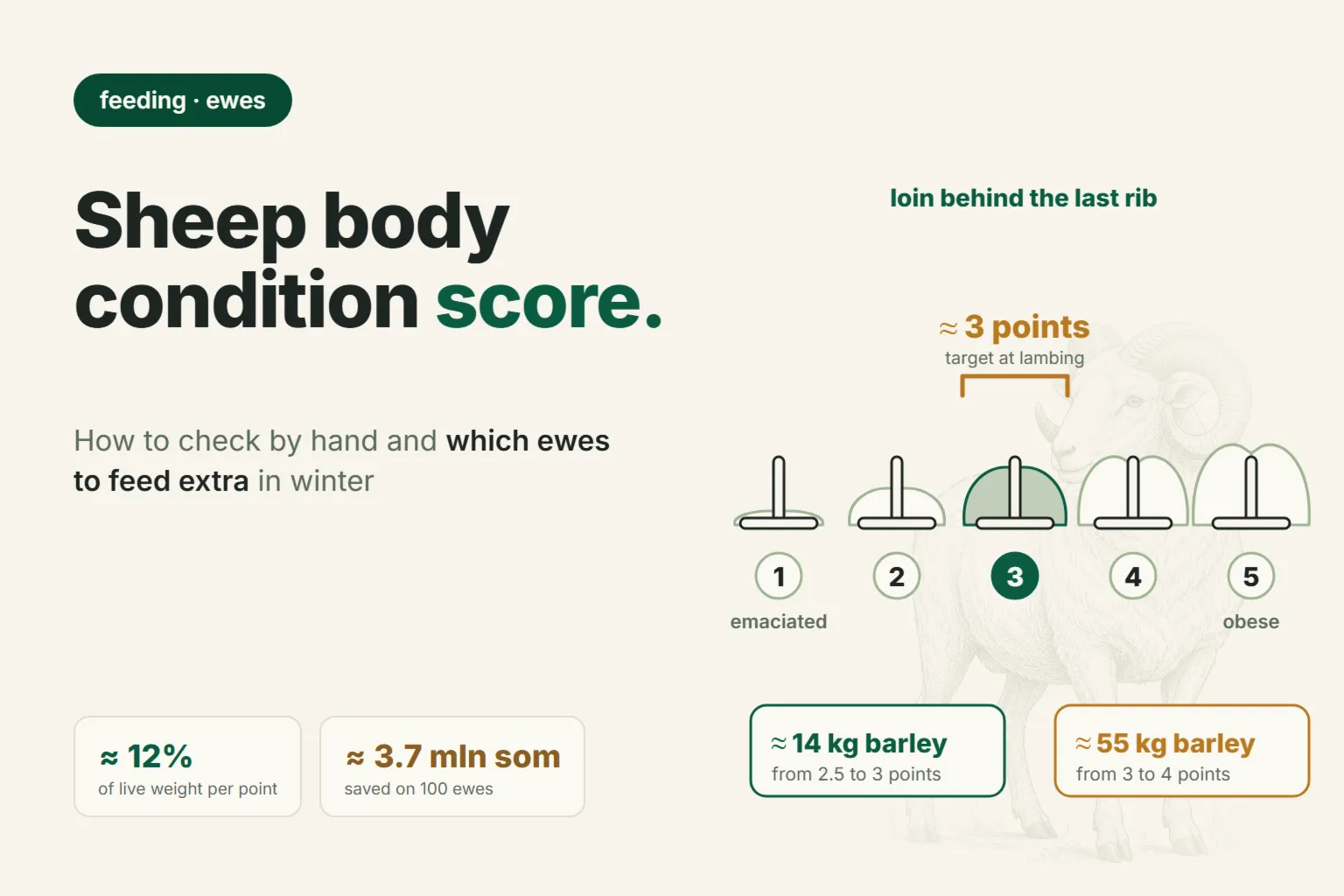
You score a sheep's body condition by hand, not by eye: put your palm on the loin just behind the last rib and, going by how the backbone feels, give a score from 1 (emaciated) to 5 (obese). A pregnant ewe carrying a single lamb needs about 3 points at lambing, and one carrying twins needs 3–3.5. One point on an adult sheep is roughly 12% of live weight, which is about 6 kg on a 50 kg ewe.
Below we cover how to feel a sheep, what each score means, how many points a ewe needs at each time of year, what it costs to raise condition, and how splitting the flock in November–December lets you feed grain only to the ewes that actually need it. The calculations use barley at 3,500 som per kg (≈ $0.29), based on olx.uz listings from October to early November 2026, and the Central Bank of Uzbekistan rate for 7 November 2026, 11,987.16 som per dollar.
What is a sheep's body condition score?
Body condition score is a rating of a sheep's muscle and fat reserves on a five-point scale in half-point steps. You need it because weight doesn't show condition: a big, thin ewe weighs the same as a small, fat one, and a pregnant ewe gets heavier from the fetus even while she herself is losing condition.
You can hardly judge an adult sheep's condition by eye: wool and a full rumen get in the way, and in fat-tailed breeds so does the tail. The Scottish advisory service SRUC (Farm Advisory Service) says outright that it is extremely hard to judge an adult sheep's body reserves by eye. That's why condition is scored by hand.
How do you check a sheep's body condition by hand?
Put the sheep in a crush or a narrow race: she has to stand calmly, because you can't feel a tensed back. Then three steps, following the SRUC method:
- Find the spot. Put your palm on the loin, the back just behind the last long rib.
- Feel the spinous processes. This is the ridge of vertebrae down the middle of the back. Run your fingers along it: is it sharp, smooth, or impossible to find?
- Feel the transverse processes and the muscle. The transverse processes are the "shelves" of the vertebrae sticking out sideways from the ridge. Slide your fingertips under their edge, then press between the ridge and the shelves and judge how full the muscle is and how much fat covers it.
Use the same pressure on every sheep, or you can't compare scores. It's best if the same person scores the whole flock.
What does each body condition score mean?
| Score | Vertebral ridge | Shelves and muscle | What to do |
|---|---|---|---|
| 1 — emaciated | sharp, sticks out | fingers slide easily under the edge, thin muscle, no fat | find the cause with a vet: teeth, worms, disease |
| 2 — thin | sticks out but smooth | medium muscle, little fat | supplementary feed |
| 3 — average | smooth, bone felt only with pressure | full muscle, moderate fat | working condition for a ewe |
| 4 — fat | felt only as a line | shelf ends can't be found, thick fat over the muscle | no grain needed |
| 5 — obese | can't be felt even with pressure | thick layer of fat, a dip over the spine | cut out grain |
The descriptions are compiled from SRUC and Oregon State University leaflets. In an ordinary commercial flock, a ewe at 5 points is very rare, according to SRUC.
How many kilograms are in one body condition point?
According to SRUC, one point is about 12% of the live weight of an adult sheep. Oregon State University gives about 13%, and the British industry body EBLEX about 10%.
| Ewe weight | One point, kg (12%) |
|---|---|
| 40 kg | ≈ 4.8 kg |
| 50 kg | ≈ 6 kg |
| 60 kg | ≈ 7.2 kg |
| 70 kg | ≈ 8.4 kg |
That shows why scales alone mislead you: if a 60 kg ewe loses half a point in two months, that's 3.6 kg of her own body, while the growing fetus and its fluids add several kilograms over the same time and hide the loss on the scales.
How many condition points does a ewe need at each stage?
The targets below are compiled from Oregon State University and the Australian Lifetime Wool program, for ewes that lamb in February–March:
| Stage | Target, points | What to do if she's off target |
|---|---|---|
| Weaning (May–June) | at least 2 | move thin ewes onto better pasture |
| Mating (August–October) | 3–3.5 | start feeding thin ewes 6–8 weeks before mating |
| Mid-pregnancy (November–December) | 2.5–3.5 | bring thin ewes up now, while there's still time |
| Lambing, ewe with a single lamb | about 3 | no sudden changes in the last 6 weeks |
| Lambing, ewe with twins | 3–3.5 | barley from 6 weeks before lambing to hold her score |
A breeding ram, as SRUC recommends, should go into mating at 3.5–4 points: during the mating season he loses up to 15% of his weight.
The main rule: raise condition before mating and in mid-pregnancy, not in the last weeks before lambing. SRUC advises avoiding sudden changes in condition during the last 45–50 days of pregnancy: about 70% of fetal growth happens in the last 6 weeks, and the ewe has less and less room in her belly for feed. How to feed ewes in those weeks is covered in the article on ketosis in pregnant ewes.
Why does body condition matter so much at lambing?
Three things depend on a ewe's condition, and all three are money:
- Lamb weight and survival. According to Lifetime Wool, losing one point during pregnancy cuts a lamb's birth weight by 0.4–0.5 kg, and lamb survival drops sharply when birth weight is under 4 kg. About 70% of deaths between birth and weaning happen in the first 48 hours. Thin ewes, according to SRUC, have weaker colostrum and less milk.
- The ewe's health. The MSD Veterinary Manual lists ewes at 2 points and below and at 4 and above as at risk of ketosis (pregnancy toxaemia), especially those carrying twins. SRUC adds that thin ewes lamb with difficulty because they are weak, fat ones because their lambs are big, and vaginal prolapse is more common in flocks with many fat ewes.
- How many lambs you get next year. According to Lifetime Wool, each extra point of condition at mating gives on average about 20 more lambs per 100 ewes. The figures come from Merinos, and in fat-tailed breeds the response may differ. There's more in our article on how to prepare a flock for mating.
How much feed does it take to raise condition by a point?
Beef + Lamb New Zealand, using Massey University data, worked out how much metabolisable energy above maintenance it takes to raise a sheep's condition. Metabolisable energy is the part of a feed's energy that the sheep actually spends on living, growing and making milk. Barley has about 10.8 MJ per kilogram.
| Condition gain | Energy above maintenance | In barley | Cost of the barley |
|---|---|---|---|
| from 2.5 to 3 points | 149 MJ | ≈ 14 kg | ≈ 48,000 som (≈ $4) |
| from 2 to 3 points | 220 MJ | ≈ 20 kg | ≈ 71,000 som (≈ $6) |
| from 3.5 to 4 points | 351 MJ | ≈ 33 kg | ≈ 114,000 som (≈ $9.5) |
| from 3 to 4 points | 593 MJ | ≈ 55 kg | ≈ 192,000 som (≈ $16) |
The takeaway: bringing a thin ewe from 2 to 3 points costs only a little over a third of what it takes to push an average one from 3 to 4. The same authors write that above 3.5 points the gain in productivity is unlikely to pay for the feed. On good feed a ewe can move one condition point in about 8 weeks (SRUC).
How do you split a flock by condition, and how much does it save?
In November–December, in mid-pregnancy, feel all the ewes and split the flock into three groups:
- 2.5 points and below — a separate pen with the best hay plus barley;
- 3–3.5 points — the usual ration;
- 4 points and above — no grain, just hay and straw.
Take a flock of 100 ewes where scoring shows 30 are thin (2.5 points). To bring them up to 3 points by lambing, you need about 14–15 kg of barley per head, that is, an extra 0.25 kg of barley a day for 60 days. Give that extra to the whole flock "just in case" and you use 1,500 kg of barley; give it only to the thin ones and it's 450 kg.
| Option | Barley over 60 days | Cost |
|---|---|---|
| Extra for the whole flock, 100 ewes | 1,500 kg | 5.25 mln som (≈ $438) |
| Extra for the thin ones only, 30 ewes | 450 kg | 1.58 mln som (≈ $131) |
| Savings | 1,050 kg | ≈ 3.7 mln som (≈ $307) |
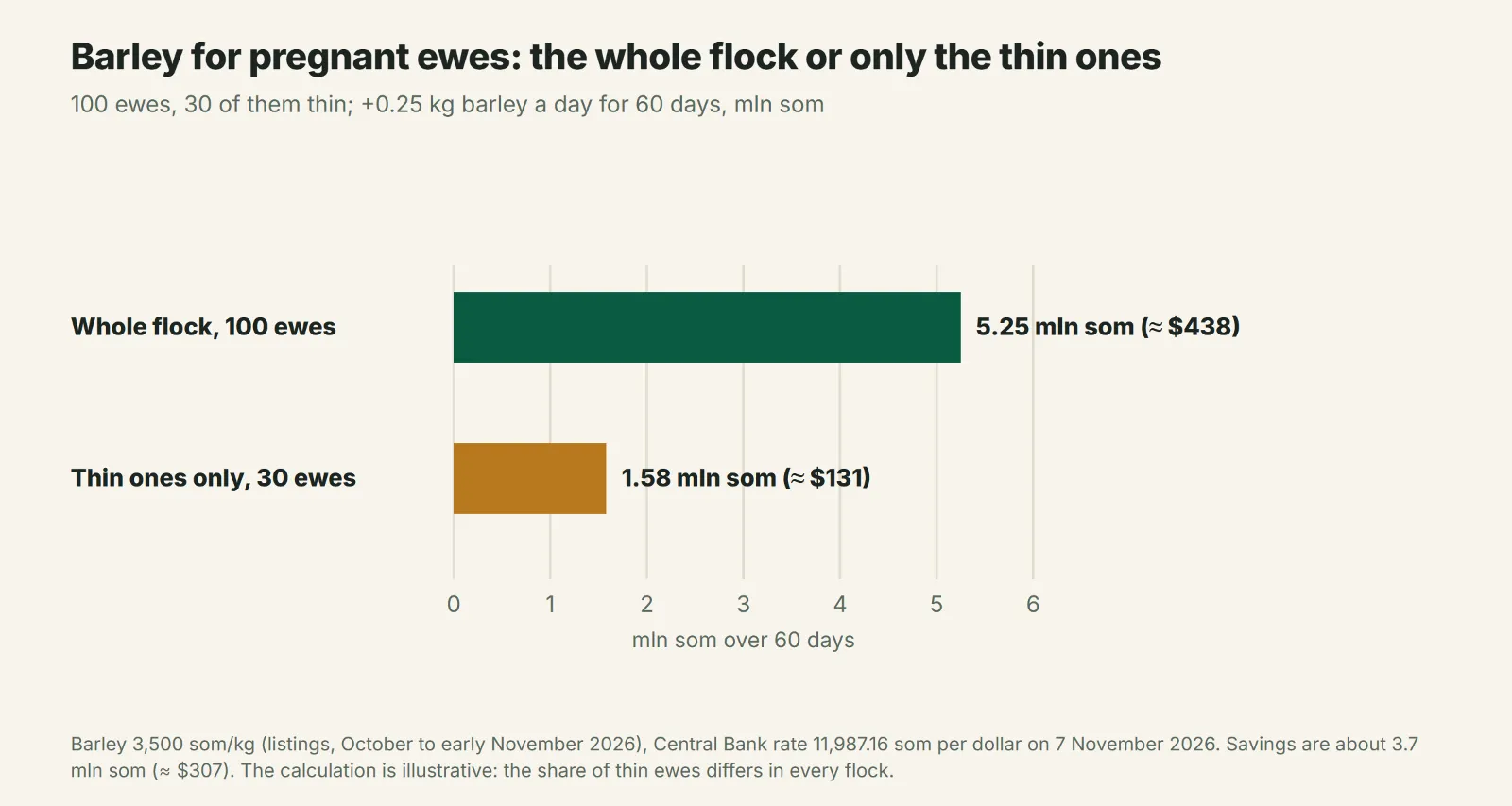
The calculation is illustrative: the share of thin ewes and the size of the extra ration differ in every flock. The logic is the same everywhere: grain pays off where a ewe is falling short, while a fat ewe doesn't need it and is harmed by it. Splitting also means the thin ewes get their full share: at a shared trough the strong ewes eat the grain first, and the thin ones get the least. It pays to buy winter grain before the frosts and compare sellers in advance, for example in the listings of barley and sheep feed for sale.
How do you score fat-tailed sheep?
In Hissar, Edilbay and other fat-tailed breeds, most of the fat goes into the tail rather than onto the loin. So a fat-tailed ewe's loin can feel thinner than her real reserves. We found no studies of body condition scoring on Hissar and Edilbay sheep specifically. For fat-tailed breeds in Africa and the Middle East, researchers use the tail as an extra measure: for example, a study of Tunisian Barbarine fat-tailed ewes (Archives Animal Breeding, 2020) scored the loin and the tail, each on its own scale.
A practical rule for fat-tailed flocks in Uzbekistan: score the loin as you would in any breed, and record the tail separately — full, medium or empty. The warning sign is a thin loin and an empty, soft tail: that ewe has already used up her reserve. Compare ewes within your own flock and the same breed.
How often should you check condition, and how many sheep should you feel?
SRUC names four key times: weaning (or no later than 8 weeks before mating), mating, mid-pregnancy, and the last weeks before lambing. For a general picture, it's enough to feel about 20% of the ewes from different corners of the flock, but no fewer than two or three dozen head. Before sorting into groups, feel them all: SRUC advises scoring every ewe, not the flock average, because thin ewes get hidden in the average score.
Write the result down against the ear tag number: two months later you won't remember who scored two and who scored three, or be able to tell whether the extra feed helped. For a small flock a notebook is enough. It's also worth weighing a control group of ewes: weight and score together show whether the ewe herself is losing condition or only the fetus is growing. You can keep each ewe's weight history in the sheep weighing and weight gain software, a section of QoyHunter, a CRM for sheep records and the bazar.qoyhunter.com marketplace: every weighing goes onto the animal's chart, and you can see who is falling behind.
FAQ
How do you judge a sheep's condition without scales?
By hand: palm on the loin behind the last rib, feel the ridge of the vertebrae and the transverse processes. A sharp, protruding ridge is 1–2 points, a smooth one felt only with pressure is 3 points, and one felt only as a line or not at all under the fat is 4–5 points. The sheep has to stand calmly.
What body condition does a ewe need before lambing?
A ewe with a single lamb needs about 3 points out of 5, and one with twins 3–3.5. Ewes at 2 points and below have light lambs and get ketosis more often, and fat ewes at 4–5 points also get ketosis more often and have a harder lambing. Raise condition in mid-pregnancy, in November–December for February–March lambing, not in the last 6 weeks.
How many kilograms are in one body condition point?
According to the Scottish service SRUC, one point is about 12% of an adult sheep's live weight: roughly 6 kg on a 50 kg ewe and 7.2 kg on a 60 kg ewe. On good feed a ewe can move one condition point in about 8 weeks.
How do you score a fat-tailed sheep?
Feel the loin as you would in any breed and score the tail separately: full, medium or empty. In Hissar and Edilbay breeds fat goes into the tail, so the loin can feel thinner than the sheep's real reserve. The warning sign is a thin loin together with an empty, soft tail.
How much does it cost to feed only the thin ewes instead of the whole flock?
In a flock of 100 ewes with 30 thin ones, an extra 0.25 kg of barley a day for 60 days costs 1.58 mln som (≈ $131) for the thin ones only, versus 5.25 mln som (≈ $438) for the whole flock, with barley at 3,500 som per kilogram (October to early November 2026). The savings are about 3.7 mln som (≈ $307).
Manage your flock in QoyHunterCRM for sheep farmers: livestock, health, weighing, finance and analytics — in the app and a Telegram bot.All features →