115 Lambs Instead of 95: How to Prepare Your Flock for Mating
Lambing rates aren't decided at lambing time — they're decided six weeks before mating. We break down ewe body condition, pre-mating flushing, ram preparation, and the ram effect, with the full math for 100 ewes at August 2026 prices.
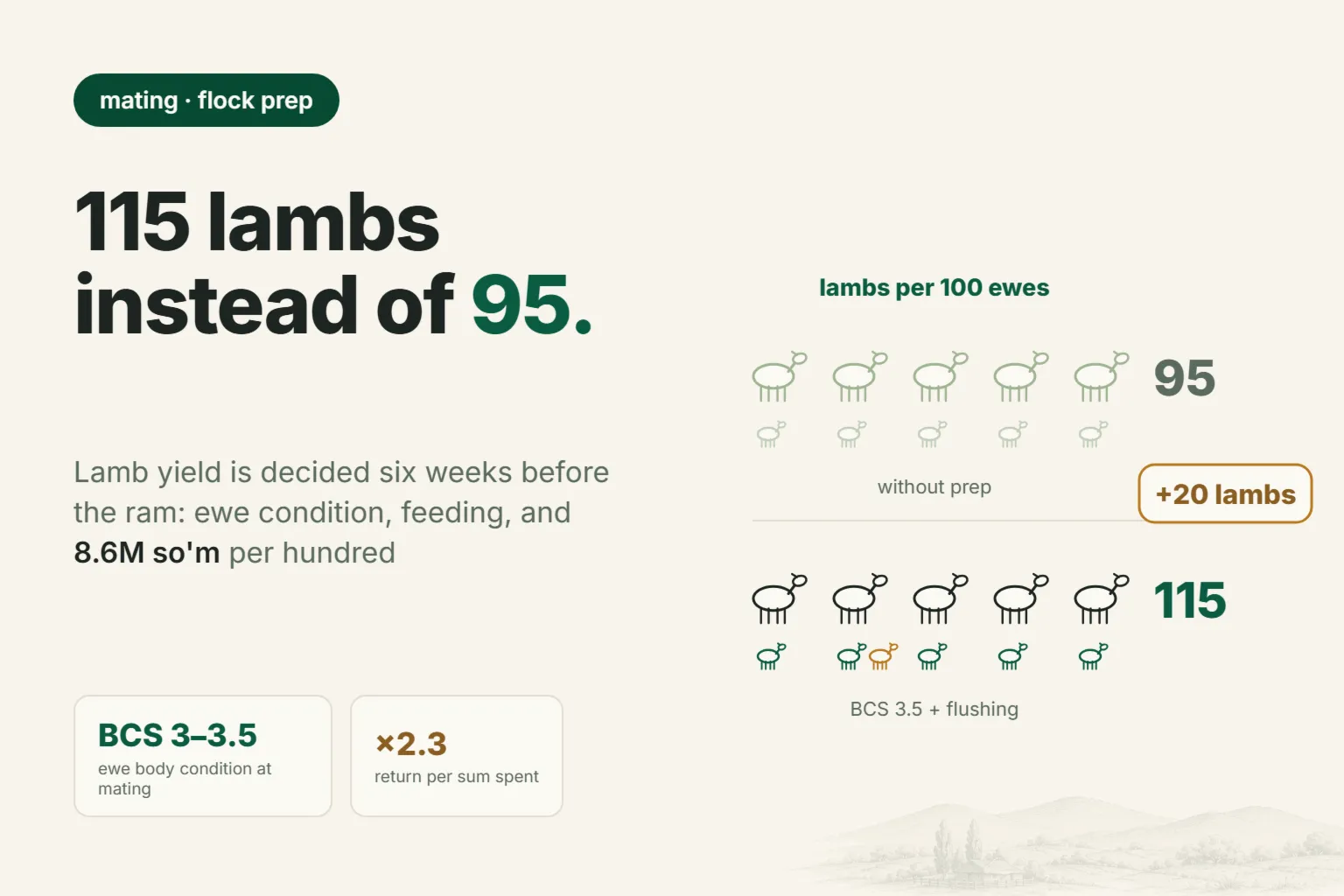
How many lambs a flock delivers in spring is decided not at lambing, but six weeks before mating. A ewe that goes to the ram in average body condition and gets 300–500 grams of concentrate feed beforehand comes into heat more readily and carries twins more often: across a hundred ewes, that's the difference between roughly 95 and 110–115 lambs. Preparing a hundred ewes costs around 8.6 million sum (≈ $720), and fifteen extra lambs bring in about 19.5 million sum (≈ $1,630) — the investment comes back more than double.
It's August now, and in Uzbekistan rams are usually turned in with the flock anywhere from September through November — most often in September–October — so lambing falls in February–March. Which means there's exactly enough time left to prepare — no more. Prices in this article are as of August 2026, exchange rate for conversion ≈ 11,950 sum per dollar, live weight 55,000 sum/kg.
How many lambs should a flock produce?
Fertility is measured simply: how many lambs are born per 100 ewes put to the ram. That figure folds in both how many ewes stayed barren and how many carried twins.
| Breed | Actual yield per 100 ewes put to the ram | Twins |
|---|---|---|
| Hissar | 105–115 | rare |
| Edilbay | 105–120 | rare |
| Jaidara | 105–115 | occasional |
| Karakul | 105–120 | rare |
| Romanov | 250–300 | twins and triplets standard; not a fat-tailed breed, shown for comparison |
Breed reference guides often quote higher numbers — a Hissar ewe, for instance, is rated at 115–120%. But that figure counts lambs per ewe that actually lambed, while the table above counts per hundred ewes put to the ram, barren ones and losses included. It's the second number that matters to the farmer — it's what actually survives to sale.
The fat-tailed breeds that Uzbek sheep farming runs on are genetically low in prolificacy — no amount of feeding will get you triplets out of a Hissar ewe. But the gap between "95 lambs per hundred" and "115 lambs per hundred" is entirely in the farmer's hands. The first number means ten ewes stayed barren and there were almost no twins. The second means only three or four stayed barren, and roughly every fifth ewe had twins.
Twenty extra lambs per hundred ewes works out to about 26 million sum (≈ $2,175) in a single season, using the cost of one barren ewe — 1.3 million sum a year. That's a sum worth spending six weeks of preparation on.
Why do the weeks before mating decide everything?
A ewe's ovulation doesn't depend on how she was fed all year — it depends on what happened to her body in the last three to four weeks before heat. Her system checks two things: is there a fat reserve (body condition), and is it growing right now (weight gain).
A ewe that's losing weight going into mating "reads" it as a bad year and releases one egg — or none at all. A ewe that's gaining weight more often releases two. This is exactly what's behind the technique livestock specialists call flushing: extra feed is given to ewes two to three weeks before the ram goes in, and kept up for another three weeks after mating starts.
Which gives you the main practical rule: working on the flock in September, once the rams are already in with it, is too late. The work happens in August.
How do you check a ewe's body condition by hand?
You can't judge a fat-tailed sheep's body condition by eye — the wool and the fat tail hide it. You check by hand: place your palm on the loin behind the last rib and feel how easily you can find the spinous and transverse processes of the vertebrae. The scale runs from 1 to 5.
| Score | What your hand feels | What to do |
|---|---|---|
| 1 — emaciated | Sharp vertebrae, almost no muscle | Treat and feed, don't put her to the ram |
| 2 — thin | Processes easy to feel, ribs visible | Feed intensively for 6–8 weeks before mating |
| 3 — average | Processes felt with pressure, back is even | Maintain and give extra feed before mating |
| 3.5 — good | Processes felt only with firm pressure | Target condition for mating |
| 4–5 — fat | Processes can't be felt, fat on the loin | No need for extra feed — and it's harmful now |
Check a couple of dozen ewes from the flock by hand — that's enough to see the overall picture. Target condition at the start of mating is a BCS of 3–3.5.
According to Australia's Lifetimewool project, which the Lifetime Ewe Management program is built on, each extra point of body condition at mating adds on average about 20 lambs per 100 ewes, with the gain running roughly linear from 1.5 to 4.5. The spread between flocks is wide — from 7 to 36 lambs — and these figures come from Merino sheep. The 3–3.5 target isn't chosen because higher doesn't work: past a BCS of 4, the risk of a difficult lambing rises, and feed spent fattening an already-fat ewe stops paying for itself. Fat-tailed breeds respond noticeably less than Merinos do — their ceiling on twins is set by genetics.
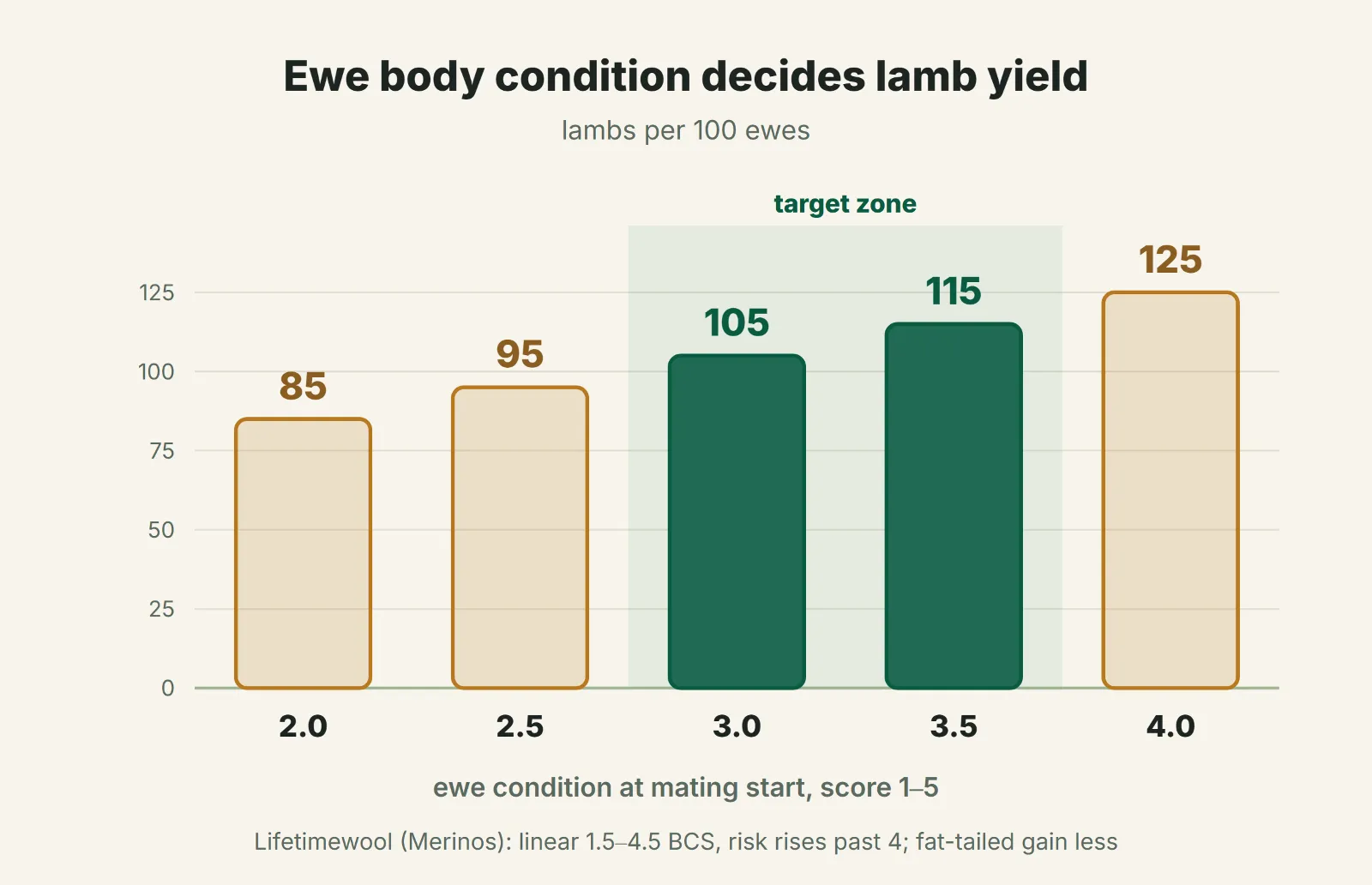
Which is also the answer to why the same flushing regimen worked for your neighbor and not for you: your neighbor's flock started at a 2 and kept gaining on the extra feed, while yours was already at a 4 with nowhere left to grow. The gain doesn't come from the grain itself — it comes from the ewe putting on weight ahead of mating.
What is flushing, and how much do you feed?
Flushing is extra concentrate feed given to ewes before mating and through the first weeks after it starts. The routine is simple:
- start 2–3 weeks before the rams go in;
- keep it up another 2–3 weeks after mating starts;
- don't cut it off abruptly — in the first days after conception, embryos die precisely from a sudden drop in feeding; taper the ration down over a week instead.
The rate is 300–500 g of concentrates per head per day on top of the normal ration. What you feed depends on what's cheapest in your area.
It is worth comparing concentrate prices in advance: buy barley and cottonseed cake in bulk in summer usually works out cheaper than topping up by the sack in the middle of the mating season.
| Feed | Rate per head per day | Cost per day | Per 100 ewes over 45 days |
|---|---|---|---|
| Cracked barley | 0.4 kg × 3,800 sum | 1,520 sum ($0.13) | 6.8 million sum (≈ $570) |
| Corn | 0.35 kg × 4,500 sum | 1,575 sum ($0.13) | 7.1 million sum (≈ $590) |
| Bran | 0.5 kg × 2,800 sum | 1,400 sum ($0.12) | 6.3 million sum (≈ $525) |
| Barley + cottonseed meal | 0.3 kg × 3,800 + 0.1 kg × 3,500 sum | 1,490 sum ($0.12) | 6.7 million sum (≈ $560) |
Barley should be fed rolled or cracked and introduced gradually over 7–10 days: switching a flock straight onto grain causes rumen acidosis, and instead of lambs you get sick ewes. If the flock is grazing good alfalfa regrowth and the ewes are already putting on weight there, part of the concentrate ration can be skipped — the weight gain is doing the job on its own.
One detail specific to a flock in hot August: hand out the extra feed early morning or evening. In the midday heat a ewe barely eats anyway, and the grain in the trough goes to whoever gets there first.
What needs to happen with the ram two months before mating?
One poorly prepared ram wrecks a season faster than a dozen thin ewes: he covers the whole group, so his problem gets multiplied by the group's size.
Sperm takes about seven weeks to mature, so anything that happened to the ram in July — heat, illness, weight loss — will show up in the September mating. What to check right now:
- body condition of 3.5–4 — a ram loses up to 10–15% of his weight over the mating period, so he can't go in thin;
- testicles — firm, resilient, matched in size, no lumps or tenderness; scrotal circumference of 32 cm or more in an adult meat-breed ram is a reliable sign of good sperm production;
- hooves — trim them a month out: a lame ram doesn't cover ewes;
- shade and water — at +40°C the testicles overheat and semen quality drops for weeks afterward; keep rams in shade during the day;
- extra feed — give the ram concentrates 6–8 weeks before mating, not starting on day one.
Under free mating, the load per ram is 30–40 ewes for an adult and 15–20 for a yearling and a half. If one ram is covering 60 ewes, some of them come into heat for nothing, and you won't find out until spring.
If that math leaves you short of rams, line up a second one early: breeding rams for sale thin out in September while prices go the other way.
How does the ram effect compress lambing into two weeks?
The technique is known as the ram effect: if ewes haven't seen, heard or smelled a ram for at least 4 weeks — 6 is safer — his sudden appearance triggers ovulation across part of the flock within a few days. Rams really do need to be kept apart — a kilometer or two away, not just in the next pen: scent and sound carry across a shared fence, and the trick won't work.
An important caveat: it only works while ewes haven't entered their natural breeding season yet. With early mating — late August and September — the response is strong; by November it's weak, since the flock is already cycling on its own by then.
What this gets the farm:
- heat comes in two waves, roughly on day 18 and day 25 after the rams go in, and the whole lambing fits into two to three weeks instead of a month and a half — night duty in the barn and working with the lambs both fit into a single stretch;
- lambs come out matched in age, which makes them easier to feed as one group and sell as one batch;
- you know in advance exactly which nights you'll need someone in the barn.
There's a catch: the first heat after rams go in is "silent" in some ewes, with no outward signs. So rams aren't pulled out after a week — they stay with the flock for two full cycles, or about 35 days.
What else needs to happen before mating?
| Timing | What to do |
|---|---|
| 8 weeks out | Check the rams, start their extra feeding, trim hooves |
| 6 weeks out | Check ewes' body condition by hand, split the flock into thin and average |
| 4–6 weeks out | Deworming and scheduled vaccinations (schedule and drug set by the vet) |
| 4–6 weeks out | Separate rams from the flock — for the ram effect |
| 3 weeks out | Start flushing, put out a mineral lick |
| Day 0 | Turn the rams in, record the date |
| +2–3 weeks | Taper off the extra feed gradually, keep rams in the flock for about 35 days |
Cull at the same time: ewes over five or six years old with worn teeth, ewes with damaged udders, and any ewe that's stayed barren two years running don't go into the new mating. Feeding them through winter is a straight loss — we worked out the cost of that in our article on barren ewes.
Record the date the rams went in and the group number right away — come spring, it's what tells you whose lamb is whose and which ewe had twins. A sheep breeding record app has an animal card and event log built for exactly this: log mating and body condition in August, and by February you can see which ewes are earning back their feed and which aren't.
What does it cost, and what does it bring back?
We're calculating for a flock of 100 ewes at August prices. Costs: 45 days of extra feed — 6.8 million sum, mineral lick for the flock — about 0.6 million sum, treatments — around 1.2 million sum. Total ≈ 8.6 million sum (≈ $720).
We're keeping the return conservative, at the low end: not twenty extra lambs, but fifteen. Every extra lamb is the difference between a ewe that lambs and one that stays barren — about 1.3 million sum a year: both eat the same, but only one has something to sell come autumn. So the gain comes to 19.5 million sum (≈ $1,630).
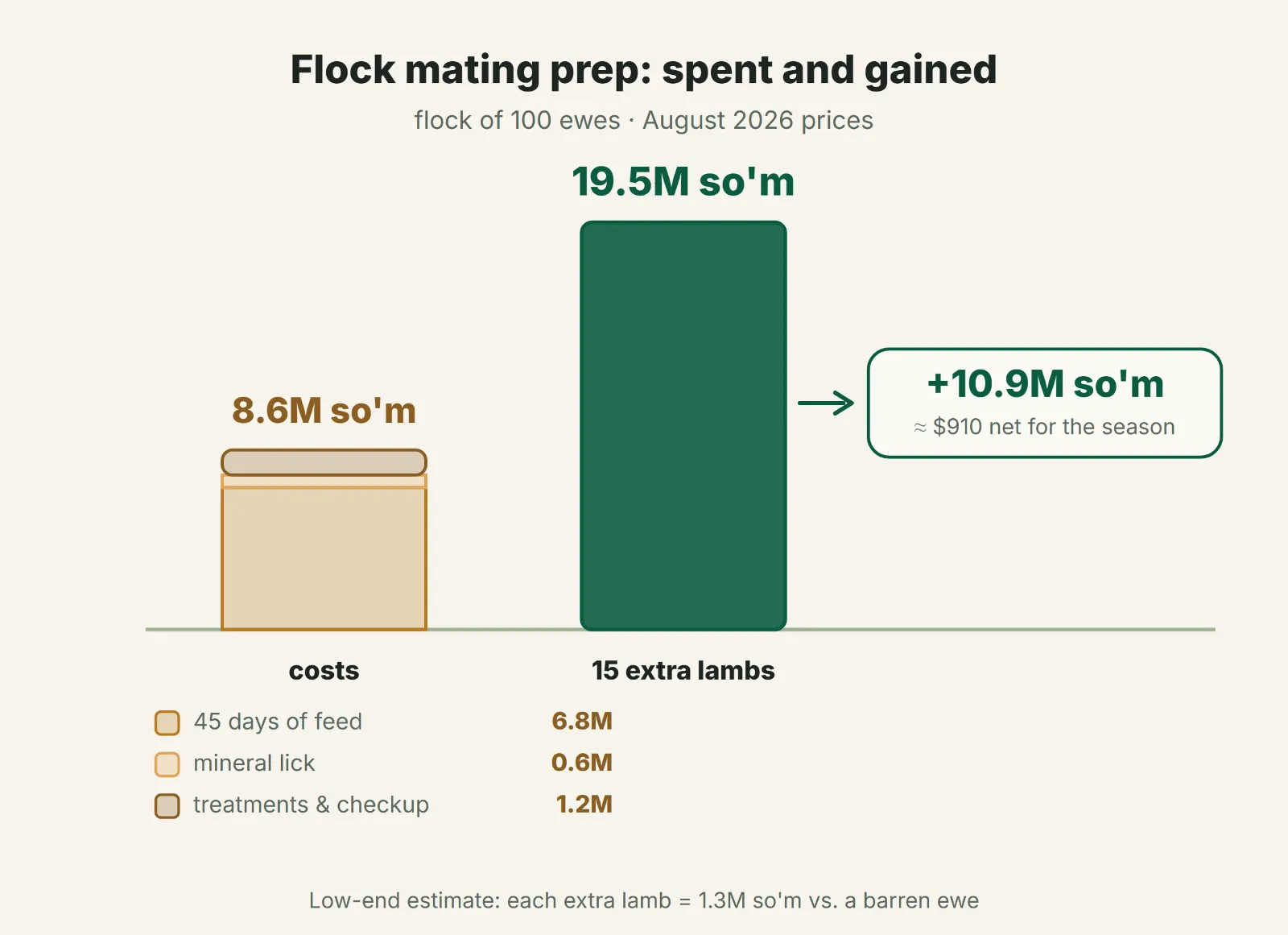
The difference is almost 11 million sum (≈ $910) net for the season — and that's the underestimated version. With a good result, the return is twice as high.
When does the preparation not pay off?
Honest about the limits of the technique — otherwise you'll spend money for nothing:
- The flock is already fat (BCS 4 and up). Flushing simply doesn't work on ewes like this, and extra grain causes metabolic problems and difficult lambing instead.
- Ewes are sick or carrying worms. The feed will go to the parasites. Treat as the vet prescribes first, feed second.
- The problem isn't the ewes — it's the ram. If 20–30% of the flock stayed barren last season, the issue is almost certainly the sire or his workload, and feeding the ewes better won't change that.
- A flock of 10–15 ewes. Run the numbers for your own scale: 45 days of extra feed will cost anywhere from 0.7 million sum for ten ewes to 1 million for fifteen, and the gain will be one or two lambs. The technique still pays for itself, but don't expect a miracle — in a flock this size, the bigger win is simply not putting thin ewes to the ram at all.
FAQ
When should I start preparing sheep for mating?
Six to eight weeks before the rams go in. For Uzbek farms, where mating most often happens in September–October, that's mid-August. Start by checking body condition and splitting the flock, then start extra feeding two to three weeks before the rams go in.
How much grain should I give ewes before mating?
300 to 500 grams of concentrates per head per day on top of the normal ration: 0.4 kg of cracked barley, or 0.35 kg of corn, or 0.5 kg of bran. For a hundred ewes over 45 days, that's about 6.8 million sum (≈ $570) at a barley price of 3,800 sum per kilogram. Introduce grain gradually over 7–10 days, or you'll get acidosis.
How many ewes can one ram cover?
An adult, healthy ram under free mating covers 30–40 ewes; a yearling and a half covers 15–20. Push the load higher and some ewes go uncovered — and you won't find out until spring, when they don't lamb.
Does extra feeding really mean more twins?
For breeds prone to twinning, yes — the gain is noticeable. In fat-tailed Hissar and Edilbay sheep, twins are genetically rare, and the main effect is different: fewer barren ewes and heat that comes in tighter and stronger across the flock. Combined, that's the same 10–20 extra lambs per 100 ewes.
Do rams need to be separated from the flock before mating?
Yes, at least 4 weeks — 6 is safer — and moved a kilometer or two away: across a shared fence, ewes can still hear and smell the rams, and the trick won't work. That way their reappearance works as a trigger: part of the flock comes into heat within the first days, and lambing comes out compact — two to three weeks instead of a month and a half. One caveat: it works best with early mating, before the flock has entered its breeding season on its own.
Can first-year ewe lambs be bred too?
Yes, once a ewe lamb reaches 65–70% of adult ewe weight: about 45 kg for Edilbay, 55 kg for Hissar. Then she delivers her first lamb a year early. A ewe lamb under 60% of adult weight doesn't go under the ram under any circumstances — she'll stay small for good. Breed-by-breed thresholds and a 50-head calculation are laid out in what age to breed a ewe lamb.
Can a ewe give more than one lambing per year?
Not with fat-tailed breeds: gestation takes five months and oestrus only comes in autumn. The practical limit is three lambings in two years — an eight-month interval — and it calls for a barn, year-round feed and early weaning. The scheme pays off only if it delivers at least 106 lambs per hundred ewes instead of the usual 95; the full calculation is in how often sheep lamb.
Manage your flock in QoyHunterCRM for sheep farmers: livestock, health, weighing, finance and analytics — in the app and a Telegram bot.All features →