
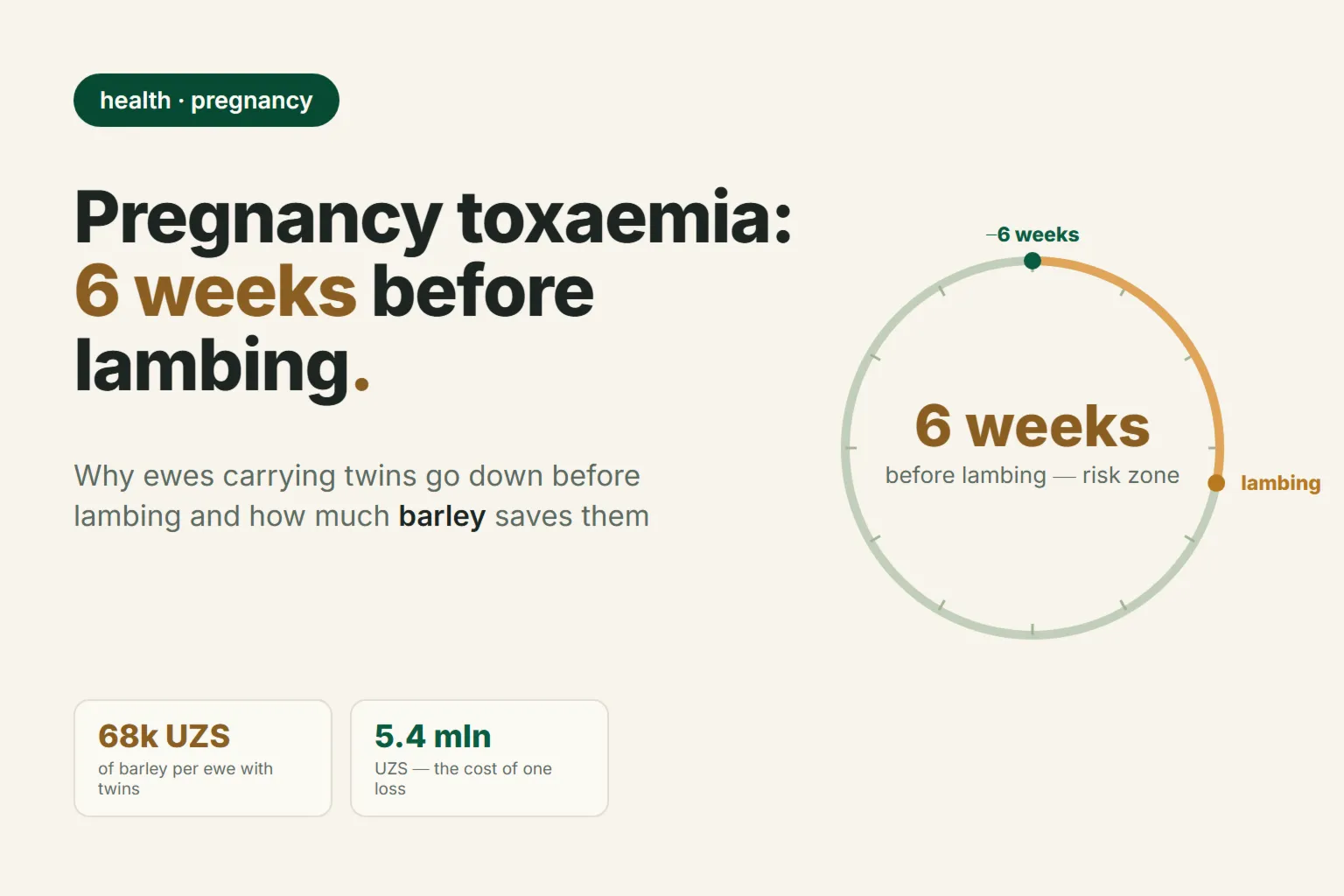
Pregnancy Toxaemia in Sheep: Signs, Treatment and How Much Barley to Feed Ewes in the 6 Weeks Before Lambing
Pregnancy toxaemia (ketosis) takes down twin-bearing ewes in the last 6 weeks before lambing. How to spot it day by day and with a ketone meter, what to drench with (propylene glycol, 60 ml twice a day) and week-by-week barley rates: 68,000 UZS (≈ $5.8) per ewe versus a 5.4 mln UZS (≈ $455) loss.
Pregnancy toxaemia (ketosis in pregnant ewes, "twin lamb disease") is an energy shortage the ewe faces in the last 4–6 weeks before lambing: the lamb — often two or three of them — draws glucose faster than the ewe can get it from feed, so her body starts burning fat and poisons itself with ketone bodies. The ewe grows weak, stops eating, goes blind, lies down, and without treatment dies within a few days, usually along with the lambs. Pregnancy toxaemia is almost entirely preventable through feeding: adding barley in the last six weeks costs about 68,000 UZS (≈ $5.8) per ewe carrying twins, while losing such a ewe together with two lambs costs the farm roughly 5.4 mln UZS (≈ $455) at autumn 2026 prices.
In Uzbekistan, the risk peaks at the end of winter. With mating in October–November, lambing falls in March–April, and the last six weeks of pregnancy land on February–March — when hay in the sheep barn is at its worst and barley is at its most expensive. That's why preparing for pregnancy toxaemia has to start now, in autumn: count the ewes, find the ones carrying twins, and buy grain.
Why does a pregnant ewe get pregnancy toxaemia before lambing?
A pregnant ewe gets pregnancy toxaemia because, late in pregnancy, her energy needs grow faster than she can eat. About 70% of a lamb's birth weight is gained in the last six weeks of roughly 150 days of pregnancy. Compared with her maintenance ration, the ewe's energy needs at this point rise by about 50%, and for a ewe carrying twins, by about 75%. At the same time, the rumen is squeezed by the growing lambs, so the ewe physically cannot eat more bulky feed.
If the ration is just hay or straw, energy falls short. The ewe starts burning her own fat, the liver can't process it fast enough, and ketone bodies — acetone and beta-hydroxybutyrate — build up in the blood. These are what poison the brain: hence the blindness, trembling, and odd behaviour.
Which ewes does pregnancy toxaemia affect most often?
Pregnancy toxaemia is almost never random. Five types of ewes are at risk:
- Ewes carrying twins or triplets. The main factor: two lambs need almost twice the glucose of one, so a twin-bearing ewe runs short of energy sooner and harder.
- Thin ewes. A body condition score below 2.5 on the five-point scale means little fat reserve, so the energy dip starts earlier.
- Overly fat ewes. A body condition score above 4 — internal fat crowds the rumen, the ewe eats less, and her liver gets overloaded faster once fat mobilisation kicks in.
- Older ewes with poor teeth: they can't keep up at the feeder and chew coarse feed less thoroughly.
- Ewes recovering from stress: driving, transport, shearing, a sharp cold snap, snowfall, a feed change, worm infestation. A day or two without proper feed can already trigger pregnancy toxaemia in a twin-bearing ewe late in pregnancy.
A shy ewe at a crowded feeder deserves a mention of its own. With less than 40–45 cm of feeding front per head, the strongest ewes eat the barley meant for the weaker ones, and an average "per flock" rate means nothing.
How to tell a pregnant ewe has pregnancy toxaemia: signs by day
Pregnancy toxaemia develops over a few days, and it can still be stopped at an early stage. The signs tend to appear in this order:
| Stage | What you see in the ewe | What to do |
|---|---|---|
| Day 1–2 | Lags behind the flock, stands apart, is the first to stop eating grain, still takes hay | Separate her, give propylene glycol, move the whole group onto stronger supplemental feed |
| Day 2–3 | Doesn't see obstacles, presses her head against the wall, tilts her head up, grinds her teeth, fine trembling, breath smells of acetone (a "sweet, fruity" smell) | Call a vet urgently: IV glucose, a decision on assisted delivery |
| Day 3–5 | Lies down, can't get up, convulsions | Chances of saving the ewe are slim; the vet decides whether to save the lambs by caesarean section |
Main rule: a pregnant ewe lying down at the end of winter is pregnancy toxaemia until proven otherwise. Hypocalcaemia (calcium deficiency) causes a similar picture, and vets often give calcium along with glucose, because the two conditions often go together.
How to test a ewe for pregnancy toxaemia without a lab?
You test a ewe for pregnancy toxaemia by measuring ketone bodies in the blood or urine, and no lab is needed for that. The same devices used by people with diabetes will do the job:
- A blood ketone meter with beta-hydroxybutyrate (BHB) strips. A drop of blood from the ear, results in 10 seconds. Per guidance from UK veterinary services and the MSD Veterinary Manual, in a pregnant ewe a BHB level up to 0.8 mmol/L is normal, 0.8–1.6 mmol/L means energy is already falling short and the group needs extra feed, 1.7–3.0 mmol/L is high risk, and above 3 mmol/L is clinical pregnancy toxaemia.
- Urine ketone test strips. Cheaper, but less accurate: a colour change on the strip confirms pregnancy toxaemia in a ewe that already shows signs, but it isn't good enough for fine-grained assessment of a group.
The most useful way to use the device isn't diagnosing one sick ewe — it's spot-checking the group. If you take blood from 8–10 twin-bearing ewes 3–4 weeks before lambing and two or three of them come back with BHB above 0.8, the whole group is short on energy, and barley needs to go up right away, without waiting for the first ewe to go down.
How to treat pregnancy toxaemia in a pregnant ewe?
Treating pregnancy toxaemia in a pregnant ewe works as long as she is still on her feet and eating at least a little. Veterinary references (including the MSD Veterinary Manual) name this as the core protocol:
- Propylene glycol by mouth — 60 ml twice a day, for 3 days; longer only on a vet's call. This is a glucose-precursor liquid; give it with a needleless syringe or bottle into the corner of the mouth, slowly, so the ewe doesn't choke. It can be mixed with warm water.
- IV glucose and calcium — given by a vet, especially if the ewe is already blind or unsteady on her feet.
- Remove the cause: move the ewe to a warm pen with water, give her the best hay available and a little barley she'll actually eat.
- Free the ewe of the lambs. The most effective treatment is ending the pregnancy: if only days remain before lambing, the vet may induce labour with a drug or perform a caesarean section. Once the lambs are out, the ewe's metabolism recovers.
Drug doses, hormonal ones especially, are for the vet to decide: inducing labour too early means losing the lambs. If the ewe has already been down for more than a day, only a minority survive — which is exactly why the economics of pregnancy toxaemia are the economics of prevention.
How much barley to feed a pregnant ewe in the 6 weeks before lambing?
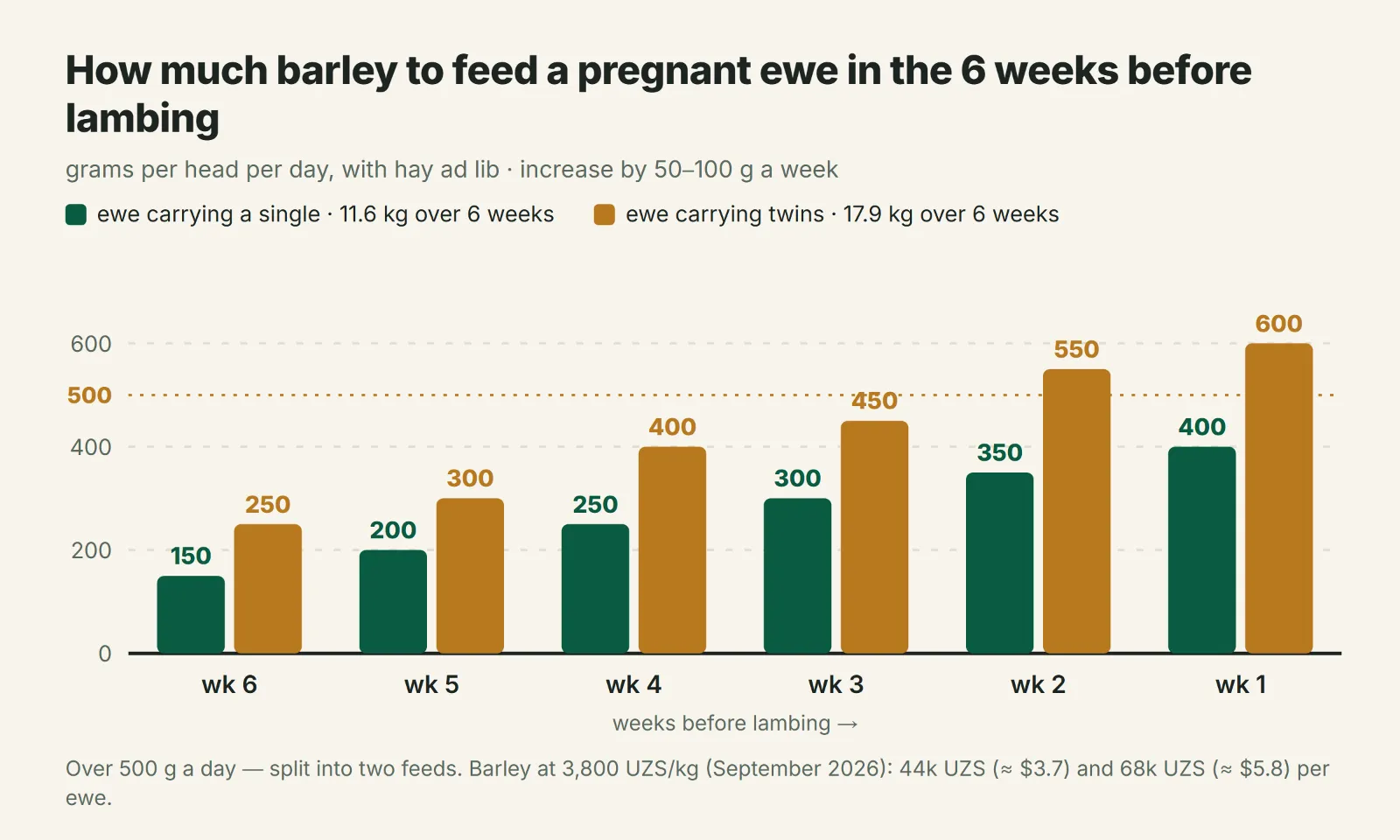
A ewe carrying twins gets from 250 g of barley a day at six weeks out up to 600 g in the last week before lambing, and a ewe with a single lamb gets 150 to 400 g. Increase it gradually, by 50–100 g a week, so the rumen adjusts to the grain. These figures assume a diet with decent hay fed freely; if the main feed is straw, more grain is needed, while good alfalfa lets you stay near the lower end.
| Week before lambing | Ewe with a single lamb, g/day | Ewe with twins, g/day |
|---|---|---|
| Week 6 | 150 | 250 |
| Week 5 | 200 | 300 |
| Week 4 | 250 | 400 |
| Week 3 | 300 | 450 |
| Week 2 | 350 | 550 |
| Week 1 | 400 | 600 |
| Total over 6 weeks | ≈ 11.6 kg | ≈ 17.9 kg |
| Cost at 3,800 UZS/kg | ≈ 44,000 UZS (≈ $3.7) | ≈ 68,000 UZS (≈ $5.8) |
Barley in September 2026 costs about 3,800 UZS/kg — the price we used in our annual cost of keeping a sheep calculation. Part of the barley can be replaced with cottonseed meal: the meal supplies protein the ewe needs for colostrum, but it doesn't fully replace the energy from grain.
Three feeding rules the ration plan doesn't work without:
- More than 500 g of grain a day — split into two feedings, morning and evening. A large single portion of barley triggers rumen acidosis — covered in detail in our breakdown of acidosis and urinary stones in rams.
- 40–45 cm of feeder space per ewe, so shy and older ewes get their share.
- Don't restrict water, even in winter: without water a ewe eats less.
It's easier to buy the grain for the whole period in autumn, before prices climb toward February. For a hundred ewes with about a third carrying twins, that works out to roughly 1.4 tonnes of barley for six weeks. You can see current offers in the barley and compound feed for sale in Uzbekistan listings, with price and the seller's district.
How to identify ewes carrying twins in advance?
Ewes carrying twins are found by ultrasound. Ultrasound scanning for pregnancy is done on day 45–90 after mating: at that stage you can see both empty ewes and the number of lambs. The flock is then split into three groups — empty, single, and twins — and fed differently. Without scanning, you're left with two bad options: feed everyone at the twin rate (overspending on grain and extra fat on single-bearing ewes) or feed everyone at the single rate (pregnancy toxaemia in the twin-bearing ewes).
If ultrasound isn't available, the at-risk group can be picked out by indirect signs: ewes that carried twins last year, and ewes with a noticeably larger belly 5–6 weeks before lambing. It's imprecise, but better than one blanket rate for the whole flock.
The second tool is hands-on body condition scoring: feel the loin behind the last rib. The target by lambing is 3–3.5 out of 5. Thin ewes (below 2.5) should start getting extra feed earlier, from week 8 before lambing; fat ewes (above 4) shouldn't be put on a starvation ration late in pregnancy — a sharp cut in feed for a fat ewe is exactly what triggers pregnancy toxaemia.
How much does losing a ewe to pregnancy toxaemia cost, and how much does prevention cost?
Losing one twin-bearing ewe to pregnancy toxaemia costs the farm about 5.4 mln UZS (≈ $455), while prevention costs about 68,000 UZS (≈ $5.8). The calculation is at autumn 2026 prices (exchange rate around 11,800 UZS per dollar):
| Item | Amount |
|---|---|
| Adult ewe, 55 kg live weight at 55,000 UZS/kg | ≈ 3.0 mln UZS (≈ $255) |
| Two lambs to weaning, net at 1.18 mln UZS each | ≈ 2.36 mln UZS (≈ $200) |
| Total loss for one twin-bearing ewe | ≈ 5.4 mln UZS (≈ $455) |
| Extra barley for a twin-bearing ewe over 6 weeks | ≈ 68,000 UZS (≈ $5.8) |
Net income per lamb at weaning (1.18 mln UZS) and the live-weight price of 55,000 UZS/kg are taken from our annual cost of keeping a sheep calculation. The loss figure doesn't include treatment, vet call-outs, or ewes culled after severe pregnancy toxaemia, so the real number is higher.
Supplementing one group of twin-bearing ewes pays for itself even if it saves just one ewe out of eighty. For a hundred ewes, with about a third carrying twins, the extra barley for all pregnant ewes costs roughly 5.2 mln UZS (≈ $440) — almost the same as losing a single ewe with two lambs.
How to avoid missing the feeding schedule across the flock
The hard part of pregnancy toxaemia isn't treatment, it's the calendar: ewes mated in different weeks start their six weeks before lambing on different days, and one rate for the whole flock doesn't work. For a small operation with 10–20 ewes, a notebook is enough: each ewe's mating date, her ultrasound result, and the date to start adding barley. At a hundred ewes, a notebook starts losing records, and it's easier to run this in software.
In QoyHunter, a CRM for sheep record-keeping with the bazar.qoyhunter.com marketplace, feed is entered into inventory with a target rate and a low-stock threshold, and usage is logged in the feeding journal — the remaining stock is deducted automatically, so you can see how much barley is going to pregnant ewes and when the supply will run out. How it works is shown on the farm feed tracking page.
What to do with lambs right after lambing so you don't lose them in the first three days is covered in our piece on why newborn lambs die.
FAQ
What can you give a ewe for pregnancy toxaemia if there's no vet nearby?
Propylene glycol: 60 ml by mouth twice a day for 3 days, given slowly with a needleless syringe into the corner of the mouth. At the same time, move the ewe to a warm pen with water, good hay, and a little barley. If the ewe is already blind, unsteady, or lying down, propylene glycol alone isn't enough — she needs IV glucose and a vet's decision on inducing labour.
Can you give a pregnant ewe sugar or honey instead of propylene glycol?
Sugar and honey given to a ewe are mostly fermented in the rumen and barely reach the bloodstream as glucose, so they do little for pregnancy toxaemia. Propylene glycol isn't fermented in the rumen — it's absorbed and converted to glucose in the liver, which is exactly why it's the one used.
From what stage of pregnancy should barley be added to ewes' rations?
From six weeks before lambing, roughly day 105 of the 150-day pregnancy. A twin-bearing ewe starts at 250 g of barley a day and works up to 600 g by the last week; a ewe with a single lamb goes from 150 to 400 g. Thin ewes should start extra feed earlier, from week eight.
Does pregnancy toxaemia happen in ewes after lambing?
It does, but less often: in high-milking ewes in the first weeks of lactation, especially if they're nursing twins on poor hay. The signs are the same — lethargy, refusing grain, an acetone smell. Prevention is the same too: enough energy in the diet and barley for nursing ewes with twins.
Can you eat the meat of a ewe slaughtered out of necessity due to pregnancy toxaemia?
The decision on emergency slaughter and whether the meat can be used is made by a vet after examining the carcass. Meat from an emaciated, drug-treated, or dead ewe is not fit for consumption; if a ewe is slaughtered, the carcass must undergo veterinary-sanitary inspection.
Manage your flock in QoyHunterCRM for sheep farmers: livestock, health, weighing, finance and analytics — in the app and a Telegram bot.All features →