Sell your ram in autumn or hold him until spring: the 2026/27 wintering calculation
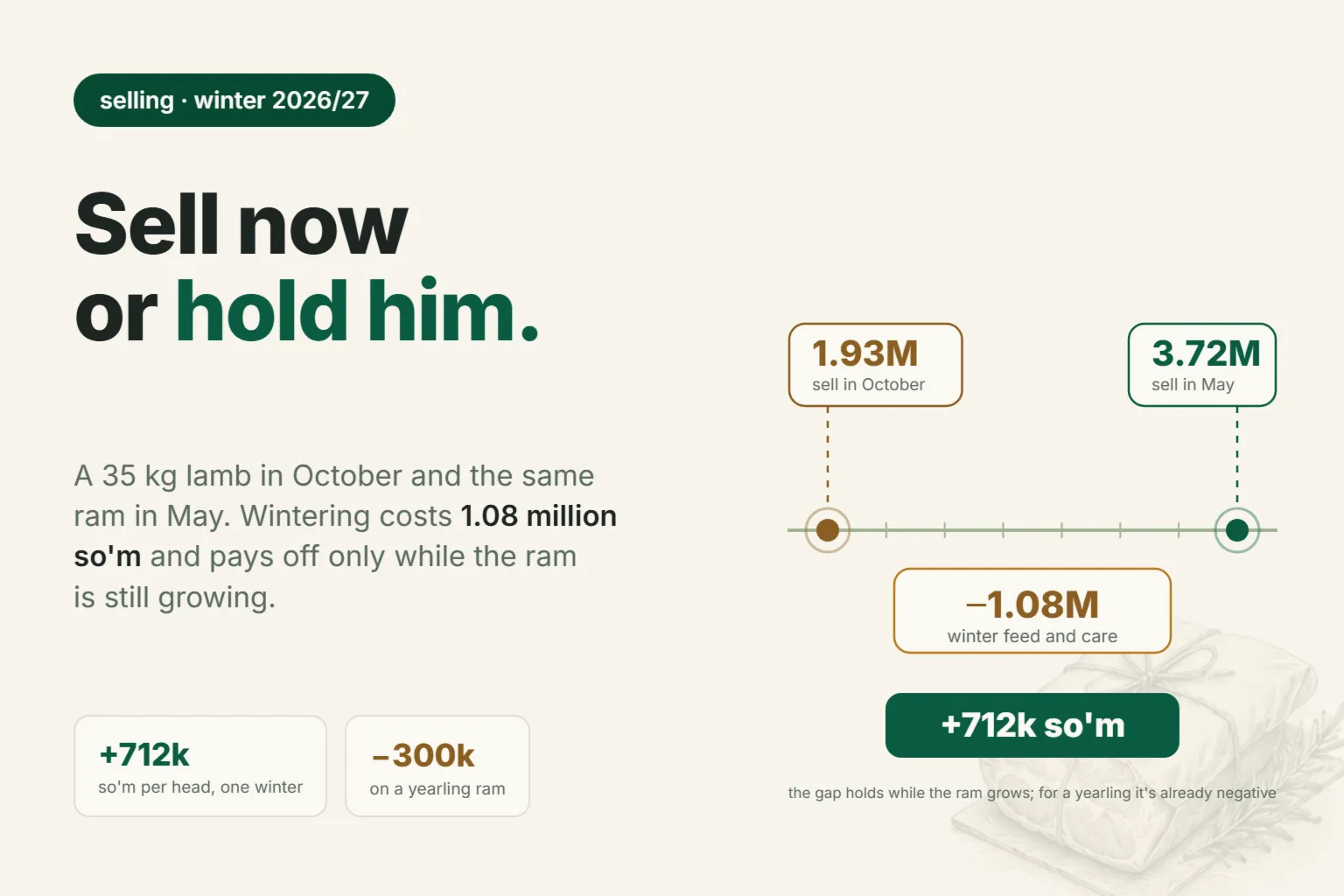
Which pays better in Uzbekistan — selling your ram in autumn or holding him until spring. A calculation at September 2026 prices: wintering one head costs 1.08 million so'm, a 35 kg lamb brings in 712,000 more by May, while a 70 kg yearling ram goes 300,000 into the red. With tables for the winter ration and the cost of weight gain, plus the signs that tell you which animals to keep for the winter.
Should you sell a ram in autumn or hold him until spring? Holding pays — but only while the animal is still growing. A spring-born lamb weighing 35 kg in October 2026 will eat around 1.08 million so'm (≈ $92) worth of feed over the winter and, by May, bring in 712,000 so'm (≈ $60) more than if you sold him now. Run the same numbers on a yearling ram of 70 kg and you get minus 300,000: the winter costs more than the gain is worth.
Below are both sides of the calculation at September 2026 prices: what a day of wintering costs, how much a ram adds on a winter ration, and how to tell which animals to keep until Qurban Hayit and which to sell in October. Conversion rate — 11,795 so'm per dollar (Central Bank of Uzbekistan, 4 September 2026).
Why a ram is worth more by spring
The price of a kilogram of live weight in Uzbekistan sits in a corridor of 55,000–65,000 so'm, and where you land inside that corridor depends less on the month than on your sales channel and the occasion. In autumn, most farms hand animals to a dealer at the gate: he takes the whole batch at once, with no trip to the market and no haggling, and he pays at the bottom of the range — 55,000–60,000 so'm per kilogram.
Mol bozor is the livestock market; every district has its own market day, usually a weekend, and trading starts before dawn. You will get more for the same animal there, but you have to haul the stock, stand all day and bargain.
By spring the picture changes. Wintering has thinned the supply, demand for a well-fed ram rises ahead of Qurban Hayit, and the market moves to the top of the corridor. In 2026 the holiday fell on 27 May; in 2027 it is expected around 16–17 May — the exact date is set by the lunar calendar. It makes sense to sell two or three weeks before the holiday, when buyers are already looking and the market is not yet flooded with animals.
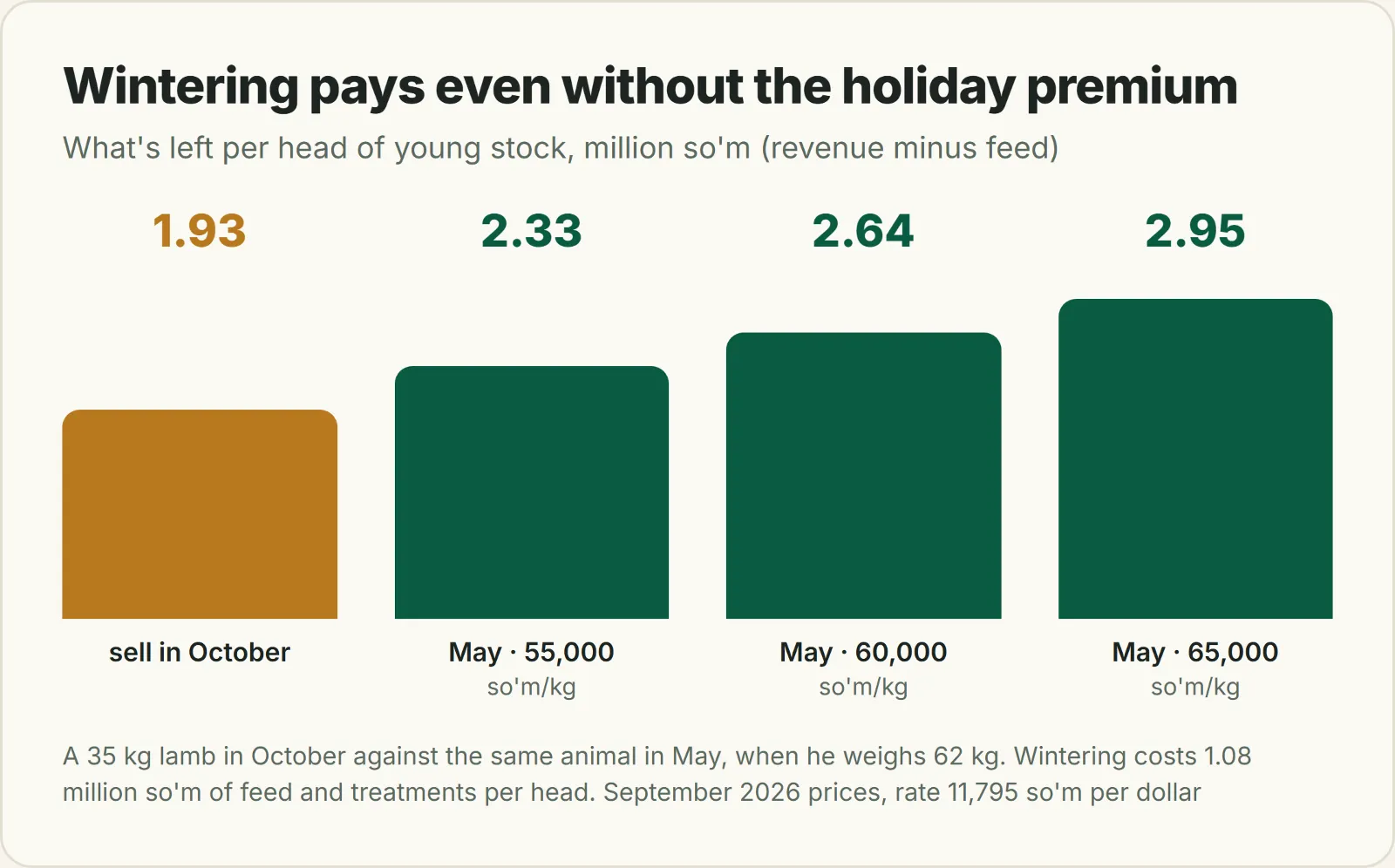
The calculations below use cautious prices: 55,000 so'm/kg in October and 60,000 so'm/kg in May — the quiet middle, not the holiday peak. Where the corridor itself comes from we covered in our piece on sheep and ram prices in Uzbekistan.
What it costs to keep a ram through the winter
We are counting the expensive scenario: a full barn ration for all 210 days of the hold, from early October to early May. In lowland districts the true barn period is shorter — 120 to 150 days — and in autumn and spring part of the feed still comes from pasture. So the real winter will cost less than our figure and the gain from holding will be larger; we deliberately take the worst case so as not to overstate the profit.
| Feed | Young stock, 35–62 kg | Price, so'm/kg | Cost per day |
|---|---|---|---|
| Alfalfa hay | 1.5 kg | 1,800 | 2,700 so'm |
| Barley | 0.4 kg | 3,800 | 1,520 so'm |
| Bran, oilseed meal | 0.2 kg | 3,000 | 600 so'm |
| Salt, mineral supplement | — | — | 100 so'm |
| Total | 4,920 so'm ($0.42) |
This is an average ration across the whole period: at the start, while the lamb weighs 35 kg, he gets 1.0–1.2 kg of hay, and by spring 1.7–1.8 kg. And this is a holding ration, not intensive fattening: on a fattening ration with 0.8–1.4 kg of concentrates the gains are quite different, but it also costs nearly twice as much.
Over 210 days that comes to 1,033,000 so'm (≈ $88) of feed per head. Add deworming, vaccination and the small change of running a farm — another 50,000 so'm or so. All told, wintering one head of young stock costs about 1.08 million so'm (≈ $92).
Hay consumption over those 210 days is 315 kg per head — roughly 16 standard 20 kg bales. For twenty head that is 6.3 tonnes. For a pure 135-day barn period the norm is different, around 200 kg for young stock — that is the figure we used in our winter hay stock calculation. Here the number is larger precisely because we feed the animal from the trough for all seven months.
The calculation: sell in October or in May
A spring-born lamb weighs about 35 kg by early October. Winter gains run below summer ones: part of the feed goes to keeping warm, and there is no pasture. A realistic benchmark for young stock on this ration is 130 g a day, that is +27 kg over 210 days. By May the animal weighs 62 kg.
| What we count | Sell in October | Hold until May |
|---|---|---|
| Live weight | 35 kg | 62 kg |
| Price per kg | 55,000 so'm | 60,000 so'm |
| Revenue | 1,925,000 so'm ($163) | 3,720,000 so'm ($315) |
| Feed and treatments | — | −1,083,000 so'm ($92) |
| What's left | 1,925,000 so'm | 2,637,000 so'm ($224) |
The difference is 712,000 so'm per head (≈ $60). Across twenty head of young stock that is 14.2 million so'm (≈ $1,210) for the winter.
Let us test other May prices. If the market does not rise at all and the ram goes at the same 55,000 so'm/kg, the gain is 402,000 so'm per head. If you manage to sell before the holiday at 65,000 — 1,022,000 so'm. In all three cases holding wins, for one reason: the animal is still growing. The margin of safety here is twofold — holding only breaks even if daily gain drops below 72 g.
When wintering doesn't pay off
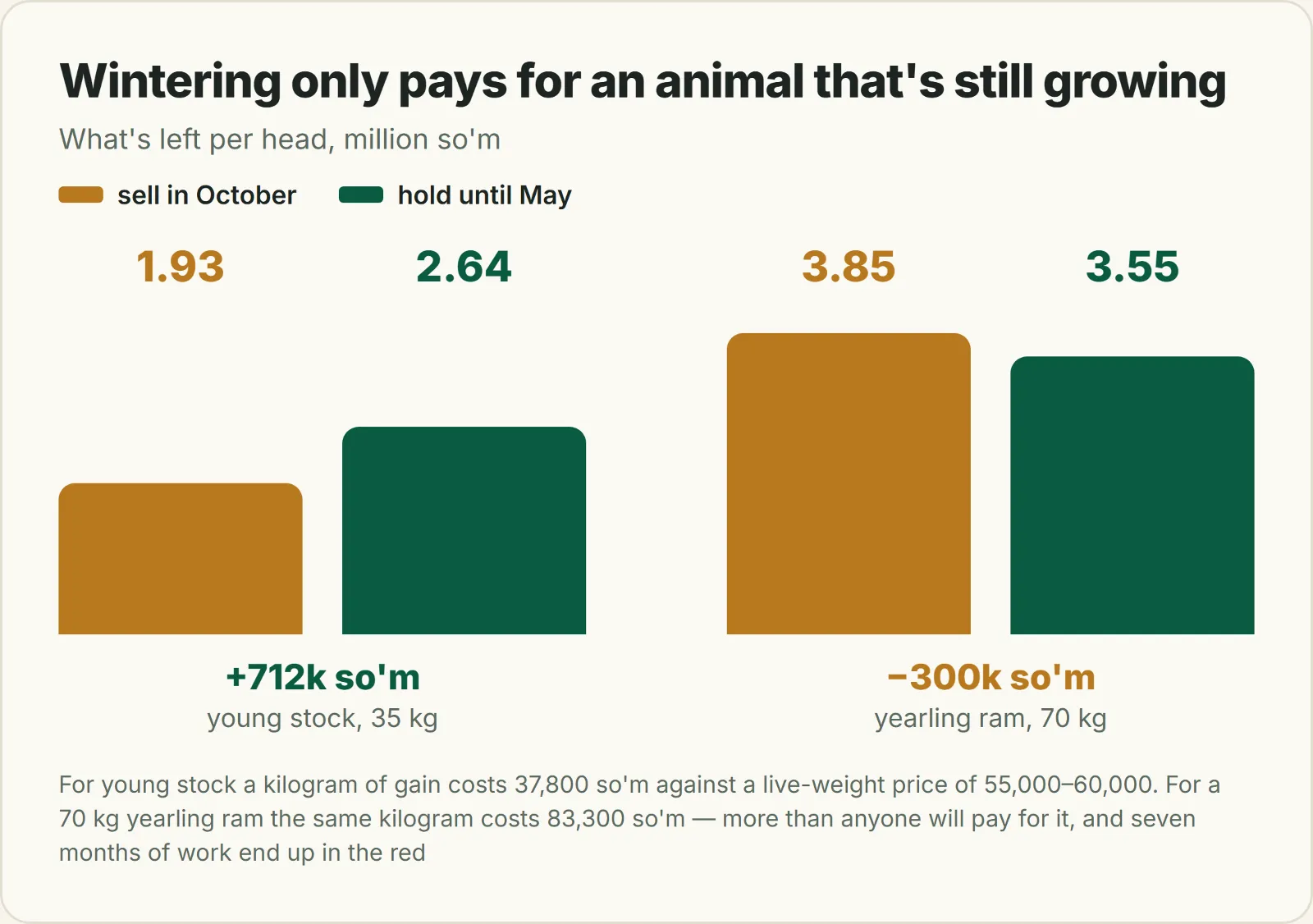
Now the same calculation for a yearling ram that weighs 70 kg in October. He has already passed the cheapest part of his growth, and every kilogram from here costs more. To make him gain anything at all over winter you have to feed a fattening ration — 1.6 kg of hay, 0.9 kg of barley, 0.5 kg of maize and 0.5 kg of bran. At winter hay prices that is about 10,000 so'm a day, or 2.15 million so'm for the winter including treatments. Gain on that ration in winter is 120 g a day, the bottom of the range for animals of 60–75 kg, that is +25 kg over 210 days.
| What we count | Sell in October | Hold until May |
|---|---|---|
| Live weight | 70 kg | 95 kg |
| Revenue | 3,850,000 so'm ($326) | 5,700,000 so'm ($483) |
| Feed and treatments | — | −2,150,000 so'm ($182) |
| What's left | 3,850,000 so'm | 3,550,000 so'm ($301) |
Wintering took 300,000 so'm (≈ $25) — and that is with the kilogram of live weight rising from 55,000 to 60,000 over the winter. Had the price stayed flat, the loss would have been 775,000.
The reason shows up in the cost of a kilogram of gain. For young stock it is 4,920 ÷ 0.13 = 37,800 so'm per kg — well below the price of live weight. For the yearling ram, 10,000 ÷ 0.12 = 83,300 so'm per kg, more than anyone will pay for that kilogram. The rule is simple: the moment a kilogram of gain costs more than a kilogram of live weight, feeding on means paying out of your own pocket. How to work that figure out by fattening phase we covered in our article on what a kilogram of weight gain costs.
Which animals to keep and which to sell now
The decision is made animal by animal, not across the whole flock.
Keep until spring:
- spring-born young stock of 30–45 kg — the cheapest part of their gain is still ahead of them;
- animals that put on 120 g a day or more over the past month;
- ewe lambs you plan to keep for the breeding flock — they are outside this arithmetic entirely.
Sell in October:
- rams older than a year and anything past 65–70 kg: they are on the plateau, and a kilogram of gain costs them more than it fetches at the market;
- anything that has been sick, fallen behind in growth or gone lame: in winter such an animal eats like a healthy one and gains half as much;
- surplus ram lambs, if feed is tight. Underfeeding the whole flock for the sake of extra head costs more than selling part of the stock in autumn.
For that decision to rest on numbers rather than on the eye, you need each animal's weight at least once a month: the difference between 90 and 150 grams a day is invisible by eye, and over a winter it is 12 kg of live weight. QoyHunter is a CRM for sheep records and the bazar.qoyhunter.com marketplace; in it you can calculate average daily gain from your weigh-ins and see which animals in the flock earn their feed and which do not.
The ones you decide not to keep are better sold ahead of time than all in one day at the market: sheep and rams for sale in Uzbekistan gives you time to bargain and puts you in front of the buyer without paying a dealer's cut.
How to make wintering cheaper
The decision to hold is really the decision to buy feed in October rather than in January. Alfalfa hay gets about half again as expensive by midwinter: a bale that costs 24,000–28,000 so'm in autumn goes for 30,000–45,000 in January (exact figures depend on the region and the harvest). In the calculation above the hay is already priced at the winter rate — 1,800 so'm per kilogram, or 36,000 per bale. Buy those same 16 bales in autumn and wintering one head gets 130,000–190,000 so'm cheaper, while the gain from holding rises from 712,000 to 840,000–900,000. That is a fifth to a quarter of the whole benefit, earned by one trip for hay in October.
What else brings the cost of wintering down:
- straw instead of part of the hay. For adult animals up to a third of the roughage can be wheat or barley straw; for young stock, less;
- buying by the batch. A truckload costs less per unit than retail, and it is easier to buy barley, maize and compound feed in autumn, before winter demand kicks in;
- troughs instead of the floor. Up to a third of hay gets trampled underfoot if you throw it on the barn floor — that is the same 100 kg of hay per head over a winter;
- dry bedding and ventilation. A damp barn means pneumonia, and losing one head over the winter takes away more than all the other savings put together.
What can go wrong
Holding is a bet, and it carries three risks worth keeping in plain sight.
Losses. One to three per cent of young stock over a winter is the target in a dry barn, with proper feeding and treatments done on time. In a damp, crowded barn the losses run noticeably higher. Every animal you lose takes with it both the autumn revenue you didn't take and the feed eaten up to that day.
Price. The state answers expensive meat by importing live animals: 150,000 head of sheep and goats are due to be brought in before the end of 2026, and imports of breeding stock are exempt from VAT. If those arrivals land in spring, the price corridor may not rise as much as you assumed. That is exactly why the calculation above uses 60,000 so'm/kg rather than the holiday peak.
Money frozen. The 1.9 million so'm you did not take in October will not work for seven months. If you have somewhere to put it that returns more than 712,000 over the winter, count that option too.
For most farms the right answer looks like this: keep the growing young stock through the winter and sell everything heavy or troubled in autumn. That gives you both cash in October for feed purchases and the better price in May — instead of betting the whole flock on a single scenario.
Deciding to sell now leads straight to the next question — who actually takes the batch. The wholesale channels and the price of a bulk discount are covered separately: who buys rams in bulk.
FAQ
When is it better to sell a ram — in autumn or in spring?
In spring, if the ram is still growing. A spring-born lamb of 35 kg adds around 27 kg over the winter and brings in roughly 712,000 so'm more than an October sale, even after 1.08 million so'm of feed costs. A yearling ram of 70 kg, on the other hand, brings in 300,000 so'm less than he would have fetched in autumn: he is already on the gain plateau, and his feed costs more than his gain is worth.
What does it cost to keep a ram through the winter in Uzbekistan?
At September 2026 prices, keeping one head of young stock runs to about 4,920 so'm a day: 1.5 kg of hay, 0.4 kg of barley, 0.2 kg of bran and a mineral supplement. Over 210 days of holding that is roughly 1.03 million so'm of feed plus 50,000 so'm for treatments. An adult ram on a fattening ration needs about 10,000 so'm a day — 2.15 million so'm for the same winter.
How much more is a ram worth at Qurban Hayit?
Ahead of the holiday the live-weight price moves to the top of its usual corridor: from 55,000 towards 65,000 so'm per kilogram and above. But the actual deal is settled by bargaining, and building the peak price into your plan is risky — 60,000 so'm/kg is the safer number to count on. In 2027 Qurban Hayit is expected around 16–17 May, and it makes sense to sell two or three weeks before the holiday.
Which lambs should be kept for the winter and which sold?
Keep young stock of 30–45 kg that put on at least 120 g a day over the past month. Sell rams older than a year and anything heavier than 65–70 kg, along with animals that have been sick, fallen behind or gone lame: in winter they eat as much as the healthy ones and gain half as much. If feed is tight, it is better to sell the surplus head in autumn than to underfeed the whole flock.
What if there isn't enough feed for the winter?
Do the arithmetic before October, not in January. One head of young stock needs about 315 kg of hay if you feed from the trough for all 210 days of the hold — that is 16 bales of 20 kg. If the count comes up short, there are three ways out: buy feed now while a bale costs 24,000–28,000 so'm, replace part of the hay with straw for the adult animals, or cut the head count with an autumn sale. The most expensive option is to keep everyone and buy hay in January at 30,000–45,000 per bale.
Manage your flock in QoyHunterCRM for sheep farmers: livestock, health, weighing, finance and analytics — in the app and a Telegram bot.All features →