Feed Records on the Farm: How Much Feed a Flock of Sheep Needs, and Why Stock Runs Out Early
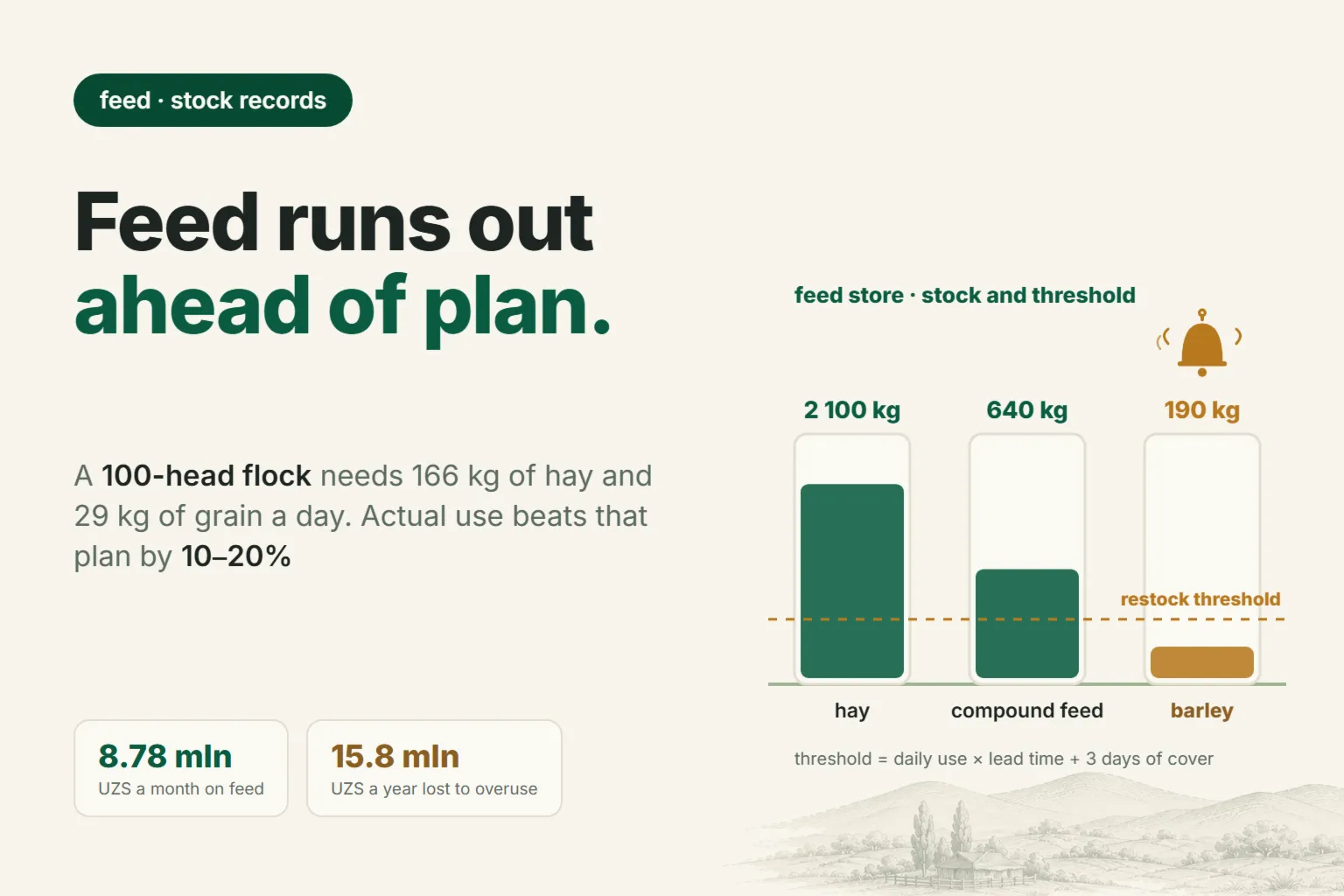
A flock of 100 sheep eats about 5 tons of hay and 870 kg of concentrates a month — 8.78 million UZS ($744) at August 2026 prices. Here's how to track feed: per-group norms, stock in and out, the reorder threshold formula, and why actual consumption runs 10-20% above the calculated norm.
A flock of 100 sheep in Uzbekistan needs roughly 5 tons of hay and 870 kg of concentrates a month — that's 166 kg of hay and 29 kg of grain a day for the whole farm. At Tashkent region prices for August 2026, the feed bill comes to 8.78 million UZS ($744) a month. Feed record-keeping on a farm exists for exactly one reason: to keep that bill from growing on its own. Without records, actual consumption, by our estimate, runs 10-20% above the norm, and the farm finds out in February, when the hay ran out ahead of schedule.
Feed record-keeping comes down to three numbers per feed type: how much arrived at storage, how much was used for feeding, and how much is left today. Below: norms by animal group, six reasons actual consumption outruns the calculated norm, the reorder threshold formula, and what this tracking looks like in the app.
How Much Feed a Flock of Sheep Needs Per Month
Take a typical Tashkent region farm with 100 head: 70 ewes, 25 growing lambs, and 5 breeding rams. The norms below are for natural feed, outside the breeding season, outside the last weeks of pregnancy, and outside lactation: during pregnancy needs rise 30-40%, and after lambing they almost double.
| Group | Head | Hay, kg per head per day | Concentrates, kg per head per day | Hay, kg per day | Concentrates, kg per day |
|---|---|---|---|---|---|
| Ewes, 55-65 kg | 70 | 1.8 | 0.2 | 126 | 14.0 |
| Growing lambs, 30-45 kg | 25 | 1.2 | 0.5 | 30 | 12.5 |
| Breeding rams | 5 | 2.0 | 0.5 | 10 | 2.5 |
| Total | 100 | — | — | 166 | 29 |
The norms in the table are floor values: lambs heavier than 40 kg already need 1.5-1.6 kg of hay, and heavy fat-tailed rams at 110-120 kg need 2.0-2.5 kg of hay and 0.5-0.7 kg of concentrates — up to 1.2-1.5 kg of concentrates during the breeding season.
Over 30 days that's 4,980 kg of hay and 870 kg of concentrates. Let's price it at Tashkent region rates for August 2026: barley at 3,800 UZS per kilogram from listings, alfalfa hay at 1,100 UZS per kilogram based on the summer market benchmark. The Central Bank of Uzbekistan rate on August 28, 2026 was 11,801.23 UZS per dollar.
- hay: 4,980 × 1,100 = 5.48 million UZS ($464);
- concentrates: 870 × 3,800 = 3.31 million UZS ($280);
- total: 8.78 million UZS a month ($744), or 88,000 UZS ($7.4) per head.
On intensive fattening, concentrates go up — to about 0.8 kg per head per day — and the feed bill rises accordingly.
We covered prices for each item and by purchase channel in our review of compound feed and grain prices for August 2026.
Why Feed Consumption Runs Above the Norm
The calculated norm is the ideal case, where every kilogram reaches the animal. On a real farm, six leaks stand between the storage and the sheep's rumen.
Measured by eye, not by weight. A norm of "1.8 kg of hay per head" turns into "a forkful." Two forkfuls from the same shepherd noticeably differ in weight, and the difference almost always runs high: underfeeding feels riskier than overfeeding. Overuse from this alone, by our estimate, is 5-15%.
Feeder losses. Feeding on the ground sends 20-40% of the hay underfoot; a simple feeder without a grate still loses 10-15%. This is the most expensive of the six leaks, and it's closed by feeder design, not by discipline — see the detailed breakdown in hay losses in sheep feeders.
Lambs grow, the norm doesn't. A lamb given 1.2 kg of hay in May is 10-15 kg heavier by August and needs a quarter more feed. The notebook entry, meanwhile, is the same as it was three months ago.
Unrecorded withdrawals from storage. A bag of barley for a neighbor, a bale of hay for your own goats, grain for the chickens. Each case is small, but over a month it adds up, by our estimate, to 3-5% of stock, and none of it shows up in the calculation.
Natural loss and spoilage. Grain stored damp (16-17% moisture) loses 2-4% of its weight as it dries down to 14%; grain that's truly wet (18-20%) loses 5-7%. You paid for kilograms, part of which was water. Hay that gets wet grows mold, and the moldy layer goes to waste: it can't be fed to sheep.
The flock changed, purchasing didn't. Buy 10 more lambs for finishing and consumption rises by 12 kg of hay a day — 360 kg a month. Orders, meanwhile, still follow last year's habit.
What Unnoticed Overuse Costs
Take the middle of the range — 15% above the norm. For our flock of 100 head, that's an extra 747 kg of hay and 130 kg of concentrates every month.
The annual figure below assumes year-round feeding from the feeder. If the flock is out on pasture in summer, don't multiply by 12 — multiply by the length of the barn period instead: in Uzbekistan's lowland districts that's 120-150 days, or 4-5 such months — about 5.9 million UZS ($503) for the season.
| Item | Overuse per month | Cost per month | Cost per year |
|---|---|---|---|
| Hay | 747 kg | 822,000 UZS ($70) | 9.86 million UZS ($836) |
| Concentrates | 130 kg | 494,000 UZS ($42) | 5.93 million UZS ($502) |
| Total | — | 1.32 million UZS ($111) | 15.8 million UZS ($1,338) |
Over a year, the excess adds up to almost 9 tons of hay and 1.6 tons of concentrates. Nine tons of hay is almost a two-month reserve of roughage for the whole flock. And the money doesn't leave all at once; it trickles out, so on the books it looks like "feed got more expensive," not like overuse.
Record-keeping doesn't eliminate overuse by itself. It makes it visible: when the norm (166 kg a day) sits next to the actual weekly usage (1,340 kg instead of 1,162 kg), the conversation with the shepherd becomes concrete, not "it feels like a lot is going out."
How to Calculate the Reorder Threshold So Feed Doesn't Run Out
The low-stock threshold is the amount of feed at which it's time to order a new batch, so you don't run empty while the delivery is on its way. It isn't set by eye at "half a bag" — it's calculated with a formula:
Threshold = daily consumption × (delivery time in days + 3 days of safety stock)
For our flock, with a 5-day delivery time:
- hay: 166 × (5 + 3) = 1,328 kg, rounded to 1,300 kg;
- concentrates: 29 × (5 + 3) = 232 kg, rounded to 250 kg.
In winter and in the days before Qurban Hayit, delivery times grow: transport gets booked up, sellers have a queue. During these periods, add another 3-5 days to the delivery time, or a threshold calculated on summer numbers will trigger too late. It's easier to compare offers and prices ahead of time through listings — you can buy compound feed and grain for sheep in the Tashkent region without registering, with the price and region shown right on the listing card.
The threshold alone doesn't save you — you still need to find out about it in time. How to set up reminders for every farm deadline, from feed purchases to vaccinations, without drowning in notifications, is covered in the article "How Not to Miss Sheep Vaccinations and Treatments".
Notebook, Spreadsheet, or App: What Actually Handles Feed Records
| Method | What it does well | Where it breaks down | Who it suits |
|---|---|---|---|
| Notebook | Stock in, date, purchase amount — easy to jot down | Almost no one logs usage: you have to find the balance by recounting bags in the barn | 10-30 head, one or two feed types |
| Spreadsheet | Calculates balance and cost, builds any breakdown you want | Filled in the evening, from memory; the shepherd feeds, the owner keeps the sheet — data arrives a week late | A farm with someone permanently at a computer |
| Phone app | The entry is made on the spot, at the moment of feeding; the balance is deducted automatically | Requires a smartphone for whoever feeds, and the habit of logging | From 30-50 head and three feed types up |
Nobody's writing off the notebook here. If you have 20 sheep and one feed type — hay — you can see the stock with your own eyes and do the math in your head, and there's no point setting up an app for that. The problem starts once feed types reach three or four, feedings run two or three times a day, and the owner isn't the one feeding: that's when the balance stops being a known number without records and becomes a guess.
How to Track Feed in QoyHunter
QoyHunter is a CRM for sheep record-keeping plus the bazar.qoyhunter.com marketplace. The "Feed" tab inside "Animals" works like a storeroom: a list of feed types with stock and threshold, plus a feeding schedule, on one screen.
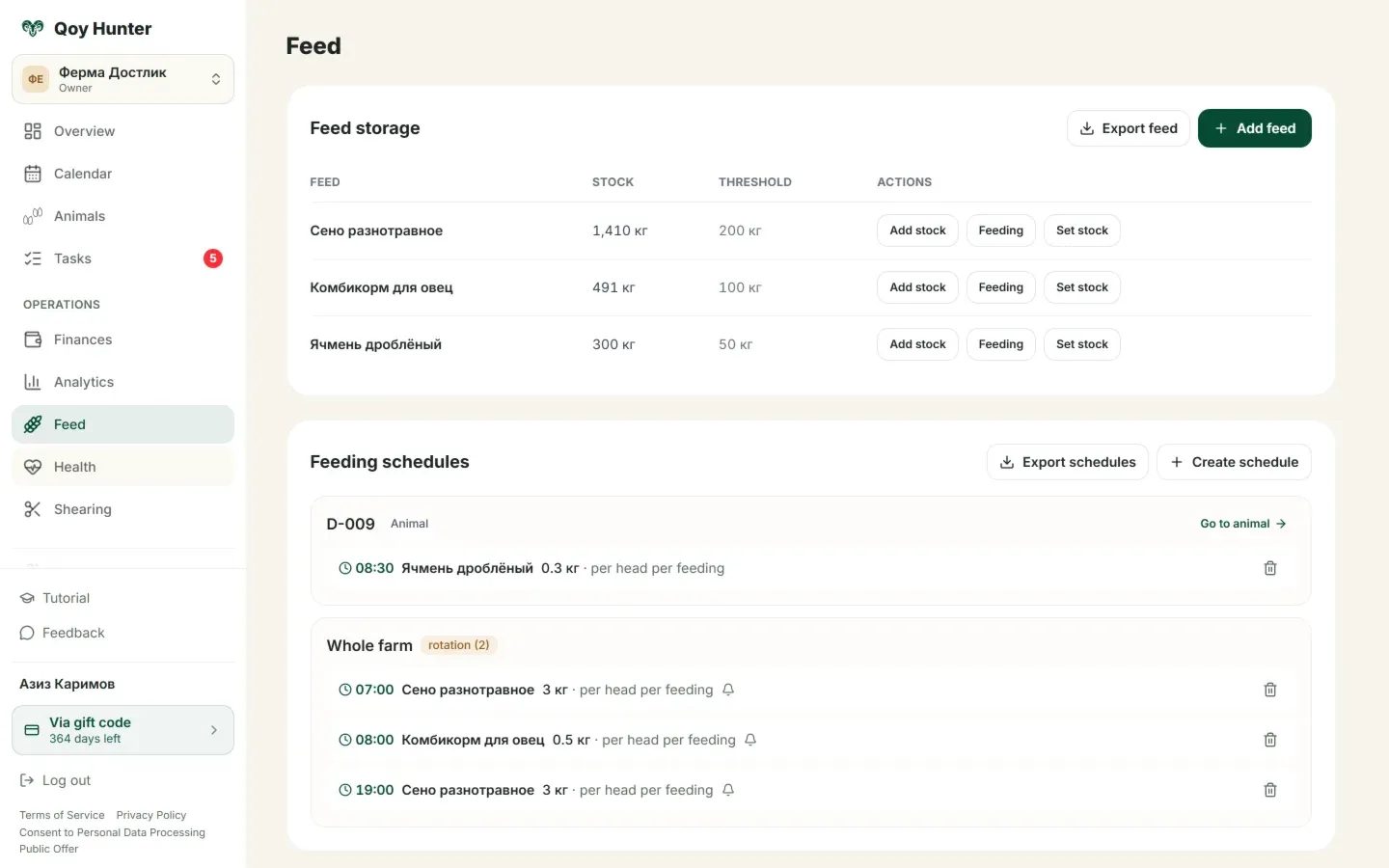
Each feed type is set up once: name, unit of measure — kilograms, bags, bales, whatever suits you — low-stock threshold, and the per-head amount per feeding. When you set up a feeding schedule, the app suggests an amount based on the animals' weight: "Recommended ~0.5 kg/day · ~0.25 per feeding" — and fills it in with one button, instead of you doing the math in your head.
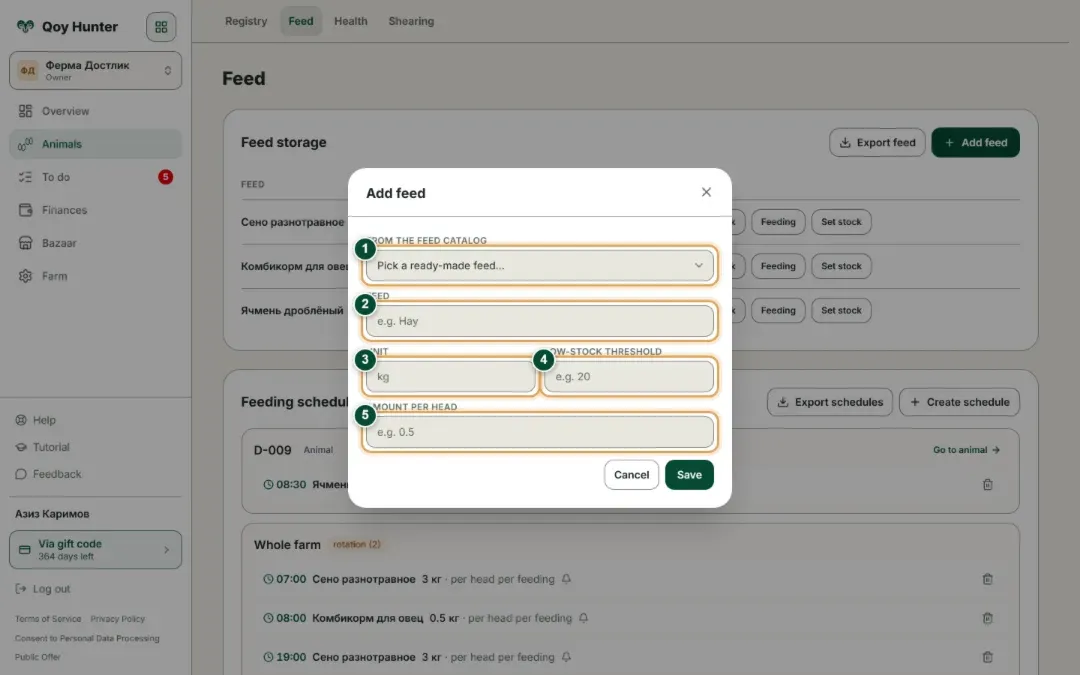
From there, three buttons do the work:
- "Add stock" — record a purchase. The balance goes up, and the batch cost flows straight into the farm's expenses, so feed lands in your finances without a second notebook.
- "Feeding" — log usage in the journal. The storage balance is deducted automatically.
- "Set stock" — correct the actual balance after a recount in storage, so the records match reality.
The threshold works on its own: as soon as a feed type drops below the set amount, a reminder to reorder comes in.
Feeding schedules set the time and the amount — for the whole farm, a group, or a single animal. For a detailed, step-by-step walkthrough of the screens, see the feature page on feed and stock tracking.
In Short
- A flock of 100 head (70 ewes, 25 growing lambs, 5 rams) eats 166 kg of hay and 29 kg of concentrates a day — about 5 tons of hay and 870 kg of grain a month.
- The feed bill for such a flock in August 2026 is 8.78 million UZS ($744) a month.
- Actual consumption outruns the norm by 10-20% due to eyeballed measuring, feeder losses, growing lambs, unrecorded withdrawals, spoilage, and a changed head count.
- At 15% overuse with year-round feeding from the feeder, a farm loses 15.8 million UZS ($1,338) a year — almost 9 tons of excess hay and 1.6 tons of grain.
- The reorder threshold is calculated as daily consumption × (delivery time + 3 days); in winter, add another 3-5 days to the delivery time.
FAQ
How much hay does a flock of 100 sheep need per month?
About 5 tons. For a mixed flock (70 ewes at 1.8 kg of hay a day, 25 growing lambs at 1.2 kg, 5 breeding rams at 2 kg), daily needs come to 166 kg of hay, which is 4,980 kg over 30 days. Add another 870 kg of concentrates. In the last 6-8 weeks of pregnancy, the ewes' norm rises 30-40%, and in the first two months after lambing it's almost double in feed volume. The stock for these periods needs to be recalculated separately.
How do you calculate the stock level at which it's time to reorder feed?
By formula: daily consumption multiplied by delivery time in days, plus three days of safety stock. For example, at 166 kg of hay a day with a 5-day delivery time, the threshold is 166 × 8 = 1,328 kg — so you should reorder once about 1.3 tons remain in storage. In winter and before Qurban Hayit, transport gets booked up, so add another 3-5 days to the delivery time.
Why does feed consumption run above the norm?
There are six main reasons: feed is measured by eye instead of a measuring container (5-15% overuse); some hay is lost in the feeder; lambs grow but the norm in the records isn't updated; feed is taken from storage for your own goats and chickens without being logged; damp grain loses 2-4% of its weight as it dries, wet grain loses 5-7%, and wet hay grows mold; the head count grew but the purchase volume stayed the same. Together, that's exactly the 10-20% above the calculation.
Do you have to log every single feeding?
No, but then the storage balance will be a guess, not a number. A minimum that already works: log every batch that comes in, recount the actual balance once a week, and compare the difference against the norm. If there are two or three feedings a day and a hired shepherd does the feeding, logging usage at the moment of feeding is easier than reconstructing it from memory at the end of the week.
Can you keep feed records in a notebook?
For a farm with 10-30 head and one or two feed types — sure. Storage in a farm that size is visible at a glance, and usage can be worked out in your head. A notebook stops keeping up once feed types reach three or four, each with its own unit of measure and threshold, and the person feeding isn't the person keeping the records: then the balance and the money drift away from reality within the first month.
Manage your flock in QoyHunterCRM for sheep farmers: livestock, health, weighing, finance and analytics — in the app and a Telegram bot.All features →