Animal Card: What to Record for Every Ewe, and How to Find the Unprofitable Ones in Your Flock
Nine fields to keep for every sheep — tag, age, weight by date, lambings, treatment and money. A September 2026 calculation: the gap between a ewe with a lamb and a barren one is 1.3M UZS a year, and only a per-animal record shows it.
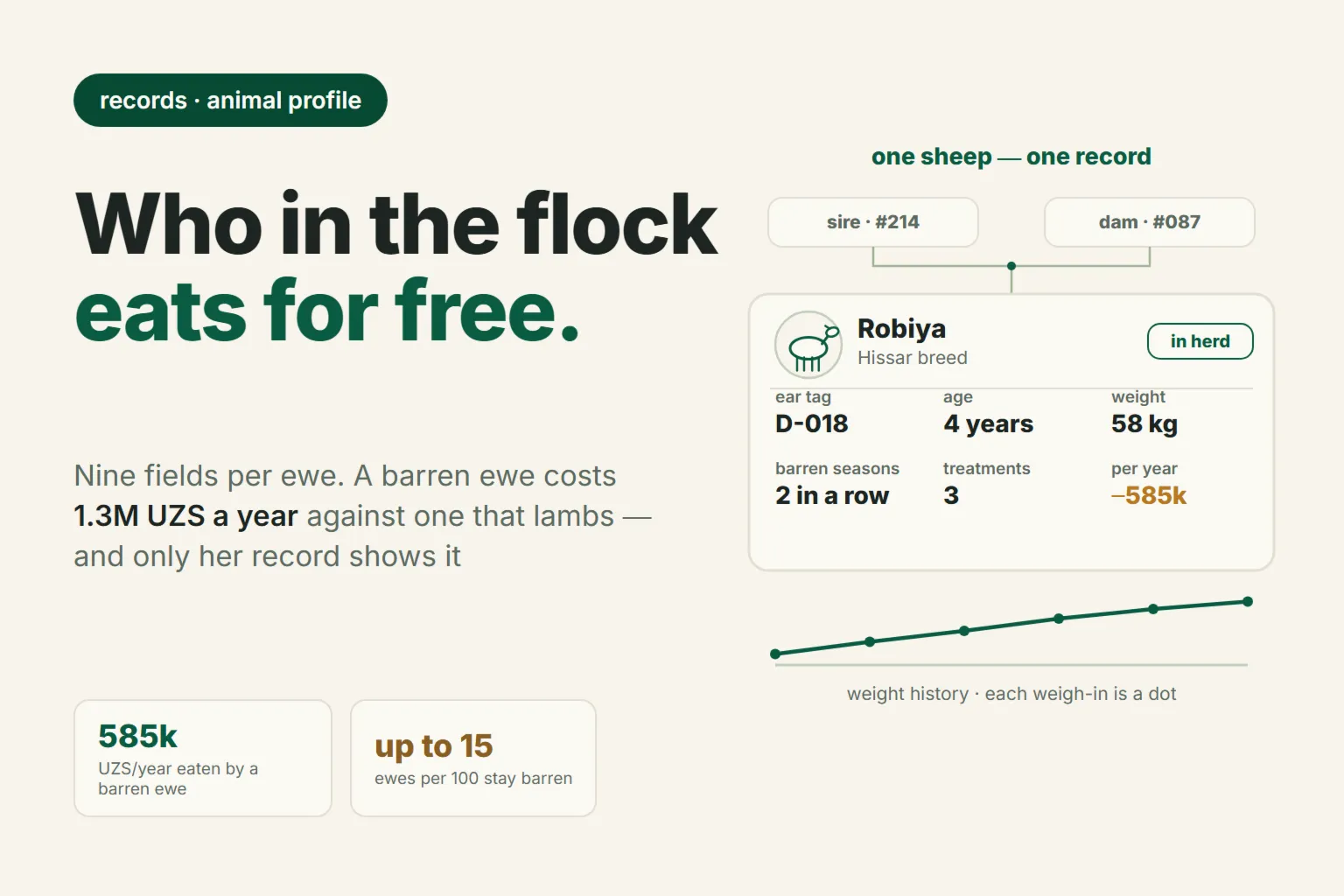
An animal card is a separate record for one sheep: ear tag, date of birth, breed, weight by date, lambings, treatment and money. You need nine fields, and five of them are entered once. A card finds an unprofitable ewe in a simple way: if an animal has an empty "lambing" field for the second season running, it's costing you 584,500 sum a year (≈ $49) in feed and treatments and giving nothing back — against a ewe with a lamb, the gap comes to about 1.3 million sum a year (≈ $114).
Below: exactly what to record, how much a ewe without a lamb costs at September 2026 prices, and how to tell when it's time to move from a notebook to an app.
Why Keep a Record for Each Sheep, Not Just the Whole Flock?
Flocks tend to get counted as one big pool: so many head, so many lambs, so many tons of hay. That kind of pooled accounting shows you the average result and hides the breakdown underneath it.
An example. A flock has 100 ewes, and 85 of them lambed. The average — "85 per hundred" — looks tolerable. But behind that number are 15 ewes that produced nothing all season, while the farmer is feeding all 100 of them. Twins are rare in Uzbekistan's fat-tailed breeds (Hissar, Edilbay, Jaidara) — 105–120 lambs per 100 ewes that lambed — so there's nothing to close the gap with. The difference between "not bad on average" and "fifteen head running at a loss" only shows up once each ewe has her own line.
The same goes for weight gain. A group's average daily gain can look normal while, inside that group, half the lambs are gaining 300 g a day on the ewe and the other half only 130 g. The first half is ready to sell, the second needs a closer look. Without a record for each animal, those two halves don't exist — there's just one average number.
What to Record for Each Animal?
The minimum set is nine fields. Five of them are entered once, in the animal's lifetime; the rest get added as events happen.
| What to record | Why it matters | How often to update |
|---|---|---|
| Ear tag number | Links the animal to every other record. Without a number, the records fall apart | Once |
| Date of birth | Gives an exact age: when to start breeding, when to cull at 5–7 years | Once |
| Sex | Separates ewes, replacement stock and feedlot animals | Once |
| Breed and breed composition | Affects the sale price and how you match breeding pairs | Once |
| Father and mother | Protects against inbreeding, lets you pick replacement ewe lambs from your best ewes | Once |
| Weight with date | Calculates average daily gain and tells you when to sell | Feedlot young stock — once a month; adult ewes — 2–3 times a year |
| Lambings: date and number of lambs | The ewe's main indicator. Two empty seasons in a row — a candidate for culling | Every lambing |
| Vaccinations, treatments, care | Timing for repeat treatment and withdrawal periods before slaughter | Every event |
| Money: purchase price, expenses, sale price | Shows the profit on this specific animal | As it happens |
Everything else — names, photos, body measurements — is nice to have, but record-keeping doesn't work without these nine fields.
How Much Does a Ewe That Didn't Lamb Cost You?
The math below is per ewe, per year, at September 2026 prices. The barn period is 135 days; pasture is treated as free, so the figure is conservative.
| Cost item | Annual amount | Price | Total |
|---|---|---|---|
| Alfalfa hay (at haymaking-season purchase price) | 300 kg | 1,100 sum/kg | 330,000 sum |
| Straw | 60 kg | 600 sum/kg | 36,000 sum |
| Concentrates | 45 kg | 3,300 sum/kg | 148,500 sum |
| Salt lick and mineral supplement | — | — | 20,000 sum |
| Vet treatments and deworming | — | — | 50,000 sum |
| Direct costs for the year | 584,500 sum (≈ $49) |
The dollar conversion uses the Central Bank of Uzbekistan's rate on September 2, 2026: 11,820.48 sum per dollar.
You can't compare that 584,500 sum directly with the price of a lamb: a ewe with a lamb eats more than a barren one does. During the suckling period she needs roughly 250,000 sum more feed for the season, plus creep feed for the lamb itself — about 110,000 sum. You need to compare the difference in results instead.
| Yearly figure | Ewe with a lamb | Barren ewe |
|---|---|---|
| Revenue (31 kg lamb × 55,000 sum/kg) | 1,705,000 sum (≈ $144) | 0 |
| Feed, minerals and treatments | −944,500 sum (≈ −$80) | −584,500 sum (≈ −$49) |
| Yearly result | +760,500 sum (≈ +$64) | −584,500 sum (≈ −$49) |
That's a difference of about 1.3 million sum (≈ $114) per barren head, per year.
Now scale it up to the flock. If 15 out of 100 ewes stay barren, the farm falls short by around 20 million sum (≈ $1,700) a year. Some of this loss is unavoidable: a ewe can miss one season because of weather, illness, or the ram. The reasons are broken down in why a ewe doesn't lamb. Only part of it is unavoidable, though: a chronically barren ewe that misses lambing two or three years running is a pure loss, and there's no reason to keep her.
How to Find the Animals in Your Flock That Aren't Paying Their Way?
The rule is simple: look at the animal's history over two or three years, not just one season.
- Pull up the lambing records for the last two seasons. Empty both times — she's a candidate for culling, no matter how the ewe looks.
- Check her age. By 5–7 years a ewe is wearing out: teeth wear down, milk yield drops. Age is calculated from the date of birth in the card, not guessed by eye; if there's no date of birth, age is judged from the teeth.
- Check whose daughters they are. If the barren ewes are daughters of the same mother, the problem isn't the individual animal — it's the line, and you shouldn't keep replacement ewe lambs from it.
- Cross-check against treatment costs. An animal treated three times in a year costs more than the flock's average figure suggests.
Flock replacement runs 15–20% of ewes a year. That's 15–20 head per hundred, and that's where the money from culled animals goes. If you don't have enough good replacement ewe lambs of your own, you look for replacements elsewhere: check sheep and rams for sale in Uzbekistan and compare the price with what a year of keeping a barren ewe costs you.
Why Does the Card Need a Pedigree — Father and Mother?
A pedigree isn't there for looks — it serves two practical purposes.
First — inbreeding. A herd sire's daughters are ready to breed as early as 8–12 months, once they've reached 65–70% of a mature ewe's weight (the right age to breed a ewe lamb). That means by the third season the ram already starts covering his own daughters — which is why you replace a sire after two full breeding seasons, before the third one begins. Inbreeding produces weak lambs, birth defects and deaths in the first days, and the ewes themselves go barren more often. Without a record of the father, there's no way to tell who's related to whom — the animals look identical.
Second — selecting replacement ewe lambs. A ewe lamb from a mother that lambed and raised her lamb to 30 kg three seasons running is worth keeping in the flock. A ewe lamb from a chronically barren mother isn't, even if she looks sturdier herself. You can only tell them apart from the record of their parents.
Notebook, Excel, or an App: Which Should You Choose?
Honestly, a notebook is enough for up to 20–30 head, and there's no reason to pay for an app. The problem starts once you have more animals than fit in your head.
| What we're comparing | Notebook | Excel | App |
|---|---|---|---|
| Works up to what size | up to 20–30 head | 50–150 head with discipline | no practical limit |
| Finding one animal's history | flip back through the dates | filter, if the table is set up correctly | by ear tag number, instantly |
| Who can keep it | one person | one person at a computer | several people, from a phone in the field |
| Reminds you about repeat treatment | no | no | yes |
| What happens if you lose it | records can't be recovered | the file lives on one computer | data is in the cloud |
| Cost | almost nothing | nothing, if you already have Excel | by subscription plan |
The notebook's weak point isn't the notebook itself, it's search: to piece together one ewe's history over three years, you have to hunt through dozens of pages, and in practice this usually just doesn't happen. Excel's weak point is discipline: the spreadsheet works as long as every event gets entered the same day, in the same columns; after six months the file usually has three sheets with three different structures.
It's important not to confuse two different jobs here. A register answers the question "how many head do I have, and are they all accounted for" — see a separate breakdown on reconciling headcount by ear tag. An animal card answers a different question: "what happened with this specific ewe over three years, and what did she bring in." The first can get by without the second, after a fashion. The second can't get by without the first.
What Does the Animal Card Look Like in QoyHunter?
QoyHunter is a CRM for tracking sheep, plus a marketplace at bazar.qoyhunter.com. On the tracking side, each animal has one card, and it opens in full — no jumping between separate logs.
The card header is the animal's passport: photos, name, breed, status ("in herd", "sold", "left"), ear tag number, sex, date of birth and age, current and expected weight, purchase price and profit on this animal. The breed and status are clickable: tapping either filters the whole flock by that breed or that status. Right there is a QR tag too: you can download and print it, and scanning it opens this exact animal's card.
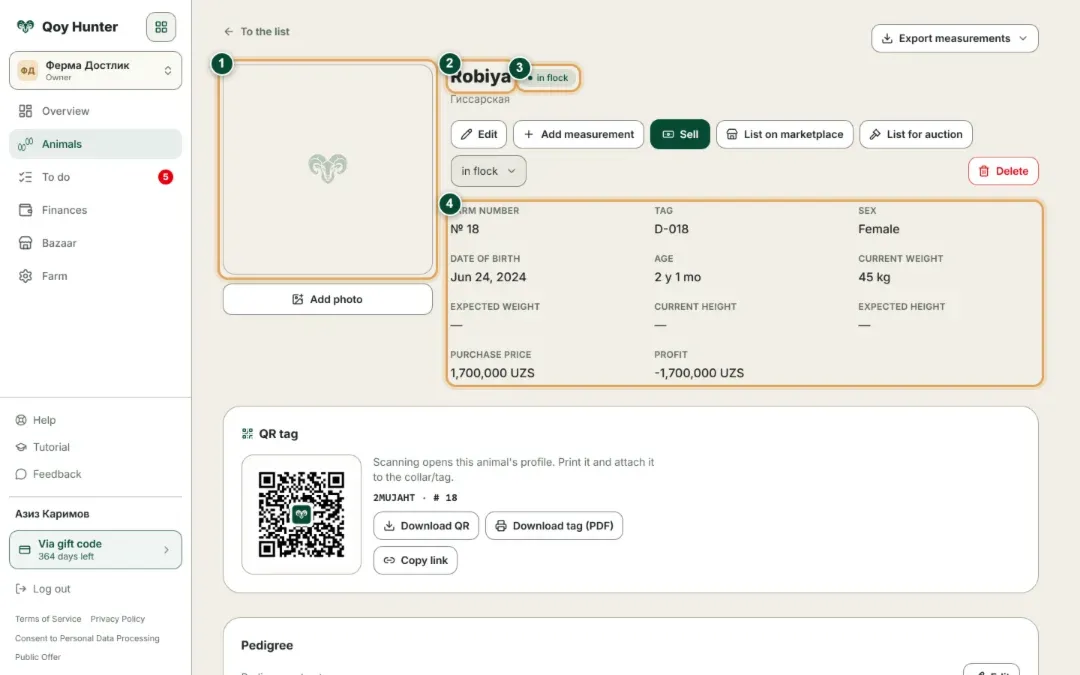
The same header is where an animal goes up for sale: the List on marketplace button builds the listing from the card's fields, and marking the sale closes it automatically. How it works, and why you need a fresh weighing before listing, is covered in selling a ram from its animal card.
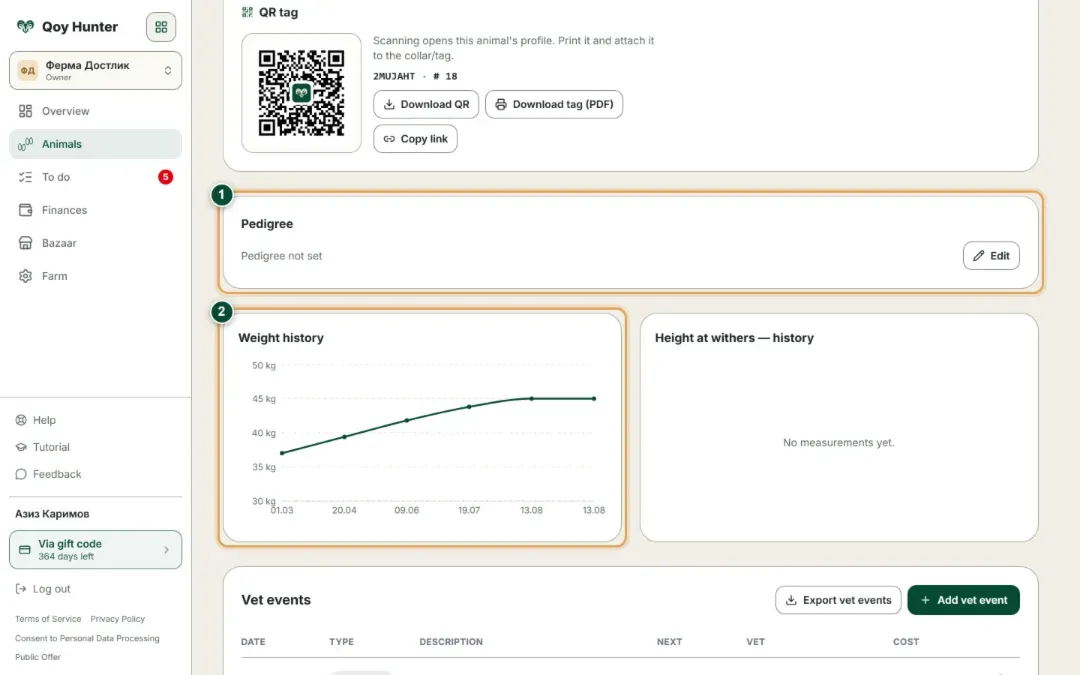
Pedigree and weight sit further down the card. The pedigree records the father, the mother and the breed composition; if a parent is also entered on your farm, its name links to its own card. In the screenshot below the pedigree is still empty — you fill it in once, with the "Edit" button. Next to it is the weight history chart: every weighing becomes a point, and the line shows at a glance whether the animal is gaining or has stalled. Height at withers is tracked separately in the same way — in this example there are no height measurements yet, so that chart is empty.
Vet events sit at the very bottom, in a single feed: vaccinations, deworming and treatment for this specific animal, with the date, the vet's name and the cost. Each entry is tagged by type, and the next-due date shows when to repeat it. In the screenshot below, the cost column shows the price of treating the whole flock, not just one animal: the feed records whatever amount was actually paid for the event.
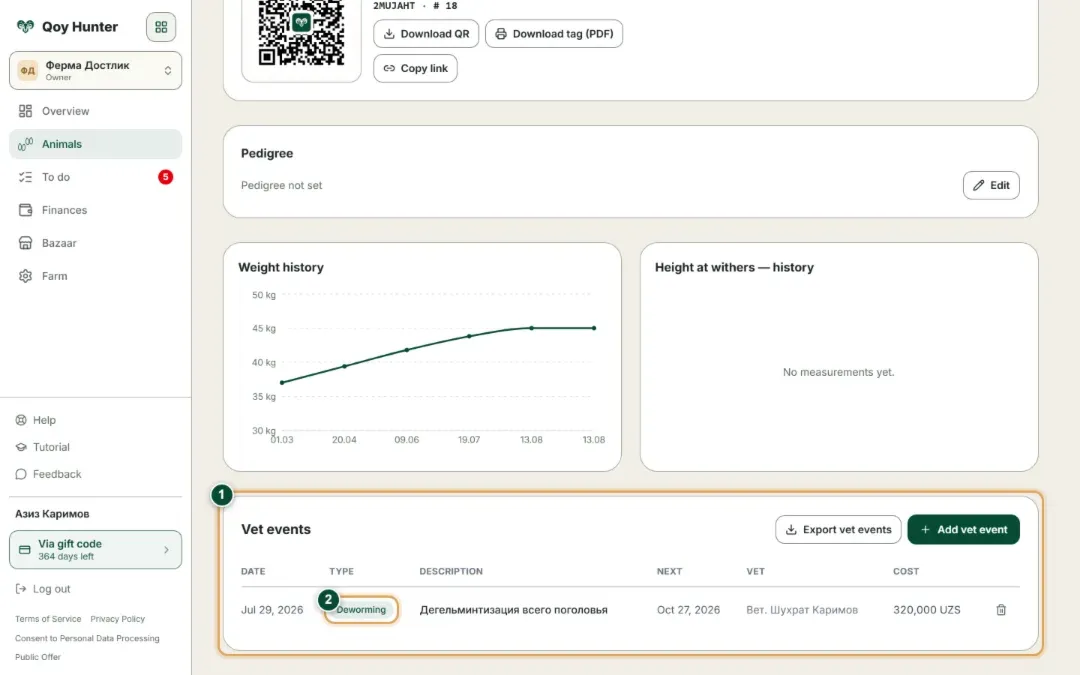
How this looks across every screen is shown on the page "the animal card with pedigree and weight history".
FAQ
What Should You Write on a Sheep's Ear Tag?
A short number that's unique on your farm is enough — D-018, for example. Everything else (breed, date of birth, who the mother is) is kept not on the tag but in the record linked to that number: the tag itself simply doesn't have room for that much text, and it wears off within a season.
Where Do You Start If You Already Have 200 Head and No History on Them?
You don't need to reconstruct the past — it's an impossible amount of work, and you'd just be guessing anyway. It's enough to enter, once, what you know today: ear tag number, sex, approximate age and current weight. History starts building from the next events — a treatment, a weighing, a sale — and after just one season, you'll be able to see for each ewe what she's paid for herself with.
How Do You Know When It's Time to Cull a Ewe?
There are three signs, and any two together are already a reason. An empty "lambing" field two seasons in a row; age 5–7 years with worn teeth; lambs she regularly fails to raise to 26–31 kg by weaning in a commercial flock. Missing a single season isn't a verdict on its own — it can happen because of weather, illness, or the ram.
What Do You Do If a Tag Gets Lost?
You attach a new tag to the animal and keep the old number in the same record — in its name or in a note. Otherwise its history from previous years gets cut off and the animal effectively becomes a new one. That's why, on farms where tags get lost often, the animal is also identified by the photo in its card, not just by the number on its ear.
Do You Need to Weigh Every Month?
For breeding ewes, two or three weighings a year are enough — before mating, before lambing and after weaning. Feedlot young stock need a different rhythm: once a month, otherwise you can't calculate average daily gain, and the point where feeding stops paying for itself will slip by unnoticed.
Manage your flock in QoyHunterCRM for sheep farmers: livestock, health, weighing, finance and analytics — in the app and a Telegram bot.All features →