
When to Wean Lambs from the Ewe: Supplement from 2 Weeks, Weaning at 3–4 Months, and +5 kg at Sale
A ewe's milk covers a lamb through about 4–6 weeks, after that it starts losing gain. When to start supplementing, what to feed, what age and weight to wean at, and how much money it brings — a per-head calculation in soums.
A lamb is born healthy and grows fast through the first month — then seems to stall. Farmers blame the breed or the heat, but the real reason is simpler: the ewe's milk has dropped off, and nothing else is feeding the lamb. Those lost kilograms are the ones you'll be missing come autumn, when it's time to sell.
Let's work through when and what to feed lambs as a supplement, what age to wean them at, and how much money that puts in your pocket per head. Prices are from July 2026, at an exchange rate of about 12,100 soums per dollar.
Why a Lamb Stalls in Its Second Month
For the first 4–6 weeks, a lamb lives on milk alone, and there's plenty of it: it gains 250–300 grams a day and wants for nothing. After that, two curves start to diverge.
A ewe's milk yield peaks around week 3–4 after lambing, then falls: by week 10 she's giving about half her peak output, and by the third month, up to three times less. The lamb, meanwhile, is growing and needs more, not less. It takes about 4–5 kg of ewe's milk for every kilogram of gain — so to keep putting on the same 250 grams a day, by the end of the second month the lamb needs more than a liter of milk daily, and a ewe past her lactation peak simply isn't giving that much anymore.
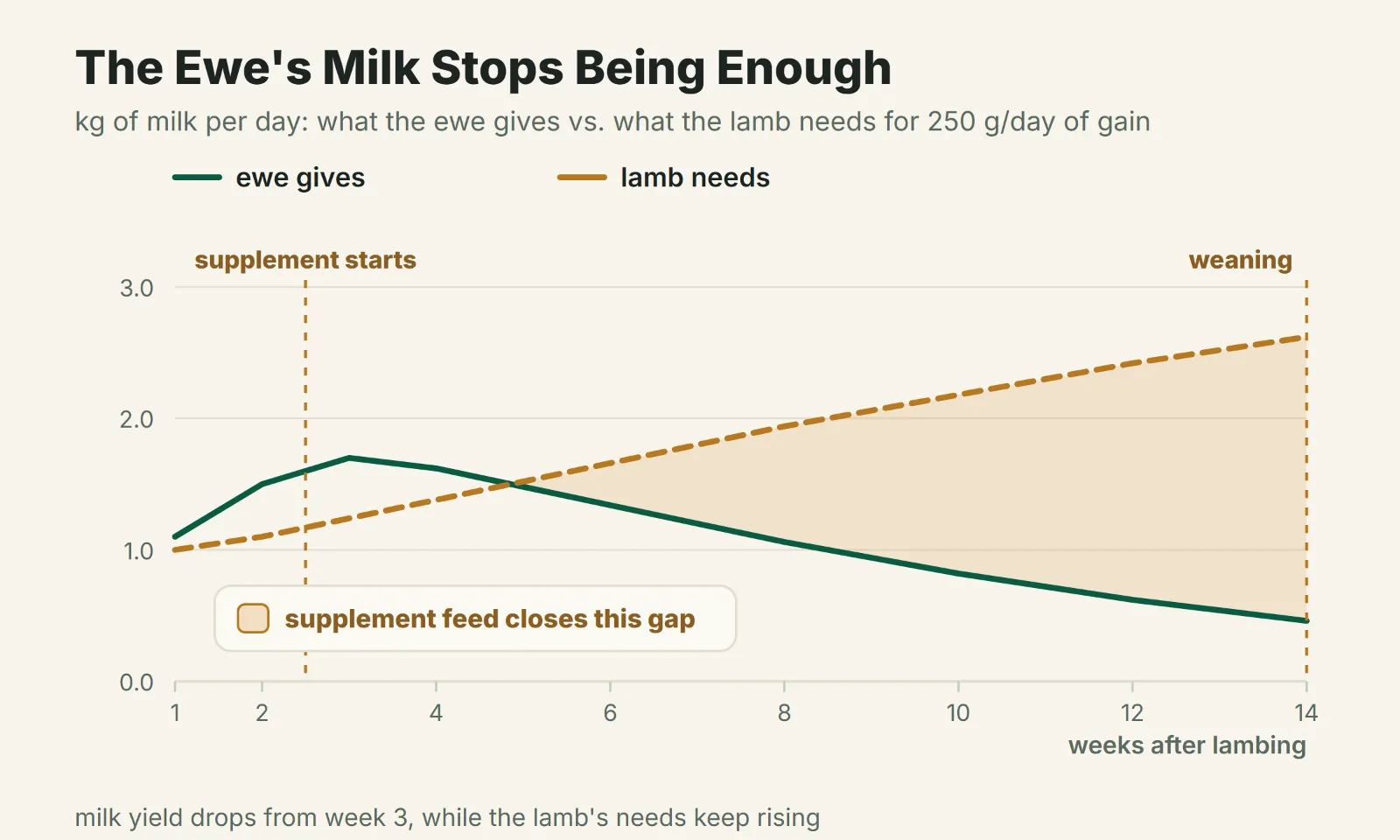
That gap between what the lamb needs and what it's getting is what's called the milk gap. The lamb doesn't lose weight — it just grows slower than it could, and the shortfall quietly builds up, day after day.
Supplemental Feed from Week Two or Three: How It Works
A lamb starts nibbling solid feed as early as 2–3 weeks old — and that's not just play: concentrates and good hay get the rumen developing, and without that, it won't be able to digest feed properly after weaning. The earlier the rumen starts working, the easier weaning goes.
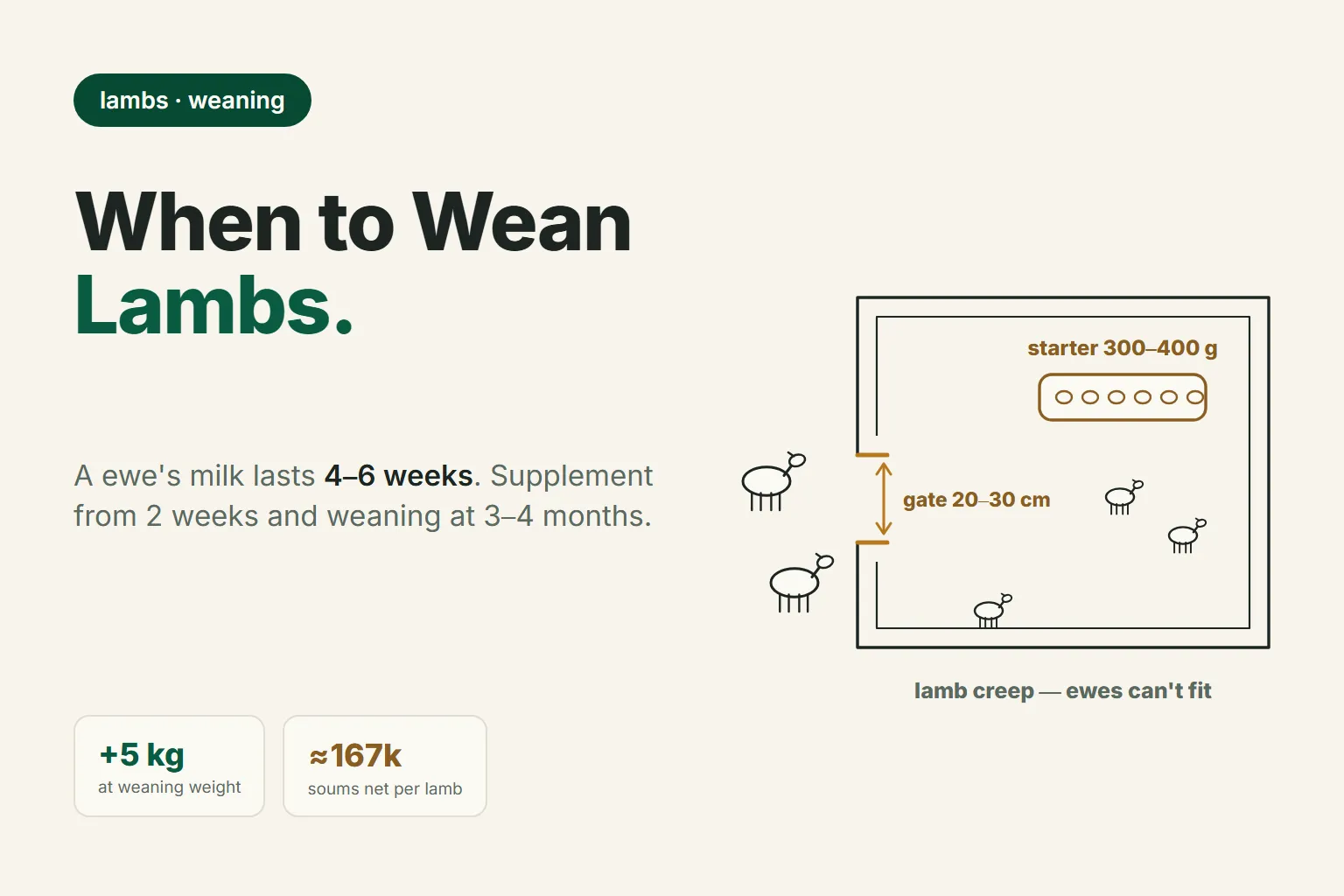
There's one problem: put feed in the shared trough, and the adult ewes eat it. So set up the supplement in a separate creep pen with a narrow gate — lambs fit through, ewes don't. Make the gate adjustable: about 20 cm wide for young lambs, widening to 25–30 cm by 2–3 months; height around 45 cm. Put the pen where the flock spends the night, so the lambs find it on their own.
The main requirement for the mix is at least 15–16% crude protein: on grain alone, a lamb won't hit the promised gain — it won't get enough protein. A working recipe from local feeds:
| Component | Share of mix | Why |
|---|---|---|
| Cracked barley | ~35% | main energy |
| Cracked corn | ~20% | energy, readily eaten |
| Wheat bran | ~20% | fiber, easier on the rumen |
| Sunflower meal (or cracked peas) | ~20% | protein — no gain without it |
| Chalk, salt, premix | ~5% | calcium and minerals |
Alongside it, put out top-quality leafy alfalfa hay (not straw) and clean water: without water, the rumen doesn't work no matter how much grain you pour in.
Start with 50–100 grams of mix per head a day, and work up to 300–400 grams by weaning (up to 500 grams if fed free-choice indoors). Feed small amounts often: leftovers go sour, and once that happens the lambs stop coming to the trough.
Don't feed cottonseed cake or meal to lambs under 4 months old — their rumen doesn't yet protect them from gossypol, and gossypol poisoning in lambs causes sudden death from heart damage. That's exactly why the protein in a starter mix comes from sunflower meal, peas, and alfalfa hay, not from the cheapest local cottonseed cake. More on gossypol in the article “What to Feed Rams for Weight Gain”.
One more must: vaccinate against clostridial disease (enterotoxemia) before lambs move onto larger grain rations. Grain in the diet sharply raises the risk, and the disease kills the biggest, fastest-growing lambs first. Schedule and timing are in the vaccination calendar.
What It Costs and What It Brings Back
We're calculating for one lamb, fed supplement from 3 weeks old to weaning at 3.5 months — about 90 days.
At July retail prices, the mix costs around 4,000 soums per kilogram (≈ $0.33): barley 3,800, corn 4,500, bran 2,800, sunflower meal around 5,000 soums/kg, plus the mineral portion.
You do not have to mix it yourself: to buy starter feed for lambs ready-made by the sack often costs no more once you count the mineral part and your own labour.
| Item | Amount | Cost |
|---|---|---|
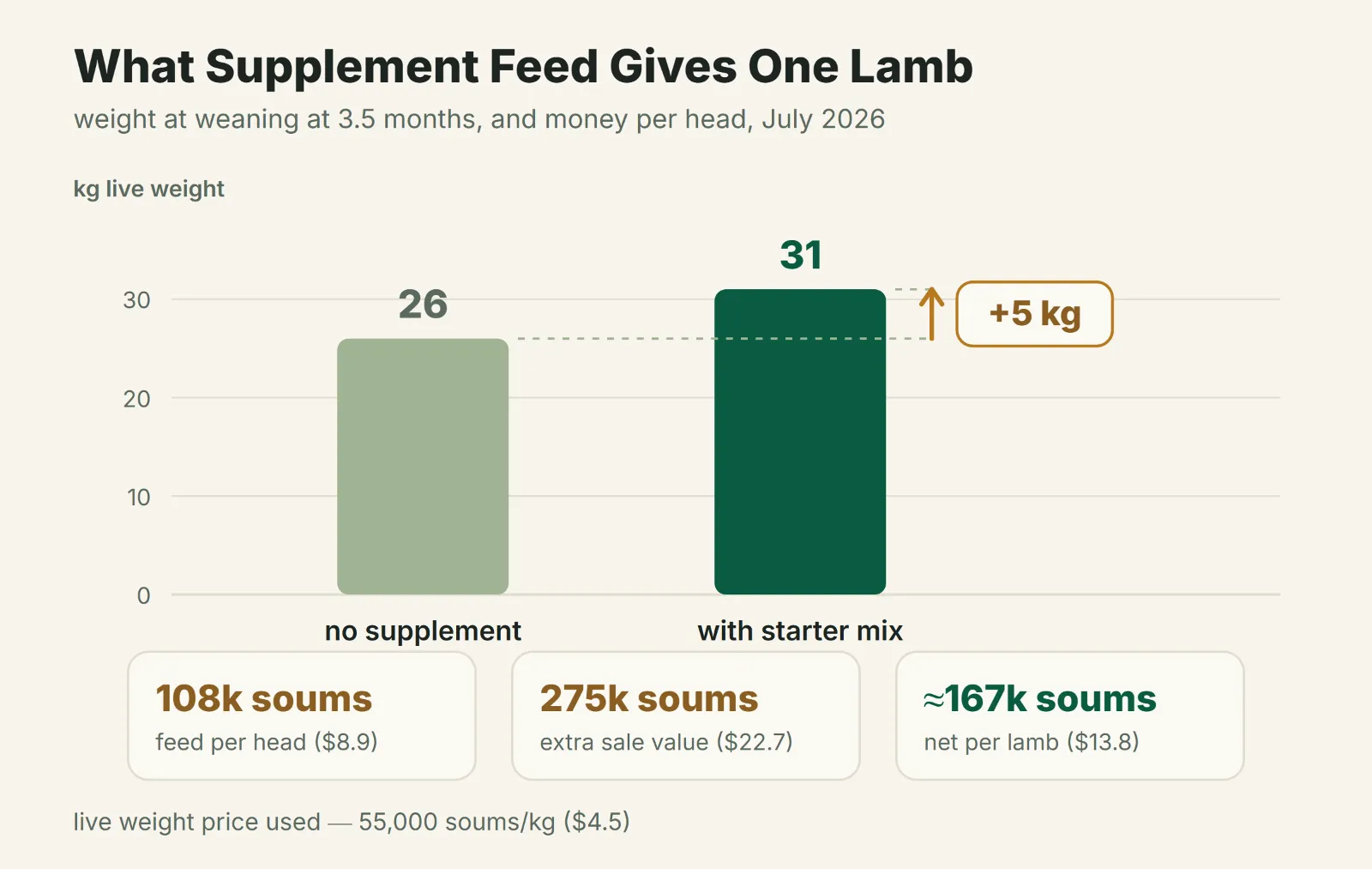
| Starter mix (avg. 0.25 kg/day) | 22 kg | 88,000 soums ($7.3) |
| Alfalfa hay for supplementing | 18 kg | 20,000 soums ($1.7) |
| Total cost per head | ≈ 108,000 soums ($8.9) |
These are bagged retail prices. Grain bought by the tonne from a farm or on the exchange costs one-and-a-half to two times less — and the return on supplementing grows accordingly.
Now the payoff. A fat-tailed lamb born at 4.5 kg, raised on milk alone over a lean summer pasture, reaches about 26 kg by 3.5 months (roughly 205 g of gain a day). With supplement, the same lamb gains 250 grams or more and reaches weaning at around 31 kg. In pedigree Hissar and Edilbay herds, good feeding gets lambs to 40–45 kg by 4 months — but those flocks have different ewes and a different ration, so we're using the conservative figures of an ordinary commercial flock.
The difference is 5 kilograms of live weight. At a conservative 55,000 soums per kilogram of live weight (≈ $4.5), that's 275,000 soums ($22.7) per head. Subtract the feed cost and you're left with about 167,000 soums ($13.8) net: every som spent on supplement returns 2.5 soums in revenue, of which 1.5 soums is clear profit.
Those five kilograms only exist if you weighed them: weaning weight control for lambs at the start and at weaning turns creep feeding from a belief into a number.
Across a flock of 50 lambs, that's 8.4 million soums (about $690) in a single season. And that's without counting that a supplemented lamb reaches slaughter condition sooner: you save weeks of expensive finishing, when a kilogram of gain costs a lot more (how to calculate the cost per kilogram of gain).
When to Wean: by Age or by Weight
The right answer is by weight, with an eye on age. Benchmarks for fat-tailed breeds:
- Age — 90–120 days (3–4 months) under ordinary suckling rearing.
- Weight — from 20–22 kg, roughly four to five times birth weight; well-supplemented lambs weigh 28–32 kg by this point, and in pedigree herds reach up to 40 kg.
- The lamb is confidently eating 250–300 g of concentrate a day — this is the main sign it's ready. If it isn't coming to the trough, weaning will mean weight loss.
Early weaning at 60–75 days is possible, but only with a full starter feeding program and good hay; on bare pasture, lambs weaned that early simply stop growing.
Weigh a sample of 8–10 head, not the whole group — that's enough to tell whether the batch is ready. Log lambing dates and weigh-ins: in QoyHunter's animal card, weight and age show up at a glance, so the weaning decision stops being a guessing match.
A bottle-reared orphan lamb is weaned earlier, at 5–6 weeks: once it weighs 11–15 kg and eats at least 250 g of starter feed a day. Milk amounts by week and the weaning plan are in our guide on what to feed an orphan lamb.
How to Wean Without Losses
Weaning is stressful for both sides, and the two places where money gets lost are known in advance: for the lamb, it's stalled growth; for the ewe, it's mastitis.
- Pull concentrates from the ewes 5–7 days before weaning (start 10–14 days ahead for high-milking ewes) and cut back succulent feed, leaving coarse hay — lactation will wind down gradually and the udder won't overfill. Don't milk out the udder after weaning: that only prolongs lactation and raises the risk of mastitis.
- Move the ewes away, not the lambs. Lambs stay in a familiar place, at familiar troughs and waterers — that keeps them calmer and gets them eating sooner. Separate ram lambs from ewe lambs right at weaning: they reach sexual maturity at 5–7 months. If there's nowhere to keep them apart, the decision on castrating ram lambs gets made ahead of time, back at lambing.
- Move the ewes far enough away that the two groups can't hear each other; otherwise both ewes and lambs will pace the fence line and lose weight.
- Don't change the feed on weaning day. Lambs should get exactly the same mix as before; wait at least 2–3 weeks before changing the ration, and do it gradually.
- Check the ewes' udders for the first five days. A hot, firm, painful udder half means mastitis — call a vet, don't wait for it to “pass on its own.” How to tell acute mastitis from chronic, what to do in the first 24 hours, and which ewes to cull before breeding is covered in mastitis in sheep: signs and treatment.
- Watch the lambs closely for the first few days after weaning. Mild fussing and bleating is a normal stress response. But if diarrhea or coughing doesn't clear up within a day, or a lamb refuses feed or falls behind the group — that's no longer stress, it's coccidiosis or pneumonia, and it needs a vet. Don't pack all the young stock into a cramped, hot shed: crowding is the main cause of both diseases.
If lambs scour or stop gaining 2–3 weeks after weaning, coccidiosis is the first suspect: its peak falls right at 4–8 weeks of age and the stress of weaning. Signs, treatment and prevention are in our article on why weaned lambs scour and stop gaining weight.
What Weaning on Time Does for the Ewe
While a ewe is nursing, she's spending her own body condition on milk — and by autumn she's thin. Her body condition at breeding time directly determines how many lambs you'll get next season: a depleted ewe comes into heat later, conceives worse, and won't be giving you twins.
With lambing in March–April, weaning falls in June–July, leaving the ewe 2.5–3 months before autumn breeding to rebuild condition on summer feed. Push weaning out to September, and you lose not just this season but the next lamb crop too. The full annual cycle is covered in the guide “Breeding, Lambing, and Lamb Care”.
Five Mistakes That Cost Money
- Waiting for the lamb to “stop nursing on its own.” Given the chance, a lamb will nurse for up to six months — at the ewe's expense, and at the expense of her next lamb crop.
- Putting feed in the shared trough. Without a creep gate, the adult ewes eat the supplement, and you're the one who paid for it.
- Switching lambs onto grain abruptly after weaning. Acidosis and enterotoxemia kill lambs on exactly this transition. Introduce grain gradually, over 2–3 weeks.
- Feeding cottonseed cake to lambs under 4 months. Cheap right up until the first death.
- Weaning and moving to a new location at the same time. Two stresses at once cost you two weeks of gain.
In Short
- A ewe's milk covers a lamb's needs for about 4–6 weeks, then the milk gap sets in.
- Start supplement at 2–3 weeks in a creep pen with a 20–30 cm gate: a mix of barley, corn, bran, and sunflower meal (15–16% protein), plus alfalfa hay and water.
- Ration runs from 50–100 g up to 300–400 g of mix a day by weaning.
- Wean at 90–120 days and 20–22 kg or more, once the lamb is confidently eating concentrate.
- Spending ≈ 108,000 soums ($8.9) per head buys +5 kg of live weight — about 167,000 soums ($13.8) of clear profit per lamb.
- Move the ewes away from the lambs, pull concentrates 5–7 days ahead, check udders for five days, and don't milk them out.
Weaning, droving and housing all on the same day cost you more than gain: pneumonia in the young stock follows — how to spot it and what it costs.
Manage your flock in QoyHunterCRM for sheep farmers: livestock, health, weighing, finance and analytics — in the app and a Telegram bot.All features →