Coccidiosis in Lambs: Why Weaned Lambs Scour and Don't Gain Weight on Feed
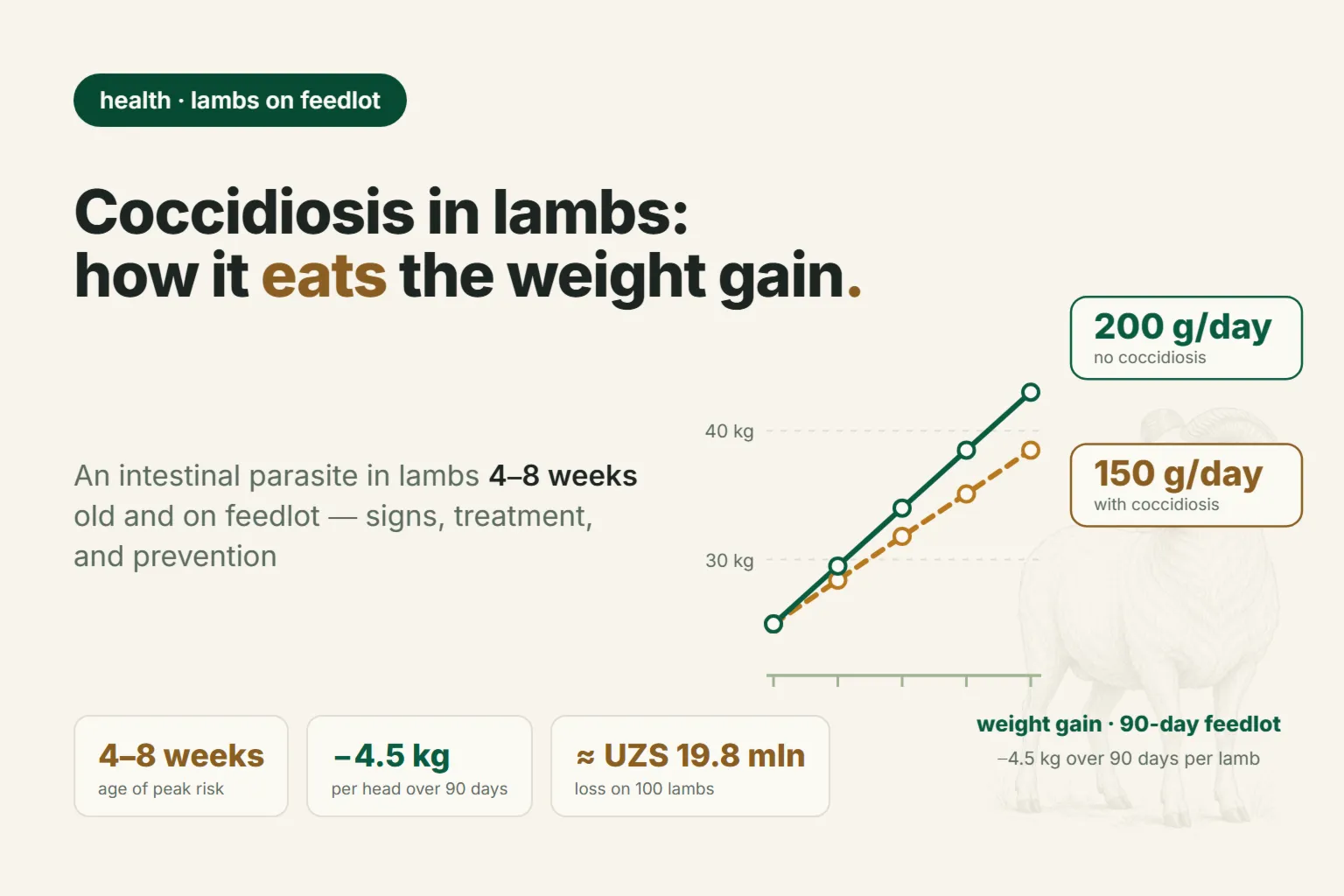
Coccidiosis hits lambs at 4–8 weeks and in the first weeks on feed. Signs, how it differs from other scours, treatment, and prevention — plus the math: when gain drops from 200 to 150 g a day, a batch of 100 lambs loses about UZS 19.8 mln (≈ $1,670) over 90 days.
Coccidiosis in lambs is an intestinal disease caused by single-celled parasites of the genus Eimeria. It most often hits lambs at 4–8 weeks and weaned lambs in their first weeks on feed, once they're crowded together in a pen. The main loss from coccidiosis isn't death — it's gain: the lamb scours, falls behind, and puts on less weight while finishing. If a batch of 100 lambs gains 150 g a day instead of 200 g, over 90 days that's −4.5 kg per head and about UZS 19.8 mln (≈ $1,670) in lost revenue for the batch.
What Is Coccidiosis in Sheep, and Where Does It Come From in a Flock?
Sheep coccidiosis is a parasitic disease of the small and large intestine. The parasite destroys gut cells from the inside, so the lamb absorbs feed poorly and loses water through scours.
Eimeria are present in nearly every flock. Adult ewes carry them without signs of disease but shed oocysts — microscopic parasite "eggs" — in their droppings. An oocyst becomes infective within 2–4 days in warm, damp conditions, and in bedding and the soil around feeders it survives for months, outlasting many disinfectants. A lamb picks up the infection by eating feed or drinking water contaminated with droppings.
Two things are worth knowing right away:
- Coccidia are strictly host-specific. Sheep Eimeria don't infect goats, chickens, or calves, and vice versa. Chicken coccidiosis poses no threat to a flock of sheep — but the droppings of adult ewes and older lambs are the main source.
- Not every species is dangerous. More than a dozen Eimeria species have been described in sheep, but severe disease comes mainly from two: Eimeria ovinoidalis and Eimeria crandallis. That's why a simple oocyst count in droppings, without identifying the species, tells you little on its own.
At What Age Do Lambs Get Coccidiosis?
Lambs most often get coccidiosis at 4–8 weeks of age, and in the first 2–3 weeks after weaning or moving onto feed. Up to a month old, a lamb is partly protected by its mother's milk, and an adult ewe has already built immunity. In between, the lamb meets the parasite for the first time, and in a large dose.
About 2–3 weeks pass between infection and scours — that's how long Eimeria need to multiply in the gut. That gives a practical rule for feeding in Uzbekistan: if you've bought or weaned lambs and put them into a shared pen, the most dangerous days are day 14 through day 30 after they go in.
An outbreak is triggered by:
- crowding — too many head per square meter, so droppings pile up faster than they can dry;
- feed off the ground, and feeders lambs can climb into with their feet;
- dampness around waterers and under the shed roof, wet bedding;
- stress: weaning, transport, mixing batches from different farms, a feed change;
- lambs of different ages in the same pen — the older ones "seed" the pen for the younger ones.
How Do You Tell Coccidiosis Apart from Other Scours in Lambs?
Scours in a lamb can have several causes, and age is a clue to which one is most likely. Only a fecal test identifying the Eimeria species, or a post-mortem exam by a vet on a dead lamb, gives a definite answer.
| Lamb's age | Likely cause of scours | How it shows |
|---|---|---|
| 1–4 days | E. coli (colibacillosis) | watery scours, rapid dehydration, often after poor colostrum intake |
| 5–10 days | cryptosporidiosis | yellow, watery scours, lamb listless, almost all lambs of the same age in the group fall sick |
| 4–8 weeks and after weaning | coccidiosis | scours with feed and mucus, sometimes blood, straining, poor growth |
| on feed, after a feed change | rumen acidosis (grain overfeeding) | scours with undigested grain, bloat, tied to a sharp jump in concentrates |
| from 2–3 months on pasture | worms (gastrointestinal nematodes) | scours and poor growth (trichostrongyles); with haemonchosis there's no scours — pale mucous membranes, "bottle jaw" |
Signs of coccidiosis in a lamb:
- scours, tail and hind legs caked in droppings; in severe cases, mucus and blood;
- straining without result, a hunched back;
- the lamb eats less, its coat is dull, its sides are sunken;
- the spread in weight within the group grows: some lambs look normal but gain more slowly.
The last sign is the most common one. Most coccidiosis on feed runs without obvious scours: lambs simply fall behind, and the owner blames the feed. The only way to catch it is with a scale: if a group gains less than a neighboring one for two weeks running after going on feed, that's a reason to send droppings for testing.
How Much Money Does Coccidiosis Cost a Feeding Operation?
Coccidiosis on feed costs money three ways: a shortfall in gain, extra feed spent per kilogram gained, and deaths in severe outbreaks. Let's work out just the first one — it's almost always there.
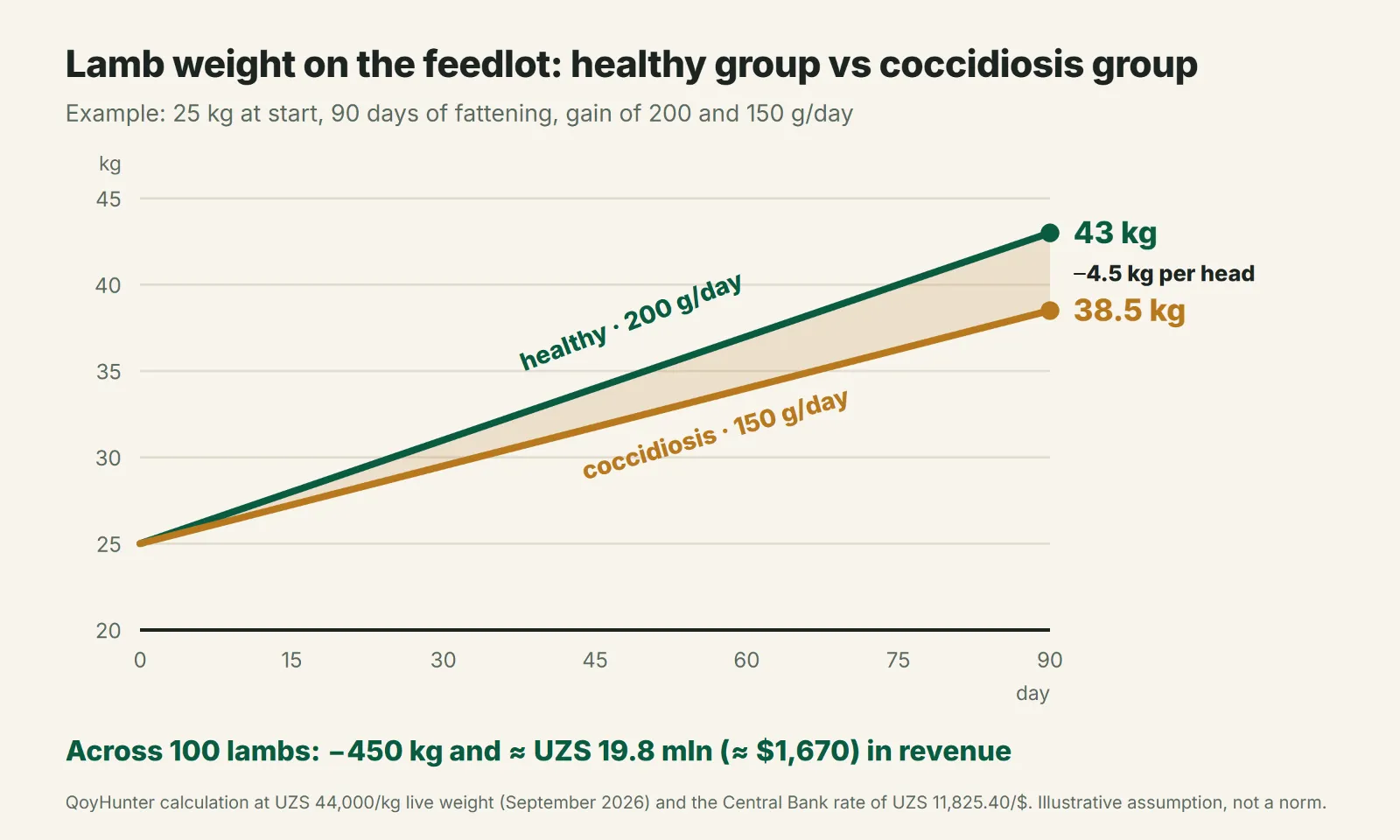
A sample calculation: a batch of 100 lambs on feed for 90 days, at a live-weight price of UZS 44,000/kg (the average price for a culled ewe in September 2026 — we're taking it as a cautious lower bound; a lamb usually sells for more per kg on the market), at the Central Bank of Uzbekistan's rate of UZS 11,825.40 to the dollar on September 26, 2026. The healthy batch gains 200 g a day; the batch with coccidiosis but no obvious scours gains 150 g. That's an assumption for the example, not a norm — the real shortfall depends on how severe the infection is.
| Metric | Healthy batch | Batch with coccidiosis |
|---|---|---|
| Daily gain per head | 200 g | 150 g |
| Gain over 90 days per head | 18 kg | 13.5 kg |
| Gain across 100 lambs | 1,800 kg | 1,350 kg |
| Revenue from gain (UZS 44,000/kg) | UZS 79.2 mln (≈ $6,700) | UZS 59.4 mln (≈ $5,020) |
| Difference | — | −UZS 19.8 mln (≈ $1,670) |
And that's without counting feed: over 90 days, a coccidiosis-affected batch eats almost as much but sells for 450 kg less. That means every kilogram of its gain costs more. For how to work out the cost per kilogram of gain using your own feed, see our breakdown of the cost of weight gain in rams.
A shortfall in gain only shows up through regular weigh-ins of the same lambs. In QoyHunter, a CRM for sheep records and the bazar.qoyhunter.com marketplace, the weighing and lamb gain records tool logs every weight to the animal's card, and a group that's falling behind shows up in the numbers within two weeks — not by eye at the end of the feeding period.
What Treats Coccidiosis in Lambs?
Coccidiosis in lambs is treated with anticoccidial drugs, and the drug and dose should be chosen by a veterinarian after a fecal test. Alongside treatment, always give fluids: a lamb with scours loses water faster than it loses weight.
What vets typically use:
- Toltrazuril and diclazuril — single-dose oral drugs. They kill the parasite at its early development stages, so they work best when given before the expected outbreak — for example, 1–2 weeks after going on feed, or at around 4–6 weeks of age. Once scours are already in full swing, the gut is damaged, and the lost gain won't come back regardless.
- Sulfonamides — given as a course to treat lambs with obvious signs.
- Fluids — a warm electrolyte solution for lambs with scours, and a separate dry pen for the weak ones.
The dose is calculated by live weight, so lambs are weighed before treatment, or at least sorted into groups by weight. The withdrawal period before slaughter differs from drug to drug and is stated in the instructions, and the gap is large: toltrazuril has a long one (42 days for Baycox Sheep in the EU), while diclazuril's can be zero. That matters on feed: a lamb only goes to slaughter once the withdrawal period is over. Treatment given 1–2 weeks after going onto a 90-day feeding period fits comfortably within that period.
Which lamb was treated, with what, and when gets logged the same day. In the flock treatment and vaccination log, the date, the drug, and the withdrawal period sit right on the animal's card, so before selling a batch you can see who's already clear to go.
How Do You Prevent Coccidiosis on Feed?
Coccidiosis isn't something you treat once for the flock's whole life: the parasite lives in the pen. So prevention is first and foremost about order in the pen, and drugs only provide insurance during the dangerous weeks.
What's done:
- Feeders raised off the ground. The rim should be high enough that a lamb can't climb into the feeder with its feet and foul the feed with droppings. Feed off the ground is a direct route of infection.
- Waterers clean, and dry around them. A puddle by a waterer is the best place for oocysts to mature. Set up waterers so water doesn't spill underfoot, and wash them regularly.
- Dry bedding and manure removal. Wet bedding is replaced, and the areas around feeders and waterers are cleaned more often than the rest of the pen. Sun and dryness lower contamination; damp and shade raise it.
- Don't crowd them. The more densely lambs are packed, the more droppings per square meter, and the worse the outbreak.
- One batch, one pen. Lambs of different ages and from different farms aren't mixed. Keep purchased lambs separate at least for the quarantine period — how to run it is covered in our article on quarantining new sheep: the 30 days that save a flock.
- Scheduled treatment during the risky weeks — following a plan from a vet: either a single-dose drug 1–2 weeks after going on feed, or an anticoccidial feed additive for the whole feeding period (for example, decoquinate).
If you're buying lambs for feeding from someone else, ask the seller what they were treated with, when, and how many weeks old they are. It's easier to do this ahead of time by browsing lambs and rams for sale in Uzbekistan: you can work it out with the owner before buying, rather than sorting it out at the gate.
FAQ
Can Coccidiosis Spread to Lambs from Chickens or Goats?
No. The Eimeria that cause coccidiosis are strictly host-specific: chicken parasites only infect chickens, and goat parasites only infect goats. What's dangerous for lambs is the droppings of adult ewes and older lambs in the same pen, so poultry in the yard won't pass coccidiosis to the flock.
Why Do Lambs on Feed Get Scours Two to Three Weeks After Purchase?
About 2–3 weeks pass between infection with coccidia and the onset of scours. Lambs get infected in the first days in a new pen, when the stress of transport and mixing batches lowers their defenses, and scours and weight loss show up right around day 14 to day 30 after going on feed. If several lambs start scouring at the same time during that window, send droppings to a vet for testing.
Can You Cure a Lamb's Coccidiosis with a Single Injection?
The main drugs against coccidiosis in lambs aren't given by injection — they're given orally, and toltrazuril or diclazuril really are given just once. But they work best before an outbreak: in a lamb whose scours have already set in, the gut is damaged, and the lost gain can't be recovered. A vet prescribes the drug and the dose based on live weight.
If Lambs Have No Scours, Can They Still Have Coccidiosis?
Yes, and that's actually the most common case. Mild coccidiosis on feed runs without obvious scours: the lambs eat, but gain less, and the spread in weight within the group grows. The only way to catch it is by regularly weighing the same lambs, and the only way to confirm it is a fecal test identifying the Eimeria species.
How Much Money Does a Farmer Lose to Coccidiosis on Feed?
In the example of a batch of 100 lambs, if gain drops from 200 to 150 g a day, over 90 days of feeding that's 4.5 kg per head and 450 kg for the batch. At a cautious price of UZS 44,000/kg live weight (the average price for a culled ewe, September 2026), the lost revenue comes to about UZS 19.8 mln (≈ $1,670), and that's without counting extra feed or deaths.
Manage your flock in QoyHunterCRM for sheep farmers: livestock, health, weighing, finance and analytics — in the app and a Telegram bot.All features →