
Castrating Ram Lambs: Do You Need to Castrate Lambs for Finishing, and at What Age
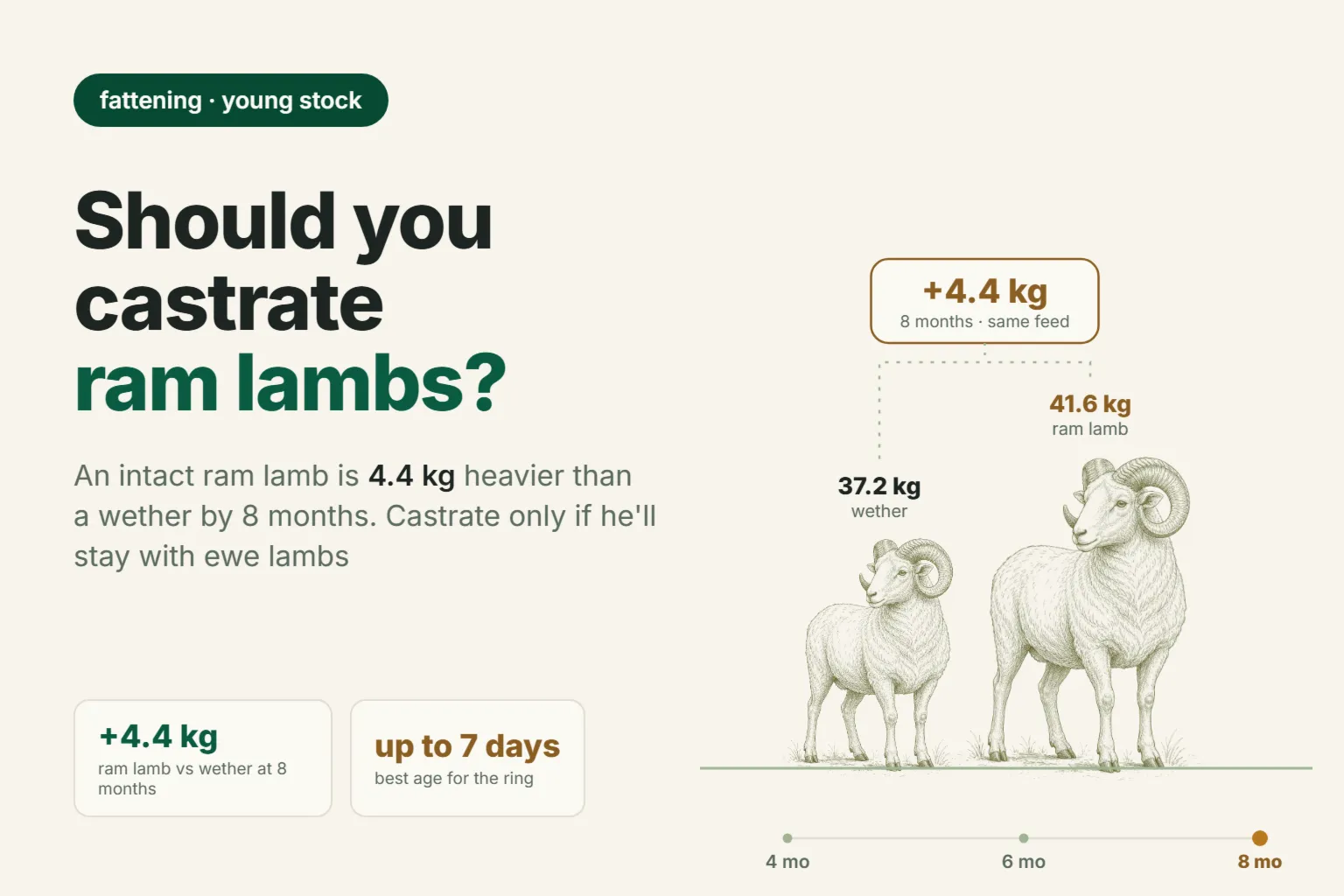
An intact ram lamb is 4.4 kg heavier than a wether by 8 months — about 242,000 soum a head. When castration is still worth it, at what age, and which method keeps you from losing the lamb.
Do ram lambs raised for finishing need to be castrated? Usually not: if you sell the ram lamb before 6–8 months, or keep him separate from ewe lambs and ewes, an intact lamb grows faster and needs less feed per kilogram of gain. In a study of the Karachay breed, an intact ram lamb weighed 41.6 kg at 8 months, against 37.2 kg for his castrated littermate: a difference of 4.4 kg, worth about 242,000 soum (≈ $20) a head at September 2026 prices. Castration is worth doing when a ram lamb stays in the mixed flock past 5 months, or is kept for more than a year. In that case, do it with a rubber ring in his first week of life.
A wether is a castrated ram. Prices in this article are as of September 2026: live weight of young stock at 55,000 soum/kg (the low end of the usual 55,000–65,000 range), and the Central Bank of Uzbekistan's rate for September 19, 2026 was 11,840 soum per dollar.
How Is an Intact Ram Lamb More Profitable Than a Wether for Finishing?
A ram lamb's testicles produce testosterone, which drives muscle and bone growth. A wether's metabolism slows down, and feed turns into fat faster than into muscle. That produces three differences that keep showing up in studies from different countries:
- higher weight gain: in a trial published in Translational Animal Science in 2025, ram lambs on an 8-week finishing period gained 394 g a day, against 324 g for wethers — a 22% higher gain for intact lambs;
- less feed per kilogram of gain: in the same trial, intact ram lambs needed roughly 12% less feed for every kilogram of gain;
- a leaner carcass: less subcutaneous fat and more muscle — that's how a meta-analysis in Meat Science (2014) sums up data from many trials.
That trial ran in the US, on meat breeds of European origin. Closer to our fat-tailed sheep is the Karachay coarse-wool breed: in a study by M. S. Gabaev (2021), ram lambs and wethers castrated at 2–3 weeks were raised under the same conditions and weighed up to 8 months old.
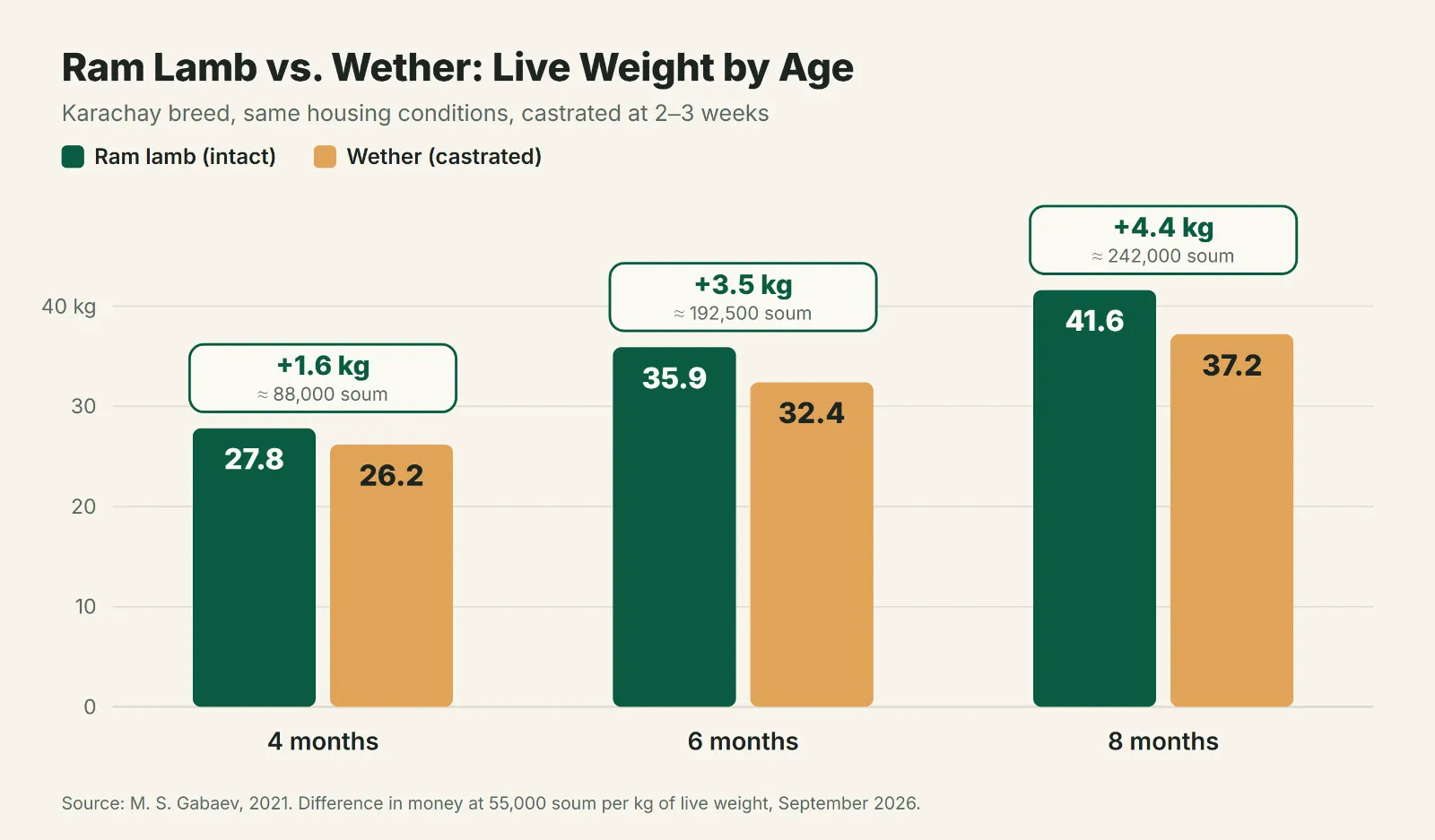
| Age | Ram lamb, kg | Wether, kg | Difference, kg | Difference in money* |
|---|---|---|---|---|
| 4 months | 27.8 | 26.2 | +1.6 | 88,000 soum (≈ $7) |
| 6 months | 35.9 | 32.4 | +3.5 | 192,500 soum (≈ $16) |
| 8 months | 41.6 | 37.2 | +4.4 | 242,000 soum (≈ $20) |
* At 55,000 soum per kilogram of live weight, September 2026.
The gap widens with age: at 4 months it's barely visible, by 8 months it's almost 12% of the wether's weight. The carcass of an 8-month-old ram lamb weighed 21.2 kg, against 17.9 kg for a wether. The fat tail didn't get any bigger on the wethers, though: 1.7 kg for intact lambs against 1.5 kg for castrated ones.
How Much Does a Farm Lose by Castrating Every Ram Lamb?
Take 50 ram lambs from a spring lambing that are finished and sold at 8 months. If you castrate all of them, the same trial's numbers say the farm comes up short by 4.4 kg × 50 head = 220 kg of live weight. At 55,000 soum, that's 12.1 million soum (≈ $1,020) for the same feed, labor, and barn space. Sell at 6 months and the difference is smaller: 3.5 kg × 50 head, or 9.6 million soum (≈ $810).
Numbers from one trial don't transfer to every flock one-to-one: breed, ration, and sale age all move the difference. The only way to check it on your own ram lambs is with a scale. Weigh ram lambs and wethers on the same day once a month and compare average daily gain. QoyHunter — a CRM for sheep record-keeping, with the bazar.qoyhunter.com marketplace — can calculate each ram lamb's average daily gain from weighings, so the difference between groups shows up within a month or two. If you don't have enough ram lambs of your own to finish, you can add more young stock through listings of ram lambs and sheep for sale.
When Does Castrating Ram Lambs Actually Pay Off?
Ram lambs reach sexual maturity at 5–7 months. From that age, an intact ram lamb in a mixed flock breeds ewe lambs and ewes, fights, and spends energy chasing rather than growing. There are three cases where castrating a ram lamb is worth it.
- Ram lambs stay with ewe lambs past 5 months, and there's nowhere to split them into separate pens. A ewe lamb goes to the ram once she reaches 65–70% of an adult ewe's weight — covered in detail in what age to breed a ewe lamb. A ewe lamb bred by accident at 5–6 months lambs while still underdeveloped: a hard birth, a weak lamb, and a dam that stays stunted herself.
- You keep a ram past a year old, or graze him without finishing. Adult intact rams in the same group fight, and per studies of mutton quality, meat from intact rams is tougher and has a stronger smell.
- A ram lamb isn't good breeding stock, and you don't split the flock into groups. A poor ram left intact will breed the ewes and ruin next year's lamb crop. Only the best ram lambs, out of prolific ewes, get kept for breeding; if you don't have one, you buy a sire — Hissar rams for sale, for instance, have their own section in the marketplace catalog.
If you sell ram lambs before 6–8 months, or wean them at 3–4 months and keep them as a separate group, castration usually isn't needed. Scotland's farm advisory service FAS reaches the same conclusion in a 2025 technical bulletin: castration is unlikely to be needed if lambs are finished and sent for slaughter before they reach sexual maturity.
The decision gets made at lambing, not in autumn: castration is cheap and safe only in the first week of life. So before lambing even starts, decide how many of your ram lambs you'll sell young and how many you'll keep longer.
| Situation on the farm | Castrate the ram lamb? |
|---|---|
| You sell before 6–8 months, keep him separate from ewe lambs after weaning | No |
| No separate pen, ram lambs graze with ewe lambs and ewes past 5 months | Yes, in the first week of life |
| You keep a ram for meat past a year | Yes |
| The ram lamb is weak, not fit for breeding, one flock only | Yes |
At What Age Should You Castrate Lambs?
The best time to castrate a lamb is day 2 through day 7 of life. Leave him alone the first 24 hours — he needs to bond with the ewe and nurse colostrum. After the first week, the pain and stress are worse. For reference, Scotland's rules: a rubber ring on a lamb older than 7 days is only allowed there with pain relief, and after 3 months only a vet can castrate a ram lamb, under anesthesia.
Late castration — "I'll wait until I can see who's breeding stock" — costs the most. The wound is bigger than on a newborn, there's more blood, flies land on the wound in warm months, and weight gain dips while it heals. If a ram lamb has already grown to 4–5 months intact, it pays better not to castrate him at all — sell him before maturity, or split him off from the ewe lambs.
Which Method Should You Use to Castrate a Ram Lamb?
| Method | Age | Pros | Cons |
|---|---|---|---|
| Rubber ring (elastrator) | 2–7 days | Cheap, no blood or open wound | Sharp pain for the first hour or longer, tetanus risk, ring must sit above both testicles |
| Bloodless pincers (Burdizzo) | Usually up to 3 months | Skin stays intact, fewer flies and infections, pain eases quickly | Takes skill, each spermatic cord is clamped separately, hard to do on very small lambs |
| Open castration with a knife | Past 3 months — a vet only, with pain relief | Reliable result | The most painful method, bleeding, open wound, flies and infection |
| Short scrotum | 2–7 days | Weight gain almost matches an intact lamb | Sterility isn't guaranteed, still needs separation from ewe lambs |
The short scrotum method pushes the testicles up against the belly wall and fits the ring on the empty scrotum below them. Testosterone keeps flowing, so these ram lambs grow almost like intact ones: in a pasture trial published in the Journal of Animal Science in 2021, they gained 132 g a day against 102 g for castrated lambs. But body heat just makes the sperm mature poorly — it doesn't disappear. It's a half-measure: you still can't keep these ram lambs next to ewe lambs.
How Do You Avoid Losing a Lamb After Castration?
- Tetanus. The dying tissue under the ring is a good place for the tetanus bacterium to take hold. The best protection is vaccinating ewes 2–6 weeks before lambing with a tetanus-component vaccine (usually a multivalent clostridial vaccine) — lambs get protection through colostrum, and against enterotoxemia too. If the ewes aren't vaccinated, the lamb gets tetanus antitoxin at castration. A vet picks the vaccine, antitoxin, doses, and pain relief.
- Check after ringing. The scrotum below the ring should dry up and drop off within 2–4 weeks. Swelling above the ring, pus, a bad smell, or a lamb lying down and not nursing — call a vet that same day.
- Cleanliness. Keep lambs on dry, clean bedding after castration, and treat the wound against flies in warm weather.
- Urinary stones during finishing. Stones form because of the ration — a calcium-phosphorus imbalance from grain and not enough water — not because of castration itself. But a wether castrated in his first weeks of life has a narrower urethra, and a stone lodges more easily in it — the MSD (Merck) Veterinary Manual lists early castration as a risk factor for blockage. That's why wethers on a grain finishing ration are kept at a calcium-to-phosphorus ratio of about 2:1, with unlimited water. If you're planning to put wethers on intensive grain finishing, you can castrate them later instead, with pincers at 2–3 months: per the same manual, castrating no earlier than 8 weeks leaves a wider urethra. More on stones in our article on acidosis and urinary stones in feedlot rams.
FAQ
Can You Castrate a Ram at 5–6 Months?
Yes, but it's a vet's job with pain relief, not an owner's job with a ring. For a 5–6-month-old ram lamb it's a major procedure: bleeding, an open wound, infection risk, and weight gain stalling while it heals. If the ram lamb will be sold within the next 2–3 months, it pays better to separate him from ewe lambs and ewes instead of castrating him.
Does a Wether Really Put On More Fat and a Bigger Fat Tail?
Carcass fat runs higher on average in castrated rams — studies from different countries back that up. But the fat tail doesn't grow from castration: in the Karachay breed trial, an intact ram lamb's fat tail weighed 1.7 kg at 8 months, against 1.5 kg for a wether's. The wether's live weight, meanwhile, was 4.4 kg lower.
How Much Money Do You Lose by Castrating Every Ram Lamb?
Per the Karachay breed trial, a wether weighs 4.4 kg less than an intact littermate by 8 months. At 55,000 soum per kilogram of live weight (September 2026), that's about 242,000 soum (≈ $20) a head, and 12.1 million soum (≈ $1,020) across 50 ram lambs — for the same feed.
What Can Replace Castration If I Don't Want to Lose Weight Gain?
There are three options: sell ram lambs before 6–8 months, before they start breeding ewe lambs; wean lambs at 3–4 months and keep ram lambs as a separate group; or use the short scrotum method in the first week of life. The last option keeps weight gain up but doesn't guarantee sterility, so separate housing is still needed there too.
Manage your flock in QoyHunterCRM for sheep farmers: livestock, health, weighing, finance and analytics — in the app and a Telegram bot.All features →