How to Raise an Orphan Lamb in 2026: Fostering, Weekly Milk Amounts, and Cost
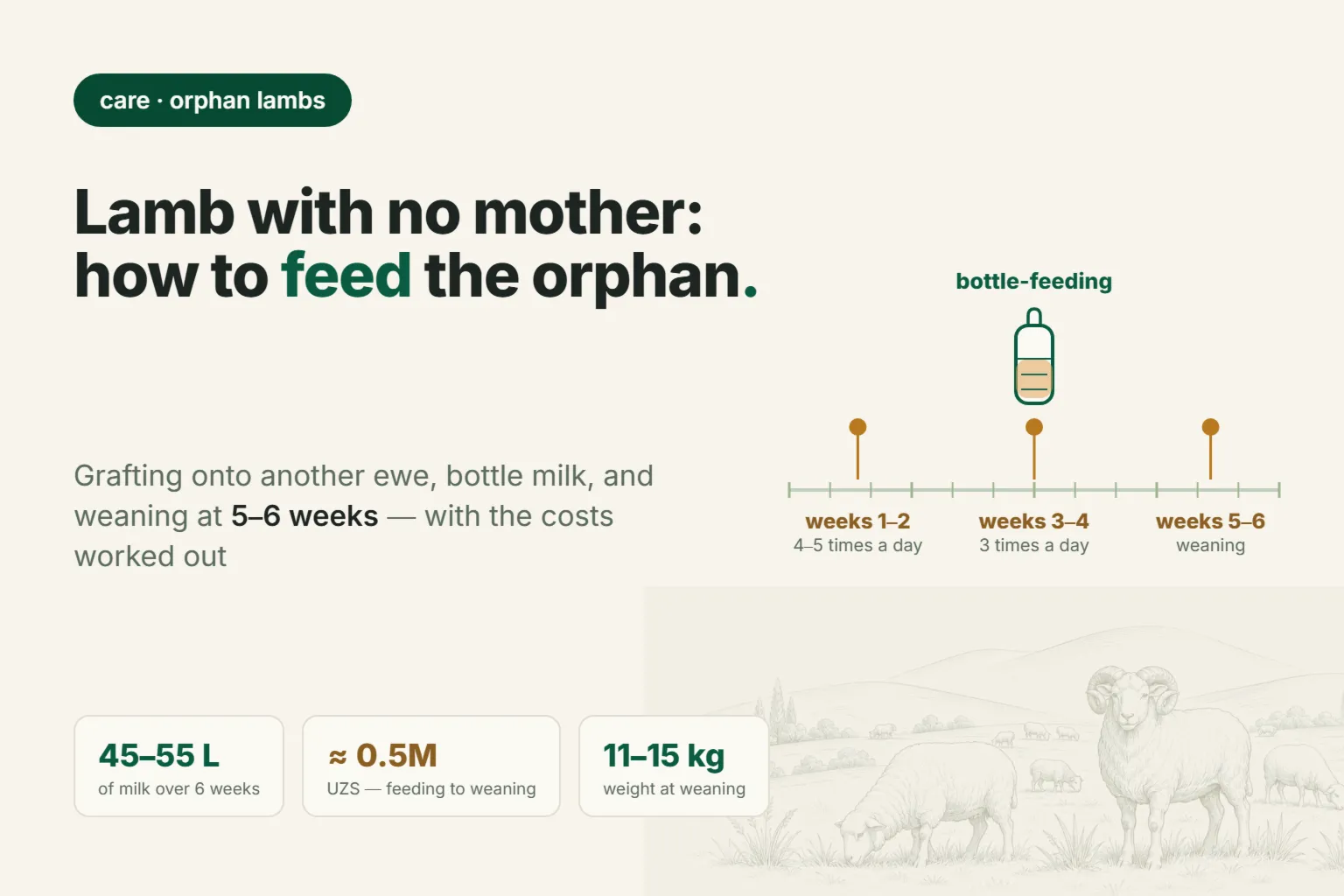
An orphan lamb is first fostered onto another ewe, and if that fails, bottle-fed: 45–55 liters of milk over 6 weeks, weaned at 5–6 weeks once it hits 11–15 kg. Week-by-week amounts, what to feed it, and the math: raising one on cow's milk costs 0.4–0.6 million UZS (≈ $32–50).
A lamb without a mother is raised one of two ways: foster it onto another ewe that has milk, or bottle-raise it on formula until weaning at 5–6 weeks. Fostering costs nothing and gives the better growth rate, so it's tried first. If that doesn't work out, an orphan lamb needs about 45–55 liters of milk over six weeks, 4–5 feedings a day for the first two weeks, and starter feed from the first week. Raised on cow's milk, that costs roughly 0.4–0.6 million UZS (≈ $32–50) in Uzbekistan in autumn 2026, while the lamb itself is worth 1.4–1.7 million UZS by 4 months. If the orphan catches up with its peers, the cost of hand-raising it pays for itself many times over.
Below: how to foster a lamb onto another ewe, what to feed it, how much milk to give by week, when to wean it, and what it costs as of September 2026.
Where Do Orphan Lambs Come From in a Flock?
An orphan lamb (farmers sometimes call it a "bottle lamb") is a lamb its own mother isn't feeding. There are four reasons for that:
- the ewe dies during lambing or shortly after it;
- the ewe rejects the lamb — usually a first-time mother that's spooked by her newborn and butts it away;
- there isn't enough milk for everyone — twins or triplets born to a ewe with a weak udder, and one lamb stays hungry all the time;
- the udder is diseased — mastitis that leaves half the udder unable to give milk.
Fat-tailed breeds (Hissar, Edilbay, Jaydara) don't throw many twins, so a flock of a hundred ewes typically ends up with a handful of orphan lambs each lambing season. But every one of those lambs is worth 1.4–1.7 million UZS by autumn if you pull it through, and nothing if you write it off.
An orphan's first day is the same as any newborn's: colostrum in the first two hours, 50 ml per kilogram of body weight, warming up, iodine on the navel. All of that is covered in detail in why newborn lambs die. This article picks up from there — what to do from day two through weaning.
How Do You Foster an Orphan Lamb Onto Another Ewe?
Fostering is the best option for an orphan lamb: the milk is free, the shepherd has no extra work, and the lamb grows like any other. A suitable foster mother is a ewe that just lost her own lamb, or one that had a single lamb and has plenty of milk. A ewe recognizes her lamb by smell, so every fostering method comes down to making the orphan smell like her own.
| Method | How it's done | When it works best |
|---|---|---|
| Wet fostering | The orphan is rubbed with amniotic fluid and afterbirth from the foster ewe right after she lambs | Best option: the ewe is lambing right now |
| Skin from a dead lamb | Skin is taken off a dead lamb and put on the orphan like a vest for a few days | The ewe lost her own lamb |
| Head-restraint stanchion | The ewe is put in a stanchion where she can eat and drink but can't push the lamb away; held 3–5 days until she accepts it | The orphan is older, or other methods didn't work |
The skin and stanchion methods are described in The Ohio State University small ruminant team's guide. While the lamb is in the stanchion, check twice a day that it's actually nursing and not just standing near the udder: a hungry lamb has a hollow-looking belly and cries.
What Do You Feed an Orphan Lamb When Fostering Isn't Possible?
If there's no ewe to foster an orphan lamb onto, you bottle-feed it. There are three options, and they're not equal.
Lamb milk replacer. A dry mix you dilute with water exactly per the label instructions: too much powder causes constipation and bloat, too little causes starvation. According to Oregon State University Extension, hand-raising one lamb to weaning takes 9–11 kg of dry replacer (20–25 lb). It has to be a replacer made for lambs specifically: sheep milk is about 39% fat on a dry-matter basis, cow's milk about 29% (per The Ohio State University), and calf replacer is too low in fat and protein for a lamb. In Tashkent's retail market in September 2026, we only came across calf replacer — a lamb-specific replacer with a price tag couldn't be found; ask at veterinary pharmacies ahead of time, before lambing.
Goat's milk. In fat content, goat's milk is close to cow's milk, not sheep's milk, but lambs do well on it: Oregon State University's guide calls it a workable substitute. Use it only from healthy goats.
Whole cow's milk. A fallback when there's no lamb replacer, and the most readily available option in Uzbekistan: a liter in Tashkent in September 2026 costs about 8,000–10,000 UZS, cheaper from a neighbor in the village. A lamb on cow's milk grows more slowly than one on sheep's milk or lamb replacer, since it has less fat. That makes it especially important to introduce starter feed early when raising a lamb on cow's milk.
Feed milk warm, at 38–40°C, from a bottle with a nipple; wash the bottle and nipple after every feeding. Sour milk and a dirty bottle are a common cause of scours in bottle lambs.
How Much Milk Should You Give a Lamb by Week?
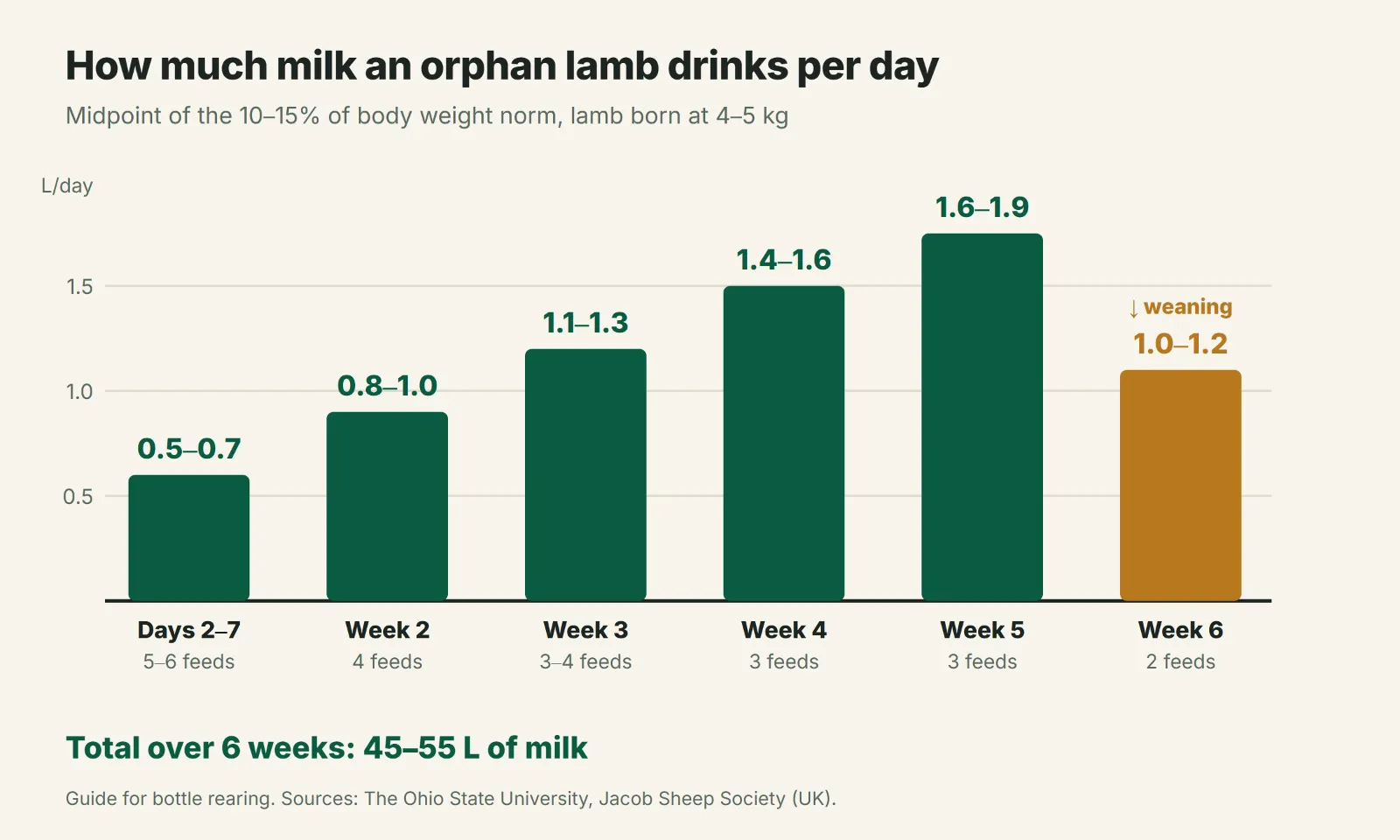
The rule for an orphan lamb is 10–15% of its live weight in milk a day, split across several feedings (per guides from The Ohio State University and the UK's Jacob Sheep Society). Don't give more at once: an overfilled abomasum causes bloat, and that kills faster than hunger does.
| Lamb's age | Feedings a day | Milk a day | What else |
|---|---|---|---|
| 2–7 days | 5–6 | 0.5–0.7 L | a warm, draft-free spot |
| Week 2 | 4 | 0.8–1.0 L | starter feed and water available |
| Week 3 | 3–4 | 1.1–1.3 L | starts eating feed |
| Week 4 | 3 | 1.4–1.6 L | hay can be introduced |
| Week 5 | 3 | 1.6–1.9 L | eats more and more feed |
| Week 6 | 2 | 1.0–1.2 L | last week of milk |
Over six weeks that comes to about 45–55 liters of milk. The figures are approximate for a lamb born at 4–5 kg: a large Hissar lamb needs closer to the upper end, a weak twin closer to the lower end. The main thing to watch is whether the lamb is lively, its sides aren't sunken, and its droppings are well-formed.
When Should You Start Feed and Hay for an Orphan Lamb?
Starter feed is introduced to an orphan lamb from the first week: it should be 18–20% protein, coarsely ground or pelleted (per The Ohio State University). In Uzbekistan, that means coarsely cracked barley with soybean meal, or a ready-made compound feed for lambs. It's best not to feed lambs cottonseed meal: it contains gossypol, which is toxic to young animals. At first the lamb only samples the feed, but by 4–5 weeks that feed is what replaces milk and develops the rumen. Where to buy compound feed and cracked barley for lambs — see lamb feed and creep pellets with prices: in August 2026, compound feed for rams in Tashkent region cost 4,600 UZS per kilogram, and a homemade mix of grain and meal about 3,750 UZS; lamb mixes carry more meal and cost more.
Clean water — always, from the first days: a lamb that drinks only milk eats dry feed poorly. Hay is usually recommended from three weeks on: any earlier and it can cause bloat in a bottle lamb.
When Should You Wean an Orphan Lamb Off Milk?
An orphan lamb is switched from milk to feed at 5–6 weeks, once three conditions are met at the same time:
- it's at least 35 days old;
- it weighs at least 11–15 kg (guides vary: 25–30 lb per The Ohio State University, 15 kg per the Jacob Sheep Society);
- the lamb is eating at least 250 g of starter feed a day.
Milk is removed all at once, in a single day. There's no need to dilute it the last week: per Oregon State University's experience, that makes the lamb transition to feed worse. What matters is that by that day it's already eating 250 g of starter feed. After weaning, keep the lamb with others its age rather than alone: it eats more readily in a group. You can compare how lambs are weaned from the ewe in an ordinary flock, and by how many kilograms weaned lambs differ, in our breakdown on when to wean lambs from the ewe.
An orphan that didn't get colostrum in time is less protected against clostridial diseases. The Ohio State University's guide recommends vaccinating such lambs against enterotoxemia and tetanus earlier than usual, at 3–4 weeks; confirm the exact timing with a veterinarian per the vaccine's instructions.
How Much Does It Cost to Hand-Raise an Orphan Lamb, and Does It Pay Off?
We're costing hand-raising one orphan lamb on cow's milk to weaning at 6 weeks, at September 2026 prices, using the Central Bank of Uzbekistan's exchange rate of 11,825.40 UZS to the dollar as of September 26, 2026.
| Item | Amount | Price | Cost, thousand UZS |
|---|---|---|---|
| Cow's milk | 45–55 L | 8,000–10,000 UZS/L | 360–550 |
| Starter feed (at compound feed price) | 5–8 kg | 3,750–4,600 UZS/kg | 19–37 |
| Total to weaning | ≈380–590 (≈ $32–50) |
What a lamb you managed to pull through is worth: a lamb weaned at 3.5–4 months weighs 26–31 kg, and at a live-weight price of 55,000 UZS/kg it's worth 1.43–1.71 million UZS (≈ $121–145) — that's how we calculated it in the article on lamb mortality. Subtract the milk and starter feed, and you're left with 0.8–1.3 million UZS per lamb, before feed costs after weaning. That math holds if the orphan catches up with its peers by 3.5–4 months: on cow's milk, a lamb can end up a few kilograms behind.
What's not in this calculation is your time. Five feedings a day for two weeks straight is real work, and on a larger farm it's better to put one person in charge of it. For one or two orphans, a notebook and bottles are enough. Once bottle lambs number around ten, it's easier to track them separately: in QoyHunter, a CRM for sheep records with the bazar.qoyhunter.com marketplace, every lamb has an animal card with mother and weight chart, and the weigh-ins immediately show which orphans are falling behind. The same records show which ewe has abandoned her lambs two years running — a good candidate to cull before the next breeding.
FAQ
Can You Bottle-Feed a Lamb on Cow's Milk?
Yes, as a fallback when there's no sheep's milk or lamb replacer. Cow's milk has less fat than sheep's milk (about 29% versus 39% on a dry-matter basis), so an orphan lamb raised on it grows more slowly. Feed it warm, at 38–40°C, at 10–15% of the lamb's weight a day split across several feedings, and introduce starter feed from the first week.
How Many Times a Day Should You Feed a Motherless Lamb?
The first week, 5–6 times a day in small portions; from the second week, 4 times; from the third or fourth week, 3 times; in the sixth week, 2 times before weaning. Daily milk volume is 10–15% of the lamb's live weight: for a 5 kg lamb, that's 0.5–0.75 liters a day.
How Do You Get a Ewe to Accept Another Lamb?
A ewe recognizes a lamb by smell, so the orphan is rubbed with the foster ewe's amniotic fluid right after she lambs, or dressed in the skin of her dead lamb for a few days. If that doesn't work, the ewe is put in a head-restraint stanchion, where she can eat and drink but can't push the lamb away, and held there 3–5 days until she accepts it.
When Can You Wean an Orphan Lamb Off Milk?
At 5–6 weeks, once the lamb weighs at least 11–15 kg and is eating at least 250 g of starter feed a day. Milk is removed all at once, in a single day, without diluting it beforehand.
Is Calf Milk Replacer Okay for Lambs?
No. Calf replacer is formulated for calves, and it's too low in fat and protein for a lamb: a lamb raised on it grows poorly. If there's no lamb-specific replacer, it's better to use goat's milk or whole cow's milk.
Manage your flock in QoyHunterCRM for sheep farmers: livestock, health, weighing, finance and analytics — in the app and a Telegram bot.All features →