Braxy in Sheep: Why Young Sheep Die After Frosts and How to Protect the Flock with Vaccination
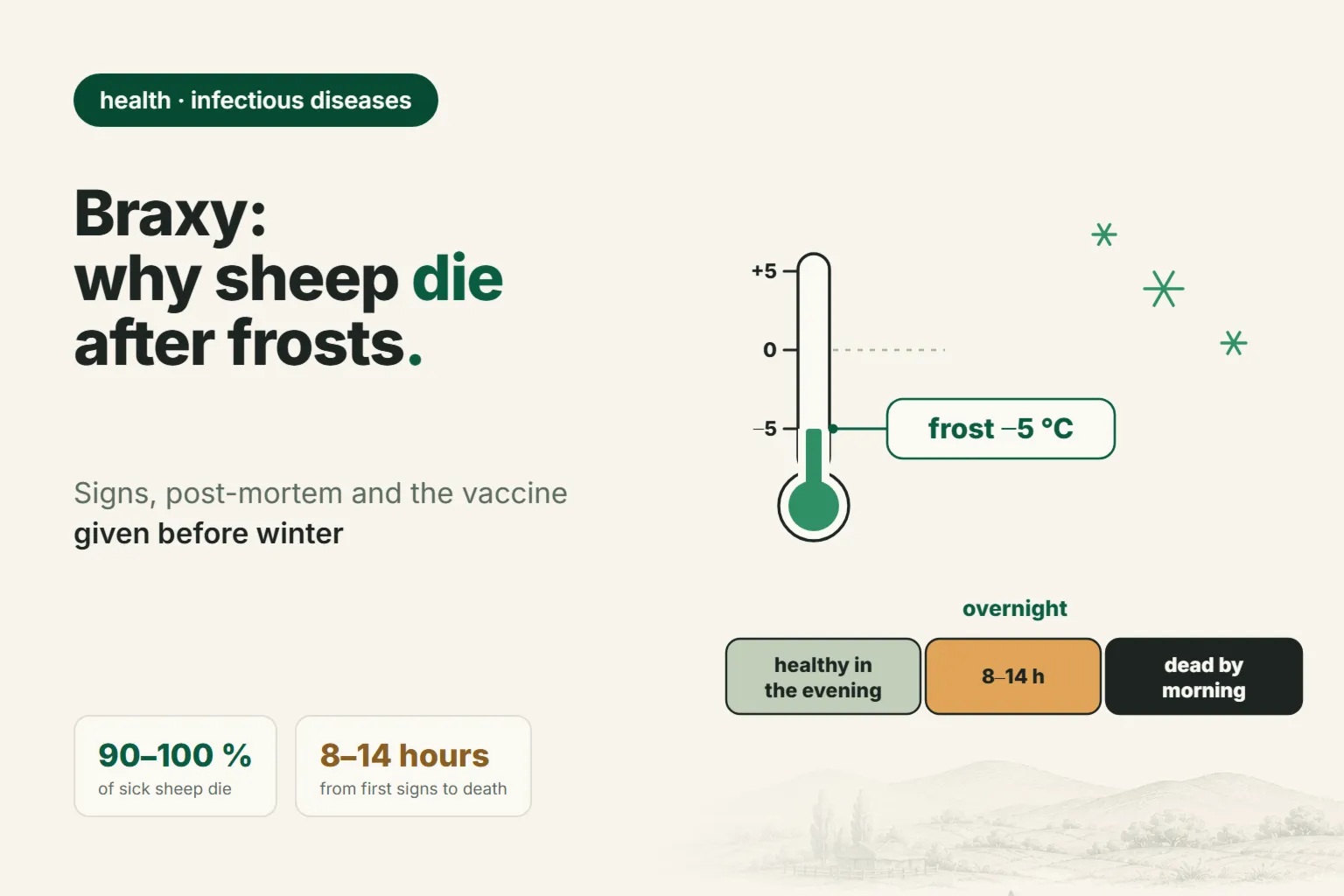
Braxy kills young and well-fed sheep within 8–14 hours, most often after frosts. Signs, how it differs from enterotoxaemia and anthrax, what to do when sheep die, the vaccination schedule before winter and the maths: vaccine for 100 head costs 1 million soum against 2.2 million for one dead sheep.
Braxy in sheep is an acute clostridial infection that kills young and the best-fed sheep within hours, most often in late autumn and early winter, after the first frosts. In the evening the sheep is healthy; in the morning she is found dead with a bloated belly. Treating braxy is almost pointless: the disease moves faster than antibiotics work. Two things save a flock — vaccination with a polyvalent vaccine before winter, and a rule never to turn hungry sheep out onto frosted grass.
Below: how to recognise braxy in sheep and tell it apart from enterotoxaemia and anthrax, what to do if a sheep dies suddenly, which schedule to use for vaccinating a flock in Uzbekistan, and what vaccination costs compared with losses in a group of 100 young sheep. Prices are as of October 2026, converted at 12,055.90 soum per dollar (Central Bank of Uzbekistan, 17 October 2026).
What is braxy in sheep and why does it come with frosts?
Braxy is an acute infectious disease of sheep in which the lining of the abomasum and duodenum becomes inflamed and bleeds, and the body is poisoned by toxins. The causative agent is the bacterium Clostridium septicum, according to the MSD Veterinary Manual. Its spores live in the soil for years and reach the sheep with grass, hay and water.
The spores alone are not dangerous in the stomach. The disease is triggered by damage to the abomasal wall. Frozen grass, feed covered in hoar frost, chilling and a sudden change of feed injure the lining — and the clostridia begin to multiply right in it. That is why, according to the vidal.ru veterinary reference, braxy is recorded mainly in spring and autumn, and in Uzbekistan the most dangerous time is from the first frosts at the end of October until mid-winter, when the flock is driven out in the morning onto frosted pasture.
Who is at risk:
- young stock — ewe lambs and ram lambs in their first or second year, especially unvaccinated ones;
- the best-fed and least active sheep — the disease develops fastest in them;
- flocks that go out to pasture on an empty stomach in the morning and first of all eat frozen grass;
- adult sheep on pasture — according to vidal.ru, young stock fall ill more often during the housed period, while on pasture adults are affected too.
How does braxy show in sheep and how long is it until death?
According to the vidal.ru reference, in an affected flock up to 30–35% of sheep fall ill, and 90–100% of those that fall ill die. Braxy runs in three forms:
| Form | What it looks like | Time to death |
|---|---|---|
| Peracute | Almost no visible signs: convulsions, foam from the mouth, bloating of the rumen. Most often the sheep is simply found dead in the morning | Minutes to a few hours |
| Acute | Temperature 40.5–41 °C, dullness, refusal to eat, rapid breathing, foam and mucus from the mouth and nose, teeth grinding, colic, sometimes bloody diarrhoea, swelling of the head and throat | 8–14 hours |
| Protracted | The same signs, but milder | 3–5 days |
The MSD manual gives a close figure: death 12–36 hours after the onset of the disease. What matters is something else — in both sources treatment barely helps: antibiotics are too slow, because the disease runs faster. In the protracted form a veterinarian may prescribe antibiotics and supportive care, but only these few sheep have a chance.
Another sign of braxy is that the carcass bloats and decomposes quickly. This makes diagnosis harder: a few hours after death, clostridia colonise the tissues of a sheep that died of another cause too. That is why, according to MSD, samples for the laboratory are taken immediately after death.
How do you tell braxy from enterotoxaemia and anthrax?
All three diseases cause sudden deaths, and you cannot tell them apart from one carcass. Only a laboratory gives a definite answer, but there are clues:
| Sign | Braxy | Enterotoxaemia | Anthrax |
|---|---|---|---|
| When | Frosts, hoar frost on grass, late autumn and winter | Fattening, a sudden increase in grain, lush grass | Mostly the warm season — after earthworks, floods and downpours |
| Who falls ill | Young stock under two years, the best-fed | Fattening lambs, the largest in the group | Any age, often other livestock too |
| What is seen on the carcass | Rapid bloating and decomposition | Often no external signs | Dark unclotted blood from the nose, mouth, anus |
| What to do with the carcass | Do not open it yourself, call the vet | Do not open it yourself, call the vet | Never open it, the carcass is only burned |
The main rule is the same in all three cases: do not open a suddenly dead sheep yourself and do not use her for meat. Anthrax causes the same sudden deaths, and opening such a carcass is absolutely forbidden — we covered this in detail in the article on what to do if a sheep dies suddenly and how to tell anthrax.
What should you do if a sheep dies in the flock after a frost?
- Call the district veterinarian the same day. Since 22 July 2026, braxy of sheep has been on the list of animal diseases for which restrictive measures (quarantine) are introduced — Resolution of the Cabinet of Ministers No. 190 of 20.04.2026, Appendix 2, item 32. The diagnosis is made by a laboratory, not by a neighbour.
- Do not open the carcass or skin it. Cover it and keep dogs away until the vet arrives.
- Do not turn the rest of the flock out in the morning until the frost has melted. Give hay before turnout — a full sheep does not rush at frozen grass.
- Examine every animal and take the temperature of suspects. Stragglers, dull animals, those grinding their teeth — separate and under the vet's supervision.
- Vaccinate the unvaccinated. Vaccinating an affected flock is the veterinarian's decision, but putting it off until spring means losing sheep all winter.
How to vaccinate sheep against braxy: the winter schedule
In Uzbekistan a polyvalent vaccine is used against braxy: one shot covers braxy, infectious enterotoxaemia, malignant oedema of sheep and lamb dysentery all at once. According to the description in state procurement documents on the gov.uz portal (April 2026), it is an inactivated vaccine made from strains of Clostridium septicum, Cl. oedematiens and Cl. perfringens types B, C and D. It contains no live bacteria. It is stored at +2…+8 °C and is not frozen — a frozen vaccine spoils, so in winter do not carry the vial in the back of a truck.
| Step | When | Why |
|---|---|---|
| First dose | In September to early October: immunity builds about 5 weeks after the first dose. If you missed that window, vaccinate now | Starts immunity |
| Second dose | After 20–25 days per the polyvalent vaccine leaflet; in an affected flock the vet may shorten this to 12–14 days | One dose does not give reliable protection |
| Booster | In spring and autumn, or per the leaflet of the specific vaccine; on affected farms, 3 months after the second dose, as the vet decides | Immunity lasts several months, not for life |
| Pregnant ewes | Per the vaccine leaflet: for the CIS polyvalent vaccine, 1.5–2 months before lambing, handled gently, without injury | The lamb gets protection with the colostrum |
According to the MSD manual, sheep vaccinated for the first time get two doses 4 weeks apart. For the polyvalent vaccine common in the CIS, the leaflet gives an interval of 20–25 days, and pregnant ewes are vaccinated 1.5–2 months before lambing. The manufacturer of this vaccine states that immunity forms 10–12 days after the second dose and lasts up to 5 months. Hence the familiar "spring and autumn" schedule: the vidal.ru reference advises vaccinating in spring and autumn, or 20–30 days before turnout to pasture. The specific vaccine, dose and interval are confirmed by the veterinarian.
If you have already vaccinated fattening lambs against enterotoxaemia with a polyvalent vaccine, they are protected against braxy too — but only while the immunity lasts. How a fattening group is vaccinated before grain, we covered in the article enterotoxaemia in sheep: why the fattest lambs die.
How much does vaccination cost, and what does braxy cost without it?
Let us count for a group of 100 young sheep — ewe lambs and ram lambs weighing about 40 kg. At a live-weight price of 55,000 soum per kg (as we counted young stock in other calculations this autumn), one dead animal is 2.2 million soum (≈ $182), not counting the feed it has already eaten.
We take the vaccine price with a margin: 5,000 soum per dose, that is 10,000 soum for a two-dose course per head. The price differs between districts — check it at your local veterinary pharmacy; it does not change the conclusion.
| Scenario for 100 head | Head dead | Loss or cost |
|---|---|---|
| Vaccinating the whole group, two doses | 0 | 1 million soum (≈ $83) |
| No vaccination, one sheep dies | 1 | 2.2 million soum (≈ $182) |
| No vaccination, three die | 3 | 6.6 million soum (≈ $547) |
| Outbreak: 30% fall ill, 90% of them die | 27 | 59.4 million soum (≈ $4,927) |
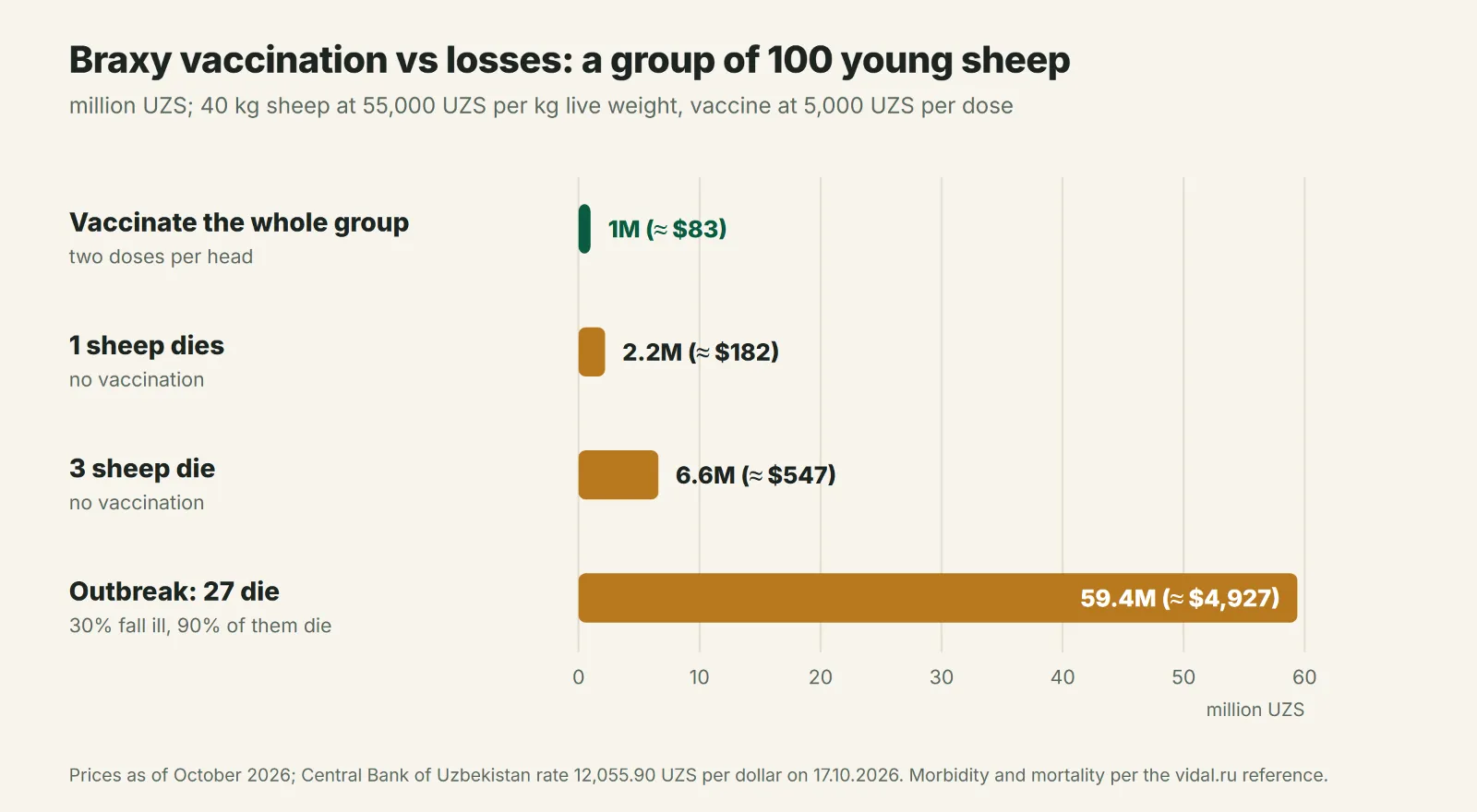
The conclusion is simple: vaccinating the whole group costs less than half of one dead sheep. If braxy takes even a single head over the winter, the vaccine has paid for itself twice over.
The scheme works only if the second dose and the spring booster are not forgotten. It is convenient to keep the dates of both shots in a sheep vaccination log with reminders for the repeat dose: QoyHunter, a CRM for sheep records and the bazar.qoyhunter.com marketplace, logs the treatment for the whole flock or for a single animal and reminds you of the next one in advance.
How should you feed and turn out sheep in winter to avoid braxy?
Vaccination is the main thing, but feed and turnout remove the very trigger of the disease:
- Do not turn the flock out on an empty stomach onto frost. Hay first in the morning, turnout after the frost has melted. This is the advice of the vidal.ru veterinary reference: give roughage before turnout in the dangerous season.
- Do not give frozen, mouldy or caked feed. Frozen silage, root crops with frost on them and mouldy hay injure the abomasum.
- Change the ration gradually, over 10–14 days — including when switching from pasture to hay and grain.
- Keep the flock in a dry sheep shed without draughts. Chilling is one of the triggers of braxy.
- Give warm rather than ice-cold water if you can, and make sure the drinkers do not freeze.
A hay reserve for the whole winter removes the temptation to drive a hungry flock out onto frost — you can buy hay and feed for wintering the flock through listings from neighbouring farms too.
FAQ
Can a sheep be cured of braxy?
Almost never. Braxy kills a sheep in 8–14 hours in the acute form, and in the peracute form she is found already dead. According to the MSD manual, antibiotics usually do not have time to work. Only sheep with the protracted form, treated by a veterinarian, have a chance. The rest of the flock is what needs saving: do not turn out onto frost, give hay and vaccinate the unvaccinated.
When should sheep be vaccinated against braxy in Uzbekistan?
Before the first frosts: it is best to start in September to early October so that immunity is in place by the cold, since it builds about 5 weeks after the first dose. Unvaccinated sheep get two doses of a polyvalent vaccine 20–25 days apart, then the vaccination is repeated in spring and autumn or per the vaccine leaflet — immunity lasts up to 5 months. Pregnant ewes are vaccinated per the vaccine leaflet — for the CIS polyvalent vaccine that is 1.5–2 months before lambing — so that the lambs get protection with the colostrum.
Can you eat the meat of a sheep that died of braxy?
No. A suddenly dead sheep is not butchered or used for meat: anthrax, dangerous to humans, causes the same sudden deaths. The carcass is not opened; it is covered and the district veterinarian is called. Since 22 July 2026, braxy has been on the list of diseases with quarantine in Uzbekistan (Cabinet of Ministers Resolution No. 190, Appendix 2, item 32).
Does vaccination against enterotoxaemia protect against braxy?
Yes, if a polyvalent vaccine was used: it covers braxy, infectious enterotoxaemia, malignant oedema and lamb dysentery all at once. But the protection lasts several months. Lambs vaccinated in summer before fattening may be left without immunity by winter — check the vaccination date and, if needed, revaccinate before the frosts.
How much does braxy vaccination cost for 100 sheep?
At a vaccine price of about 5,000 soum per dose, a two-dose course for 100 head costs roughly 1 million soum (≈ $83) as of October 2026. One dead sheep weighing 40 kg at 55,000 soum per kilogram of live weight costs 2.2 million soum (≈ $182) — more than vaccinating the whole group.
Manage your flock in QoyHunterCRM for sheep farmers: livestock, health, weighing, finance and analytics — in the app and a Telegram bot.All features →