Anthrax in Sheep: Signs, Vaccination and What to Do If a Sheep Dies Suddenly
Anthrax in sheep runs for hours: the animal is found already dead, with dark unclotted blood from the nose and mouth. Why such a carcass must never be opened or butchered, at what age to vaccinate lambs, how long quarantine lasts and what an outbreak costs a flock of 100 ewes.
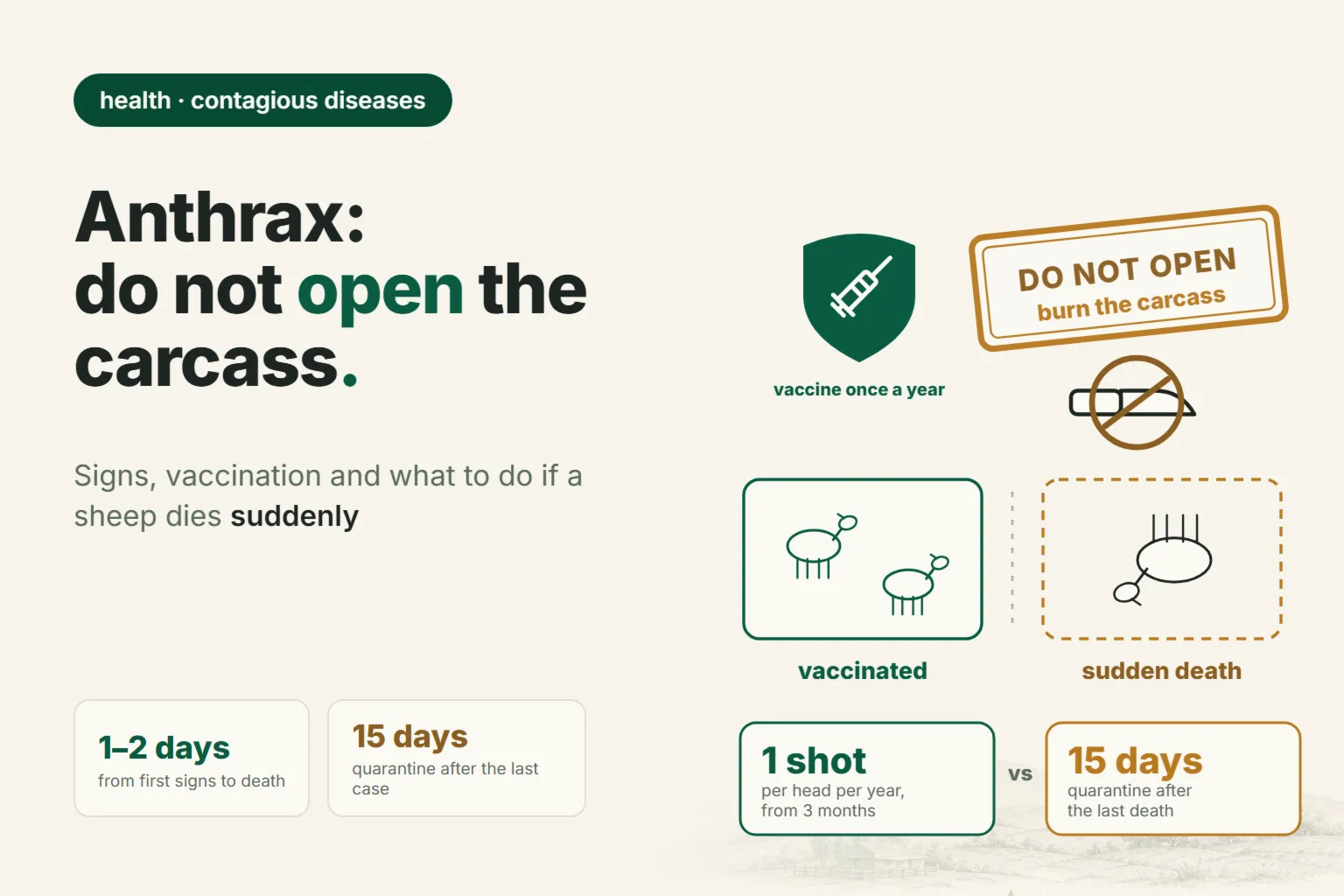
Anthrax in sheep almost always looks like sudden death: the ewe was healthy in the evening, and in the morning she is lying dead, bloated, with dark, unclotted blood from the nose, mouth or anus. There is usually no time to treat her — the disease runs for hours, rarely a day or two. That is why there is only one defence: vaccinate the whole flock every year before turning it out to pasture, and if a sheep dies suddenly, do not open her, do not skin her and do not butcher her for meat — call the district vet right away.
Below: how to recognise anthrax in sheep, why a carcass is more dangerous than a living sick sheep, when and with what flocks are vaccinated in Uzbekistan, and what one outbreak costs a farm. Prices are as of October 2026, at the Central Bank of Uzbekistan rate for 14 October 2026 — 11,913 soum per dollar.
What is anthrax and where does it come from on pasture?
Anthrax is an acute infectious disease of animals and humans caused by the bacterium Bacillus anthracis. The danger is not the bacterium itself but its spores: once they reach the soil with the blood of a dead animal, they live there for decades. According to the State Veterinary Committee of Uzbekistan, the pathogen survives in the environment for up to 100 years, so vets keep old burial sites of dead livestock under watch and check soil samples.
A sheep catches it on pasture: she swallows spores with grass and soil or breathes them in with dust. Outbreaks are most common in the warm season, from spring to autumn. Downpours, floods and earthworks are also dangerous: water and machinery bring old spores up to the surface. Short grass in a drought is dangerous too: the sheep nips it right at ground level and takes in soil along with it.
What are the signs of anthrax in sheep?
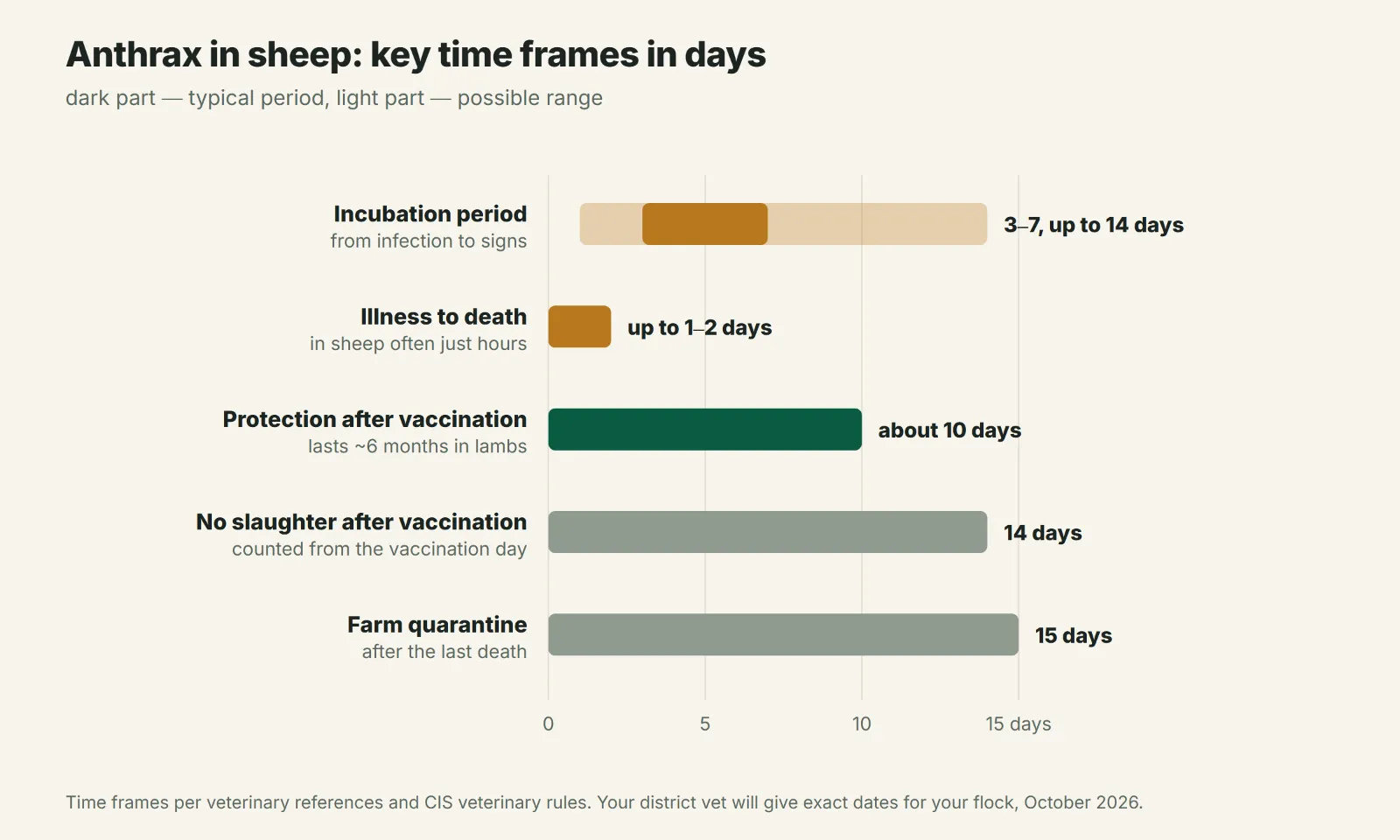
In sheep and goats anthrax mostly runs in a peracute form: the animal drops within a few hours, and the owner often finds only a carcass. The incubation period after infection is usually 3–7 days, rarely from 1 to 14.
If you manage to catch a living sick sheep, the signs are:
- high temperature, up to 41–42 °C;
- the sheep trembles, staggers, grinds her teeth, breathes hard and fast;
- the mucous membranes of the eyes and mouth are bluish, with pinpoint haemorrhages;
- convulsions, then collapse and death.
Signs of a sheep that has died of anthrax:
| What you see on the carcass | Why it matters |
|---|---|
| Dark, almost black blood from the nose, mouth, anus | The blood does not clot — the main sign, and the point at which the carcass is not touched |
| The carcass bloats fast and hard | Decomposition is faster than usual |
| Rigor mortis is weak or absent | A dead animal normally stiffens within a few hours |
| Death is sudden, without a long illness | Sets it apart from most chronic diseases |
Sudden death in a sheep is also caused by other diseases — enterotoxaemia, acute poisoning, bloat. You cannot tell them apart by eye: only a laboratory can make the diagnosis, from a blood or ear sample that the vet takes without opening the carcass. So the rule is simple: any sudden death of a sheep with no clear cause is treated as anthrax until the test says otherwise.
Why must a sheep carcass never be opened or butchered?
Because inside a closed carcass the anthrax bacterium forms almost no spores and dies off within a few days as the body rots. When a carcass is opened, cut or skinned, the blood meets the air — and the bacteria turn into spores that will live in that ground for decades. Butchering a single dead sheep makes a yard or a pasture infectious for a long time.
The second reason is people. A person catches anthrax mostly while slaughtering and butchering sick livestock, through scratches on the hands: that is how the skin form of the disease appears — a sore with a black scab. Outbreaks like this have happened in Uzbekistan: in 2014, in the Khavast district of Syrdarya region, more than 30 people ended up in hospital, and all of them had slaughtered sick livestock or sold or bought its meat. The skin form accounts for up to 99% of cases in humans. Untreated, it kills up to 20% of those who fall ill; with timely antibiotic treatment, less than 1%.
What to do if a sheep dies suddenly:
- Do not touch the carcass and keep dogs, children and other animals away from it. Cover it if you have something to cover it with.
- Call the vet at once — the district veterinary service — and report the death. This is the owner's duty, not a choice.
- Do not sell or slaughter the rest of the flock until the vet decides, and do not use the meat or hide of the dead sheep in any form.
- Do not wash the spot where the carcass lay with water onto the ground — the veterinary service disinfects it.
- The veterinary service disposes of the carcass. At the requirement of the sanitary and epidemiological service of Uzbekistan, animals that died of anthrax are burned, and the site is disinfected. Burying such a sheep in an ordinary pit on your own plot is not allowed.
What and when to vaccinate sheep against anthrax?
A live spore vaccine is used. In the CIS countries, a vaccine from the 55-VNIIVViM strain is used; worldwide, one from the Sterne 34F2 strain. The schedule for sheep:
| What | When |
|---|---|
| First vaccination of lambs | from 3 months |
| Revaccination of adult sheep | once a year |
| Revaccination of lambs | per the vaccine leaflet and the vet's instruction: protection in young animals lasts about 6 months |
| When protection appears | about 10 days after the shot |
| How long protection lasts | in adult sheep, about 12 months; in young animals, about 6 months |
| Slaughter of vaccinated animals | not earlier than 14 days after vaccination |
The best time is spring, before the flock goes out to pasture, so that protection has built up by the outbreak season. Lambs born after the spring campaign are vaccinated in autumn, when they turn 3 months old.
Two important caveats:
- Antibiotics kill the vaccine. The vaccine is live: if you give the flock antibiotics a few days before vaccination or right after it, protection may not develop. Space treatment and vaccination apart — ask your vet and check the vaccine leaflet for the interval.
- Weak and sick animals are not vaccinated in the general round — they are vaccinated after they recover. Pregnant ewes are not vaccinated in the last month before lambing — the vaccine leaflet says so. Vaccination is also not done in severe heat or frost.
In Uzbekistan, livestock is vaccinated against anthrax in planned campaigns in spring and autumn: according to the State Veterinary Committee, 36.7 million head of livestock were vaccinated in 2020. The sanitary and epidemiological service reminds owners that the owner is obliged to vaccinate livestock every year. When buying livestock, ask for a veterinary service certificate. Find out the campaign dates at your local veterinary station and check whether your flock is on the plan — especially if you bought sheep recently or keep them on a new pasture.
What does an anthrax outbreak cost a flock?
Let us count for a flock of 100 ewes. For the calculation we take a sheep at the price of a culled ewe weighing 50 kg — about 2.4 million soum (≈ $201) at 48,000 soum per kilogram of live weight, as in our calculation of fattening cull ewes before sale.
Deaths. Anthrax in an unvaccinated flock rarely takes just one sheep. If at least 5 head die before the vet arrives, the direct loss is about 12 million soum (≈ $1,007).
Quarantine. A quarantine is placed on the affected yard: under the veterinary rules of the CIS countries it is lifted no earlier than 15 days after the last death, and then a final disinfection is carried out. For all that time the sheep cannot be sold, moved out or slaughtered for meat, and no new livestock is brought onto the yard. If the outbreak falls in autumn, the flock misses the best weeks for sales, while feed costs carry on as usual.
Vaccination. Against these losses stands one shot per head per year in the planned campaign. Who pays for the vaccine and the vet's visit, ask at your local veterinary station: even if you pay yourself, vaccinating the whole flock costs incomparably less than one dead ewe.
To record the vaccination date for the whole flock and not miss the next one, the vaccination and vet treatment log is handy — QoyHunter, a CRM for sheep records and the bazar.qoyhunter.com marketplace, reminds you of the planned date in advance. The full vaccination schedule by month is in the sheep vaccination calendar.
How do you avoid bringing anthrax in with bought sheep?
Anthrax does not pass from sheep to sheep as easily as pox or foot-and-mouth disease — sheep catch it mostly from the soil. But buying is still risky: a sheep could have been infected on someone else's pasture and die at your place, and your farm gets the quarantine.
- Ask for a veterinary certificate and the date of the last anthrax vaccination. A sheep vaccinated less than 14 days ago is not yet protected.
- Keep bought sheep apart for 30 days and vaccinate them if the last shot was more than a year ago or there are no papers. We covered how to set up such a quarantine in the article "Quarantine for new sheep".
- Do not buy meat or hides from emergency slaughter: a cheap carcass "from the neighbour's yard" is the most common way anthrax reaches people.
Vaccinated sheep of known origin can be found among the sheep and rams for sale: before the deal, ask the seller for the vaccination date and the vet's certificate.
FAQ
Can you eat the meat of a sheep that died of anthrax?
No. The meat, hide, wool and offal of a sheep that died of anthrax, or died suddenly with no clear cause, may not be eaten, sold or fed to dogs. When butchering, a person is infected through scratches on the hands, and the spores from the blood stay in the ground for decades. The veterinary service disposes of the carcass — by burning.
At what age should lambs be vaccinated against anthrax?
Lambs are vaccinated from 3 months, and adult sheep are revaccinated once a year, best in spring before turnout to pasture. Protection appears about 10 days after the shot. It lasts about 12 months in adult sheep and about 6 in lambs, so lambs are revaccinated as the vet directs. Lambs born after the spring campaign are vaccinated in autumn.
Can anthrax in sheep be treated?
In sheep there is almost never time: the disease runs for hours, rarely a day or two. Antibiotics and anti-anthrax serum help only at the very start of the illness and only as prescribed by a vet. The main protection for a flock is the yearly vaccination, not treatment.
What should I do if a sheep suddenly dies in the flock?
Do not open or butcher the carcass, keep people and animals away from it, and report it to the district vet at once. Do not sell or slaughter the other sheep until the vet decides. If anthrax is confirmed, the yard is put under quarantine, which under CIS rules is lifted no earlier than 15 days after the last death.
Can a ram be sold after anthrax vaccination?
Alive — yes, vaccination does not forbid it. A vaccinated animal may be slaughtered for meat not earlier than 14 days after vaccination. It is worth showing the buyer a veterinary certificate with the vaccination date.
Manage your flock in QoyHunterCRM for sheep farmers: livestock, health, weighing, finance and analytics — in the app and a Telegram bot.All features →