Sheep lice and keds: how to find and treat them in winter
Sheep lice and keds: signs, how to find them in the fleece, what to treat the flock with (ivermectin or deltamethrin), when to repeat and what it costs for 100 ewes in 2026.
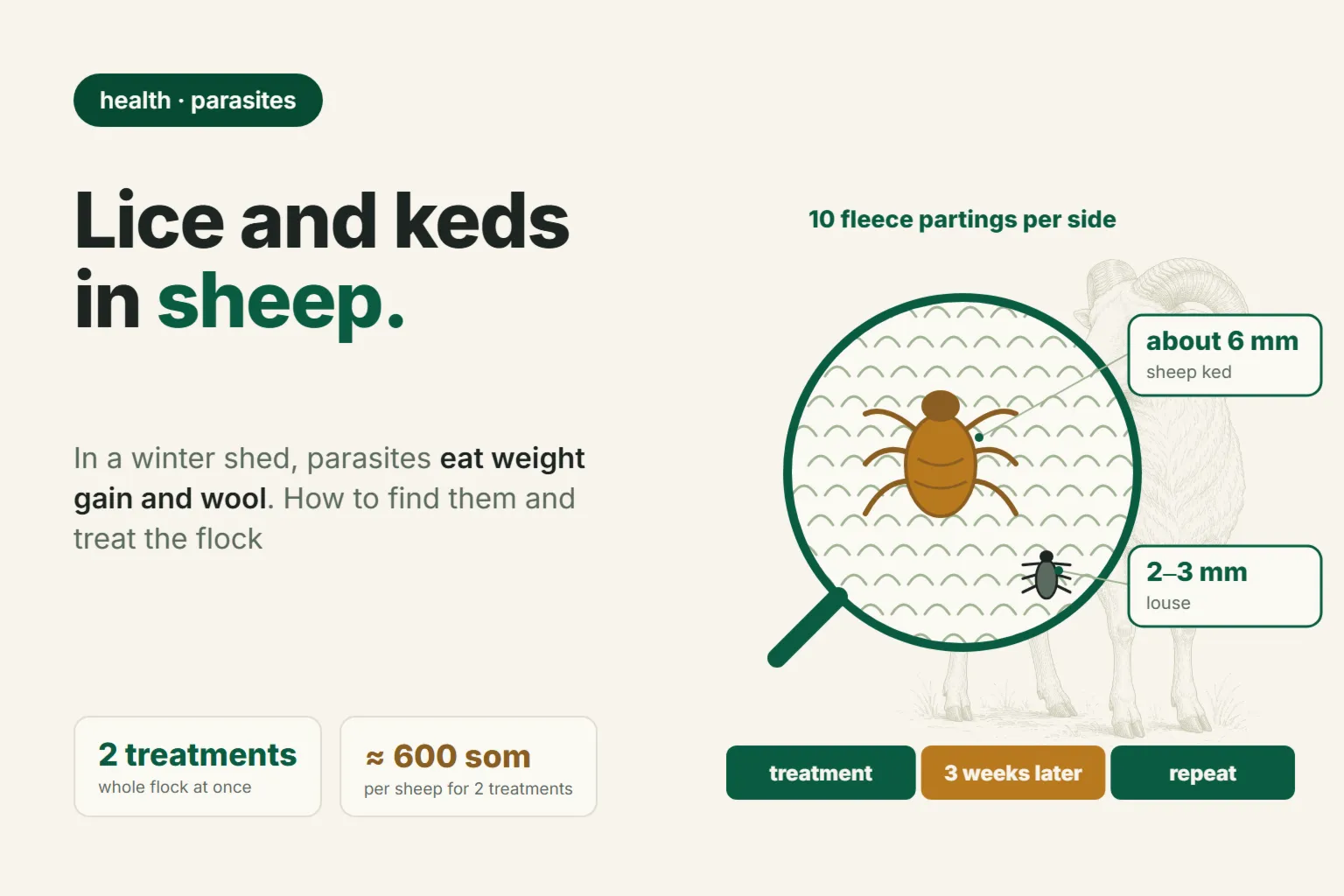
Lice and sheep keds are cleared by treating the whole flock at once and then repeating the treatment: after 2–3 weeks for lice, after 3–4 weeks for keds. The first treatment kills the adult parasites, the second kills the ones that hatched from eggs and pupae in the meantime. A 1 % ivermectin injection works on keds and sucking lice but is unreliable against biting lice, so those need a pour-on or spray based on deltamethrin or cypermethrin. Two ivermectin doses cost about 600 som (≈ $0.05) per sheep, while in older studies the weight difference between lambs treated for keds and untreated ones reached 2.5 kg per head.
Below: how to find the parasites in the fleece, how they differ, what they cost a flock of 100 ewes, and how to treat a flock in a winter shed. Prices come from listings on bazar.qoyhunter.com as of 6 November 2026, converted at 12,055.90 som per dollar (Central Bank of Uzbekistan, 17 October 2026), with live weight at 55,000 som per kilogram, as in our autumn 2026 calculations.
How is a sheep ked different from lice?
The sheep ked (Melophagus ovinus) is a wingless fly that spends its whole life in the fleece and feeds on blood. An adult ked is about 6 mm long, reddish-brown, on six gripping legs, and visible to the naked eye (SDSU Extension). The female does not lay eggs: she gives birth to one ready larva at a time, the larva pupates at once and sticks to the wool, and a young ked emerges from the pupa after 19–30 days, depending on temperature (University of Wyoming). A female lives 100–130 days and produces 12–15 larvae in her lifetime.
Sheep lice are smaller wingless insects that also live only on the sheep. There are two kinds, and the difference matters for treatment:
- Biting lice, Bovicola ovis, feed on skin flakes and wool grease. Ivermectin injections are unreliable against them, and the drug is not registered for biting lice.
- Sucking lice, genus Linognathus, drink blood. Both injections and pour-on products work on them.
Neither keds nor lice live long off the sheep: a ked that drops off usually dies in under a week (MSD Veterinary Manual), biting lice usually die within a few days, though in a shed, among tufts of wool, they can survive for up to 2–3 weeks. So the main route of infection is contact with an infested sheep, but a vacated shed should be cleaned out and kept free of clean sheep for 3 weeks.
| Ked | Biting louse | Sucking louse | |
|---|---|---|---|
| Size | about 6 mm, visible at once | 2–3 mm, seen when parting the fleece | about 2 mm, seen when parting the fleece |
| Feeds on | blood | skin flakes | blood |
| Where to look | neck, sides, belly, rump | back, sides, neck | legs, muzzle, belly |
| Ivermectin 1 % (injection) | works | unreliable | works |
| Deltamethrin, cypermethrin (topical) | works | works | works |
Why do lice and keds flare up in winter?
Ked numbers peak in winter and early spring (MSD Veterinary Manual). There are three reasons: the fleece is long and warm by winter, the flock is packed tightly in the shed and the parasite passes from sheep to sheep at every contact, and in summer shearing removes most of the parasites along with the wool. According to data cited by SDSU Extension (Evans, 1950), shearing removes 75–91 % of adult keds and 70–94 % of pupae.
The practical takeaway for Uzbekistan: after spring shearing there are few parasites on the flock, by November–December their numbers climb again, and by February–March, at lambing, ewes pass keds on to the lambs. It pays to treat the flock before lambing, not after.
How can you tell that sheep have lice or keds?
The first signs show without a vet:
- sheep rub against walls, feeders and each other, and bite at their own sides;
- wool comes off in clumps, with bald patches on the sides from scratching;
- brown spots on the fleece are ked droppings;
- lambs and weak ewes have pale mucous membranes (anemia), and lambs lag in growth.
To check the flock, part the fleece with your hands down to the skin. The Australian method for lice is at least 10 partings, 10 cm long, on each side, from neck to hip. Check the 10 sheep that scratch the most, not the first ones you catch. Look for keds on the lower half of the body: neck, ribs, belly, rump. One louse in every 10 cm parting means 3,000–4,000 lice per sheep (PIRSA, South Australia).
If sheep itch and there are wet yellow crusts under the wool but no parasites show when you part it, that may be mange. How it differs and how it is treated is covered in the article on mange in sheep: the treatment plan is different.
What do lice and keds cost a flock of 100 ewes?
The main loss from keds is lamb weight gain: the parasite drinks blood, and a lamb has little to spare. In older studies cited by SDSU Extension, the weight difference between treated and untreated lambs reached 2.5 kg per head (the ration also played a part); with heavy infestation lambs can also die. The second loss is the hide: ked bites leave hard nodules in the skin, and tanned sheepskin sells for less (University of Wyoming).
Biting lice barely affect live weight; the loss is in the wool: 0.3–0.8 kg less clean wool per sheep (Western Australian study, 1982). For coarse-wool Hissar and Edilbay sheep, whose wool is worth almost nothing, that is minor. For Karakul and fine-wool sheep it is a noticeable sum.
| Item | Calculation for 100 ewes | Amount |
|---|---|---|
| Ivermectin 1 %, two doses | 200 ml = 2 bottles of 100 ml × 30,000 som | 60,000 som (≈ $5) |
| Lost lamb weight gain under heavy infestation | up to 2.5 kg × 100 lambs (one per ewe) × 55,000 som | up to 13.75 mln som (≈ $1,140) |
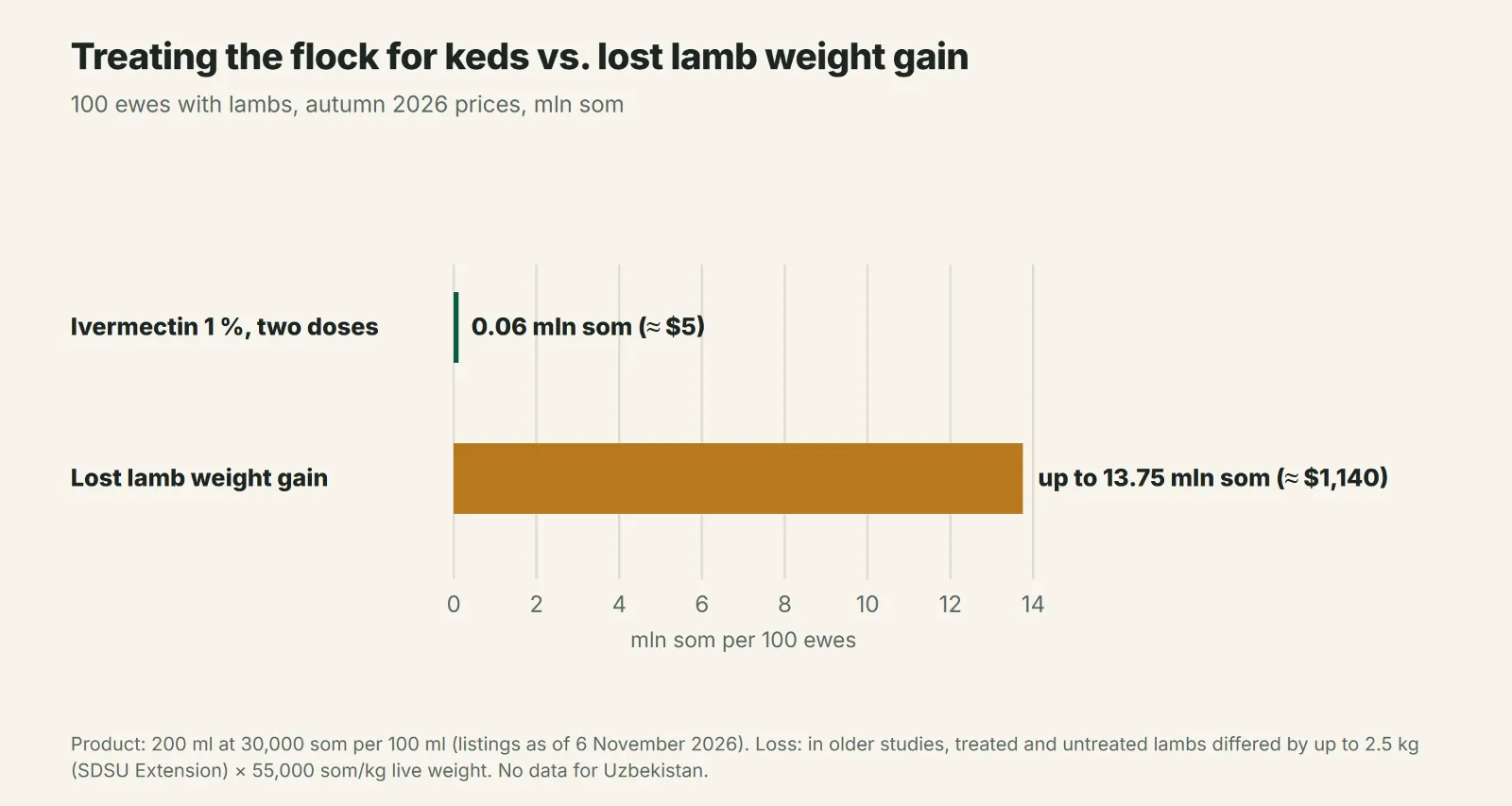
The lost-weight figure is the upper limit from foreign studies, with no data for Uzbekistan. But even if the real loss is ten times smaller, treatment pays for itself many times over.
What should you treat sheep with for lice and keds?
The choice of product depends on what you found in the fleece:
- Keds or sucking lice only: a 1 % ivermectin injection. The usual dose in the instructions is 1 ml per 50 kg of live weight under the skin, so about 1 ml per adult sheep. The same shot also works on roundworms; for mange (psoroptic mange) two shots are needed, spaced as the instructions say. As of 6 November 2026, a 100 ml bottle of 1 % ivermectin in listings costs 30,000 som and a 50 ml bottle 20,000 som, so the product for two doses comes to about 600 som (≈ $0.05) per sheep.
- Biting lice, or you do not know which: a topical product based on deltamethrin or cypermethrin, as a spray, pour-on or dip. In Scotland (SAC) and the UK (NADIS) they state outright that injections do not work against biting lice; in an Ethiopian study from 2022 ivermectin was 81 % effective against them. Topical products kill both lice and keds.
- The repeat is required. The product does not kill louse eggs or ked pupae. The second treatment is done at the interval in the product's instructions. As a rule of thumb: for lice, repeat after 2–3 weeks (the MSD Veterinary Manual says a repeat is often needed as early as 2 weeks); for keds, after 3–4 weeks, and the University of Wyoming advises 19–30 days.
Agree on the product and dose with a vet: they will confirm what is actually in the fleece and pick a product for pregnant ewes and lambs.
Ready products for lice and keds, such as ivermectin and cypermethrin concentrates for spraying and dipping, can be found among veterinary drugs and feed for sale: as of 6 November 2026 the section holds 176 listings, with prices set by the sellers.
How do you treat a flock in winter without harming it?
- The whole flock at once, rams and lambs included. An untreated sheep reinfests the whole shed within a month. Each sheep's dose is calculated from live weight.
- No dipping in winter. A wet sheep in cold wind catches a chill. In winter choose an injection, or a spray or pour-on on a warm, windless day, with as little water as possible.
- The best time for topical treatment is after shearing. The wool is short and the solution reaches the skin. Dipping is allowed no sooner than 3 days after shearing, once the cuts have closed, as the instructions for the deltamethrin product Delcid say, for example.
- Pregnant and weak ewes: follow the instructions. The Delcid instructions forbid treating weakened animals and pregnant ewes within 2 weeks of lambing; other products have different limits.
- Meat withdrawal period. For Delcid, slaughter is allowed 15 days after the last treatment, and for 1 % ivermectin it is 21–28 days depending on the product, so check the instructions. A ram for sale or for Qurbon Hayit is treated well ahead, not a week before the deal.
- New sheep go through quarantine. A purchased sheep is treated before it joins the main flock; how to set up quarantine is covered in the article on quarantining new sheep.
Treatment dates are easy to lose: the first was in November, and a month later nobody remembers when the repeat is due or which lambs were born after. In QoyHunter, a CRM for sheep records and the bazar.qoyhunter.com marketplace, each treatment is logged on the sheep's card and the repeat comes up as a reminder; see the section on tracking sheep health and treatments.
FAQ
Is the sheep ked dangerous to humans?
The sheep ked lives only on sheep and does not survive long without one: a ked that falls on the ground or on clothes usually dies in under a week. It may bite a person during shearing or inspection but will not live on them. After working with an infested flock it is enough to change clothes and shake them out.
Can I treat only the sheep that are scratching?
No. Lice and keds pass from sheep to sheep on contact, and part of the flock already carries parasites even though the sheep is not yet scratching. Treat the whole flock on one day, rams and lambs included, and repeat after 2–4 weeks (as the product's instructions say), or the parasites from the untreated sheep will come back within a month.
Why are there still lice after an ivermectin shot?
Most likely they are biting lice. A 1 % ivermectin injection works on keds and sucking lice but is unreliable against biting lice and is not registered for them. You need a topical product based on deltamethrin or cypermethrin, as a spray or pour-on, with a repeat after 2–3 weeks.
How much does it cost to treat 100 sheep for keds?
As of 6 November 2026, a 100 ml bottle of 1 % ivermectin in listings costs 30,000 som. At a dose of about 1 ml per adult sheep, two treatments of 100 ewes need 200 ml, which is about 60,000 som (≈ $5) for the product, or roughly 600 som per sheep. Topical products against biting lice are dosed by the instructions, and their price depends on volume and concentration.
When is the best time to treat sheep for keds?
There are two convenient points: right after spring shearing, when parasites are few and the wool is short, and in late autumn, before housing and before lambing, so ewes do not pass keds on to lambs. In winter choose an injection or a spray on a warm day, not a dip.
Manage your flock in QoyHunterCRM for sheep farmers: livestock, health, weighing, finance and analytics — in the app and a Telegram bot.All features →