New Sheep Quarantine: 30 Days That Save Your Flock from Scab
A sheep bought at the bazaar looks perfectly healthy — scab shows up two weeks later, already inside your own shed. We break down quarantine for new animals: a separate pen, treatments on arrival day, what to check every morning, and the math behind why 16,000 sum a head beats an 18-million-sum outbreak.
It's almost never the air that infects a flock. It's the truck that brought in the new animals.
You bought fifteen lambs for fattening, or a breeding ram ahead of the autumn mating season. The animals looked lively, eyes clear, fleece even. Two weeks later half the flock is rubbing against fence posts. A month after that the lambs have stopped gaining weight instead of putting it on, and by winter animals start dying in the shed. You paid for all this on the day you bought the animals — the bill just arrived late.
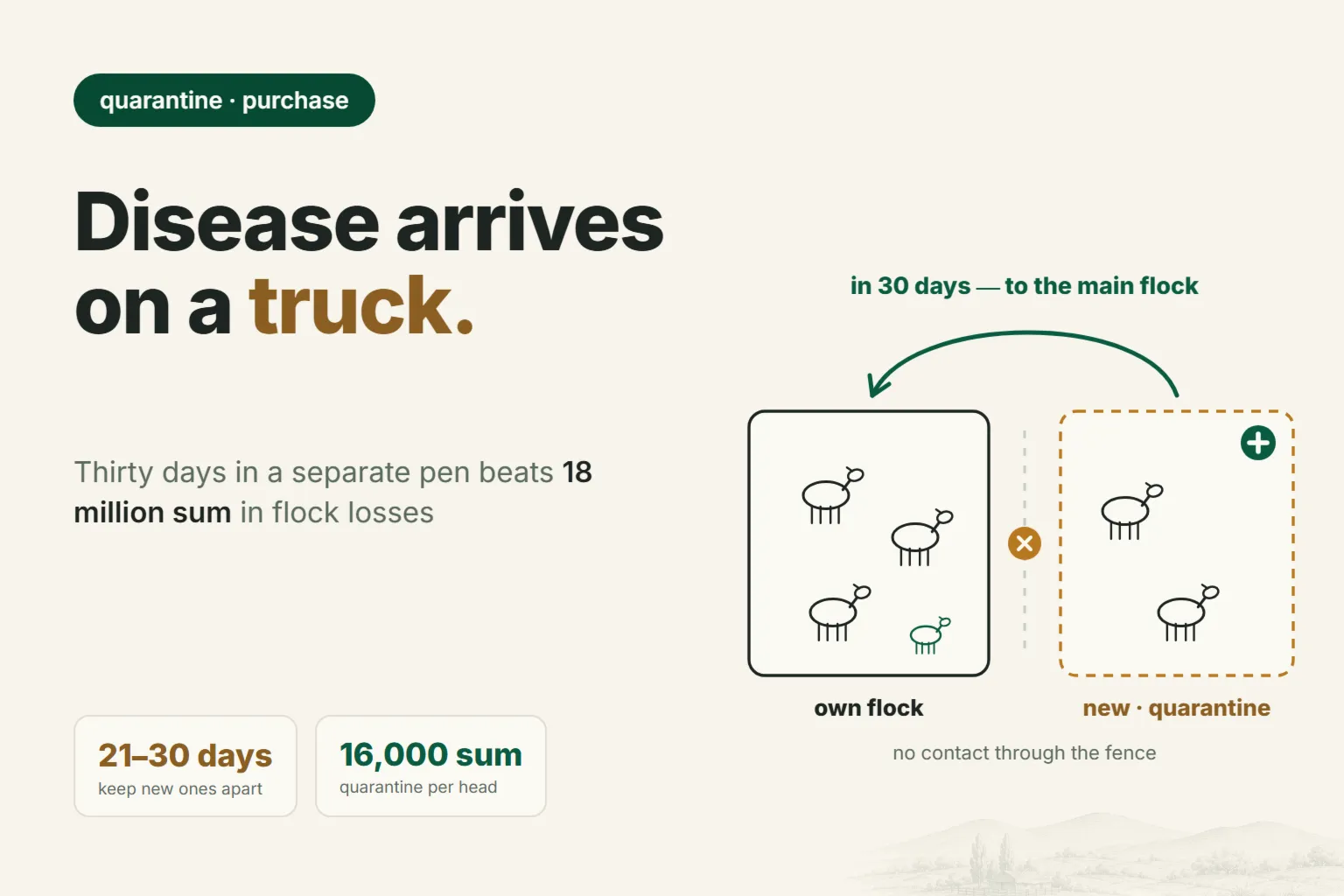
Quarantine is the cheapest insurance in sheep farming. Thirty days in a separate pen plus treatments cost around 16,000 sum a head (≈ $1.3), while one outbreak brought onto a 75-head farm costs 18 million sum (≈ $1,500). Here's the step-by-step: what actually arrives with a new sheep, how to set up a quarantine pen, what to do on arrival day, and what to check every morning. Prices are from August 2026, exchange rate used for conversion — ≈ 12,000 sum to the dollar.
Why a Healthy-Looking Sheep Is Dangerous
Time passes between infection and the first signs of disease — that's the incubation period. The seller isn't necessarily lying to you: they may genuinely not know the animal is already carrying mites or bacteria. That's exactly why a once-over at the bazaar guarantees nothing, while quarantine guarantees almost everything.
There's a trap specific to our climate: in summer, scab runs hidden. The mites retreat to sheltered spots on the body, the itching is mild, and the fleece still looks decent. Come autumn, the animals get shut into the shed, humidity climbs, and the disease breaks out across the whole flock. You bought the animal in July — you "got" the outbreak in November, and never noticed the connection.
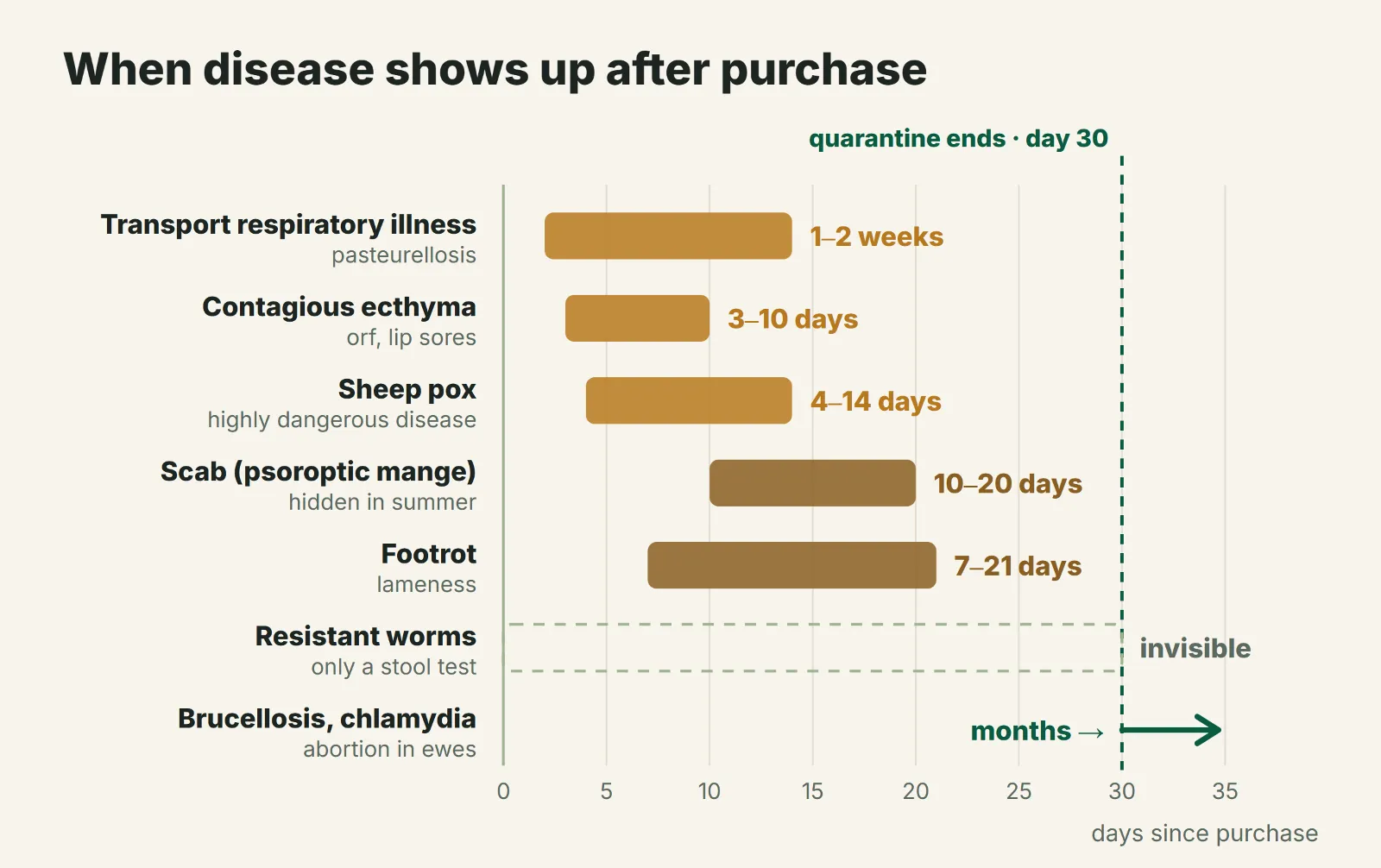
Here's what actually arrives with a new animal, and when you'll see it.
| What gets brought in | When it shows up after arrival | What it costs you |
|---|---|---|
| Transport-stress respiratory disease (pasteurellosis) | First 1–2 weeks | Coughing, fever, lamb deaths |
| Contagious ecthyma / orf (scabby mouth) | 3–10 days | Lambs can't nurse or eat, transmissible to humans |
| Sheep pox | 4–14 days | A notifiable disease, abortions in ewes, district-wide quarantine |
| Psoroptic mange (sheep scab) | 10–20 days, longer in summer | Itching, weight loss across the whole flock, the entire flock needs treating |
| Foot rot | About two weeks (7–21 days) | Lameness, lost weight gain, can stay on a farm for years |
| Drug-resistant worms | Not visible at all | Your regular anthelmintic stops working across the whole flock |
| Brucellosis, chlamydiosis | Months — until lambing | Abortions, infertility; brucellosis is dangerous for your family |
Quarantine catches the first five rows. The sixth is caught by a proper quarantine drench on arrival. The last one — only a health certificate from the vet service and a conversation with the seller before you hand over any money.
Sheep pox is the costliest disease that arrives with a purchased sheep: the signs day by day and the loss calculation for a 100-ewe flock are in sheep pox: signs, vaccination and what an outbreak costs.
What a Quarantine Pen Actually Is
Quarantine isn't "put them in the far corner of the shed." It's physical separation.
- A separate pen or shed, ideally away from the main flock and not downwind of it.
- No nose-to-nose contact through the fence. Sheep reach toward each other, and that's exactly how scab mites, orf and respiratory infections spread. Leave at least a couple of meters between the groups, or put up a solid wall.
- Its own trough, water and tools. Forks, buckets, shovel — separate and marked. Scab mites survive off the animal for up to 15–18 days — on a fence, on the post they rubbed against, in the back of a truck, in tufts of shed wool. That's why, after a sick batch, the pen and the vehicle don't get "a day off" — they stand empty for two to three weeks after cleaning and disinfection.
- Feed and handle the new animals last, after the main flock, never before. Mites and hoof dirt travel just fine on boots and clothing.
- Give them proper floor space, not a crowded pen: overcrowding alone triggers half of these diseases on its own. We covered the space and ventilation standards per head in our piece on sheep shed design.
The quarantine period is 21–30 days. Thirty days covers the incubation period of nearly every fast-developing contagious disease. If any animal in the group falls sick, the clock resets from the last case.
Arrival Day: A Six-Point Checklist
- Check every animal. Skin behind the ears, on the withers and at the base of the tail (the mite's favorite spots), hooves for smell and horn separation, eyes and nose for discharge, lips for scabs, udders on the ewes. Normal temperature for a sheep is 38.3–39.9 °C (MSD Veterinary Manual), and above 40.5 °C is already a fever. If several animals are running a fever at once, that's a reason to call the vet, not wait it out.
- Hooves: trim and bathe. Trim back overgrown horn and run the animals through a bath with a 10% zinc sulphate solution, letting them stand in it for a few minutes. This clears up mild cases and stops foot rot from getting into your shed. Full detail on the disease in our foot rot breakdown.
- Treat for external parasites. Ivermectin products are injected by live weight and strictly by the route on the label (Ivomec subcutaneously, Ivermek intramuscularly, in the rump or neck) — the standard label dose is 1 ml per 50 kg (0.2 mg per kg of body weight), and for severe psoroptic mange the protocol calls for a repeat injection 7–10 days later. Confirm the exact dose, the product, and whether a repeat is needed with your vet: concentration varies between products, and overdosing is dangerous for pregnant ewes. Estimate weight with a tape — formula and table here.
- Quarantine drench with a different active ingredient than the one you normally use. The point is to avoid bringing in parasites already resistant to your regular product. After treatment, keep the animals in the pen for a day or two instead of turning them straight out to pasture: that gives time for the eggs to pass, so you don't seed the pasture with them. Schedules and seasons in our piece on worms.
- Feed — no sudden moves. For the first 3–5 days, hay and water only, free choice; bring in concentrates gradually. Transport is stressful enough on its own, and a sudden serving of barley on top of it is a direct route to acidosis, which we've written about separately.
- Tag and record. Number, arrival date, seller, weight, what you treated with and when, the date of the repeat injection. Without a record, that second treatment 7–10 days later gets lost in the daily rush — and it's the one that decides the outcome. We made record-keeping in a veterinary treatment log free for exactly this reason: an animal card, treatment dates and reminders on your phone instead of a notebook you can never find.
Scheduled vaccinations go not on arrival day, but once the animal has recovered from the journey, and after deworming: a wormy animal won't build solid immunity. The full-year schedule is in our vaccination calendar.
What to Check Every Morning for Thirty Days
The walk-through takes five minutes. You're looking for five things:
- itching — the animal rubs against posts, matted tufts of wool on its sides;
- lameness — even on one leg, even in just one animal;
- coughing and a runny nose, belly-breathing, falling behind the group;
- scours (diarrhea), especially in young stock;
- going off feed — a sheep that doesn't come to the trough is almost always sick.
Spot any of these signs, and you separate that animal from the quarantine group, call the vet, and reset the thirty-day clock. You'll usually end up treating the whole group, not just one animal — the mites or bacteria have already spread around the pen.
The specific products, doses and treatment schedules for your farm are for your vet to decide — this checklist shows what and when to do, but it doesn't replace an exam and a prescription.
Check legs and mouths separately: several new sheep going lame with fever and sores on the coronary band is a reason to call the vet at once. That is how foot-and-mouth disease often shows in sheep, and it passes easily to cattle on the same farm. Signs and a loss calculation are in our guide to foot-and-mouth disease in sheep.
What to Ask the Seller Before You Hand Over Any Money
- A veterinary health certificate from the state vet service for animal movement: without it you have no idea which farm or region the flock is actually coming from.
- What they've been treated with and when: last deworming, vaccinations, external parasite treatment.
- Whether ewes on the farm have had abortions — that's the first question that points to brucellosis and chlamydiosis.
- Look at the flock you're buying from, not just the animal you've picked. If one in ten in that flock is lame, walk away — foot rot is almost certainly already there.
- Don't mix batches from different sellers in the same quarantine pen: one sick group will infect the other, and you'll lose both.
How to judge the animals themselves when buying for fattening — age, weight and the maximum price worth paying — we worked through in a separate breakdown.
It is easier to compare several offers before the deal: sheep and ram sale listings show weight, age and price rather than just the seller’s promises.
Also ask when the animal was vaccinated against brucellosis: after the Rev-1 vaccine, a blood test may stay positive for up to a year. How to tell a vaccinated sheep from an infected one and when to test is covered in brucellosis in sheep: signs, testing and Rev-1 vaccination.
What Quarantine Costs, and What Skipping It Costs
Let's run the numbers for a 60-head farm buying 15 lambs for fattening at 30 kg each.
Quarantining 15 head:
| Item | Per head | Per batch |
|---|---|---|
| Two injections for external parasites | 6,000 sum | 90,000 sum |
| Deworming | 4,000 sum | 60,000 sum |
| Hoof bath (zinc sulphate) | 1,000 sum | 15,000 sum |
| Separate pen: bedding, disinfection | 5,000 sum | 75,000 sum |
| Total | 16,000 sum | 240,000 sum (≈ $20) |
Plus your own time: thirty days of tending two groups instead of one.
A scab outbreak across the whole farm (75 head):
| Item | Amount |
|---|---|
| Treating the whole flock, twice | 450,000 sum |
| Lost weight gain: 3 kg per head × 58,000 sum/kg | 13,050,000 sum |
| Loss of two lambs | 4,800,000 sum |
| Total | ≈ 18.3 million sum (≈ $1,525) |
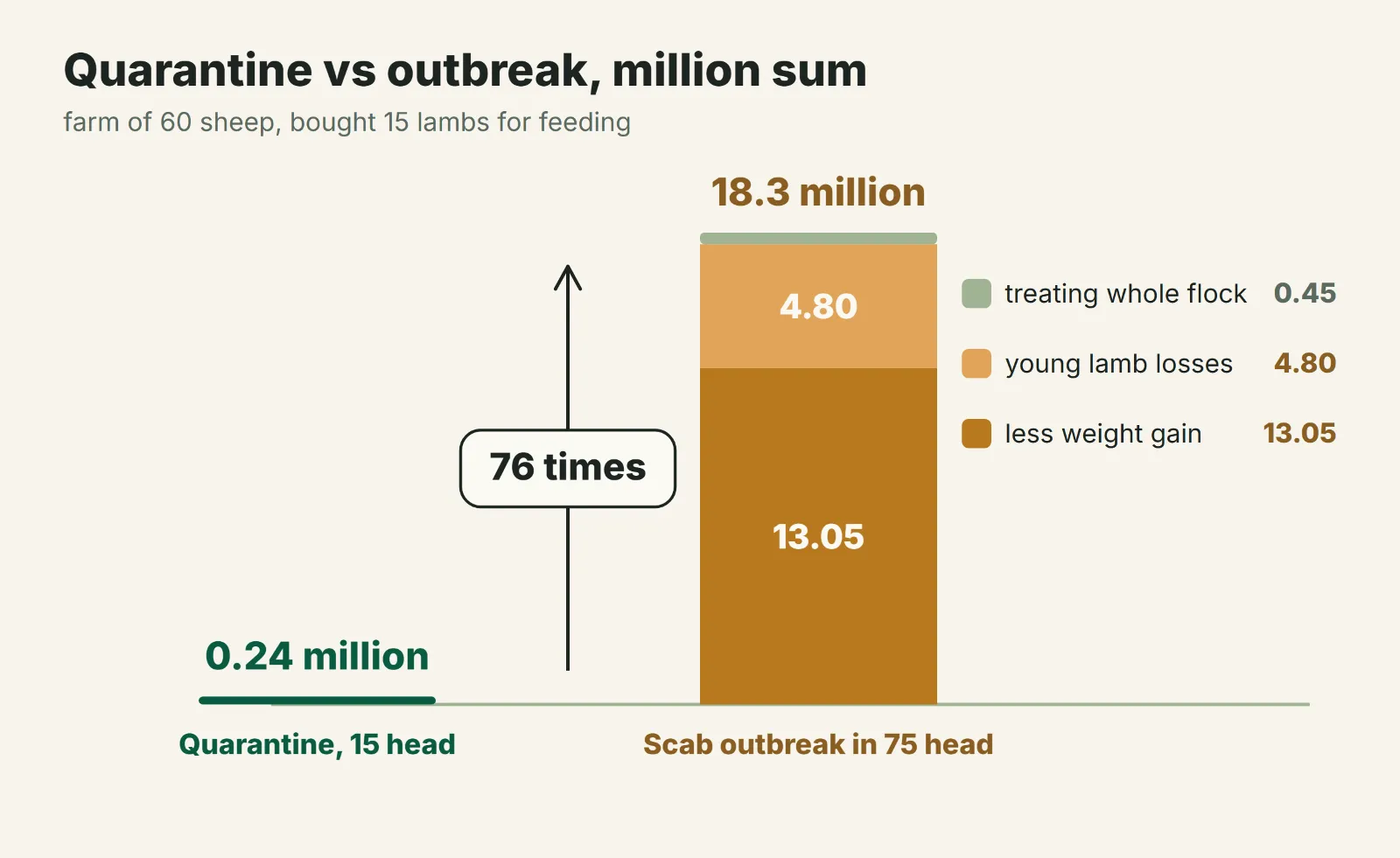
That's a 76-fold difference. The objection "I've never once brought anything in" checks out too, in its own way: for skipping quarantine to actually pay off, you'd need to buy without consequences more than seventy times in a row. Sheep farmers who get burned once quarantine for the rest of their lives — and that's not caution, that's arithmetic.
In Short
- Disease comes into the flock with a purchase, not through the air. A once-over at the bazaar doesn't replace quarantine: the incubation period for scab runs up to 20 days.
- Keep new animals separate for 21–30 days, no contact through the fence, with their own trough and tools, and tend to them after the main flock.
- On arrival day: a full check, hoof trim and zinc sulphate bath, an external-parasite injection repeated after 7–10 days, a quarantine drench with a different active ingredient, and a day's hold before pasture.
- The first few days: hay and water, bring in grain gradually; vaccinate only once the animal has recovered from the journey.
- Every morning, check five signs: itching, lameness, coughing, scours, going off feed. One sick animal resets the thirty-day clock.
- Quarantine costs around 16,000 sum a head. One outbreak costs 18 million across the farm. Think of it as insurance at a very good rate.
More often than not, it's scab that shows up during quarantine: a bought sheep develops crusted bald patches two to three weeks after the move. What to do about it, and when to treat the whole flock — in our breakdown of sheep scab and the treatment timeline before the barn.
Manage your flock in QoyHunterCRM for sheep farmers: livestock, health, weighing, finance and analytics — in the app and a Telegram bot.All features →