Sheep scab: why the flock rubs itself raw, and what treating too late costs you
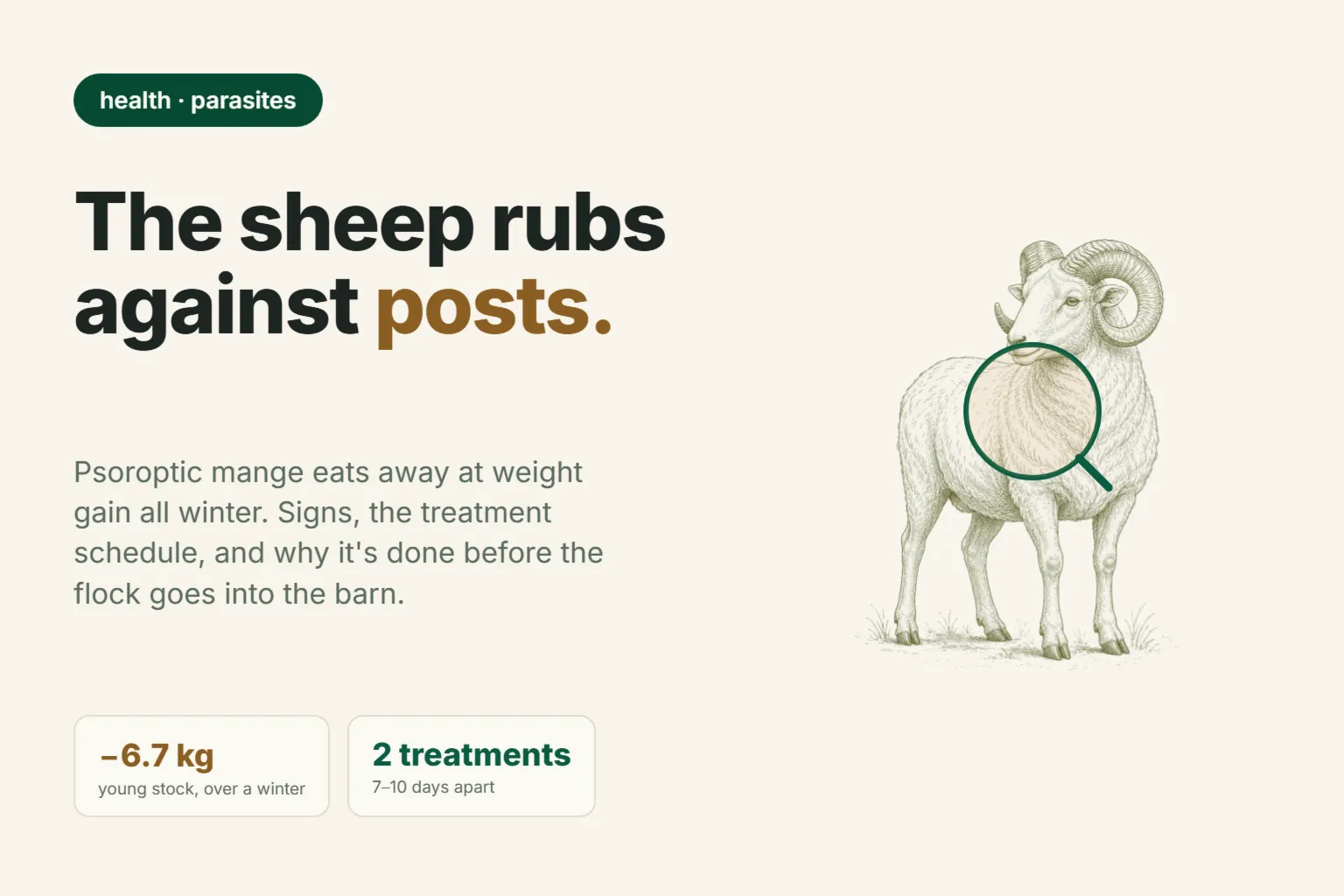
Sheep scab is psoroptic mange, caused by the mite Psoroptes ovis. We break down the signs by stage, how to tell it apart from lice and ringworm, the cost of lost weight gain in so'm, and the yearly treatment calendar that keeps the flock clean before it goes into the barn.
Sheep scab is psoroptic mange: a skin mite, Psoroptes ovis. You can spot the first signs without a vet — the sheep rubs against posts and the feeder, wool on the back, withers, and sides mats and comes away in clumps, and underneath it you'll find damp yellow crusts. It's treated with two injections of 1% ivermectin (the standard dose per drug labels is 1 ml per 50 kg of live weight, repeated after 7–10 days) or by dipping the whole flock in an acaricide solution.
The key thing about timing: treat the flock in fall, before it goes into the barn — not in January, once the sheep are already rubbed raw. In a warm, crowded barn the mite breeds all winter, and infected young stock can come out of it in spring 5–8 kg lighter than healthy animals. On a farm with thirty head of young stock, that's 8–13 million so'm (≈ $700–1100) in lost revenue over one winter. Prices in this article are from August 2026: live weight at 55,000 so'm/kg, the Central Bank of Uzbekistan's rate on August 21, 2026 — 11,847 so'm per dollar.
What is sheep scab, and which mite causes it
Scab is an umbrella term for three different diseases caused by three different mites. They're treated in a similar way, but they start in different places, and that's exactly how you tell them apart.
| Disease | Mite | Where it starts | Why it's dangerous |
|---|---|---|---|
| Psoroptic mange (sheep scab) | Psoroptes ovis | Withers, back, rump, sides — wherever the wool is thickest | The main form in fat-tailed breeds; spreads through the flock in winter |
| Sarcoptic mange | Sarcoptes scabiei var. ovis | Head, muzzle, ears, around the eyes | The mite burrows tunnels in the skin; itching is worse and treatment takes longer |
| Chorioptic mange | Chorioptes bovis | Legs below the hock, a ram's scrotum | Hits a breeding ram's semen quality right before mating |
In Uzbekistan, with its fat-tailed breeds and long barn period, psoroptic mange is by far the most common. Psoroptes ovis lives on the skin's surface and feeds on lymph from inflamed patches. The full circle — egg to egg — takes 11–19 days, and an egg reaches the adult mite stage in about two weeks. So a single treatment with a drug that doesn't kill eggs won't clear the flock — you need a repeat.
Off the animal, the mite doesn't die right away either: it stays infectious for 15–18 days in the bedding, in the cracks of the feeder, and on the barn walls. That's why a treated flock put back into an untreated barn gets reinfected.
How to tell a sheep has scab: signs by stage
Psoroptic mange develops slowly, and for the first three or four weeks it's easy to write off as "the wool's just shedding."
Early stage (2–4 weeks). The sheep is restless, rubs against the fence, posts, and feeder, and bites at its own side. Tufts of wool are left on thorns and rails. The skin under the wool on the withers still looks normal, but has already reddened in patches.
Middle stage. Bald patches with a sharp edge show up on the back and rump. Wool at the edge of a bald patch pulls out in a tuft, with no effort. Underneath — damp yellow-grey crusts and folds of skin.
Advanced stage. Widespread bald patches, thickened skin gathered into folds, the animal loses weight and falls behind the flock, and lambs and weak young stock die of exhaustion. The fleece is crusted over, and buyers won't pay a thing for it.
The check takes a minute: part the wool on the withers and the rump along the edge of a bald patch and look for crusts. A vet lab confirms the exact diagnosis with a skin scraping from the edge of the lesion — the mite shows up under a microscope. Always ask for a scraping if more than two or three head in the flock are scratching: the treatment schedule depends on which mite it is.
Telling scab apart from lice, ringworm, and mineral deficiency
Scab isn't the only reason a sheep scratches. It's easy to mix these up, and all four causes call for different treatment.
| Sign | Scab (psoroptic mange) | Lice and keds | Ringworm (trichophytosis) | Sulfur/mineral deficiency |
|---|---|---|---|---|
| Where it starts | Withers, back, rump | Neck, withers, along the back | Head, neck, around the eyes | Evenly over the whole body |
| What it looks like | Bald patches with crusts, wool mats | Dull wool, insects and nits visible at the roots | Round patches with sharp edges, grey scales | Wool dry and brittle, no bald patches |
| Itching | Severe — the sheep rubs itself raw | Moderate, constant | Mild | Mild |
| What's under the wool | Damp yellow crusts | Live insects 1–2 mm long | Dry, round lesions | Clean skin |
| How it's resolved | Ivermectin or dipping, twice | Topical products per the label; injectable ivermectin is weak against biting lice — around 81% efficacy vs. 97–100% for topical treatment | Treatment as prescribed by a vet | Salt lick, mineral premix |
| Dangerous to people | No — the mite doesn't survive on people | No — sheep lice are species-specific | Yes — trichophytosis spreads to people | No |
Ringworm is worth remembering on its own: it's the only one of the four causes that's genuinely dangerous to people. If the bald patches are round, sharp-edged, and free of weeping crusts, work in gloves and call a vet — don't just go buy an acaricide.
Why scab flares up in winter, and why you don't see it in summer
In summer the flock looks clean, and the farm assumes scab is gone. In reality the mite hasn't gone anywhere: after shearing, in the sun, it retreats into protected spots — the ears, groin, perineum, folds under the fat tail — and the disease goes into a hidden form. A handful of animals stay carriers, healthy on the outside.
In fall the conditions flip. The wool has grown back, humidity under the fleece is up, the flock is packed tightly into the barn, feed is thinner, and immunity is lower. The mite gets warmth, moisture, and constant contact between animals — and over the winter it works its way through the whole flock.
That's where the practical, money-saving conclusion comes from: you treat against scab before the flock goes into the barn, not after bald patches show up. Treatment in September–October costs exactly the same as it does in January, but in January the price comes with lost weight gain, treating advanced cases, and losing the weakest animals on top.
What scab costs a flock of 100 head
Let's run the numbers for a mid-sized farm: 100 head, 30 of them young stock wintering over, a barn period of 135 days. The figures below are our own estimate, not an official norm — real losses depend on what stage the disease was caught at.
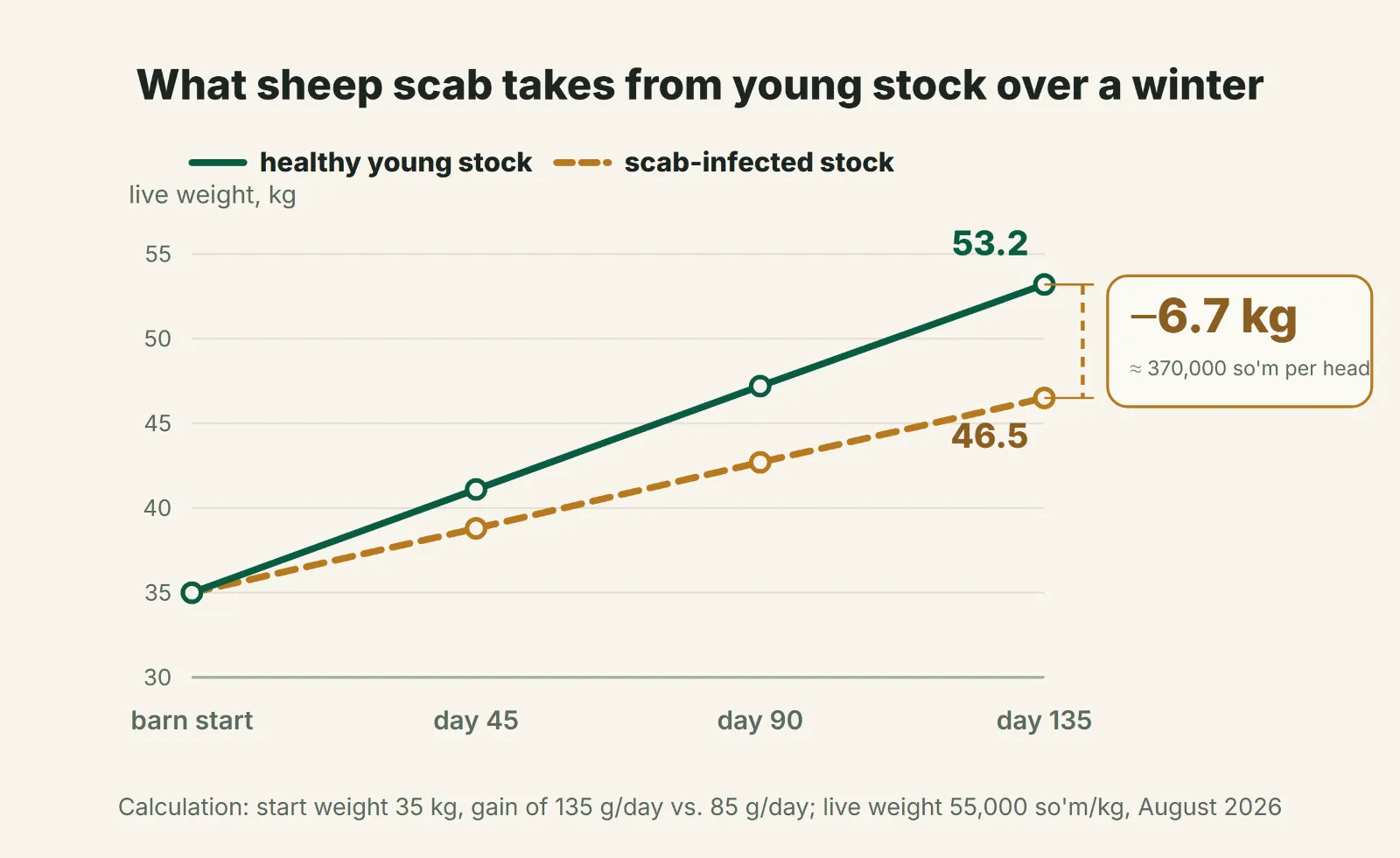
Healthy young stock on a regular winter ration — not intensive fattening — gain 120–150 g a day (on intensive fattening for fat-tailed breeds it's 150–250 g, which we covered separately). An infected sheep burns energy on itching and inflammation, eats worse, and gains 40–60 g a day less. Over the 135-day barn period, that difference adds up to 5–8 kg of live weight per head. In our piece on quarantine we used a gentler estimate, 3 kg per head: there, the outbreak gets caught early and treated within the first few weeks. Here the count runs over the full barn period, with the disease working through the flock all winter.
| Loss item | Calculation | Money |
|---|---|---|
| Weight shortfall, one head | 5–8 kg × 55,000 so'm | 275,000–440,000 so'm (≈ $23–37) |
| Shortfall across 30 head of young stock | 30 head × 275,000–440,000 so'm | 8.3–13.2 million so'm (≈ $700–1100) |
| Deaths from exhaustion | 1–2 head at 35 kg live weight × 55,000 so'm | 1.9–3.9 million so'm (≈ $160–330) |
| Crusted fleece | 150–300 kg from the flock, written off at 2,500 so'm/kg | 0.4–0.8 million so'm (≈ $35–65) — small change next to the weight shortfall |
| Treating advanced cases | 2 treatments of the whole flock + the barn + a repeat course | Many times pricier than prevention |
Wool is the smallest line item on this list, and that's no paradox: the coarse fleece of fat-tailed breeds sells for pennies even in clean condition. The money gets lost on the scale, not in the shearing.
The prevention side of the ledger looks modest. The dose of 1% ivermectin is 1 ml per 50 kg of live weight — roughly a millilitre per adult sheep; bigger ewes and the breeding ram take more. With the mandatory repeat, a 100-head flock uses at least 200 ml of the drug for a full course. A 100 ml bottle of 1% ivermectin, per listings on bazar.qoyhunter.com as of August 21, 2026, runs 30,000 so'm; a 50 ml bottle — 20,000 so'm. So the whole course for the flock costs around 60,000 so'm (≈ $5) for the drug alone, not counting labor. Check current prices at vet supplies and feed for the flock: as of August 21, 2026 the section had 48 listings, including vet products.
How to treat sheep scab: ivermectin, doramectin, and dipping
The doses below are a guide from drug labels, not a prescription. The vet chooses the exact schedule and drug based on the scraping result, and you always need to check the insert for your specific bottle: dose, route, interval, and meat withdrawal period all vary by manufacturer.
| Method | Dose and frequency | When it's convenient | What to watch for |
|---|---|---|---|
| Ivermectin 1%, injection | 1 ml per 50 kg (0.2 mg/kg), twice, 7–10 days apart. Route strictly per the label: Ivomec is given subcutaneously, Ivermek — intramuscularly, in the rump or neck | In fall, before the flock goes into the barn — works in the cold, no dip needed | The restriction isn't on lactation, it's on milk: milk from dairy animals can't be used for 28 days after the injection; the ban doesn't apply to nursing ewes whose milk goes only to their lambs. Meat withdrawal period — 28 days |
| Doramectin 1%, intramuscular | For scab in sheep — 1 ml per 33 kg (300 mcg/kg), a single dose. That's higher than the "cattle" dose of 1 ml per 50 kg — the mite survives that one | When there's no one to catch the flock twice | The longest meat withdrawal period of the three — 70 days per European labels |
| Plunge dip (deltamethrin, cypermethrin, amitraz) | Whole flock, twice; take the interval from the label: 7–10 days for deltamethrin and amitraz, 14 for cypermethrin solutions | In summer, 3–5 days after shearing, once the nicks have closed over — the wool is short, the solution reaches the skin | Don't dip straight off the clippers — the solution gets into fresh nicks. Needs warm weather and a warm solution; don't turn out a wet animal into the wind |
| Treating the barn | Acaricide solution (deltamethrin, cypermethrin) on walls, feeders, and cracks, after the flock is moved out — an injectable drug won't work on the building | On the day of the animals' second treatment | Old bedding must be hauled out, or the flock reinfects itself |
Four rules treatment doesn't work without:
- Treat the whole flock at once, including animals that look healthy and the breeding ram. The mite is already on them, it's just not visible yet; treat only the sick ones and you'll get a second wave within a month.
- A repeat is mandatory. Ivermectin doesn't kill mite eggs. The first treatment clears adult mites and larvae; the second, 7–10 days later, gets whatever hatched since then.
- Treat the barn along with the animals. The mite survives up to 15–18 days in bedding and cracks, and a clean flock in a dirty barn gets reinfected.
- Don't treat exhausted or sick animals just to keep them with the group. The labels for ivermectin and dip solutions explicitly forbid treating emaciated animals or those with infectious disease. Separate them and get a vet to look — they'll decide what to treat with and when.
Figure the dose from live weight, not by eye: underdosing doesn't kill the mite, it just trains the population to resist the drug. If you don't have scales, estimate weight with a tape — we described the formula in our piece on how to estimate a ram's weight without scales.
Don't use used motor oil, diesel, or ash: they burn the skin, don't reach the mite deep in the folds, and leave the animal eating worse afterward.
When to treat the flock: a year-round calendar
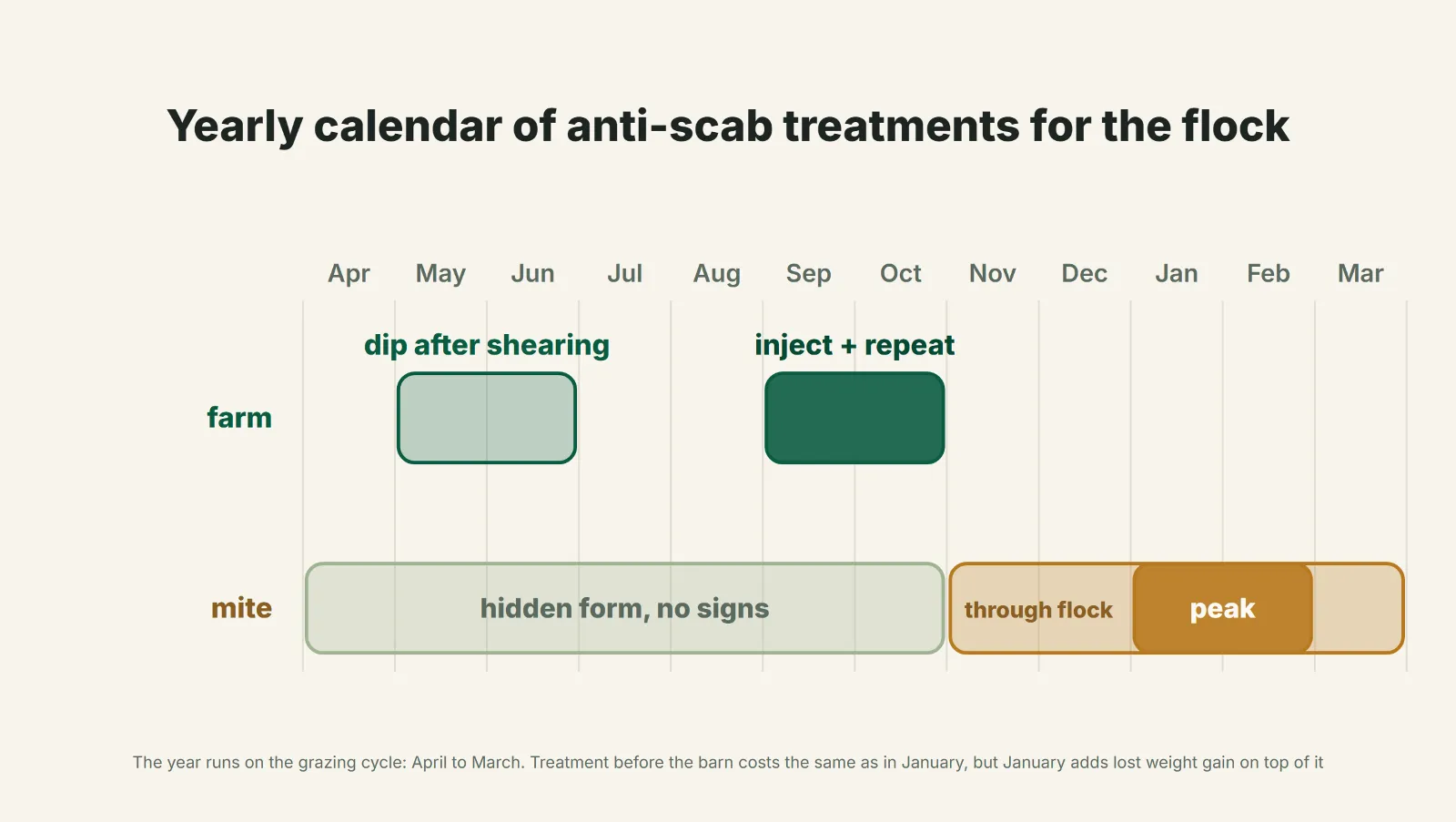
For a farm in Uzbekistan, the schedule looks like this:
- May–June, 3–5 days after shearing — dip the whole flock, once the nicks from the clippers have closed over. The wool is short, the solution reaches the skin, and the weather is warm. This is the most effective treatment of the year.
- September–October, before the flock goes into the barn — an ivermectin injection for the whole flock. This lines up with fall deworming: the same drug handles both roundworms and the skin mite (ivermectin doesn't touch tapeworms or liver flukes — more on that in the deworming calendar). In the seasonal deworming calendar, the scab treatment is listed as "at barn entry" — that's the same moment, just timed by the date the flock goes indoors, not by the calendar date of winter.
- 7–10 days after the injection — a repeat for the whole flock.
- Any new animal — treat on the first day of quarantine, then keep it away from the flock for 21–30 days. We break down why that pays off in our piece on quarantining newly bought sheep.
When you plan a treatment, keep the meat withdrawal period in mind. It's on the specific drug's label: for ivermectin it's usually 28 days, for doramectin given intramuscularly to sheep — up to 70 days. So for a holiday slaughter or a sale, give the injection not a month ahead, but two or three.
How to avoid bringing scab back in
- Check the animal when you buy it. Part the wool on the rump and withers, look at the skin, and ask when it was last treated. Come fall, one of the reasons animals show up at the bazaar is that the flock has started scratching. If you're buying from a listing, ask for photos of the skin under the wool, not just a general shot: sheep and rams for sale in Uzbekistan let you message the owner before you drive out.
- Keep new animals separate. 21–30 days of quarantine, with treatment on day one.
- Shearers bring their own tools — ask them to disinfect the clippers before they start. That's exactly how the mite travels between farms.
- Don't mix flocks at a shared watering point or a shared pen, especially in fall.
- Log the treatment dates. Six months on, nobody remembers whether the whole flock got treated in September or just the animals that were easy to catch. At QoyHunter — a record-keeping CRM for sheep, plus the marketplace at bazar.qoyhunter.com — we keep that in a treatment log and reminders for every sheep: date, drug, who was treated, when the next one's due. A notebook does the same job while the flock's small and one person is keeping the records.
FAQ
Is sheep scab contagious to people?
The scab mite, Psoroptes ovis, doesn't survive on people: close contact with a sick sheep can cause brief skin irritation that clears up on its own. The sarcoptic mange mite can trigger an itchy rash, but it doesn't turn into real human scabies either. The genuinely dangerous diagnosis is a different one — ringworm (trichophytosis): it spreads to people, especially children. So if you see round, sharp-edged bald patches, work in gloves and get the animal in front of a vet.
Can I treat just the sheep that are scratching?
No. By the time the first sheep starts scratching, the mite has already spread to its neighbors — the symptoms just aren't visible yet. Treat the whole flock in a single day, including the breeding ram and the young stock, plus the barn. The exception is exhausted or sick animals: separate them and get a vet to look. Spot-treating gets you a second wave in three or four weeks, and you'll be treating again, this time with lost weight gain already on the books.
How many days after treatment can a ram be slaughtered for meat?
Check the withdrawal period on the specific drug's label: for injectable ivermectin it's usually 28 days, for doramectin given intramuscularly to sheep — up to 70 days. There's one practical takeaway for a farm: if a ram is headed for sale or a holiday slaughter, don't treat it in the last two or three months before the deal — treat it well ahead of time, with margin to spare.
Why did scab come back a month after treatment?
There are usually four reasons: no repeat treatment 7–10 days later, and mites hatched from eggs; not every animal got treated; the flock went back into an untreated barn with old bedding; a new animal came in without quarantine. Check this list — one of these was almost certainly skipped.
Do used motor oil, diesel, and ash actually work?
No. These burn the skin, mat the wool together, and don't reach the mite in skin folds or under crusts — and the animal eats worse and loses weight afterward. Only acaricide products actually work: injectables (ivermectin, doramectin) or dip solutions (deltamethrin, cypermethrin, amitraz). Check age and weight limits for lambs on the specific drug's label, and figure the dose strictly from live weight.
Manage your flock in QoyHunterCRM for sheep farmers: livestock, health, weighing, finance and analytics — in the app and a Telegram bot.All features →